

Time Management for IB Students
Why the Diploma Needs a Different System Than Anything You’ve Used Before
Why Normal School Time Management Doesn’t Transfer to the IB
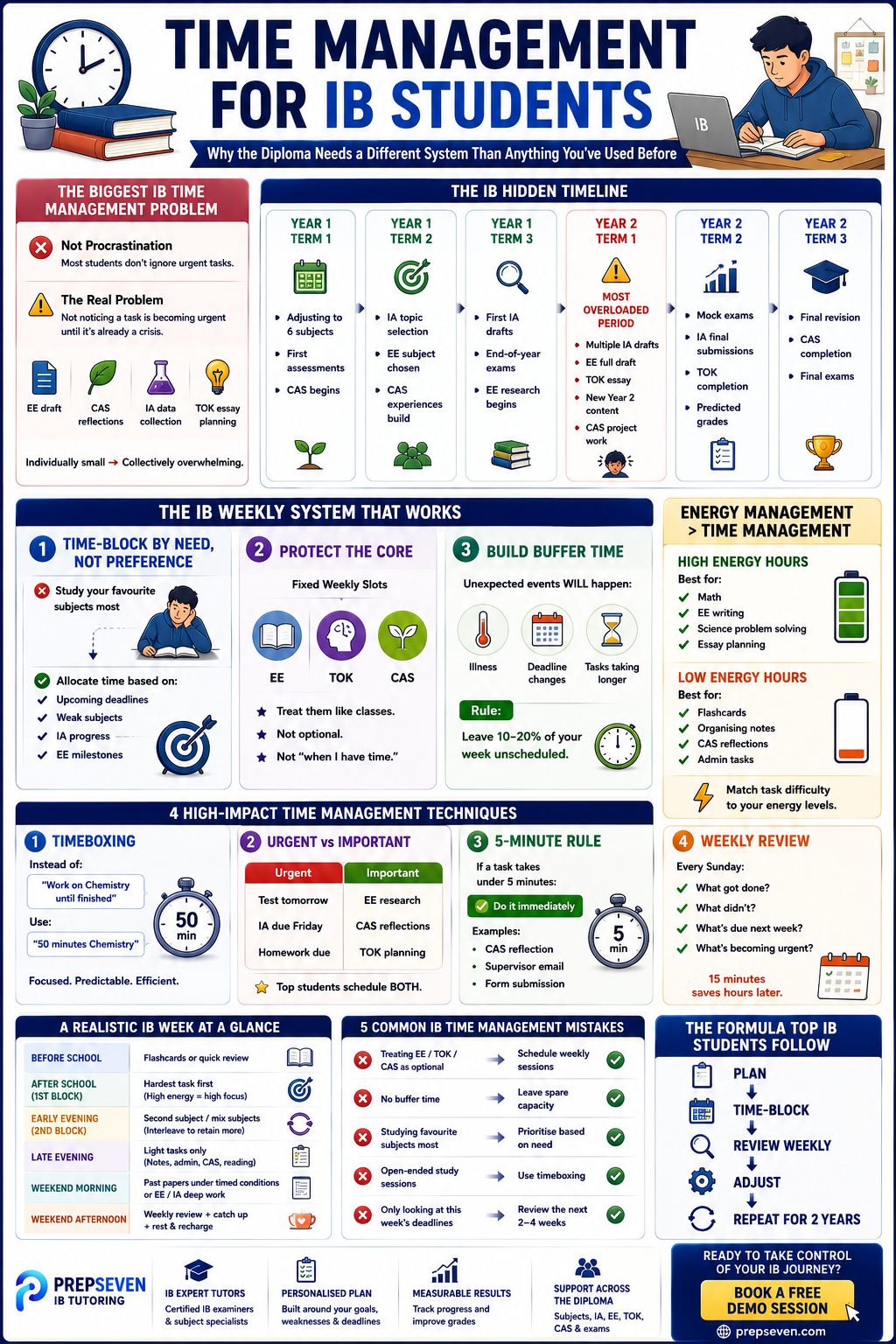
Most students arrive at the Diploma Programme with a time management system that worked perfectly well before: do the homework due this week, study harder when a test is close, repeat. That system breaks down in the IB, not because IB students are less organised, but because the structure of the Diploma is fundamentally different from anything that system was built to handle. You’re not managing one subject’s deadlines at a time. You’re managing six subjects, each with its own internal assessment timeline, plus an Extended Essay that unfolds across both years, plus a Theory of Knowledge essay and exhibition, plus CAS, all running concurrently, with almost none of it synchronised to a single, obvious weekly rhythm.
The result is a course where the biggest threat to a strong final grade often isn’t a lack of understanding in any one subject. It’s the slow, quiet accumulation of small, low-urgency tasks, a CAS reflection here, an early EE draft there, a Biology IA data collection session that needed to happen weeks ago, that don’t feel urgent individually but collectively create a crisis exactly when exam preparation should be the priority. Good time management in the IB isn’t really about working harder. It’s about building a system that makes the invisible, spread-out workload visible early enough to act on it.
The single biggest time management failure in the IB isn’t procrastinating on something urgent. It’s not noticing that something is becoming urgent until it already is, because it spent months sitting quietly in the background while exam-focused subjects took all the visible attention. A working system has to surface those background tasks regularly, not just react to whatever feels most pressing this week.
Mapping the Diploma’s Hidden Timetable
Before any weekly routine can work, it helps to actually see the whole two-year landscape laid out, because the Diploma’s real deadline pressure rarely comes from any single moment. It comes from several different components reaching their own quiet peak at different, overlapping points across the two years, often without much warning if you haven’t been tracking them deliberately.
Seeing this laid out usually produces one of two reactions: relief, because the pressure points are now visible and plannable rather than vague and looming, or alarm, because Year 2 Term 1 in particular is genuinely as overloaded as it looks. Both reactions are useful. The goal of mapping this timetable isn’t to make the workload feel lighter, it’s to make sure none of it arrives as a surprise.
The Weekly System That Actually Holds Up Across Two Years
A time management system that only works for a few intense weeks before falling apart isn’t actually a system, it’s a sprint, and the IB is too long for sprinting to be a viable full-course strategy. What holds up over two years is usually simpler and less dramatic than students expect: a consistent weekly structure that allocates time deliberately across exam subjects and the core components, rather than letting whichever deadline feels loudest each week absorb all the available attention.
Time-Block by Subject Weight, Not by Subject Preference
Left unplanned, study time naturally drifts toward favourite subjects, the ones that feel rewarding to work on, rather than toward the subjects or components that actually need the most attention. A working weekly system starts by deciding, deliberately and in advance, roughly how much time each subject and each core component genuinely needs this particular week, based on what’s actually due or building, not based on which subject is most enjoyable to sit down with. This sounds obvious written out, but very few students actually do it; most simply start with whatever feels most urgent or most appealing when they sit down, which is a recipe for the quieter, less appealing tasks to be perpetually deferred.
Protect Time for the Core Before It Becomes a Crisis
EE, TOK, and CAS rarely have a single, dramatic weekly deadline the way a subject test does, which is exactly why they’re the components most likely to be neglected until they suddenly aren’t. The fix is to treat them as fixed, recurring calendar commitments, not as flexible tasks to fit in whenever time allows. A short, consistent weekly slot for EE research and writing, even thirty to forty-five minutes, sustained across many months, produces a far stronger essay with far less last-minute stress than the more common pattern of leaving it untouched for weeks and then attempting several thousand words of focused writing under deadline pressure.
Build In Buffer Time on Purpose
Every plan assumes things go roughly as expected, and over two years, they won’t, always. A teacher reschedules a deadline, an illness costs a week, a piece of coursework takes longer than planned. Students who build their weekly schedule with zero slack find that the first disruption, and there will be several across two years, throws the entire system off in a way that’s hard to recover from. Deliberately leaving some unscheduled time each week, treated as a buffer rather than as free time to be filled automatically, gives the system room to absorb the inevitable disruptions without collapsing.
Four Techniques Worth Building Into the Routine
Timeboxing Instead of Open-Ended Sessions
Open-ended study sessions, just sit down and work on Chemistry until it feels done, tend to expand to fill whatever time is available, regardless of how much was actually needed. Timeboxing, deciding in advance that a specific task gets a fixed amount of time, say fifty minutes, and then moving on regardless of whether it feels finished, tends to produce more focused effort and prevents one subject from quietly swallowing time that other subjects or components needed. It also makes weekly planning more predictable, since a week built from a known number of fixed time blocks is much easier to plan around than one built from open-ended sessions of unknown length.
Sorting Tasks by Urgency and Importance, Not Just Urgency
It’s natural to work on whatever feels most urgent this week, the test on Thursday, the IA draft due Friday, but urgency and importance aren’t the same thing, and a system driven purely by urgency consistently neglects important-but-not-yet-urgent work like EE research or early IA planning until it becomes urgent on its own, usually at an inconvenient moment. A simple weekly habit, sorting the coming week’s tasks into genuinely urgent, important but not yet urgent, and low-priority, and deliberately protecting some time for the second category even when nothing is forcing it, is one of the most effective ways to prevent background tasks from becoming emergencies.
Clearing Small Admin Tasks Immediately
A meaningful amount of IB-related mental load comes not from the substantial work itself but from small, lingering administrative tasks, replying to a supervisor’s email about the EE, logging a CAS reflection, submitting a form, that take only a few minutes each but accumulate into a persistent background hum of unfinished business if they’re allowed to pile up. A simple rule, if something takes less than five minutes, do it immediately rather than adding it to a list, keeps this category of task from ever becoming a real source of stress.
Running a Short Weekly Review
Spending fifteen minutes at the end of each week looking honestly at what actually got done, what didn’t, and what’s quietly approaching over the next few weeks is a small habit that prevents the most common IB time management failure: not noticing a deadline is close until it’s almost too late. This is also the natural moment to check the kind of two-year deadline map outlined earlier in this guide, since a five-minute glance at what’s coming in the next month is far more useful than discovering a major IA deadline with three days of warning.
Energy Management Matters as Much as Time Management
Two students can have identical free time on paper and still get very different amounts of genuine, focused work done, because the hours themselves aren’t equally valuable. Most people have a window in the day where focus comes more easily, for some students that’s early morning before school, for others it’s late afternoon, and a much smaller, more depleted window later in the evening where the same task takes noticeably longer and produces noticeably weaker work. A time management system that ignores this and treats every available hour as interchangeable tends to schedule the most demanding work, a tricky Math problem set, a difficult EE section, into whichever slot happens to be free, rather than into the slot where it’s actually likely to get done well.
A more effective approach matches task difficulty to energy level deliberately. The most demanding, highest-concentration work, new content, difficult problem sets, EE writing, goes into whichever window genuinely produces the best focus, even if that means rearranging a schedule that looks less tidy on paper. Lower-concentration tasks, reviewing flashcards, organising notes, logging a CAS reflection, fit naturally into the lower-energy windows where deep focus wasn’t likely anyway. This isn’t about working more hours. It’s about recognising that an hour of tired, distracted effort on a hard problem is worth far less than the same hour spent on an easier task, with the hard problem moved to a point where genuine focus is actually available.
What a Realistic Week Actually Looks Like
Abstract advice about timeboxing and weekly reviews is easier to apply once it’s translated into something concrete. Here’s how the principles above tend to play out across a typical week, not as a rigid template to copy exactly, since every student’s school timetable and energy patterns differ, but as an illustration of how the pieces fit together in practice.
The specific slots matter less than the underlying logic: demanding work goes where focus is genuinely available, lighter tasks absorb the lower-energy windows, and at least one stretch of real rest is protected deliberately rather than left to whatever time happens to be left over.
Ordinary procrastination advice tends to assume a single deadline you’re avoiding. The IB produces a subtler version of the same problem: tasks that genuinely don’t feel urgent for months, because their deadline is genuinely months away, but that quietly need steady attention well before that deadline arrives if the final product is going to be any good. An Extended Essay isn’t actually due until well into Year 2, but an EE that’s only started seriously a few weeks before that deadline is structurally different, and usually weaker, than one built from consistent research and drafting spread across a much longer period.
This is a harder kind of procrastination to notice, because it doesn’t feel like avoidance in the way ignoring an assignment due tomorrow does. It feels like reasonable prioritisation, focusing on what’s actually due this week. The fix isn’t willpower, it’s structure: treating long-horizon components as fixed weekly commitments from early on, as described above, so that steady progress happens automatically rather than depending on remembering, every single week, that something with a distant deadline still deserves attention now.
Common Time Management Mistakes
The System Matters More Than the Willpower
Students who manage the IB workload well aren’t, as a rule, more disciplined than everyone else. They’re usually working from a better system, one that makes the spread-out, low-urgency parts of the Diploma visible early, protects time for them before they become urgent, and leaves enough slack to absorb the disruptions that two years of school inevitably bring. None of this requires extraordinary willpower. It requires building the habits, weekly time-blocking, protected core component time, a short weekly review, early enough that they’re already running on their own well before the moments they matter most.
Want help building a time management system that actually fits your subjects?
PrepSeven tutors work with students to map their specific IA, EE, TOK, and CAS deadlines against their exam subjects, and build a weekly system that holds up across the full two years of the Diploma.
Book a Free Demo Session at prepseven.com