
Introduction to the IB Middle Years Program
The IB Middle Years Programme (MYP) is designed for students between the ages of 11 and 16 and acts as one of the most important transition phases in a student’s academic journey. These are the years where students move beyond basic classroom learning and begin developing the analytical thinking, research habits, independence, and academic discipline required for higher-level education.
Developed by the International Baccalaureate Organization, the MYP is now taught in IB World Schools across the globe and is widely recognized for its inquiry-based and concept-driven approach to learning.
Unlike traditional systems that often separate subjects into isolated academic silos, the MYP encourages students to see connections between disciplines and apply learning to real-world situations. A science concept may connect to environmental policy, mathematical reasoning may connect to economics or design, and literature discussions may connect to global social issues.
This interdisciplinary structure is one of the defining strengths of the programme.
The MYP is also very different from systems built primarily around memorization and final examinations. Students are encouraged to ask questions, investigate problems, reflect on their learning, and develop independent thinking from an early stage.
For many students, the MYP becomes their first exposure to:
- research-based assignments,
- criterion-based grading,
- presentations,
- reflective learning,
- project-based assessments,
- and long-term academic planning.
This is exactly why the programme serves as such a strong foundation for the IB Diploma Programme later on.
At the same time, the transition into the MYP can initially feel challenging for students who are used to highly structured or exam-focused education systems. Many students entering the programme are surprised by how often they are asked to explain reasoning, analyze concepts, reflect on learning processes, and apply ideas instead of simply reproducing textbook information.
Over time, however, these same expectations help students become significantly more confident, independent, and academically mature learners.
Educational Philosophy behind the MYP
The philosophy behind the Middle Years Programme is centered around developing students not only academically, but also intellectually, socially, emotionally, and ethically.
The programme is built on the idea that education should go beyond memorizing content for examinations. Instead, students should learn how to think critically, solve problems, communicate effectively, collaborate with others, and understand the world around them.
One of the biggest differences students notice in the MYP is the shift toward conceptual learning.
Rather than teaching isolated facts, the programme encourages students to explore “big ideas” and understand why concepts matter beyond the classroom. Students are constantly asked to connect learning to global issues, personal experiences, and real-world applications.
For example:
- a Design project may involve solving a real usability problem,
- a Science unit may connect directly to climate change or sustainability,
- and an Individuals and Societies lesson may examine how political systems affect human rights and global inequality.
This approach helps students move away from passive learning and become more engaged in the learning process itself.
The MYP also places strong emphasis on international-mindedness and cultural awareness. Students are encouraged to understand perspectives beyond their own environment and think about how local actions connect to larger global systems.
At the same time, reflection becomes a major part of the programme.
Students are not only expected to complete work, but also to evaluate:
- how they approached a task,
- what strategies worked,
- where they struggled,
- and how they can improve.
Initially, many students find reflective writing repetitive or unfamiliar. Over time, however, it becomes one of the reasons MYP students develop stronger self-awareness and independent learning habits compared to students in more traditional systems.
The philosophy of the MYP aligns closely with the skills universities increasingly value today: adaptability, communication, critical thinking, creativity, and the ability to apply knowledge in unfamiliar situations.
Structure of the IBMYP Curriculum
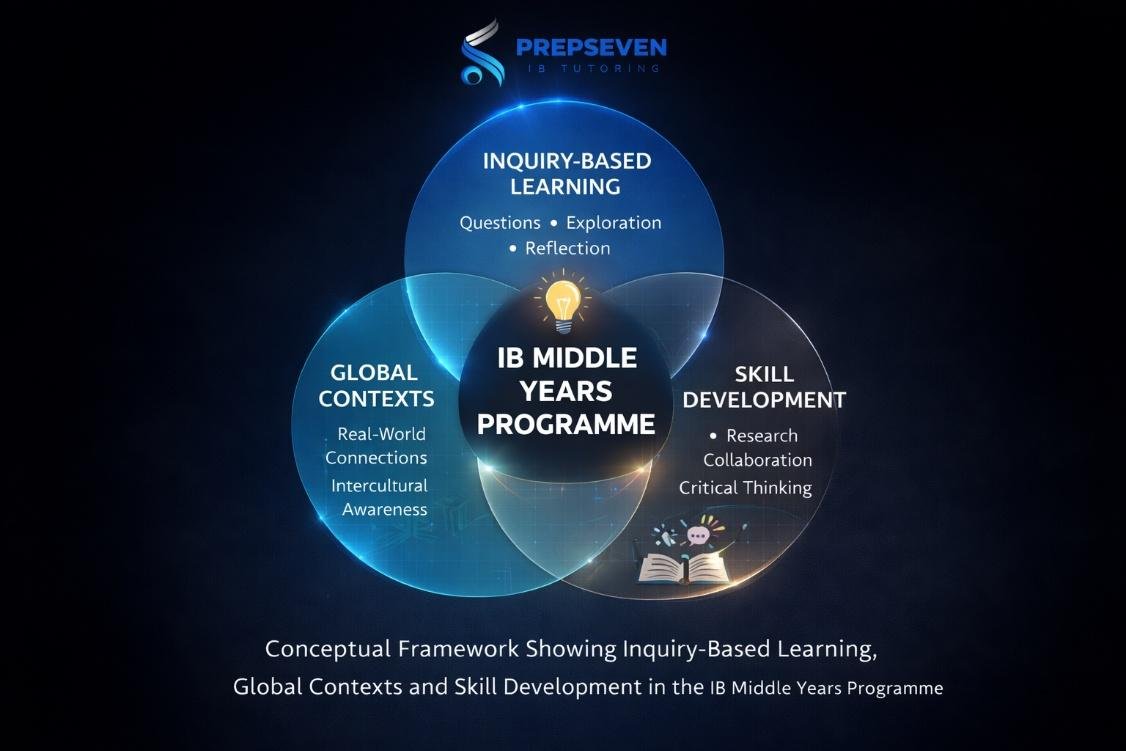
The Middle Years Programme is built around a balanced curriculum containing eight subject groups, interdisciplinary learning, project-based inquiry, and real-world application.
One of the defining features of the MYP is that students continue studying a broad range of subjects instead of specializing too early. This allows students to build strength across sciences, mathematics, humanities, languages, arts, and practical disciplines simultaneously.
The curriculum is intentionally designed to develop both conceptual understanding and applied skills.
Unlike traditional systems where subjects often function independently, the MYP encourages students to identify relationships between disciplines. Students begin understanding that real-world problems rarely belong to only one academic subject.
For example:
- environmental issues may involve science, politics, economics, and ethics simultaneously,
- while design projects may combine mathematics, creativity, technology, and communication skills together.
Another important aspect of the MYP is flexibility.
While the International Baccalaureate Organization provides the framework, schools still have some freedom in how they structure units and learning experiences as long as they maintain IB standards and assessment expectations.
This allows schools to adapt learning to different student populations while preserving the core philosophy of the programme.
Subject Groups in the MYP
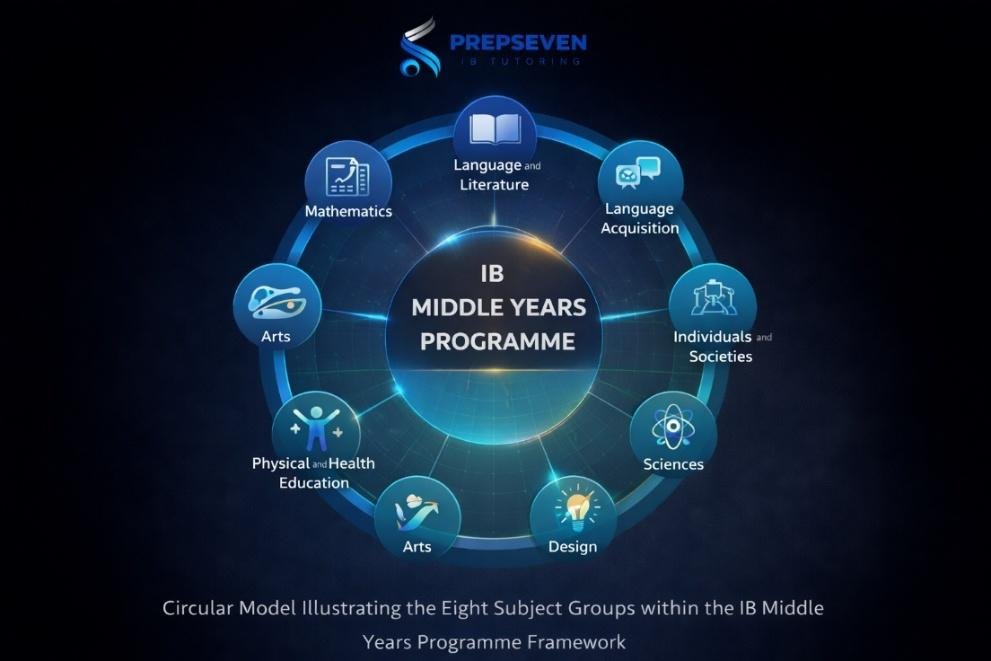
The eight groups of subjects that comprise the IBMYP Curriculum offer a full and balanced learning experience for all students. The eight subject groups contain both conceptual and application-based learning.
Language and Literature
Language and Literature focuses on communication, textual analysis, interpretation, and expression. Students study literary and non-literary texts while learning how language shapes meaning, identity, culture, and perspective.
As students move through the programme, they begin developing analytical writing skills that later become extremely important in the Diploma Programme.
Language Acquisition
Language Acquisition encourages multilingual communication and cultural understanding. Students learn how to communicate in an additional language while also exploring cultural perspectives connected to that language.
Unlike traditional language classes focused mainly on grammar exercises, MYP language learning emphasizes practical communication and contextual understanding.
Individuals and Societies
This subject group focuses on humanities and social sciences, including areas such as history, geography, economics, politics, and culture.
Students are expected to investigate real-world issues, analyze evidence, interpret perspectives, and understand how societies function.
Many students first begin developing formal analytical writing and source-evaluation skills within this subject group.
Sciences
The Sciences subject group focuses on inquiry, experimentation, observation, and scientific reasoning.
Students are encouraged not only to learn scientific concepts but also to think like scientists by:
- forming hypotheses,
- evaluating evidence,
- designing investigations,
- and interpreting results.
Practical investigations and criterion-based lab work become increasingly important as students progress through the programme.
Mathematics
Mathematics in the MYP emphasizes logical reasoning, problem-solving, communication, and application.
Students are encouraged to understand mathematical concepts conceptually rather than relying purely on memorization of procedures.
This becomes especially important later in DP Mathematics, where application and reasoning matter significantly more than repetition.
Arts
The Arts subject group allows students to develop creativity, reflection, and personal expression through visual arts, music, theatre, or other artistic disciplines.
Unlike many traditional arts programmes, the MYP also includes process evaluation, reflection, and conceptual understanding alongside creative production.
Physical and Health Education
Physical and Health Education focuses on physical wellbeing, teamwork, goal-setting, and healthy lifestyle development.
Students learn not only physical skills but also concepts related to health, personal development, and balanced living.
Design
Design is one of the most distinctive subject groups within the MYP.
Students work through structured design cycles to solve practical problems by researching, planning, creating, testing, and evaluating solutions.
This subject develops problem-solving, creativity, organization, and innovation skills that become increasingly valuable in modern education and careers.
Core Components of the Program
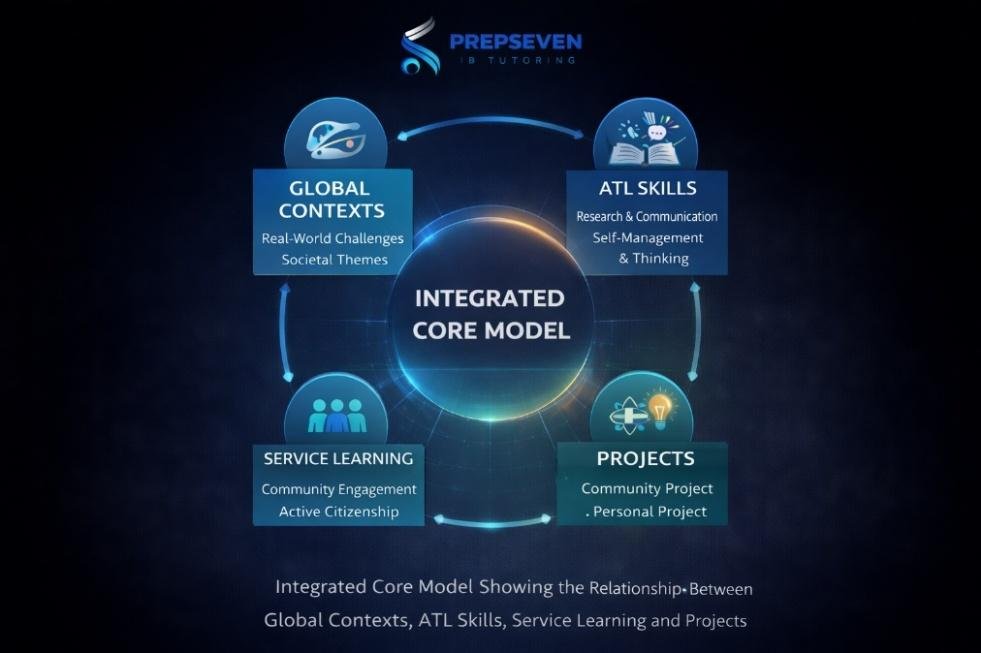
Beyond academic subjects, the MYP includes several framework elements that shape how students learn throughout the programme.
Global Contexts
Global Contexts help students connect classroom learning to real-world situations and larger global issues.
Instead of learning concepts in isolation, students are constantly encouraged to ask:
- Why does this matter?
- Where does this connect to the real world?
- How does this affect people globally?
This helps students see education as something practical rather than purely theoretical.
Approaches to Learning (ATL)
Approaches to Learning, commonly called ATL skills, form one of the most important foundations of the MYP.
These skills include:
- communication,
- research,
- collaboration,
- organization,
- self-management,
- and critical thinking.
What makes ATL important is that these skills are developed continuously across all subjects rather than taught separately.
Over time, students gradually become more independent learners capable of managing projects, deadlines, presentations, and complex assignments with less teacher dependence.
Service as Action
Service as Action encourages students to connect learning with meaningful engagement in their communities.
The goal is not simply volunteering for the sake of completing hours. Instead, students are encouraged to reflect on how their actions create impact and how learning can contribute positively to society.
This component also helps students begin developing leadership, empathy, initiative, and responsibility from an early stage.
Community Project and Personal Project
The MYP includes major independent projects that are often considered some of the most valuable learning experiences in the programme.
The Community Project is usually completed collaboratively and focuses on service learning and community engagement.
The Personal Project, completed in the final year of the MYP, is often viewed as the culmination of the programme.
Students independently investigate a topic of personal interest over an extended period while documenting:
- research,
- planning,
- reflection,
- and product development.
For many students, the Personal Project becomes their first experience managing a large independent academic project almost entirely on their own.
This is also one of the reasons MYP students often transition more comfortably into the Extended Essay and Internal Assessments in the Diploma Programme later on.
Assessment Framework in the MYP
One of the biggest differences between the Middle Years Programme and many traditional education systems is the way students are assessed.
In most conventional systems, students are judged primarily through final examinations and percentage-based scoring. The MYP, however, follows a criteria-based assessment model where students are evaluated according to specific academic skills and learning objectives rather than being compared directly against other students in the class.
This initially feels unfamiliar to many students and parents because the focus shifts away from memorization and toward demonstrating understanding, application, communication, and analysis.
In practical terms, this means that a student is not rewarded simply for reproducing textbook information. Instead, they are expected to show how effectively they can apply knowledge, explain reasoning, solve problems, analyze information, and communicate ideas clearly.
Each subject in the MYP has its own assessment criteria, and students are assessed multiple times throughout the academic year across different types of tasks.
For example, in Sciences, students may conduct investigations, analyze experimental results, and evaluate the reliability of their conclusions. In Individuals and Societies, they may interpret sources, build arguments, and analyze global issues. In Design, students work through structured design cycles involving research, planning, product creation, and evaluation.
Assessment in the MYP is therefore continuous rather than dependent on a single examination.
Students complete a wide range of assignments including presentations, essays, investigations, projects, performances, reports, demonstrations, and collaborative tasks. Many students entering the MYP initially struggle with this because they are used to preparing for tests rather than managing long-term assignments and reflection-based work.
Another important aspect of the MYP assessment model is reflection.
Students are regularly expected to think about how they approached a task, what strategies they used, where difficulties occurred, and how they could improve in future work. This reflective process is a major reason why MYP students gradually become more independent and self-aware learners over time.
As students move into the later years of the programme, the assessment style also begins preparing them for the expectations of the IB Diploma Programme. Research tasks become more sophisticated, analytical writing becomes more structured, and students are expected to manage larger projects with increasing independence.
For many students, the transition into MYP assessment is challenging at first because the programme rewards depth of thinking rather than surface-level answers. However, once students understand how the criteria work, they often become much more confident in approaching complex academic tasks.
Grading System and Academic Progression
A score of 7 represents excellent understanding and highly effective application of skills, while lower scores indicate more limited achievement of the assessment objectives.
One of the most important things students gradually realize in the MYP is that grades are not determined simply by effort or task completion. Strong performance depends on how well a student demonstrates the skills required by the criteria.
For example, a student may understand a topic well but still lose marks if explanations lack analysis, organization, evidence, or evaluation. This is why understanding the rubric becomes extremely important in the MYP.
The criteria-based system also helps students identify their strengths and weaknesses more clearly.
A student may perform strongly in communication but struggle with analysis, or may excel in research but need improvement in organization and reflection. Over time, this creates a much more detailed understanding of academic development than traditional percentage systems often provide.
Another important feature of the MYP grading structure is that it encourages long-term improvement.
Because students are assessed repeatedly throughout the year using similar criteria, they gradually learn how to refine their responses, strengthen analytical depth, and improve academic communication.
This process becomes extremely valuable later in the Diploma Programme where criterion-based marking becomes even more demanding.
For students planning to continue into the IB Diploma Programme, the MYP acts as a critical foundation stage. By the end of the programme, students are usually far more comfortable with:
- structured writing,
- research tasks,
- independent projects,
- presentations,
- and analytical thinking
than they were when they first entered the programme.
Skills Developed Through the MYP
One of the strongest aspects of the Middle Years Programme is that it develops skills extending far beyond traditional classroom learning.
Students are not simply learning academic content. They are gradually learning how to think, communicate, research, collaborate, and manage responsibility independently.
This transformation often becomes noticeable over the five years of the programme.
Students who initially struggle with organization, presentations, independent learning, or reflection usually become significantly more confident and academically mature by the later years of the MYP.
The programme places strong emphasis on inquiry and critical thinking. Students are encouraged to ask questions, challenge assumptions, investigate issues deeply, and support arguments using evidence rather than simply accepting information passively.
Research skills also become increasingly important throughout the programme.
By the later years of the MYP, students are already learning how to:
- evaluate sources,
- structure investigations,
- reference information,
- and present findings clearly.
These skills become extremely useful during the Diploma Programme, particularly for Internal Assessments, Theory of Knowledge, and the Extended Essay.
Communication skills are another major area of development within the MYP.
Through presentations, collaborative projects, discussions, performances, and written tasks, students learn how to express ideas more confidently and effectively.
The programme also develops time management and organizational ability in ways many students do not initially expect.
Managing multiple projects, assessment deadlines, reflections, and coursework across different subjects teaches students how to plan ahead rather than rely entirely on last-minute preparation.
This is one of the biggest reasons students transitioning from the MYP into the Diploma Programme often adapt more comfortably to IBDP workload expectations compared to students entering the DP from non-IB systems.
Transition from MYP to Diploma Programme
The MYP has one of its greatest advantages as it prepares students to take on the academic challenges presented through the IB Diploma Program as they transition from one to the other. Conceptual learning, as well as research-based skills and independent thought, all through their experiences in MYP have contributed to a smooth transition of those students into IB’s more rigorous course delivery.
As a result of their participation in the MYP, students will also have greater academic discipline, improved analysis, and increased self-esteem than do their peers who have not participated in the MYP.
PrepSeven’s Approach to MYP Academic Support
When designing our systems postively affective for the student who is facing the difficulties connected with their engagement in the Middle Years Programme at PrepSeven, our prioritisation of this student’s understanding of social connection will also hold true to that student’s success with assessments.
We provide the following types of support:
• Mentoring around the courses offered in connection to the Middle Years Programme
• Mentoring around project and research frameworks
• Developing skills through ATL
• Providing academic planning and feedback cycles for the student
• Providing academic strategies for the student based on building both their level of self-confidence and their academic success.
Personalised academic strategies that are methodical for the student to create improvement in performance levels as well as confidence levels.
Final Perspective
The IB Middle Years Programme provides a very complete kind of education; it gives students an academic challenge and helps them develop in all areas. By combining academic subjects, using real-life experiences, and providing opportunities for students to learn, the IB MYP prepares students to keep learning throughout their lives and to succeed in furthering their education. The advantages of being mentored and having access to an academic support system will help students maximize the benefits of the MYP and build their confidence as they strive to reach their goals.
At PrepSeven, our job is to help students successfully navigate this process by giving them direction and assurance as they work within the IB MYP framework according to the standards set forth by the IB and the worldwide community.