
PrepSeven | Online IB Diploma Programme Tutoring authored by Shankar Mutneja (Founder of Prepseven)
What Is the IB Diploma Programme?
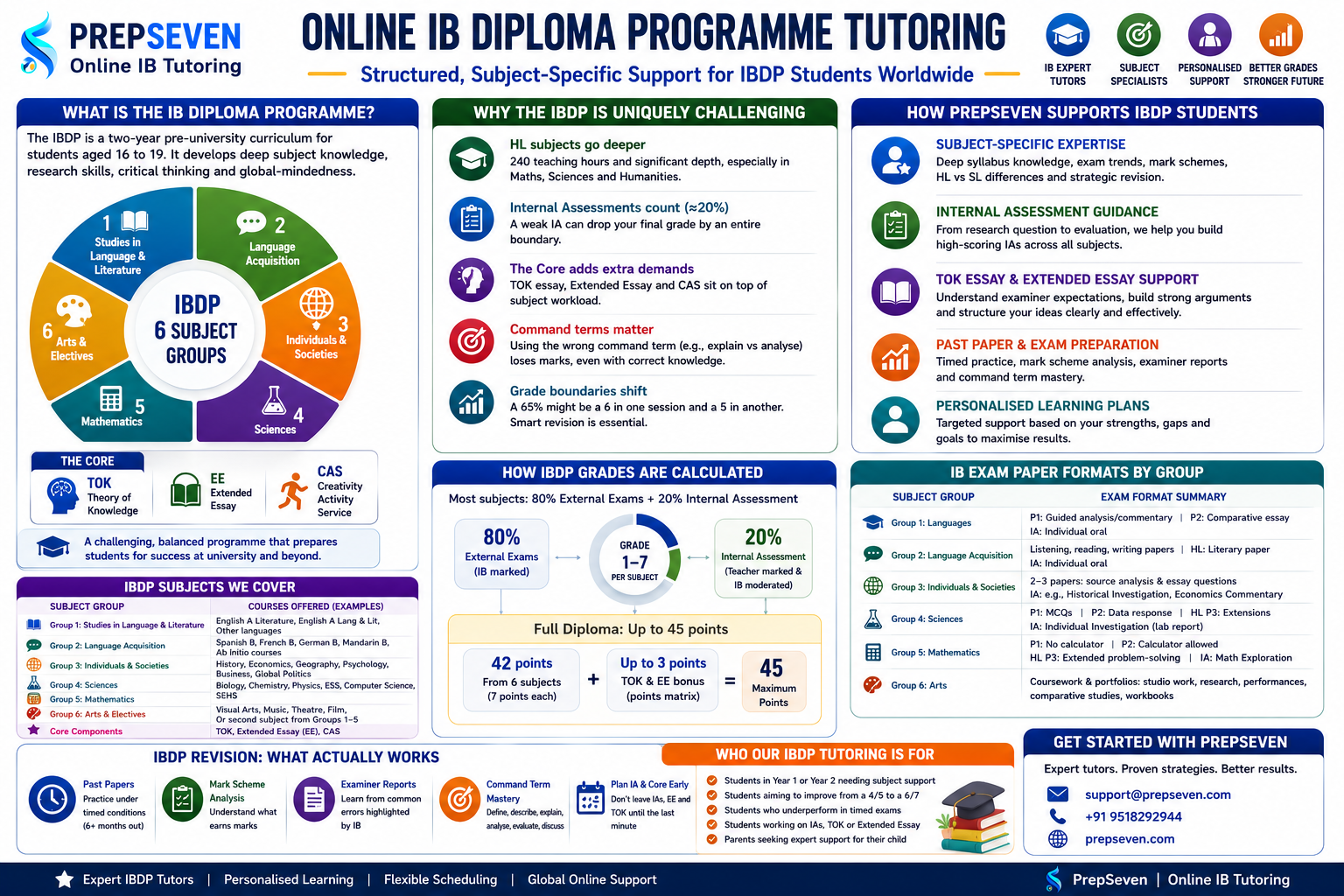
The IB Diploma Programme (IBDP) is a two-year pre-university curriculum for students aged 16 to 19. It is widely regarded as one of the most demanding and respected qualifications in the world, and universities across every continent actively seek out IBDP graduates. The programme covers six subject groups, a core component made up of Theory of Knowledge (TOK), the Extended Essay (EE), and Creativity, Activity, Service (CAS), and culminates in a rigorous examination session each May and November.
That breadth is exactly why students need targeted support. A student who is strong at essays but struggles with data response questions in Economics will face very different challenges compared to a student who understands Biology theory but cannot structure a lab report. At PrepSeven, we tutor the IBDP as it actually works, not as a generic set of academic skills.
Why the IBDP Is Uniquely Challenging
The IBDP is not just hard because the content is advanced. It is hard for a specific set of structural reasons that most tutoring services underestimate:
- Higher Level subjects demand 240 teaching hours and go significantly deeper than SL. HL Maths, HL Chemistry and HL History in particular require a fundamentally different approach to revision.
- Internal Assessments count for roughly 20% of the final grade in most subjects. A weak IA can pull an otherwise strong student down by an entire grade boundary.
- The Core requirements (TOK essay, Extended Essay, CAS) sit on top of subject workload. Many students underestimate the TOK essay in particular, treating it as a philosophy exercise when it has very specific examiner expectations.
- Command terms govern how you answer every question. Writing a detailed explain when the paper says analyse is a structural error, not just a content error, and it loses marks even if the knowledge is correct.
- Grade boundaries shift each session. A raw score of 65% might earn a 6 in one session and a 5 in another. Understanding where boundaries typically sit helps students allocate revision time more efficiently.
How PrepSeven Approaches IBDP Tutoring
Every student who comes to PrepSeven starts with a short diagnostic. We look at what they have already covered in class, how they are performing on practice papers, and where the specific gaps are. Then we build a plan that targets those gaps without wasting time on material that is already solid.
Subject-Specific Expertise
We tutor the full IBDP across all six subject groups. Our tutors know the syllabuses in detail, including which topics appear most frequently in exam papers, what the mark schemes actually reward, and how HL and SL assessment differs within the same subject. For example, in IB Economics, we teach students the difference between using a diagram to illustrate versus using one to analyse, because that distinction matters at the A3 level in the internal assessment criteria.
Internal Assessment Guidance
IAs are one of the most under-tutored aspects of the IBDP. We work with students through every stage of the IA process: choosing a research question that is appropriately scoped, structuring the investigation correctly, ensuring the methodology section is complete, and refining the evaluation so it addresses real limitations rather than generic ones. For sciences especially, a well-designed individual investigation can be the difference between a 5 and a 7.
TOK Essay and Extended Essay Support
The TOK essay is assessed against two criteria: how well the student understands the prescribed title and how well they develop a reasoned argument using Areas of Knowledge and Ways of Knowing. Many students write interesting essays that score poorly because they drift from the title or fail to bring in counterclaims. We help students understand what the IB is actually looking for and how to structure a response that satisfies the rubric without losing the intellectual quality.
For the Extended Essay, we help students narrow a research question to something genuinely investigable within 4000 words, structure the argument so it builds logically, and use sources in a way that demonstrates critical engagement rather than summary.
IBDP Subjects We Cover
Understanding the IBDP Exam Structure
A lot of students go into exam season without a clear picture of how their final grade is actually calculated. Here is what that looks like across typical IBDP subjects:
Exam Paper Formats by Group
IBDP Revision: What Actually Works
Students often ask us how they should revise for the IBDP. The honest answer is that generic revision techniques, flashcards, passive rereading, watching explainer videos, are insufficient for a programme that rewards applied thinking. Here is what we focus on with students:
- Past paper practice under timed conditions, starting from at least 6 months before the exam. This is non-negotiable. The IB recycles question formats and the style of questions is as important as the content.
- Mark scheme analysis. Students who understand how mark schemes are written stop losing marks on technique. A mark scheme is not just an answer key. It tells you what level of conceptual depth is being rewarded.
- Examiner report review. IB publishes examiner reports after each session highlighting common errors. These are some of the most valuable revision resources available, and most students never look at them.
- Command term drilling. We spend time early in tutoring making sure every student can distinguish between define, describe, explain, analyse, evaluate, and discuss, because these terms appear on every paper and determine the expected depth of answer.
- IA and core work before the exam rush. Many students leave IA submissions and EE revisions until Year 2, by which point they are competing with exam preparation. We encourage parallel timelines.
Get Started with PrepSeven
If you or your child is preparing for the IBDP and wants tutoring that actually understands the programme, get in touch. Every session at PrepSeven is led by tutors who have worked with IB students across multiple subject groups and know what it takes to score in the top grade boundaries.
Book a free demo lesson to see how we work, or reach out to our team at support@prepseven.com. We tutor students globally through live online sessions and flexible scheduling.