
IB Diploma Programme (IBDP) Curriculum – Complete Guide by PrepSeven
Introduction: The IB Diploma Programme Explained
The International Baccalaureate Diploma Programme (IBDP) is widely considered one of the most academically demanding and respected pre-university qualifications in the world. Designed for students between the ages of sixteen and nineteen, the programme is known for combining academic rigor with research, analytical thinking, writing, and real-world application.
The International Baccalaureate Organization was founded in Geneva, Switzerland, in 1968 with the goal of creating an internationally recognized curriculum for globally mobile students. Over the decades, however, the IB evolved into much more than an international qualification. Today, the IBDP is offered in thousands of schools across the world and is recognized by leading universities in the United Kingdom, the United States, Canada, Europe, Singapore, Australia, and many other countries.
What makes the IB Diploma Programme different from most traditional school systems is the way it assesses students. The programme is not built around memorization alone. Students are constantly expected to analyze information, write structured arguments, evaluate evidence, conduct research, complete investigations, deliver oral presentations, and apply concepts to unfamiliar situations.
The workload itself is one of the biggest reasons the IBDP has a reputation for difficulty. A student in the IB is not simply preparing for final exams. Across the two years, students simultaneously manage Internal Assessments (IAs), oral examinations, laboratory investigations, essays, portfolios, presentations, the Extended Essay (EE), Theory of Knowledge (TOK), and Creativity, Activity, Service (CAS).
In practical terms, IB students are almost always working toward multiple deadlines at the same time.
However, this is also exactly why universities value the programme so highly. Students graduating from the IBDP are usually far more comfortable with research, academic writing, independent learning, time management, and critical thinking compared to students from many other curricula.
At PrepSeven, our academic systems are built specifically around the structure and assessment philosophy of the IB Diploma Programme. Our support extends beyond subject tutoring into Internal Assessments, Extended Essays, TOK essays and exhibitions, revision planning, academic writing, and exam strategy aligned with official IB expectations.
Understanding the IB Diploma Programme
The IB Diploma Programme is often described as a balance between breadth and depth, but for students, this balance translates into something very practical: studying a wide range of academically demanding subjects while also specializing in specific areas connected to future university goals.
Unlike many national curricula where students narrow down subjects early, IB students continue studying languages, mathematics, sciences, and humanities together. A science student still studies literature and writing. A humanities student still studies mathematics and scientific reasoning. This structure is designed to create academically versatile students rather than students who specialize too narrowly too early.
At the same time, the programme allows students to develop deeper expertise through Higher Level (HL) subjects. For example, a student planning to pursue medicine may choose Biology HL and Chemistry HL, while a future economics student may take Mathematics AA HL and Economics HL.
Another major difference between the IBDP and traditional school systems is the importance of coursework.
In subjects such as Mathematics, Biology, Chemistry, Physics, Geography, History, Economics, Psychology, Business Management, Computer Science, and Environmental Systems and Societies, students complete major Internal Assessments (IAs) that contribute directly toward the final grade.
These are not small assignments. Many IAs involve months of research, experimentation, data analysis, writing, editing, and teacher feedback. In subjects like sciences, the IA often resembles a small-scale university research investigation. In Mathematics, students complete a mathematical exploration based on a personally chosen topic. In Geography, students conduct fieldwork and write formal reports. In History, students complete source-based historical investigations.
For many IB students, the IA becomes one of the most important parts of the subject because it represents marks that can be improved gradually over time rather than earned in a single exam sitting.
Language subjects include another major assessment component called the Individual Oral (IO). In the IO, students verbally analyze literary and non-literary works under timed conditions while discussing global issues, authorial choices, and thematic interpretation. For many students, the IO becomes one of the most stressful components of the programme because it tests analytical ability, communication, confidence, and structure simultaneously.
The IBDP also places unusually high emphasis on writing.
Between Internal Assessments, TOK essays, EE drafts, commentaries, reflections, and exam essays, IB students end up writing tens of thousands of words during the two-year programme. By the end of the diploma, many students are already familiar with the type of academic writing expected in the first year of university.
This is one of the reasons IB graduates are often considered academically prepared for higher education environments.
At PrepSeven, our support structure is designed around the actual realities of the programme. Students are guided not only through content learning, but also through subject selection, IA planning, EE supervision, revision scheduling, academic writing, and long-term workload management.
Overall Structure of the IBDP Curriculum
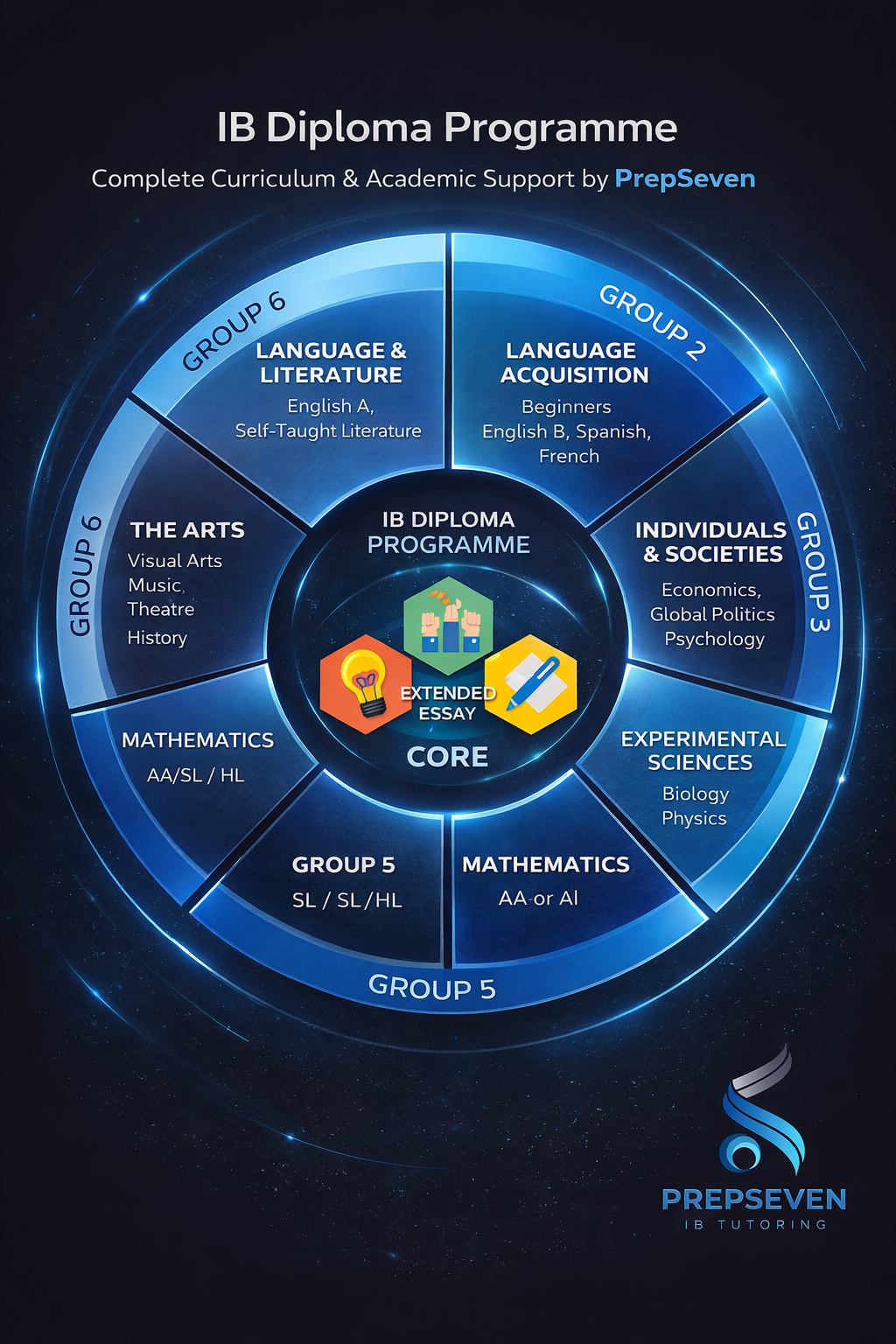
The IB Diploma Programme is structured around six academic subject groups and three compulsory core components.
The curriculum is designed intentionally to prevent students from becoming academically one-dimensional. Instead of focusing only on sciences, only humanities, or only mathematics, students are expected to maintain balance across multiple disciplines while simultaneously developing expertise in chosen Higher Level subjects.
This combination of breadth and specialization is one of the defining features of the IBDP.
The Six Subject Groups in the IB Programme
The IBDP curriculum is often represented visually as a hexagon with six subject groups surrounding the IB Core.
Group 1: Studies in Language and Literature
Group 1 focuses on advanced language skills, literary analysis, interpretation, and communication. Subjects in this group require students to study literary works, non-literary texts, media, and global issues while developing analytical writing skills.
Courses such as English A: Literature and English A: Language and Literature are known for demanding strong essay-writing ability and critical interpretation skills. Students analyze authorial choices, themes, symbolism, narrative techniques, and cultural perspectives in significant depth.
The assessments in Group 1 often include:
- literary analysis essays,
- comparative essays,
- unseen text analysis,
- and the Individual Oral (IO).
Students who struggle with structured writing or time management often initially find these subjects challenging because IB responses are heavily criterion-based and require precise analytical depth.
Group 2: Language Acquisition
Group 2 focuses on second-language learning and multilingual communication.
Subjects may include Spanish B, French B, Hindi B, ab initio language courses, and other language acquisition options depending on the school.
The emphasis is not only on grammar and vocabulary, but also on communication, cultural understanding, listening comprehension, reading analysis, and written expression.
Assessments typically involve:
- listening papers,
- reading comprehension,
- written responses,
- and oral examinations.
Many students underestimate Group 2 subjects initially, but language acquisition in the IB requires consistent practice over two years rather than last-minute memorization.
Group 3: Individuals and Societies
Group 3 subjects focus on understanding human behavior, institutions, systems, societies, and global issues.
Subjects such as Economics, Geography, History, Psychology, Business Management, Digital Society, and Global Politics require students to move far beyond memorization. Students are expected to evaluate evidence, analyze case studies, compare perspectives, interpret data, and construct balanced arguments under timed conditions.
Essay-writing ability becomes extremely important in many Group 3 subjects, especially History, Global Politics, and Economics.
Most Group 3 subjects also include major Internal Assessments. For example:
- Economics students complete real-world commentary portfolios,
- Geography students conduct fieldwork investigations,
- History students complete historical investigations,
- Psychology students analyze experimental studies,
- and Business Management students write business research reports.
Group 4: Experimental Sciences
Group 4 includes Biology, Chemistry, Physics, Environmental Systems and Societies, Sports Exercise and Health Science, and Computer Science.
These subjects focus heavily on scientific inquiry, experimentation, practical application, and analytical reasoning.
Unlike many school systems that focus mainly on theoretical science, IB sciences strongly emphasize data analysis, evaluation, uncertainty discussion, and experimental design.
The science Internal Assessment is one of the most significant coursework components in the entire diploma programme. Students conduct an independent scientific investigation that contributes directly toward their final grade.
Students often discover that scoring highly in IB sciences is not only about understanding concepts but also about:
- writing high-quality evaluations,
- understanding methodology,
- interpreting data correctly,
- and communicating scientifically.
Group 5: Mathematics
Mathematics in the IB Diploma Programme is divided into two major pathways:
- Mathematics: Analysis and Approaches (AA)
- Mathematics: Applications and Interpretation (AI)
Each pathway is offered at both Standard Level and Higher Level.
Mathematics AA focuses more heavily on algebra, calculus, proof, and abstract mathematics, making it the preferred route for students pursuing engineering, physics, mathematics, economics, or highly quantitative university courses.
Mathematics AI places greater emphasis on statistics, modeling, interpretation, and real-world applications of mathematics.
Mathematics AA HL is widely regarded by students as one of the most difficult subjects in the entire IB Diploma Programme because of both the complexity of the content and the pace of the course.
All mathematics students also complete a mathematical exploration as their Internal Assessment, where they investigate a mathematical idea independently.
Group 6: The Arts
Group 6 includes subjects such as Visual Arts, Theatre, Music, Dance, and Film.
These subjects combine creative expression with academic analysis and reflection. Students are assessed not only on performance or artistic production but also on research, process documentation, evaluation, and conceptual understanding.
Unlike many traditional arts courses, IB arts subjects involve substantial written analysis alongside practical work.
Students also have the option to replace Group 6 with another subject from Groups 2, 3, or 4. This flexibility is often used by students planning to pursue science, medicine, economics, engineering, or business-related university pathways.
Higher Level and Standard Level in the IBDP
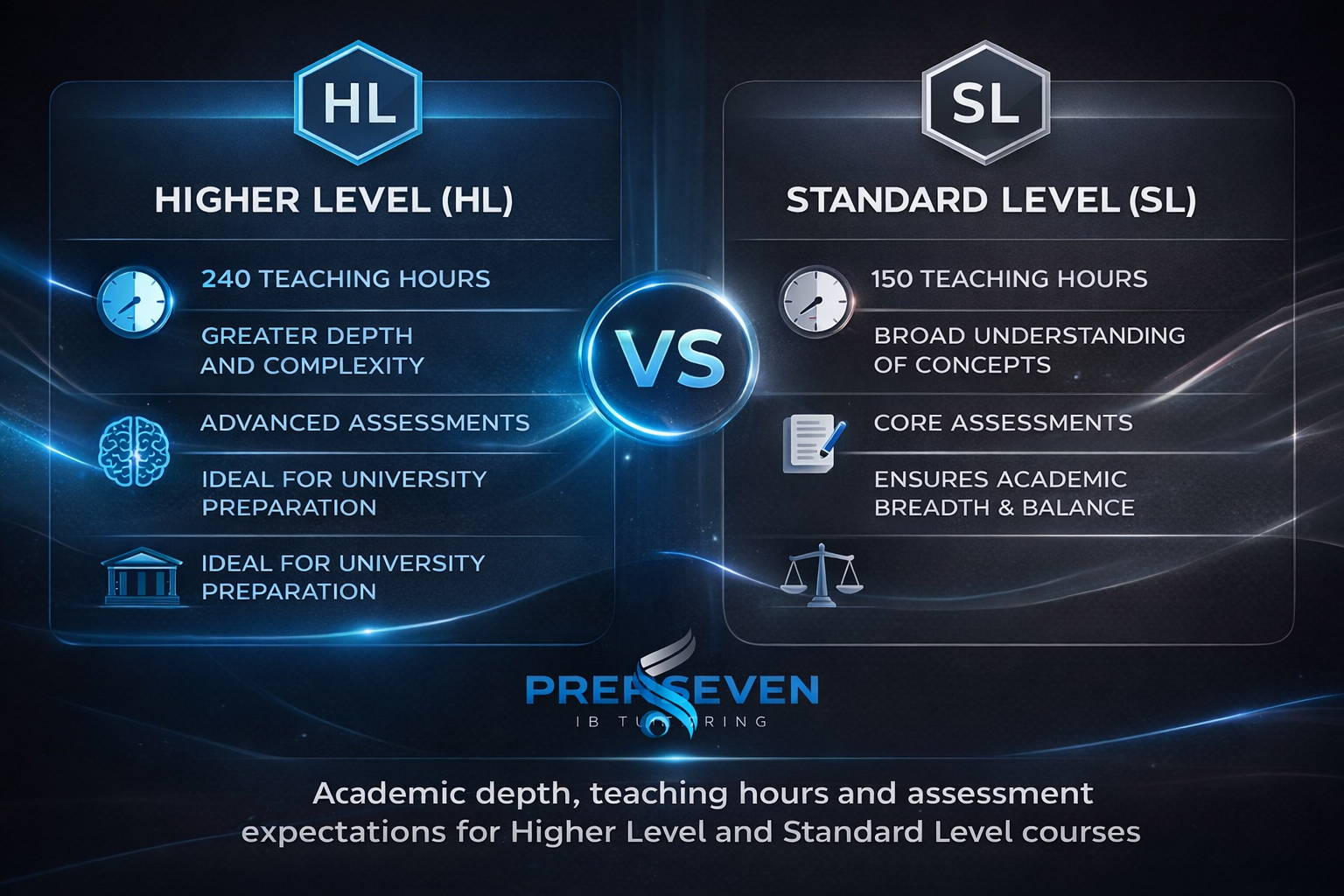
Every IB Diploma student studies a combination of Higher Level (HL) and Standard Level (SL) subjects.
Most students choose:
- three HL subjects and three SL subjects,
although some students take four HL subjects depending on university goals and academic capability.
Higher Level subjects involve significantly more depth, more difficult assessment requirements, and additional course content.
In practical terms, HL subjects are usually the courses students spend the most time studying.
For example:
- Biology HL includes additional topics and deeper application questions compared to SL.
- History HL includes an additional Paper 3 and regional depth study.
- Mathematics AA HL introduces far more advanced calculus, proof, and algebraic concepts.
- Economics HL includes more quantitative and theoretical analysis.
HL subjects require approximately 240 teaching hours, while SL subjects require around 150 teaching hours.
Students usually select HL subjects based on intended university degrees. Engineering students often require Mathematics AA HL and Physics HL. Medical applicants frequently choose Biology HL and Chemistry HL. Law and humanities students may prioritize History HL, English HL, or Global Politics HL.
Choosing the correct HL combination is one of the most important strategic decisions in the IB Diploma Programme because university requirements differ significantly across countries and degree programs.
At PrepSeven, students receive subject-selection guidance aligned with university admissions expectations, workload manacongement, and long-term academic goals.
The Core of the IB Diploma Programme
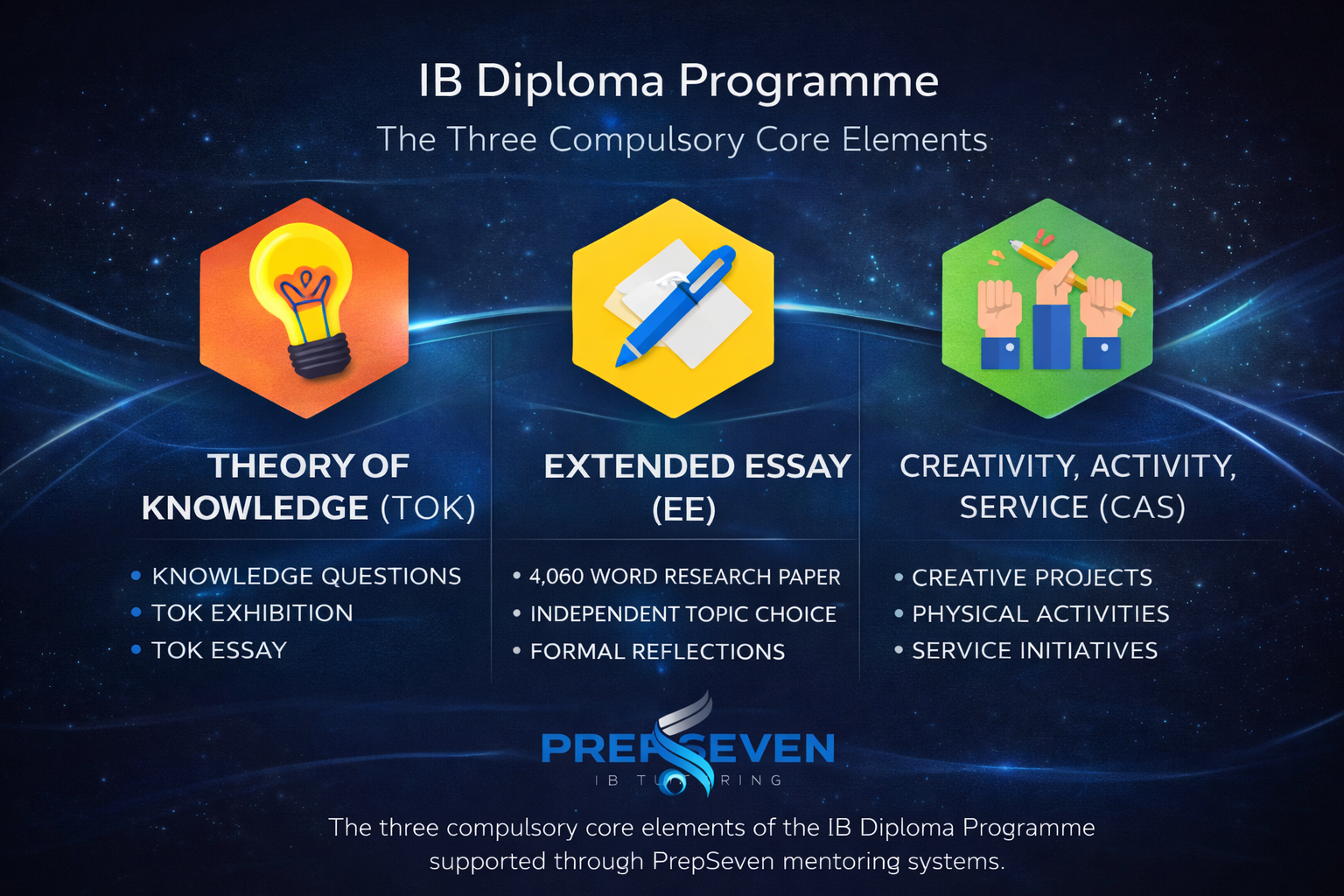
One of the defining features of the IB Diploma Programme is its compulsory core, which every diploma student must complete alongside their six academic subjects.
The IB Core consists of:
- Theory of Knowledge (TOK),
- the Extended Essay (EE),
- and Creativity, Activity, Service (CAS).
Together, these components are intended to develop reflection, independent research, critical thinking, and personal growth beyond traditional classroom learning.
For many students, however, the IB Core also becomes one of the most stressful parts of the programme because it runs simultaneously with regular subjects, Internal Assessments, mock exams, and university applications.
At the same time, the Core is also one of the biggest reasons universities respect IB students academically.
Theory of Knowledge (TOK)
Theory of Knowledge, usually called TOK by students, is one of the most unique parts of the IB Diploma Programme.
At first, TOK often confuses students because it does not function like a normal school subject. There is no textbook to memorize and no straightforward “correct answer” structure. Instead, TOK focuses on how knowledge itself is formed, evaluated, interpreted, and challenged.
In simple terms, TOK is essentially philosophy applied to real-world knowledge.
Students explore questions such as:
- How do we know something is true?
- Can scientific knowledge ever be completely objective?
- Does language shape the way we think?
- Can historical knowledge be biased?
- Are emotions and reason always separate?
The course constantly connects to other IB subjects. For example, students may compare evidence in History versus Biology, or discuss how interpretation differs in Literature and Mathematics.
For many students, TOK initially feels abstract and difficult because success depends more on argument quality, examples, and perspective analysis than memorization.
TOK contributes toward the final diploma score through two assessed components.
TOK Exhibition
The TOK Exhibition is internally assessed and requires students to select three real-world objects connected to one of the official IB prompts.
Students must explain how each object relates to questions about knowledge and justify the significance of the connection.
A strong TOK Exhibition is not about choosing “fancy” objects. It is about making clear, thoughtful, and convincing links between real-world situations and knowledge questions.
TOK Essay
The TOK Essay is a 1,600-word externally assessed essay written on one of the prescribed titles released by the IB each examination session.
This essay is where many students struggle because IB examiners look specifically for:
- balanced arguments,
- counterclaims,
- real-world examples,
- clarity of reasoning,
- and strong connections between Areas of Knowledge.
The TOK Essay and Extended Essay together can contribute up to 3 additional points toward the final diploma score.
Although students often joke about TOK being “confusing philosophy,” the course develops skills that become extremely useful at university level, especially in research-heavy fields where evaluating evidence and analyzing perspectives matters.
Extended Essay (EE)
The Extended Essay, commonly called the EE, is one of the most academically demanding components of the entire IB Diploma Programme.
Students are required to complete an independent research paper of up to 4,000 words under the supervision of a teacher mentor.
The EE is often a student’s first experience with genuine academic research at a near-university level.
Students select a topic from an IB subject and develop a focused research question that can be investigated analytically rather than descriptively.
Although students technically may choose many different IB subjects for the EE, most students prefer selecting a Higher Level subject because:
- they already study it in greater depth,
- they are more familiar with the content,
- and they usually have stronger conceptual understanding in HL subjects.
For example:
- a Biology student may investigate enzyme activity,
- an Economics student may evaluate the impact of inflation policies,
- a Psychology student may analyze cognitive biases,
- or an English student may explore literary themes and authorial techniques.
One of the biggest mistakes students make in the EE is choosing a topic that is too broad.
The strongest Extended Essays are highly focused, deeply analytical, and supported by clear research methodology.
The EE is assessed externally by IB examiners using criteria related to:
- focus and method,
- knowledge and understanding,
- critical thinking,
- presentation,
- and engagement.
Students are also required to complete formal reflection sessions throughout the process and submit reflection writing as part of the final assessment.
In reality, the EE becomes much more than just a school assignment.
It teaches students:
- academic research,
- source evaluation,
- referencing,
- citation systems,
- analytical writing,
- and long-form argument construction.
These are exactly the kinds of skills students later use in university dissertations and research assignments.
Creativity, Activity and Service (CAS)
Creativity, Activity, and Service is the experiential learning component of the IBDP. It engages students in creative activities, physical endeavors, and service projects for a minimum of eighteen months.
The objective of CAS is to foster personal growth, leadership skills, teamwork, resilience, and awareness of social and ethical issues. Students undertake experiences that challenge them intellectually, physically, and socially. Reflection is an essential component of CAS, as students are required to reflect on their learning and personal development throughout the experiences.
CAS is ungraded, but all CAS requirements must be met for the award of the IB Diploma.
Assessment in the IB Diploma Programme
The assessment system in the IB Diploma Programme is one of the biggest reasons the curriculum is considered academically rigorous across the world. Unlike many traditional school systems where almost everything depends on a final board examination, the IB evaluates students continuously through a combination of coursework, oral assessments, research projects, practical investigations, and final exams.
This means that success in the IBDP is rarely about last-minute studying alone. Students are expected to perform consistently over two years while managing multiple long-term assignments simultaneously.
One of the defining characteristics of IB assessment is that students are tested not only on knowledge, but also on analysis, evaluation, communication, and application. Memorizing information is never enough on its own. In almost every subject, students are expected to justify arguments, interpret unfamiliar material, evaluate evidence, and connect concepts across topics.
This is why many students initially find the transition into the IB difficult, especially if they previously studied in systems focused primarily on rote learning.
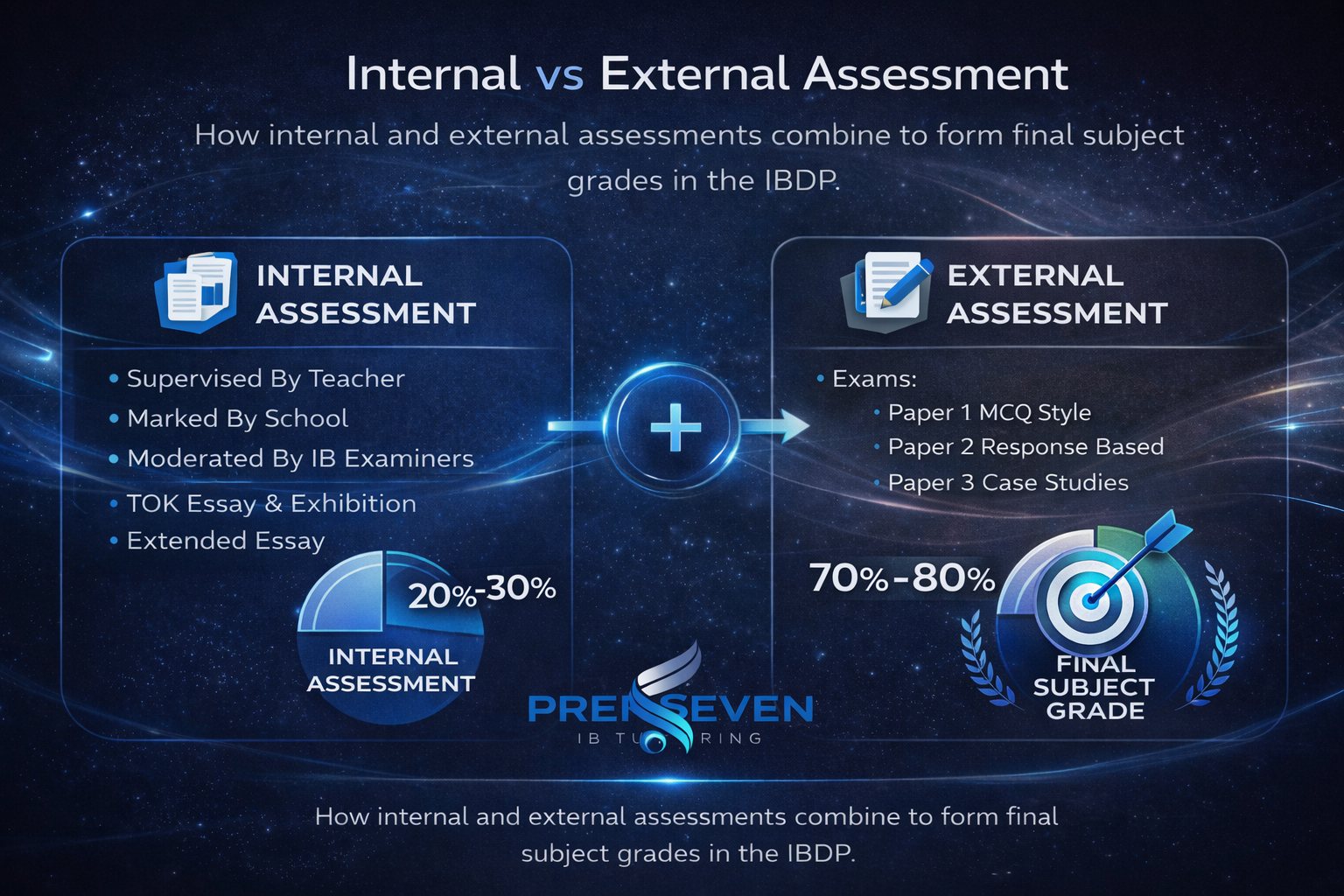
A major part of the IB assessment structure comes from Internal Assessments, commonly called IAs. Almost every subject contains some form of internally assessed coursework that contributes directly toward the final grade. These are completed during the two years and marked initially by teachers before being moderated by IB examiners internationally.
For many students, IAs become one of the most important parts of the programme because they are essentially marks that can be improved gradually over time instead of being earned entirely in a high-pressure exam hall.
In Mathematics, students complete a Mathematical Exploration where they independently investigate a mathematical concept or real-world application. In the sciences, students conduct experimental investigations that resemble small-scale university lab research projects. Subjects such as Geography, History, Economics, Psychology, Business Management, Computer Science, and ESS also include substantial coursework components requiring analysis, evaluation, research, and formal academic writing.
Students often underestimate how demanding these assessments become because every IA follows strict IB rubric criteria. Strong subject knowledge alone is usually not enough to score highly. Students also need:
- proper structure,
- criterion-focused writing,
- analytical depth,
- evaluation skills,
- and strong presentation.
Language subjects include another extremely important assessment component called the Individual Oral, commonly known as the IO.
The IO requires students to verbally analyze literary and non-literary texts while discussing global issues, authorial choices, themes, and interpretation under timed conditions. For many students, this becomes one of the most stressful assessments in the diploma because it combines analytical thinking with public speaking under pressure.
At the same time, students who prepare properly over the two years often perform very well in the IO because it allows them to work closely with texts in advance and refine their understanding gradually.
The external examination component of the IBDP takes place at the end of the two-year programme and is marked by official IB examiners worldwide.
One of the reasons IB examinations are considered difficult is because the questions rarely reward direct memorization. Students are expected to apply concepts in unfamiliar contexts and explain reasoning clearly.
For example, in subjects like History and English, essay-writing ability becomes extremely important because students must construct analytical arguments under strict time conditions. In Mathematics and the sciences, students are often tested on problem-solving and application rather than predictable textbook-style repetition.
Many students entering the IB initially believe that studying harder automatically guarantees better grades. Over time, however, they realize that understanding the mark scheme and examiner expectations is equally important.
IB assessment is heavily criterion-based. Examiners are trained to look for very specific skills and response patterns. This is why students sometimes feel surprised when answers that seem “correct” do not necessarily score highly.
Learning how IB command terms work becomes extremely important. Words such as:
- evaluate,
- analyze,
- discuss,
- compare,
- justify,
- explain,
- and to what extent
all require different response styles and different levels of depth.
Another important reality of the IBDP is moderation. Even though many coursework components are marked by school teachers initially, samples are later checked by IB examiners to ensure global consistency across IB World Schools. This moderation system is one of the reasons universities trust the credibility of IB grades internationally.
At PrepSeven, students are trained not only in subject content, but also in understanding how the IB assessment system actually works. Our support focuses heavily on:
- examiner expectations,
- rubric interpretation,
- IA structuring,
- essay-writing technique,
- revision strategy,
- and command-term analysis.
This helps students approach the programme strategically instead of simply studying harder without direction.
IBDP Grading System and Diploma Award
The grading system in the IB Diploma Programme differs significantly from many traditional school systems.
Each subject is graded on a scale from 1 to 7, with:
- 7 representing excellent performance,
- 6 and 5 representing strong performance,
- and lower scores indicating weaker understanding or incomplete achievement of assessment objectives.
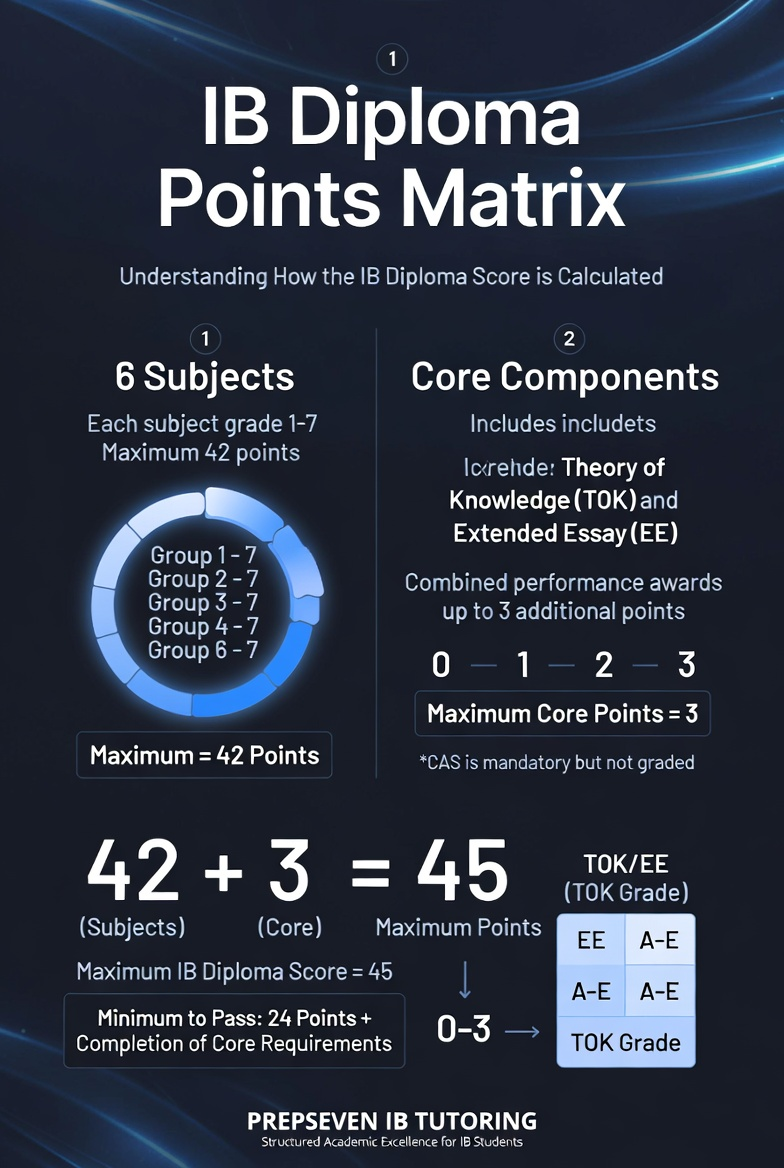
Across the six academic subjects, students can earn a maximum of 42 points.
In addition to subject grades, students may receive up to 3 extra core points based on combined performance in Theory of Knowledge (TOK) and the Extended Essay (EE). This brings the overall maximum diploma score to 45 points.
Although the minimum requirement for earning the diploma is generally 24 points, the actual diploma conditions are more complicated than simply crossing a score threshold.
Students must also:
- complete CAS requirements,
- avoid failing core components,
- meet minimum Higher Level performance requirements,
- and avoid certain combinations of very low subject scores.
One of the biggest misconceptions about the IB is that only perfect scores matter.
In reality, universities evaluate IB students differently depending on the country, course competitiveness, and predicted grades. In many strong universities globally, scores in the mid-to-high 30s are already considered academically impressive.
At the same time, highly competitive courses such as medicine, engineering, law, economics, or computer science at top universities may expect very high HL scores and strong overall predicted grades.
Predicted grades themselves become an extremely important part of the IB journey because universities in countries such as the UK often make conditional offers based on predicted performance before final IB results are released.
This means that consistency during the programme matters enormously. Strong Internal Assessments, class tests, mock examinations, and teacher evaluations can directly influence university admissions opportunities.
Another reason universities value IB students highly is because the grading boundaries are adjusted based on exam difficulty each year through grade boundaries rather than fixed percentage systems.
For example, scoring 75% in one subject may already be enough for a 7 depending on the difficulty of the paper.
This system makes IB grading very different from percentage-based curricula and often surprises new students and parents initially.
Skills Developed Through the IB Diploma Programme
The IBDP has been specifically designed to be aligned with the development of transferable skills in the life domain, both academic and beyond. Students have the opportunity to acquire expertise in the areas of research, critical reading, academic writing, and data analysis. Students have the opportunity to acquire skills in the areas of time management, independent learning, and reflection.
Collaboration, ethical problem-solving, and intercultural communication have been integrated into the curriculum through group work, debates, CAS, and interdisciplinary learning.
Real-World Application of Learning in the IBDP
Another focus of the IB Diploma Programme is the application of knowledge in the real world. In their courses, students learn about global issues such as climate change, inequality, economic development, technology disruption, and political governance.
In their courses in scientific subjects, students learn how to use experimental and data analysis skills. In their courses in social science subjects, they learn how to use policy and social effect analysis skills. In their courses in language and literature, they learn how to use identity, culture, and power analysis skills. In their courses in business and economics, they learn how to use market and decision analysis skills.
In their CAS activities, students learn how to use their knowledge in real-world situations by working with the community and social causes.
Preparing for University Through the IBDP
Universities have always accepted the IBDP as one of the best indicators of a student’s ability to cope with the academic environment of the university level. Students who have completed the IBDP course have been found to be better suited to independent work, research, writing, and problem-solving.
The EE course is almost similar to the research assignments given to students at the university level. The TOK course helps students to be better equipped to cope with the critical reading and analysis of the subject.
The weightage system helps students to be more disciplined in their academic work.
At PrepSeven, the academic planning is university compatible, which means that the subjects, Higher Levels, and exam performance are compatible with the university level.
Why Families Choose PrepSeven for IBDP Support
PrepSeven is an IB specialized academic tutoring service that offers academic support to Internal Assessments, Extended Essays, Theory of Knowledge, and subject knowledge. Our systems have been developed with IB rubric criteria, examiner requirements, and IB documentation in mind.
Students are given timelines, feedback, structures, and research that mimic the academic process of the IB Diploma program.
Final Perspective on the IBDP Curriculum
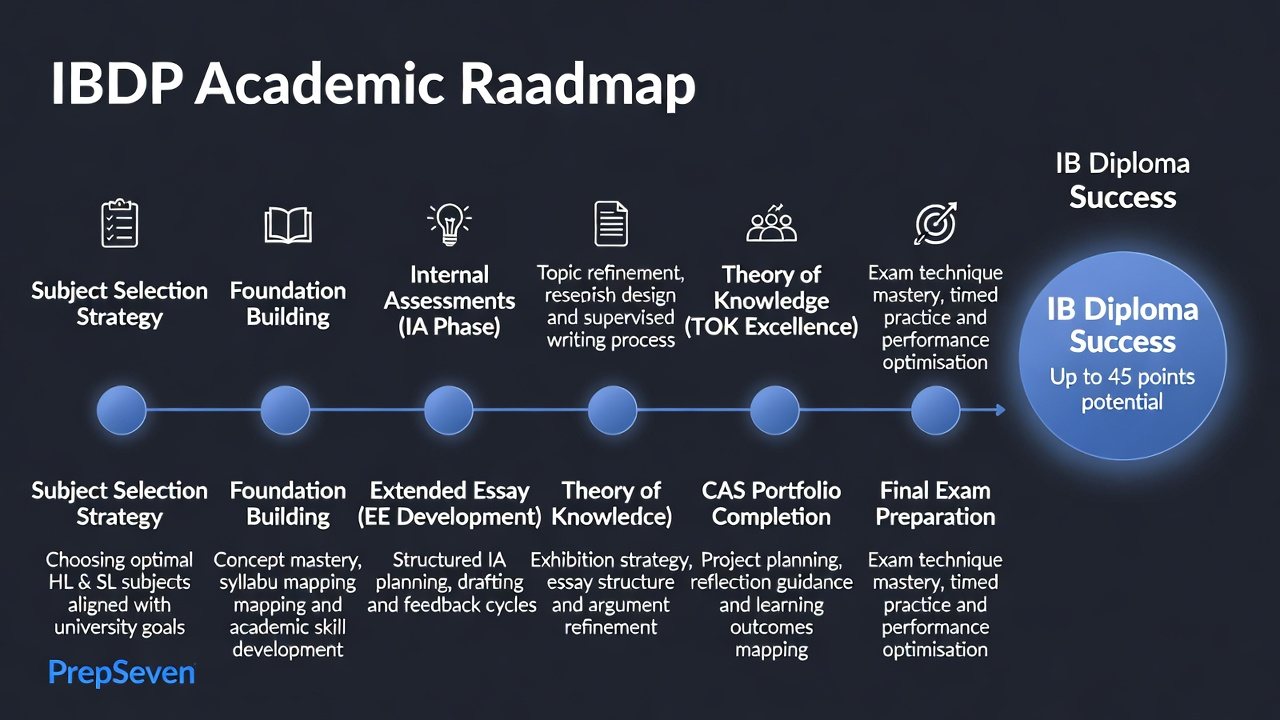
The IB Diploma Programme is a comprehensive educational program that promotes intellectual rigor, academic rigor, moral awareness, and internationalism. It is constructed in such a manner that the students who complete the program will not only have in-depth knowledge of their subjects but also the ability and skills to succeed in their future endeavors.
With its holistic approach to education, the IBDP remains one of the most well-rounded and forward-thinking pre-university qualifications in the world today.
As PrepSeven, our job is to ensure that the students have clarity and confidence in the curriculum.