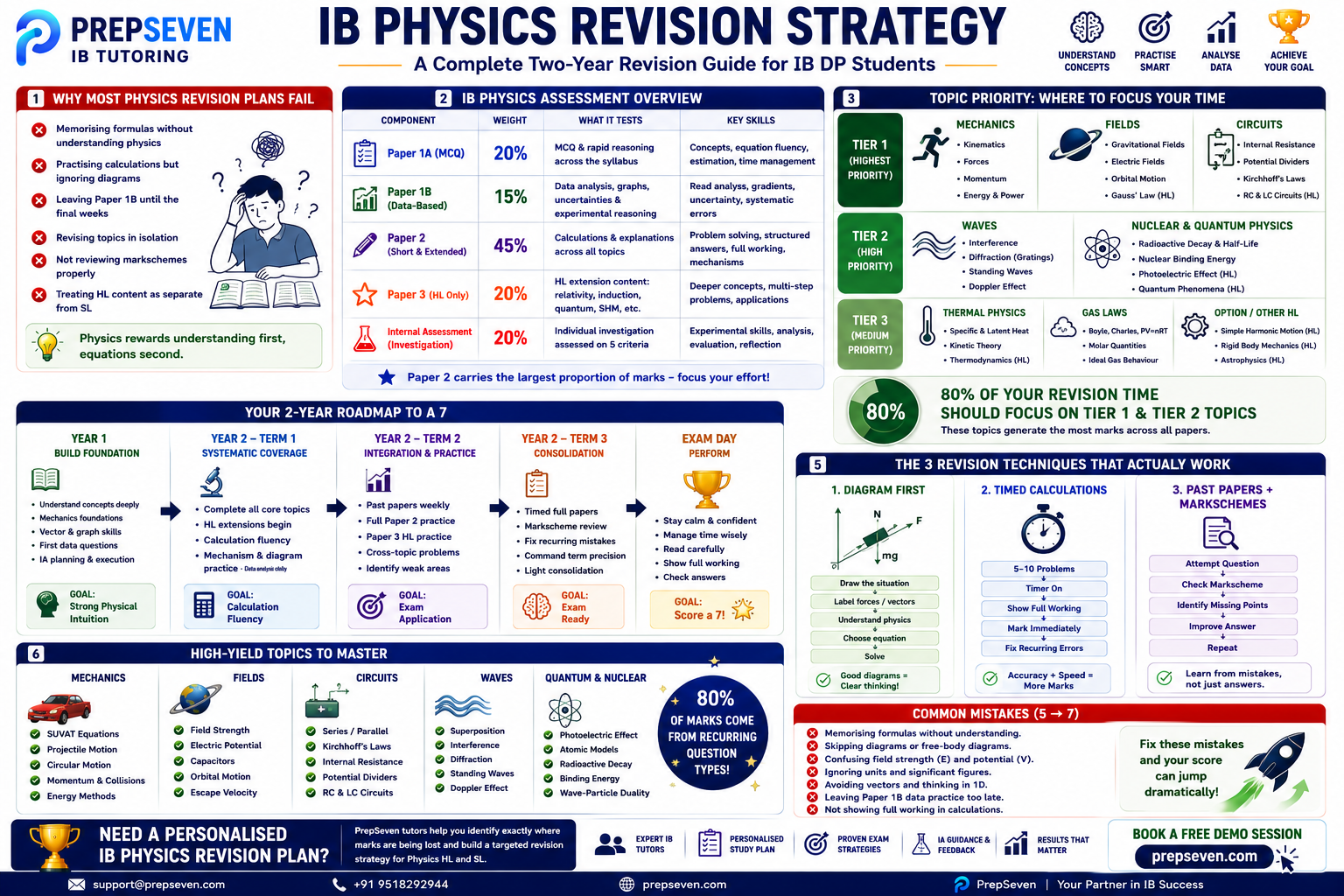
A Complete Two-Year Revision Guide for IB DP Students
Why IB Physics Needs a Different Revision Strategy Than the Other Sciences
IB Physics is the Group 4 subject where mathematical fluency and conceptual understanding cannot be separated. A question on projectile motion is not really testing whether you remember a formula. It is testing whether you can visualise a vector being split into components, recognise which equation of motion applies to which axis, and carry the algebra through without losing a sign. Students who treat Physics as a set of formulas to memorise hit a ceiling quickly, because the IB rewards the ability to apply unfamiliar combinations of ideas to situations the syllabus never explicitly describes.
The 2025 first-assessment syllabus organises the course around five themes, Space Time and Motion, the Particulate Nature of Matter, Wave Behaviour, Fields, and Nuclear and Quantum Physics, each running from foundational SL content through to a more demanding HL extension within the same theme. This structure matters for revision because it means HL extension topics are never really separate material. Relativity builds on the kinematics and momentum covered at SL. Induction builds on the electric and magnetic fields covered at SL. A revision strategy that revises each HL extension topic in isolation, disconnected from its SL foundation, makes the subject feel far harder than it needs to be.
This guide sets out a revision strategy built around three pillars that need separate, deliberate practice: conceptual understanding of the physical principles underlying each phenomenon, mathematical and graphical fluency across the calculation-heavy sections of the course, and the specific data-analysis and practical skills the IB tests directly through Paper 1B and the Internal Assessment. Students who build all three steadily across two years, rather than relying on a final-term cram, are consistently the ones who reach the top grade bands.
The single biggest mistake in IB Physics revision is practising calculation questions without first building the conceptual picture they are testing. A student who can substitute numbers into the kinematics equations but cannot sketch what is physically happening in a velocity-time graph will be caught out the moment a question changes the scenario slightly. A revision strategy that always asks what is physically going on before reaching for an equation produces the flexible understanding that separates a 6 from a 7.
What the Exam Actually Rewards: A Paper-by-Paper Breakdown
IB Physics is assessed through four papers plus the Internal Assessment, and each component rewards a slightly different skill. Understanding exactly what each paper is testing, rather than revising the syllabus as one undifferentiated block, is what allows revision time to be spent where it actually moves the grade.
Paper
What It Tests
Where Marks Are Typically Lost
What Good Revision Builds
Paper 1A (MCQ)
Conceptual understanding and rapid quantitative reasoning across the full syllabus
Confusing closely related quantities (e.g. speed vs velocity, impulse vs force); spending too long on one question instead of moving on
Equation fluency without hesitation; conceptual precision that distinguishes similar-sounding quantities; disciplined time management with a per-question target
Paper 1B (Data-Based)
Interpreting an unfamiliar experimental scenario, extracting data from graphs and tables, propagating uncertainty
Misreading what the question is actually asking for (a value vs a trend vs an explanation); weak gradient and area-under-graph technique; uncertainty rules applied inconsistently
Regular practice with unfamiliar data sets; fluency reading gradients, intercepts, and areas from graphs; systematic uncertainty propagation habits
Paper 2 (Extended Response)
Calculations across the full syllabus and structured extended-response questions requiring a chain of physical reasoning
Leaving multi-step calculations blank when stuck rather than attempting partial credit; correct numerical answers without the working needed for method marks; explanations that state a result without justifying it physically
Discipline of writing every step of working; practice structuring extended responses so each sentence earns a markscheme point; explicit linking of physical reasoning to the final answer
Paper 3 (HL Extension)
HL-only content: relativity, rigid body mechanics, thermodynamics, simple harmonic motion, induction, quantum physics, fusion and stars
Treating HL extension as a separate subject from the SL foundation it builds on; weak fluency with the more abstract mathematics (e.g. Lorentz factor, moment of inertia, complex exponential decay)
Explicit practice connecting each HL extension topic back to its SL foundation; systematic practice of the recurring Paper 3 question types for each theme
Internal Assessment (20%)
Personal Engagement, Exploration, Analysis, Evaluation, and Communication of an individual physics investigation
Generic Evaluation without quantified limitations; weak uncertainty propagation; insufficient justification for the chosen variables and methodology
Genuine engagement with a question you actually want to answer; systematic uncertainty analysis throughout, not bolted on at the end; deliberate comparison of results against theory or literature values
Topic Priority: Where to Concentrate Revision Time
IB Physics content is not equally weighted in examination frequency or in mathematical difficulty. Mechanics underpins a large share of the entire course, fields and waves are mathematically demanding and appear constantly, and several topics are predictable, calculation-heavy, and reward systematic preparation more reliably than others. A revision strategy that allocates time according to this reality, rather than working through the syllabus in a flat order, produces a better return per hour of revision.
Topic Area
Examination Frequency
Why It Is High Priority
Key Skills to Master
Kinematics, Forces, and Momentum (Theme A)
Very high: the foundation for nearly every other topic, including the HL extensions
Almost every mechanics question, and a large share of fields and waves questions, depends on confident vector resolution, free body diagrams, and the equations of motion
Resolving vectors into components without hesitation; constructing accurate free body diagrams; choosing the correct suvat equation for a given axis; conservation of momentum in one and two dimensions
Work, Energy, and Power (Theme A)
High: appears in nearly every mechanics question as a secondary check or alternative method
Energy methods often provide a faster route to an answer than force methods, and examiners frequently test whether students recognise when to switch approach
Work-energy theorem applied fluently; recognising when energy conservation is more efficient than a forces approach; power as the rate of energy transfer in real contexts
Electricity and Circuits (Theme B.5)
Extremely high: calculation-intensive and tested at every level, including in Paper 1B data questions
Circuit calculations are reliable, predictable question types that reward systematic preparation, and they connect directly to the IA for many students
Kirchhoff’s laws applied to series and parallel combinations; internal resistance and terminal potential difference calculations; potential divider circuits and their use in sensors
Fields: Gravitational and Electric (Theme D)
Extremely high: among the most mathematically demanding content and a major source of Paper 2 and Paper 3 marks
Gravitational and electric fields share an almost identical mathematical structure, and questions frequently test whether students recognise the parallel rather than treating them as unrelated topics
Field strength and potential calculations using the inverse-square relationships; orbital mechanics including escape velocity; circular motion in fields at HL, including motion in combined electric and magnetic fields
Wave Behaviour (Theme C)
Very high: standing waves, interference, and the Doppler effect are reliable, recurring question types
Wave questions test both conceptual understanding of superposition and precise calculation of path difference, frequency, and wavelength relationships
Standing wave patterns on strings and in pipes; two-source interference and diffraction grating calculations; the Doppler effect for both sound and light, including redshift at HL
Nuclear and Quantum Physics (Theme E)
High, and very high at HL where quantum physics is examined directly
Radioactive decay calculations and atomic models are predictable once the method is mastered, and quantum physics at HL is conceptually demanding and heavily tested in Paper 3
Half-life and decay constant calculations including graphical methods; nuclear binding energy and mass defect calculations; the photoelectric effect and wave-particle duality at HL
Thermal Physics and Gases (Theme B.1 to B.4)
Moderate to high: gas law calculations are predictable, and thermodynamics is a demanding HL extension topic
Gas law and specific heat capacity calculations are dependable marks once the method is secure, while thermodynamics at HL requires fluency with the first law applied across different processes
Gas law calculations including molar quantities; specific and latent heat calculations; the first law of thermodynamics applied to isothermal, adiabatic, isobaric, and isochoric processes at HL
Fields and mechanics together generate more marks across the IB Physics papers than any other pairing of topics, and they are also where errors compound most easily because most questions require several sequential steps built from a diagram. A single sign error in resolving a vector, or confusing field strength with potential, cascades through the rest of the calculation. The revision strategy that pays off most directly here is not learning more content but building the habit of drawing a clear diagram before calculating anything, checking units at every stage, and verifying that the final answer is physically reasonable.
The Two-Year Revision Strategy
Year 1: Building the Conceptual Foundation
The purpose of Year 1 is not exam preparation. It is building genuine physical intuition for mechanics, the foundation that almost everything else in the course depends on, alongside the mathematical habits, vector handling, graph reading, and unit discipline, that make every later topic easier. Students who rush through Year 1 without building this foundation find that fields and waves, which assume fluency with vectors and graphical analysis, become disproportionately difficult in Year 2.
Year 1 Phase
Timing
Physics Focus
Revision Actions
Active learning during teaching
Throughout Year 1
Kinematics, forces, momentum, work and energy, introductory thermal physics and waves
After each topic, practise sketching the situation from scratch and labelling every force or vector before attempting a calculation. Identify gaps immediately rather than letting them accumulate.
Vector and graph fluency building
Throughout Year 1, dedicated weekly time
Resolving vectors, reading gradients and areas under velocity-time and force-extension type graphs
Complete short problem sets weekly that require reading a value from a graph rather than being given it directly. This single skill underpins a large share of Paper 1B and Paper 2 marks across the whole course.
Mechanics deep revision
End of each relevant unit, repeated at end of Year 1
The full chain: free body diagram, Newton’s second law, suvat equations, energy methods as a check
Practise solving the same mechanics problem two ways, once with forces and once with energy, to build the judgement of which method is faster for a given question.
IA planning and execution
Year 1 Term 2 to 3
Your specific IA topic: the physics background, the methodology, uncertainty analysis
Treat the IA as a genuine investigation. The uncertainty analysis and graphical skills built here transfer directly to Paper 1B questions.
First data and graph practice
End of Year 1
Interpreting physics data, calculating gradients and intercepts, basic uncertainty propagation from past Paper 1B questions
Complete three or four past Paper 1B sections without time pressure. Identify whether errors are conceptual or procedural, such as gradient calculation technique.
Year 2 Term 1: Systematic Coverage and Calculation Fluency
Year 2 Term 1, roughly August to December, is where the remaining syllabus content is covered systematically, calculation fluency across fields, waves, and electricity is built deliberately, and the recurring Paper 2 question structures become a regular part of weekly practice.
Five circuit calculation problems including at least one combined series-parallel network; one past Paper 2 circuits extended response
3 hours content, 2 hours calculation practice
Weeks 4 to 6
Gravitational and electric fields: field strength, potential, orbital mechanics, escape velocity
Three complete orbital mechanics problems; field strength and potential graphing practice; one extended response connecting gravitational and electric field formulae
Standing wave problem set across strings and pipes; at least two diffraction grating calculations; one extended response on the Doppler effect applied to a real scenario
3 hours content, 2 hours calculation practice
Weeks 10 to 12
Thermal physics and gas laws: specific and latent heat, the ideal gas law, kinetic theory
Gas law calculations across at least three different scenarios; two calorimetry-style specific heat capacity problems with uncertainty discussion
2 hours content, 2.5 hours calculation practice
Weeks 13 to 15
Nuclear and quantum foundations: atomic models, radioactive decay, half-life, nuclear binding energy
Decay constant and half-life calculations from at least three different data sets; two nuclear binding energy and mass defect calculations
2.5 hours content, 2 hours calculation practice
Weeks 16 to 18
HL extension introduction: simple harmonic motion, rigid body mechanics, or relativity depending on teaching order
Connect each HL extension topic explicitly back to its SL foundation; complete the first past Paper 3 questions for the topics covered so far
2 hours content, 2 hours calculation practice
Year 2 Term 2: Integration, Past Papers, and HL Extension Mastery
Year 2 Term 2, roughly January to March, shifts the balance from content coverage to integrated application. This is where past paper volume increases substantially and where the connections between topics, which generate the hardest exam questions, become the primary revision focus.
Month
Focus
Weekly Actions
Specific Targets
January
HL extension consolidation and connection to SL foundations
For each HL extension topic, explicitly write out which SL concept it builds on and how; complete one past Paper 3 per week under timed conditions
By end of January: able to complete a past Paper 3 at approximately 65 to 70 percent accuracy with clear understanding of which topics need further work
February
Cross-topic integration and Paper 2 practice
Practise questions that connect multiple topics, such as fields and circular motion, or waves and quantum physics; complete one full Paper 2 under timed conditions per week
By end of February: full Paper 2 under timed conditions scoring above the grade 6 boundary; extended responses consistently structured to match the markscheme
March
Past paper volume and systematic gap closing
Two full past papers per week, alternating timed completion and careful markscheme-based review; identify the three recurring error patterns costing the most marks and address each specifically
By end of March: consistent past paper performance above the grade 6 boundary across Papers 1, 2, and 3; identified error patterns with a specific correction plan for each
Year 2 Term 3: Pre-Exam Consolidation
Weeks Before Exam
Focus
Daily Actions
6 to 8 weeks before
Full paper practice and systematic weak-area targeting
One timed full paper per week, rotating Paper 1, 2, and 3; review every lost mark by category: conceptual gap, calculation error, graph or data misread, command term misread; concentrate additional time only on categories still producing losses
4 to 5 weeks before
High-frequency calculation type consolidation
Daily timed practice on the highest-frequency calculation types: circuits, fields, standing waves, half-life, gas laws. Five problems per day rotating through these types until each is automatic
2 to 3 weeks before
Command term precision and graph fluency
Write one model answer per day for a past Paper 2 extended response question, checking explicitly against the markscheme for which physical statements earn marks; complete one Paper 1B section per day focused on gradient, intercept, and uncertainty extraction
Final week
Light consolidation only
Review summary notes on the five highest-frequency topics: mechanics, circuits, fields, waves, and nuclear decay. Complete one past paper under exam conditions. Prioritise sleep and reduce new content exposure to near zero.
The Three Skills That Need Separate, Deliberate Practice
Conceptual Understanding: Building the Physical Picture First
IB Physics rewards students who can explain what is physically happening before reaching for an equation, not just substitute numbers correctly. This is built through deliberate practice describing a scenario in words and diagrams before calculating anything, rather than jumping straight to formula manipulation. The most powerful version of this practice is the diagram-first approach: for any mechanics, fields, or circuits question, draw the situation, label every force, field, or current, and only then decide which equation applies.
Practise this approach across a wide range of scenarios: why does a satellite in a higher orbit move more slowly than one in a lower orbit? Why does increasing the frequency of a wave at a fixed speed decrease its wavelength? Why does the terminal potential difference of a cell drop as current increases? Each of these requires connecting a foundational principle to an observed outcome through a specific physical chain, and practising this chain explicitly, out loud or in writing, builds the flexible understanding that high-mark explanation questions reward.
A useful test of whether your conceptual understanding is exam-ready is to take any physical situation from the syllabus and explain it twice: once using the standard approach the textbook presents, and once using an alternative method the exam might require instead. If you can explain projectile motion using the suvat equations, can you also explain the same motion using energy conservation to find the maximum height without ever calculating time? The second explanation is harder and is exactly what separates 6s from 7s.
Mathematical Fluency: Building Speed and Accuracy Together
Mathematical fluency in IB Physics is not about knowing the right formula. It is about resolving vectors, rearranging equations, and substituting values quickly, accurately, with correct units, and with the discipline to show every step so that method marks are available even when the final answer is wrong. This is a skill that improves through volume and through deliberate error review, not through understanding alone.
The most effective calculation practice is timed and immediately reviewed. Complete a problem set of five to ten calculations from a single topic area, time yourself, then check every answer against a markscheme or solution, paying attention not just to whether you got the right answer but to whether your method was efficient and your units were correct throughout. Errors that recur across multiple problems, consistently forgetting to convert units, consistently mishandling significant figures, consistently making the same algebraic error in rearranging an equation, indicate a specific procedural gap that needs targeted correction, not just more general practice.
Calculation Area
Common Procedural Error
Targeted Fix
Vector resolution in mechanics
Mixing up sine and cosine when resolving a force or velocity at an angle; forgetting that components must be treated independently
Always sketch the vector triangle before resolving, and label which component is adjacent and which is opposite to the given angle
Circuit calculations
Treating a parallel combination as if it were in series, or vice versa; forgetting that current is conserved at a junction
Redraw the circuit clearly before calculating, marking current direction and labelling each branch before applying Kirchhoff’s laws
Field and orbital calculations
Confusing field strength with potential, which differ by a sign and a power of distance; forgetting that gravitational potential is always negative
Before every field calculation, explicitly state which quantity is being calculated and write its defining equation alongside the working
Wave and Doppler calculations
Using the wrong path difference condition for constructive versus destructive interference; sign errors in the Doppler equation when source and observer move in different directions
Draw the source and observer with clear direction arrows before applying the Doppler equation, and state the path difference condition in words before substituting numbers
Radioactive decay calculations
Confusing decay constant with half-life; misapplying the exponential decay equation when given activity rather than number of nuclei
Always state explicitly which quantity, number of nuclei, activity, or mass, the question has given before selecting the form of the decay equation to use
Data Analysis and Graphical Skills: The IB-Specific Techniques
Paper 1B data interpretation and graphical analysis are skills specific to how the IB assesses physics, and they require practice in the exact format the exam uses, not just general understanding of the underlying physics. A student can understand circular motion conceptually and still lose marks by misreading what an unfamiliar graph is showing, or by writing a data interpretation answer that states a trend when the question asked for a calculated value.
Graph practice should involve extracting gradients, intercepts, and areas under a curve from unfamiliar axes, including recognising what physical quantity each represents, since the IB regularly presents data in non-standard forms specifically to test whether understanding is genuine rather than memorised. This is a skill that improves with repetition on real past paper data, not just by reading worked examples in a textbook.
Paper 1B practice should focus specifically on reading exactly what each question asks: stating a value with correct units and significant figures, identifying a specific source of uncertainty or systematic error rather than giving a generic answer, and recognising when a question wants a numerical answer derived from the graph rather than a verbal description. Completing past Paper 1B sections regularly throughout Year 2, rather than only in the final weeks, builds this skill to the level of fluency the exam requires.
Weekly Revision Schedule Template
Day
Year 1 (Typical Week)
Year 2 Term 1 (Typical Week)
Year 2 Term 2-3 (Typical Week)
Monday
Review lesson content using active recall: explain the underlying physics from memory before checking notes
Content revision of current topic: 45 minutes on the conceptual foundation before calculation practice
Past paper MCQ section: timed, then markscheme review identifying every wrong answer and why
Tuesday
Calculation problem set on current topic, timed and self-marked
Calculation practice: 5 to 10 problems on current topic with full working shown and reviewed
Extended response practice: one 6 to 8 mark question timed, then detailed markscheme comparison
Wednesday
Diagram practice connecting current topic to mechanics foundations
Graph or data practice depending on current topic
Paper 1B practice: complete a full data-based section under timed conditions
Thursday
Active recall of mechanics fundamentals, free body diagrams and suvat equations, regardless of current topic
HL extension content connected explicitly to its SL foundation
Full Paper 3 practice (HL) or extended past paper section, rotating topic focus weekly
Friday
Review week’s content using active recall: what can you explain from memory?
Weekly review: identify the procedural calculation errors from this week’s practice and correct them explicitly
Weak area targeting: 1 hour on the topic or skill area showing most marks lost in recent past papers
Weekend
Catch up on any gaps; brief review of previous topic (spaced repetition); rest
One past paper question from a previous topic area (spaced repetition); IA work if active
One full past paper under timed exam conditions; careful markscheme review the following day
Common Revision Mistakes and How to Avoid Them
Revision Mistake
Why It Fails
What to Do Instead
Memorising formulae without understanding which variables they connect
Many IB Physics errors come from substituting into the wrong version of an equation, such as confusing instantaneous and average values, because the formula was memorised without understanding what each symbol represents
For every formula, explicitly note what each symbol represents and under what conditions the equation applies, and practise identifying which form is needed from the wording of the question
Treating mathematical and conceptual revision as the same activity
Understanding why a satellite’s orbital speed depends on its radius and being able to calculate that speed accurately under time pressure are different skills that require separate, deliberate practice
Schedule conceptual explanation practice and calculation practice as distinct activities in your weekly plan, not as one combined revise fields session
Avoiding vector-heavy mechanics questions because they feel harder than substitution-based ones
Vector resolution underpins circular motion, projectile motion, and fields, and avoidance compounds the difficulty over time as the gap between comfort with simple substitution and discomfort with vectors widens
Schedule vector practice weekly from early in Year 1, not just in the final revision phase. Treat it as a skill requiring the same repetition as any calculation type
Leaving Paper 1B practice until the final weeks
Paper 1B tests scientific reasoning and graph-reading skills that take time to develop and that content revision alone does not build
Begin Paper 1B practice in Year 2 Term 1. One section per week from early in Year 2 builds the skill far more effectively than cramming in the final fortnight
Not reviewing past paper answers against the markscheme in detail
Checking only whether the final numerical answer was correct misses information about method marks, units, significant figures, and structural issues with extended responses that are costing marks even on questions that felt right
Review every past paper response point by point against the markscheme, noting not just right or wrong but which specific elements, method, units, significant figures, structure, earned or lost marks
Underrevising HL extension content because it feels disconnected from the SL course
HL Paper 3 content is sometimes treated as lower priority because it is taught later and feels separate from the SL foundation, but it builds directly on earlier content and carries significant weight in the HL grade
Treat HL extension topics as a deepening of SL content, not separate material. Revise them with explicit reference back to the SL concept each one extends
Want a personalised IB Physics revision plan?
PrepSeven tutors work with students to identify exactly where marks are being lost in IB Physics, whether that’s calculation procedure, conceptual gaps, or data analysis technique, and build a targeted revision plan around it.