

IB Math AA vs AI: Which Should You Choose?
A Complete Guide for IB DP Students and Parents
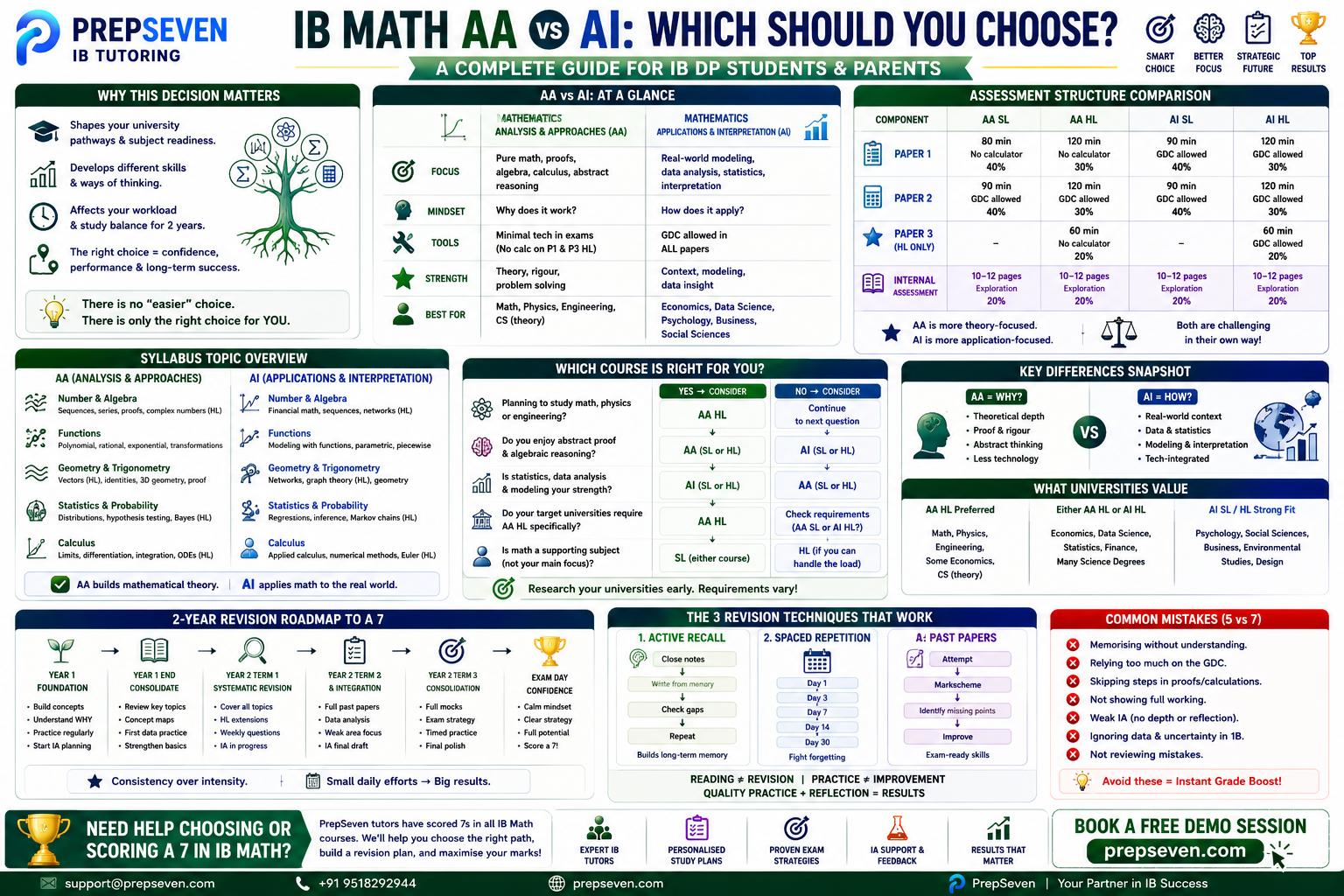
Why This Decision Matters More Than Most Students Realise
When the IB introduced its current mathematics framework, it replaced the old Mathematical Studies, Mathematics SL, and Mathematics HL structure with two separate courses: Mathematics Analysis and Approaches (AA) and Mathematics Applications and Interpretation (AI). Each is available at Standard Level and Higher Level, giving students four combinations to choose from. The decision is more consequential than most students appreciate when they make it in Year 11 or early Year 12, because the two courses develop genuinely different mathematical skills, and the gap between them widens significantly at Higher Level.
The choice is not simply about which course is harder. AA HL is the most demanding mathematics option in the Diploma Programme, but AI HL is not easy, and a student who chooses AI HL for the wrong reasons and struggles with statistical modelling and technology-heavy problem solving will not have an easier experience than they would have had in AA SL. The right question is not which course is harder but which course develops the mathematical thinking that aligns with what you want to do next.
This guide explains the genuine differences between AA and AI at both levels, how each course is assessed, what the content actually covers, and which course fits which student profile and university pathway. It also addresses the misconceptions that lead students to make the wrong choice, which consistently cost them either university admissions or two years of mathematics that does not serve their goals.
The most important thing to understand before reading this guide is that there is no universally correct answer to which course to take. AA and AI are different courses designed for students with different goals, not a harder and easier version of the same thing. A student who needs mathematics for economics, data science, or social science research may be better served by AI HL than AA SL, even though AA SL is perceived as more rigorous by students who have not looked at what AI HL actually covers.
What AA and AI Actually Are
Mathematics Analysis and Approaches is built around the traditional core of pure mathematics: algebra, functions, calculus, proof, and the abstract reasoning that underpins those areas. It is the course for students who want to engage with mathematics as a discipline in its own right, or who need the specific mathematical foundations that pure and applied mathematics degrees, engineering, physics, and some economics programmes require. The emphasis throughout is on understanding why mathematical results hold, not just how to apply them.
Mathematics Applications and Interpretation is built around the use of mathematics to model, analyse, and make decisions about real-world situations. It covers statistics, probability, and modelling in greater depth than AA, and it integrates technology throughout, with the GDC and other tools being genuinely central to the approach rather than supplementary aids. The emphasis is on mathematical thinking applied to context, which is the mathematical skill most relevant to the social sciences, business, design, psychology, and data-oriented fields.
Both courses share some common content, particularly at SL level: basic algebra and functions, introductory calculus, and core statistics and probability appear in both syllabuses. But they diverge significantly in emphasis, depth, and what the assessments reward. A student who is strong in AA is not automatically strong in AI, and vice versa, because the mathematical habits of mind that each course develops are genuinely distinct.
The Four Course Options Explained
AA SL: The Standard Pure Mathematics Path
AA SL covers algebra and functions, trigonometry, exponential and logarithmic functions, introductory calculus including differentiation and integration of standard functions, and statistics and probability at a solid foundational level. The course is assessed on two exam papers: Paper 1 with no calculator and Paper 2 with a GDC. The internal assessment is a mathematical exploration.
AA SL is the appropriate choice for students who need a solid mathematical foundation but are not pursuing heavily mathematics-dependent university programmes. It provides the algebraic and calculus foundations that many science-adjacent degrees require, without the additional proof and abstract reasoning demands of AA HL. Students who find mathematics manageable but not their strongest subject, and who want a course that will prepare them for university-level quantitative work without dominating their study time, often find AA SL the right fit.
Where students underestimate AA SL is in assuming it is significantly easier than AA HL. The gap in content is real, but Paper 1 in AA SL still requires genuine algebraic fluency without a calculator, and the calculus content is demanding enough that students who have not built strong foundations in earlier years find it challenging. AA SL is not a fallback for students who are weak in mathematics. It is a coherent course for students whose mathematical needs and interests align with its scope.
AA HL: The Rigorous Pure Mathematics Course
AA HL is the most demanding mathematics course in the IB Diploma Programme. It extends the AA SL content with proof by induction, complex numbers, further trigonometry, differential equations, Maclaurin series, vectors and matrices at depth, and the additional Paper 3 which presents extended unseen problems requiring mathematical reasoning across topic areas. Teaching hours are 240 compared to 150 for SL.
AA HL is designed for students who are serious about mathematics itself, or who need the specific content and level of rigour that it develops. Mathematics, physics, engineering, and some computer science degree programmes either require or strongly prefer AA HL, and students applying to competitive programmes in these fields need to be aware of this. The course is also the appropriate preparation for mathematics at university level in a way that no other IB mathematics option matches.
The students who genuinely thrive in AA HL are those who find mathematical abstraction genuinely interesting, not just those who are good at calculation. Proof, the ability to construct a rigorous logical argument and verify a mathematical result from first principles, is central to the course in a way that distinguishes it from every other IB mathematics option. Students who can compute correctly but dislike or struggle with abstract reasoning will find AA HL harder than their prior performance suggests.
AI SL: Mathematics for Context and Application
AI SL covers similar foundational content to AA SL in terms of algebra and functions, but with a markedly different emphasis. Statistics and probability take up a significantly larger proportion of the course, including regression analysis, the normal distribution, chi-squared tests, and basic probability models. Calculus is present but applied rather than proof-based, and the GDC is used throughout both papers.
AI SL is the appropriate choice for students who need mathematics for social science, humanities, psychology, design, or business pathways, where the ability to work with data, interpret statistical results, and model real-world situations is more directly relevant than pure algebraic manipulation or calculus. It is also a reasonable choice for students who need to meet a mathematics requirement without mathematics being central to their degree aspirations.
The misconception that AI SL is easier than AA SL is partly true in terms of content abstractness but misleading in terms of what is actually required. AI SL students are expected to use their GDC fluently, interpret complex statistical outputs correctly, and engage with modelling problems that require contextual reasoning. Students who choose AI SL because they find abstract algebra hard, but who are also weak at statistics and data interpretation, will not find it easier. They will find it differently hard.
AI HL: The Data and Modelling Course at Depth
AI HL is the most underrated course in the IB mathematics suite. It is not AA HL without the proof, which is how it is sometimes characterised by students who have not looked at its content. It is a demanding course in statistical inference, mathematical modelling, graph theory, Markov chains, numerical methods, and the mathematics of uncertainty and decision-making. These are skills that are increasingly central to data science, economics research, social science, finance, and any field where mathematical modelling of real-world complexity is required.
AI HL students sit three papers, all with a GDC. The HL extension content includes formal statistical inference, probability distributions in depth, Markov chains, networks, and numerical methods for solving differential equations. The internal assessment is the same mathematical exploration format as AA, but oriented toward modelling and data analysis.
The students who should seriously consider AI HL are those heading toward economics, psychology, data science, environmental science, social research, or business, where the ability to construct, fit, evaluate, and critically interpret mathematical models is a core professional skill. These students will likely use AI HL content directly in their university studies in a way that AA SL content would not serve them.
A student applying to study economics at a competitive university faces a genuine question about whether AA HL or AI HL better serves their application and their preparation. Many top economics programmes list AA HL as preferred or required. Others, particularly those with a strong econometrics or data science focus, recognise AI HL as directly relevant. The honest answer is that it depends on the specific programme, and students in this position should check the admissions requirements of their target universities before choosing.
Syllabus Content: What You Actually Study in Each Course
How Each Course Is Assessed
The assessment structures differ significantly between AA and AI, and understanding these differences matters for students whose exam performance varies with format. AA places more weight on written algebraic work and no-calculator reasoning. AI integrates technology throughout and places more weight on interpretation and modelling in context.
The most important structural difference for students to understand is the no-calculator paper in AA. Paper 1 in AA SL and both Paper 1 and Paper 3 in AA HL require students to work without any technology. This demands genuine algebraic fluency: the ability to manipulate expressions, apply calculus techniques, work with complex numbers, and handle trigonometric identities accurately by hand. Students who have become dependent on their GDC for routine algebraic steps will find AA Paper 1 significantly more difficult than their practice suggests.
AI has no no-calculator paper at either level. This does not make AI easier overall, but it means the type of mathematical fluency being tested is different. AI students are expected to use technology intelligently and interpret its outputs correctly, which requires understanding what the calculator is doing rather than just which buttons to press. An AI student who can run a regression but cannot explain what the R-squared value means, or who can compute a p-value but cannot interpret what it implies about the null hypothesis, will consistently lose marks on interpretation questions.
University Pathways: Which Course Do You Actually Need
This is the question that should drive the decision for most students, and it requires genuine research rather than assumptions. The IB’s own guidance is that AA is for students who enjoy developing mathematical arguments and want to study mathematics or mathematics-dependent subjects, while AI is for students who will use mathematics as a tool in other subjects. But this framing understates the rigour of AI HL and overstates how universal the preference for AA is across universities.
The single most important action any student can take before choosing between AA and AI is to look up the mathematics requirements of five or six specific university programmes they are genuinely interested in. This takes thirty minutes and will tell you more than any general guidance. A student who wants to study economics at the University of Edinburgh, LSE, and UCL needs to know what each of those programmes actually specifies, not what the general guidance says economics students tend to choose.
The Misconceptions That Lead Students to the Wrong Course
Misconception 1: AI is the easier option
This is the most damaging misconception in the AA vs AI decision. AI SL is probably less demanding than AA SL for students who are strong in abstract algebra but weak in statistics and data interpretation, because the type of mathematical thinking required is different. But AI HL is not easier than AA SL. It is a different course that demands fluency in statistical reasoning, model interpretation, and technology-integrated problem solving. Students who choose AI HL because they want an easier HL mathematics experience and find themselves struggling with Markov chains and formal hypothesis testing have made an error based on a false assumption.
The more accurate characterisation is that AA is harder for students who struggle with abstract algebra and proof, and AI is harder for students who struggle with statistical reasoning and contextual interpretation. Neither course is universally easier.
Misconception 2: AA is always better for university
This was true in an earlier era of university admissions, when the old Mathematics HL was the standard for competitive applications. It is increasingly not true. Many universities and degree programmes are explicit about accepting either AA or AI at HL, and some data-oriented degree programmes are genuinely better served by AI HL preparation. The shift toward data science, quantitative social science, and applied statistics across many disciplines means that AI HL content is increasingly directly relevant.
The students for whom AA HL is clearly necessary are those pursuing mathematics, physics, or engineering. For almost all other fields, the decision requires actual research into specific programme requirements rather than a general assumption that AA is more prestigious.
Misconception 3: You can always switch later
In theory, students can switch between AA and AI, or between SL and HL, during Year 1. In practice, the content diverges quickly enough that a student who switches from AI to AA mid-year, or from SL to HL, faces a genuine catch-up problem. The no-calculator demands of AA Paper 1 require algebraic fluency that takes time to build, and the HL extension content in AA is substantial enough that joining mid-year is difficult. Treat the initial choice as close to final and invest the research time upfront.
Misconception 4: Your primary school maths performance predicts which course to take
Students who were very strong at pre-DP mathematics often assume AA HL is the natural next step. This is not always correct. Pre-DP mathematics is largely computational: it tests the ability to apply procedures correctly. AA HL tests the ability to reason abstractly, construct proofs, and engage with mathematics that does not have a clear procedural path. A student who was top of their class in Year 10 mathematics but who dislikes abstract reasoning and proof will likely find AA HL more of a struggle than their prior performance suggests.
Conversely, a student who found pre-DP mathematics difficult because of the pace or computational focus, but who is genuinely curious about how mathematical models work in the real world and thinks clearly about data, may find AI HL more natural than their prior grades suggest.
Which Course Is Right for You: A Clear Framework
The HL vs SL Decision Within Each Course
Choosing AA or AI determines the content and emphasis of your mathematics education. Choosing SL or HL determines the depth, workload, and assessment demand. These are genuinely separate decisions, though they are often conflated.
The argument for HL in either course is primarily about university admissions and intellectual development. Many competitive programmes require or strongly prefer HL mathematics. HL mathematics also develops a depth of mathematical thinking that SL does not, which has value beyond the qualification itself. The cost is significant: HL mathematics takes 240 hours compared to 150 for SL, and the additional 90 hours are genuinely demanding, not just more of the same content.
The argument for SL is that it allows more time for the subjects that are central to your pathway. A student taking HL Biology, HL Chemistry, and HL English who adds AA HL mathematics to that combination is likely to be under significant strain. If mathematics is a supporting subject rather than your primary focus, SL provides solid preparation without the workload of HL, and the time saved is better invested in the subjects that matter most for your pathway.
The honest calculation is this: if your target university programmes require or strongly prefer HL mathematics in a specific course, take HL. If they do not, consider carefully whether the additional workload serves you better than the time it costs.
One underappreciated factor in the HL vs SL decision is what happens to your mathematics engagement when the course gets difficult. Students who find mathematics interesting even when it is hard tend to do well at HL because the difficulty is motivating. Students who find mathematics tolerable when they understand it but discouraging when they are stuck tend to struggle at HL because the course regularly presents problems without obvious routes forward. Be honest with yourself about which category you are in.
The One-Page Decision Guide
Not sure which IB Math course is right for you?
PrepSeven tutors have worked with students across all four IB Math options. We can help you understand your options, audit your university requirements, and build a study strategy that fits your pathway.
Book a Free Demo Session at prepseven.com