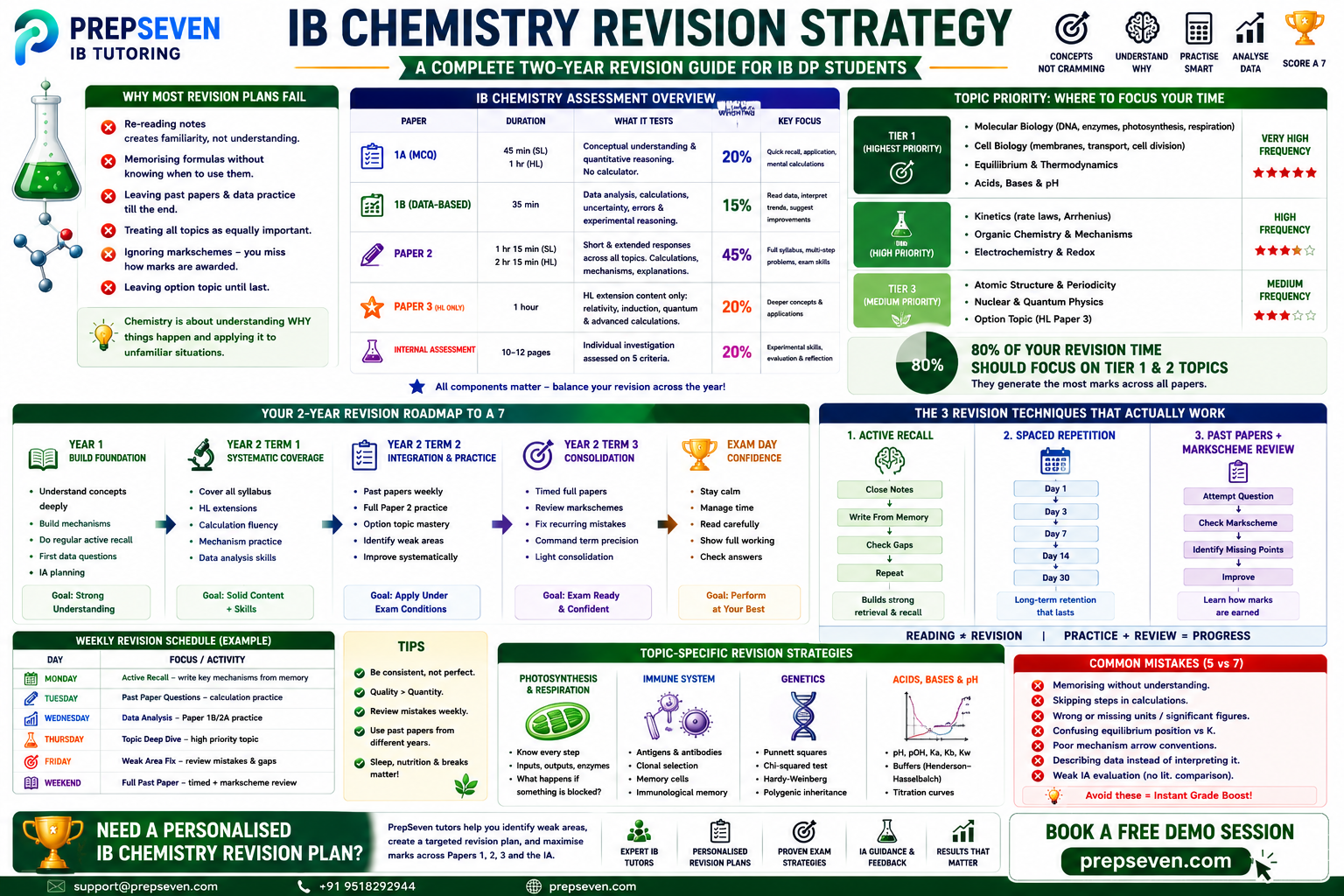
A Complete Two-Year Revision Guide for IB DP Students
Why IB Chemistry Needs a Different Revision Strategy Than Biology or Physics
IB Chemistry sits in an unusual position between the two other Group 4 sciences. It has the content volume that makes Biology demanding and the mathematical and conceptual rigour that makes Physics demanding, often within the same topic. A single equilibrium question can require algebraic manipulation, conceptual understanding of Le Chatelier’s principle, and precise recall of which species are included in the equilibrium expression. A revision strategy built only around content memorisation, the way some students approach Biology, will leave you unable to handle the calculation-heavy questions. A revision strategy built only around problem drilling, the way some students approach Physics, will leave you unable to explain why a reaction happens the way it does.
The 2023 first-assessment syllabus reorganised IB Chemistry around two themes, Structure and Reactivity, which reflects the genuine conceptual architecture of the subject: understanding what matter is made of and how it bonds, and understanding how and why matter changes. The most effective revision strategies mirror this structure, building genuine conceptual understanding of bonding and structure first, because it underpins almost everything else, and then layering reactivity, kinetics, equilibrium, thermodynamics, acids and bases, redox, and organic chemistry on top of that foundation.
This guide sets out a revision strategy built around three pillars that need separate, deliberate practice: conceptual understanding of why chemistry happens the way it does, calculation fluency across the genuinely mathematical sections of the course, and the specific skills of data interpretation and mechanism drawing that the IB tests directly. Students who build all three across two years, rather than cramming content in the final term, are the ones who reach the top grade bands.
The single biggest mistake in IB Chemistry revision is treating the subject as a list of facts and formulas to memorise. Chemistry questions at the top mark bands almost always require connecting ideas across topics: explaining a physical property using bonding theory, explaining reaction rate using both kinetics and thermodynamics, explaining titration curve shape using both acid-base equilibrium and stoichiometry. A revision strategy that builds these connections deliberately, rather than revising each topic in isolation, is what produces flexible understanding that holds up under exam conditions.
What the Exam Actually Rewards: A Paper-by-Paper Breakdown
Paper
What It Tests
Where Marks Are Typically Lost
What Good Revision Builds
Paper 1A (MCQ)
Conceptual understanding and quantitative reasoning, often requiring calculation without a calculator
Confusing closely related concepts (e.g. equilibrium position vs equilibrium constant); running out of time due to slow mental calculation
Equation fluency without reference to the formula sheet; conceptual precision that distinguishes similar-sounding ideas; quick estimation and ratio reasoning skills
Paper 1B (Data-Based)
Reading and interpreting experimental data; calculations using provided data; uncertainty analysis
Misreading what type of answer is required (trend description vs explanation); weak uncertainty propagation skills
Regular practice interpreting unfamiliar data sets; fluency with uncertainty calculation and propagation rules
Paper 2 (Extended Response)
Calculations across the full syllabus; organic mechanisms; extended response questions requiring structured chemical argument
Leaving calculations blank when stuck rather than attempting partial credit; mechanisms drawn with incorrect arrow conventions; extended responses that are correct but insufficiently structured to match the markscheme
Discipline of always attempting calculations fully; mechanism-drawing practice with strict adherence to conventions; structured answer-writing practice for extended responses
Treating HL extension as separate from SL foundations rather than a deepening of them
Explicit practice connecting each HL extension topic back to its SL foundation; systematic practice of the recurring Paper 3 question types
Internal Assessment (20%)
Personal Engagement, Exploration, Analysis, Evaluation, Communication of an individual chemistry investigation
Generic Evaluation without specific limitations; missing comparison to literature values; weak uncertainty propagation
Genuine engagement with the investigation; systematic uncertainty analysis; deliberate comparison of results to literature or theoretical values
Topic Priority: Where to Concentrate Revision Time
IB Chemistry content is not equally weighted in examination frequency or in conceptual difficulty. A revision strategy that allocates time proportionally to how often a topic generates marks, and how mechanistically demanding it is, will outperform one that works through the syllabus in a flat, undifferentiated way.
Topic Area
Examination Frequency
Why It Is High Priority
Key Skills to Master
Bonding and Structure
Very high: the conceptual foundation for nearly every other topic
Bonding determines structure, which determines intermolecular forces, which determines physical properties. Almost every property-comparison question requires this full chain of reasoning
VSEPR theory and molecular geometry from first principles; the chain from bonding type to physical property; formal charge and resonance at HL; hybridisation connected to geometry
Equilibrium and Thermodynamics
Extremely high: equilibrium calculations and Gibbs free energy appear in every session
These two topics are deeply connected and together account for a large share of Paper 2 and Paper 3 marks; they combine calculation and conceptual demand more than any other area
ICE table method for equilibrium calculations; Le Chatelier’s principle applied correctly to both equilibrium position and K; Born-Haber cycles at HL; Gibbs free energy and its temperature dependence
Acids, Bases, and pH
Extremely high: calculation-intensive and tested at every level
pH and equilibrium calculations for weak acids and bases, buffers, and titration curves are reliable, predictable question types that reward systematic preparation
Fluency moving between pH, pOH, Ka, Kb, Kw; buffer calculations using Henderson-Hasselbalch; titration curve interpretation including indicator selection at HL
Kinetics
High, especially at HL
Rate law determination and the Arrhenius equation are reliable HL Paper 2 and Paper 3 question types that require both calculation and conceptual explanation
Determining order of reaction from experimental data; Arrhenius equation and activation energy calculation; connecting rate to collision theory and the Maxwell-Boltzmann distribution
Organic Chemistry and Mechanisms
Very high at HL: mechanisms are heavily tested in Paper 2 and Paper 3
Organic synthesis and mechanism questions reward genuine understanding of electron movement over memorised reaction conditions
SN1 vs SN2 conditions and stereochemistry; electrophilic addition and Markovnikov’s rule; electrophilic aromatic substitution; multi-step synthesis problem-solving
Electrochemistry and Redox
High: appears regularly in Paper 2 and Paper 3
Electrode potential calculations and redox balancing are calculation-heavy and predictable once the method is mastered
Balancing redox equations using half-equations; standard electrode potential calculations for non-standard conditions at HL
Atomic Structure and Periodicity
High: foundational and tested directly
Periodic trends are tested as explanation questions requiring connection to atomic structure, not just trend recall
Explaining periodic trends using effective nuclear charge and shielding; electron configuration including HL d-block content; spectroscopic data interpretation
Equilibrium and acid-base chemistry together generate more marks across the IB Chemistry papers than any other pairing of topics, and they are also where calculation errors compound most easily because each question typically requires several sequential steps. A single sign error in an ICE table, or confusing Ka with pKa, cascades through the rest of the calculation. The revision strategy that pays off most directly here is not learning more content but building error-checking habits: writing out every step explicitly, checking units at each stage, and verifying that final answers are physically reasonable before moving on.
The Two-Year Revision Strategy
Year 1: Building the Conceptual Foundation
The purpose of Year 1 is not exam preparation. It is building genuine understanding of the chemical principles that everything else in the course depends on: atomic structure, bonding, and the fundamentals of chemical change. Students who rush through Year 1 content without building real understanding find that Year 2 HL extension content, which assumes fluency with the SL foundation, becomes disproportionately difficult.
Year 1 Phase
Timing
Chemistry Focus
Revision Actions
Active learning during teaching
Throughout Year 1
Atomic structure, bonding and structure, periodicity, introductory stoichiometry and energetics
After each topic, practise explaining the underlying mechanism without notes: why does this bonding type produce this structure? Why does this trend exist? Identify gaps immediately rather than letting them accumulate.
Bonding and structure deep revision
End of each relevant unit, repeated at end of Year 1
The full chain: bonding type, structure, intermolecular forces, physical properties
Practise the property-comparison reasoning chain on ten different pairs of substances. This single skill underpins a large share of Paper 1 and Paper 2 marks across the whole course.
Calculation fluency building
Throughout Year 1, dedicated weekly time
Mole calculations, stoichiometry, introductory enthalpy calculations, introductory pH and equilibrium
Complete short calculation problem sets weekly. Build the habit of writing every step, checking units, and verifying significant figures before moving to the next topic.
IA planning and execution
Year 1 Term 2-3
Your specific IA topic: the chemical background, the methodology, uncertainty analysis
Treat the IA as a genuine investigation. The uncertainty analysis and calculation skills built here transfer directly to exam calculation questions.
First data and graph practice
End of Year 1
Interpreting chemistry data, calculating gradients, basic uncertainty propagation from past Paper 1B questions
Complete three or four past Paper 1B sections without time pressure. Identify whether errors are content-based or procedural (e.g. gradient calculation technique).
Year 2 Term 1: Systematic Coverage and Calculation Fluency
Year 2 Term 1, roughly August to December, is where the remaining syllabus content is covered systematically, calculation fluency across all topic areas is built deliberately, and organic mechanisms become a regular part of weekly practice.
Week Range
Content Focus
Calculation and Application Practice
Weekly Commitment
Weeks 1-3
Equilibrium: ICE tables, equilibrium constant expressions including heterogeneous equilibria, Le Chatelier’s principle applied to both position and K
Five equilibrium calculation problems including at least one involving heterogeneous equilibrium; one past Paper 2 equilibrium extended response
3 hours content, 2 hours calculation practice
Weeks 4-6
Thermodynamics: Hess’s law, bond enthalpy calculations, entropy, Gibbs free energy and its temperature dependence; Born-Haber cycles at HL
Three complete Born-Haber cycle calculations (HL); Gibbs free energy temperature-dependence problems; one extended response on spontaneity
3 hours content, 2 hours calculation practice
Weeks 7-9
Acids and bases: pH and pOH calculations, weak acid and base equilibrium with the approximation method, buffers, titration curves and indicator selection at HL
Buffer calculation problem set; at least two titration curve sketching and indicator selection questions; one extended response connecting acid strength to molecular structure
3 hours content, 2 hours calculation practice
Weeks 10-12
Kinetics: factors affecting rate, rate law determination from data, integrated rate equations and half-life at HL, Arrhenius equation and activation energy at HL
Rate law determination from at least three different experimental data sets; two Arrhenius equation calculations including graphical determination of activation energy
Draw each mechanism type from scratch at least five times without reference; complete three multi-step synthesis problems working backwards from the target product
2.5 hours content, 2 hours mechanism-drawing practice
Weeks 16-18
Electrochemistry and redox: balancing half-equations, standard electrode potentials, electrolysis calculations, Nernst-type calculations at HL
Redox balancing problem set covering acidic and basic conditions; electrode potential calculation problems for non-standard conditions
2 hours content, 2 hours calculation practice
Year 2 Term 2: Integration, Past Papers, and HL Extension Mastery
Year 2 Term 2, roughly January to March, shifts the balance from content coverage to integrated application. This is where past paper volume increases substantially and where the connections between topics, which generate the hardest exam questions, become the primary revision focus.
Month
Focus
Weekly Actions
Specific Targets
January
HL extension consolidation and connection to SL foundations
For each HL extension topic, explicitly write out which SL concept it builds on and how; complete one past Paper 3 per week under timed conditions
By end of January: able to complete a past Paper 3 at approximately 65-70% accuracy with clear understanding of which topics need further work
February
Cross-topic integration and Paper 2 practice
Practise questions that connect multiple topics (e.g. enthalpy and bond structure, kinetics and equilibrium); complete one full Paper 2 under timed conditions per week
By end of February: full Paper 2 under timed conditions scoring above the grade 6 boundary; mechanism questions consistently using correct arrow conventions
March
Past paper volume and systematic gap closing
Two full past papers per week, alternating timed completion and careful markscheme-based review; identify the three recurring error patterns costing the most marks and address each specifically
By end of March: consistent past paper performance above the grade 6 boundary across Papers 1, 2, and 3; identified error patterns with a specific correction plan for each
Year 2 Term 3: Pre-Exam Consolidation
Weeks Before Exam
Focus
Daily Actions
6-8 weeks before
Full paper practice and systematic weak-area targeting
One timed full paper per week (rotate Paper 1, 2, 3); review every lost mark by category: content gap, calculation error, mechanism convention error, command term misread; concentrate additional time only on categories still producing losses
4-5 weeks before
High-frequency calculation type consolidation
Daily timed practice on the highest-frequency calculation types: equilibrium, pH and buffers, enthalpy, rate law and Arrhenius, redox balancing. Five problems per day rotating through these types until each is automatic
2-3 weeks before
Command term precision and mechanism fluency
Write one model answer per day for a past Paper 2 extended response question, checking explicitly against the markscheme for which biological- wait, chemical- statements earn marks; draw two organic mechanisms per day from memory with correct arrow conventions
Final week
Light consolidation only
Review summary notes on the five highest-frequency topics: bonding, equilibrium, acids and bases, kinetics, organic mechanisms. Complete one past paper under exam conditions. Prioritise sleep and reduce new content exposure to near zero.
The Three Skills That Need Separate, Deliberate Practice
Conceptual Understanding: Building the Explanatory Chain
IB Chemistry rewards students who can explain why a chemical phenomenon occurs, not just describe what occurs. This is built through deliberate practice connecting ideas across topics rather than revising each topic as an isolated unit. The most powerful version of this practice is the property-or-behaviour explanation chain: for any chemical observation, work through atomic structure, then bonding, then structure, then intermolecular forces or reactivity, until you reach the property or behaviour in question.
Practise this chain on a wide range of examples: why does sodium chloride have a higher melting point than methane? Why is the boiling point of water anomalously high? Why does increasing temperature shift an endothermic equilibrium to the right? Why does a tertiary halogenoalkane favour SN1 over SN2? Each of these requires connecting a foundational concept to an observed outcome through a specific mechanistic chain, and practising this chain explicitly, out loud or in writing, builds the flexible understanding that high-mark explanation questions reward.
A useful test of whether your conceptual understanding is exam-ready is to take any chemical observation from the syllabus and explain it twice: once in the direction the textbook presents it, and once from an unfamiliar angle the exam might use. If you can explain why increasing temperature increases reaction rate using collision theory, can you also explain why a small temperature increase produces a disproportionately large rate increase, in terms of the Maxwell-Boltzmann distribution and the exponential term in the Arrhenius equation? The second explanation is harder and is exactly what separates 6s from 7s.
Calculation Fluency: Building Speed and Accuracy Together
Calculation fluency in IB Chemistry is not about knowing the right formula. It is about applying it quickly, accurately, with correct units, and with the discipline to show every step so that method marks are available even when the final answer is wrong. This is a skill that improves through volume and through deliberate error review, not through understanding alone.
The most effective calculation practice is timed and immediately reviewed. Complete a problem set of five to ten calculations from a single topic area, time yourself, then check every answer against a markscheme or solution, paying attention not just to whether you got the right answer but to whether your method was efficient and your units were correct throughout. Errors that recur across multiple problems, consistently forgetting to convert units, consistently mishandling significant figures, consistently making the same algebraic error in rearranging an equation, indicate a specific procedural gap that needs targeted correction, not just more general practice.
Calculation Area
Common Procedural Error
Targeted Fix
Equilibrium (ICE tables)
Forgetting to exclude pure solids and liquids from the equilibrium expression; sign errors in setting up the change row
Practise writing the equilibrium expression first, before setting up the ICE table, to fix in your mind which species are included
pH and weak acid/base calculations
Confusing Ka with pKa; applying the approximation method when it is not valid (when dissociation is not small relative to initial concentration)
Before every weak acid calculation, explicitly check whether Ka is small enough relative to concentration to justify the approximation
Enthalpy calculations (Hess’s Law, Born-Haber)
Sign errors when reversing a reaction in Hess’s Law cycles; omitting a step in Born-Haber cycles
Always draw the full energy cycle diagram before calculating; label every arrow with its correct sign before summing
Rate law and Arrhenius calculations
Incorrect order determination when rate change is not a simple integer multiple of concentration change
Practise using logarithms to determine non-integer orders; do not assume order must always be 0, 1, or 2 without checking
Redox balancing
Forgetting to balance oxygen using water and hydrogen using H+ in acidic conditions, or H2O and OH- in basic conditions
Use a consistent systematic method every time: balance the element being oxidised/reduced, then oxygen, then hydrogen, then charge
Mechanism and Data Skills: The IB-Specific Techniques
Organic mechanism drawing and Paper 1B data interpretation are skills specific to how the IB assesses chemistry, and they require practice in the exact format the exam uses, not just general understanding of the underlying chemistry. A student can understand SN1 and SN2 conceptually and still lose marks by drawing mechanism arrows that do not follow IB conventions, or by writing a data interpretation answer that describes a trend when the question asked for an explanation.
Mechanism practice should involve drawing each examinable mechanism type from memory, repeatedly, with explicit attention to where each arrow starts (a bond or a lone pair) and where it points (the location electrons move to), and ensuring all relevant charges and intermediates are shown. This is a motor and visual skill as much as a conceptual one, and it improves with repetition on paper, not just by reading mechanism diagrams in a textbook.
Paper 1B practice should focus specifically on reading exactly what each question asks: stating a trend without explaining it, calculating a value with correct units and significant figures, identifying a specific source of uncertainty or systematic error rather than giving a generic answer. Completing past Paper 1B sections regularly throughout Year 2, rather than only in the final weeks, builds this skill to the level of fluency the exam requires.
Weekly Revision Schedule Template
Day
Year 1 (Typical Week)
Year 2 Term 1 (Typical Week)
Year 2 Term 2-3 (Typical Week)
Monday
Review lesson content using active recall: explain the mechanism from memory before checking notes
Content revision of current topic: 45 minutes on the conceptual foundation before calculation practice
Past paper MCQ section: timed, then markscheme review identifying every wrong answer and why
Tuesday
Calculation problem set on current topic, timed and self-marked
Calculation practice: 5-10 problems on current topic with full working shown and reviewed
Extended response practice: one 6-8 mark question timed, then detailed markscheme comparison
Wednesday
Concept map connecting current topic to bonding and structure foundations
Mechanism or data practice depending on current topic
Paper 1B practice: complete a full data-based section under timed conditions
Thursday
Active recall of bonding and structure (weekly regardless of current topic)
HL extension content connected explicitly to its SL foundation
Full Paper 3 practice (HL) or extended past paper section, rotating topic focus weekly
Friday
Review week’s content using active recall: what can you explain from memory?
Weekly review: identify the procedural calculation errors from this week’s practice and correct them explicitly
Weak area targeting: 1 hour on the topic or skill area showing most marks lost in recent past papers
Weekend
Catch up on any gaps; brief review of previous topic (spaced repetition); rest
One past paper question from a previous topic area (spaced repetition); IA work if active
One full past paper under timed exam conditions; careful markscheme review the following day
Common Revision Mistakes and How to Avoid Them
Revision Mistake
Why It Fails
What to Do Instead
Learning formulas without understanding the conditions under which they apply
Many IB Chemistry errors come from applying a formula or approximation outside its valid range, such as using the weak acid approximation when dissociation is not actually small
For every formula, explicitly note the conditions under which it is valid alongside the formula itself, and practise identifying when those conditions are and are not met
Treating calculation and conceptual revision as the same activity
Understanding why equilibrium shifts and being able to calculate an equilibrium constant accurately under time pressure are different skills that require separate, deliberate practice
Schedule conceptual explanation practice and calculation practice as distinct activities in your weekly plan, not as one combined ‘revise equilibrium’ session
Avoiding organic mechanisms because they feel harder than calculation topics
Mechanisms are heavily weighted at HL and avoidance compounds the difficulty over time as the gap between comfort with calculation topics and discomfort with mechanisms widens
Schedule mechanism practice weekly from the point organic chemistry is introduced, not just in the final revision phase. Treat it as a skill requiring the same repetition as calculation fluency
Leaving Paper 1B practice until the final weeks
Paper 1B tests scientific reasoning skills that take time to develop and that content revision alone does not build
Begin Paper 1B practice in Year 2 Term 1. One section per week from early in Year 2 builds the skill far more effectively than cramming in the final fortnight
Not reviewing past paper answers against the markscheme in detail
Checking only whether the final numerical answer was correct misses information about method marks, units, significant figures, and structural issues with extended responses that are costing marks even on questions that ‘felt right’
Review every past paper response point by point against the markscheme, noting not just right or wrong but which specific elements (method, units, sig figs, structure) earned or lost marks
Underrevising HL extension content because it is taught later in the course
HL Paper 3 content is sometimes treated as lower priority because it is covered later and feels separate from the SL foundation, but it is worth 20% of the HL grade and builds directly on earlier content
Treat HL extension topics as a deepening of SL content, not separate material. Revise them with explicit reference back to the SL concept each one extends
Want a personalised IB Chemistry revision plan?
PrepSeven tutors work with students to identify exactly where marks are being lost in IB Chemistry, whether that’s calculation procedure, mechanism conventions, or conceptual gaps, and build a targeted revision plan around it.