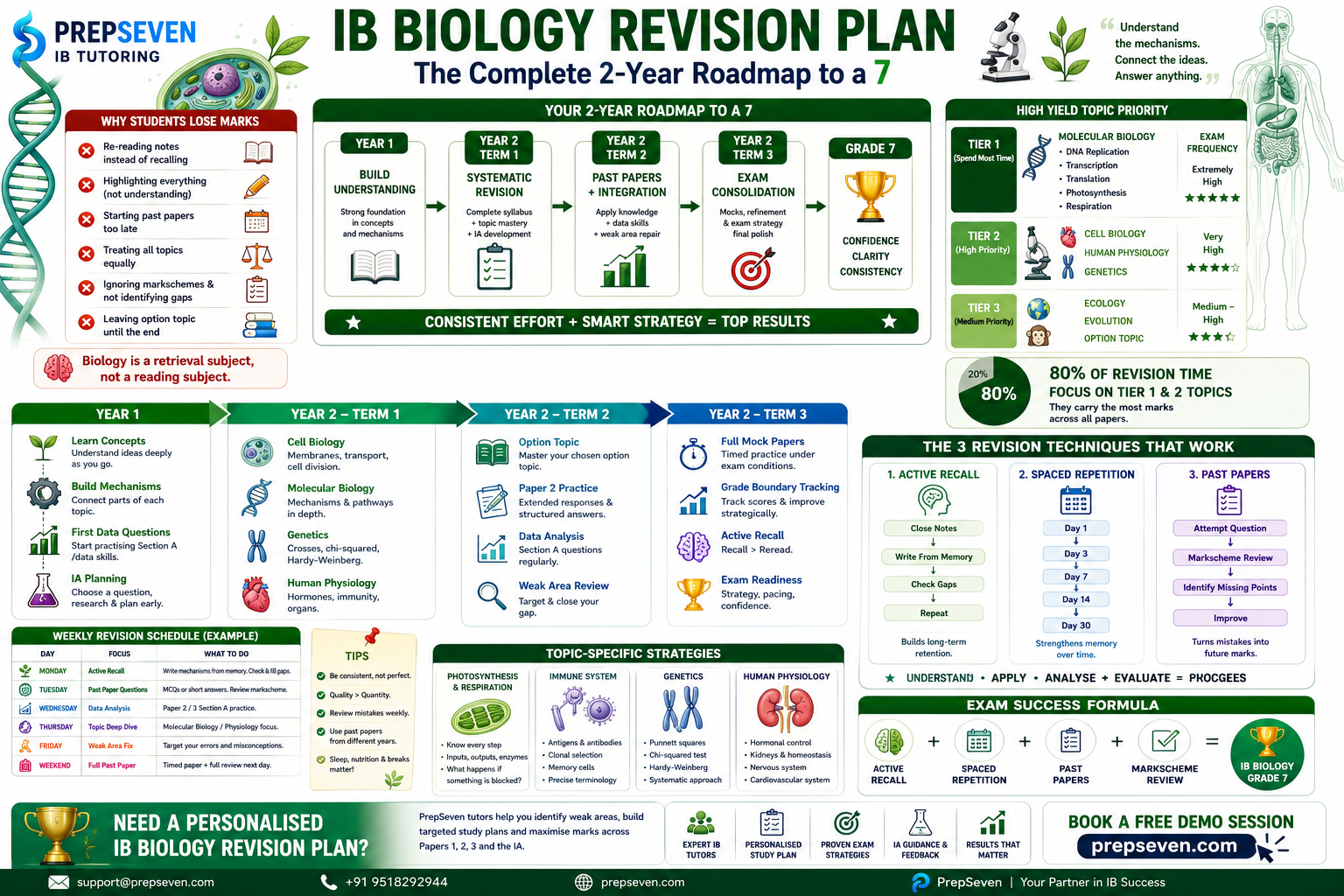
A Complete Two-Year Revision Guide for IB DP Students
Why Most IB Biology Revision Plans Fail
IB Biology is the most content-heavy of the three Group 4 sciences, and the students who underperform on it are almost never those who lacked intelligence or effort. They are those who mismanaged the content volume: starting revision too late, revising passively by re-reading notes, treating all topics as equally important, and leaving data interpretation practice until the final weeks when it is too late to build genuine fluency.
The syllabus spans eleven core topics at SL, with HL extensions and an option topic on top. The new 2025-first-assessment curriculum is organised around conceptual frameworks rather than isolated fact lists, which means the exam does not simply ask you to recall what you memorised. It asks you to apply biological understanding to novel scenarios, interpret unfamiliar data, and construct arguments using evidence. A revision plan that only addresses content coverage will not get you to a 7, and in most cases will not even get you to a 6.
This revision plan is built around three principles. First, content revision and application practice are not the same thing and both need dedicated time. Second, the topics that generate the most exam marks deserve the most revision time. Third, the skills being tested in data-based questions, extended responses, and the IA evaluation are learnable with deliberate practice and should be treated as skills rather than knowledge.
The revision plan that works for IB Biology is not one that ensures you have read everything. It is one that ensures you can retrieve the high-frequency content accurately without your notes, apply the key mechanisms to unfamiliar scenarios, and interpret biological data correctly under timed conditions. These three capabilities are developed differently and require different revision strategies. Building all three simultaneously across the two years of the course is what distinguishes students who score 7 from those who score 5.
Understanding What the Exam Rewards
Before designing a revision plan, it helps to understand exactly what the three papers are testing and how their mark distribution should shape your priorities.
Paper
What It Tests
Where Most Marks Are Lost
What Good Revision Builds
Paper 1A (MCQ)
Factual recall, conceptual understanding, application of biological principles to novel scenarios presented in four-option format
Choosing plausible but incorrect options because surface understanding does not distinguish them; running out of time because equation substitution without understanding is too slow
Deep conceptual knowledge that distinguishes between closely related biological ideas; fluency with key mechanisms so MCQ options can be evaluated quickly
Paper 2 (Short and Extended Answer)
Data interpretation in Section A; structured questions on core topics; extended responses requiring biological argument with evidence
Describing what data shows rather than interpreting it; writing extended responses that are biologically correct but lack precise terminology that matches the markscheme; running out of time on extended responses
Regular data interpretation practice on past paper Section A questions; extended response writing with markscheme comparison; precise biological language for high-frequency explanation topics
Paper 3 (Options and Experimental)
Section A: data-based questions on experimental biology common to all students; Section B: option topic content
Treating Section A as lower priority and lacking scientific reasoning skills; underrevising the option topic
Scientific reasoning habits built through regular Paper 3 Section A practice; systematic option topic revision throughout Year 2
Internal Assessment (20%)
Personal Engagement, Exploration, Analysis, Evaluation, Communication of an individual investigation
Weak Evaluation with generic limitations; insufficient depth in Analysis; no connection between results and biological theory
Genuine engagement with the investigation rather than protocol-following; specific limitation identification; comparison of results to biological predictions or literature values
Topic Priority: Not All Content Is Equal
IB Biology has more content than any other Group 4 science and more content than most students can revise exhaustively in the time available. The practical response to this is to prioritise topics by examination frequency and to ensure that the highest-frequency topics are revised to genuine depth, not just surface familiarity.
Extremely high: questions in every session across all papers
The most heavily examined area of the entire course; questions approach these topics from multiple angles and require mechanistic understanding, not just recall
DNA replication mechanism including the role of each enzyme; transcription and translation step by step; enzyme active site and inhibition mechanisms; light-dependent and light-independent reactions of photosynthesis; glycolysis, link reaction, Krebs cycle, and oxidative phosphorylation
Cell membrane and transport questions are perennial; mitosis and meiosis are examined every session
Fluid mosaic model with function of each component; distinction between diffusion, facilitated diffusion, active transport, osmosis, endocytosis, exocytosis with precise definitions; stages of mitosis and meiosis with chromosome behaviour at each stage
Human Physiology (digestion, cardiovascular, immune system, kidneys, nervous system, hormones)
Very high: extended responses in Paper 2 frequently draw on human physiology
The breadth of human physiology content means there is almost always a question in every session; the immune system and hormonal control are particularly heavily examined
Mechanism of clonal selection and immunological memory; hormonal control of the menstrual cycle and blood glucose; kidney filtration and reabsorption mechanisms; neural control of heart rate and ventilation; resting potential and action potential sequence
High: genetics problems appear in Paper 2 almost every session
Genetics questions combine biological knowledge with calculation, making them reliable scorers for well-prepared students
Monohybrid and dihybrid cross Punnett squares; sex-linked inheritance problems; chi-squared test interpretation; Hardy-Weinberg equilibrium and when it applies; polygenic inheritance at HL
Ecology (energy flow, nutrient cycles, population dynamics, conservation)
Medium-high: ecology appears in Paper 2 extended responses and Paper 3
Ecology questions often appear in extended responses alongside evolution, making them higher combined priority than they appear individually
Energy pyramids and why energy is lost at each trophic level; nitrogen and carbon cycle processes and the organisms involved; factors affecting population size; examples of conservation biology with specific evidence
Evolution and Biodiversity (natural selection, speciation, cladistics)
Medium: appears regularly but usually at lower mark allocation than molecular biology
Evolution questions require connecting mechanisms to evidence; combined with genetics and ecology they form a significant portion of extended response options
Mechanism of natural selection with specific examples; evidence for evolution including fossil record, comparative anatomy, molecular biology; cladistics and how cladograms are constructed at HL
Option Topic (A, B, C, or D depending on school)
High: entire Paper 3 Section B
The option topic is examined with the same rigour as the core and represents a substantial proportion of Paper 3 marks
Whichever option your school studies: master it to the same depth as the core topics, not as supplementary material
Molecular biology is not just the most examined topic in IB Biology. It is the topic where the gap between surface knowledge and genuine understanding is widest, and where that gap shows up most clearly in exam performance. A student who knows that photosynthesis involves light-dependent and light-independent reactions, but who cannot explain what happens to the products of the light-dependent reactions when light is suddenly removed, or what the effect of a specific inhibitor on the electron transport chain would be on ATP production, is not prepared for the Paper 2 extended response questions on photosynthesis. Revision of molecular biology is only complete when you can explain mechanisms in unfamiliar directions, not just in the direction the textbook presents them.
The Two-Year Revision Plan
Year 1: Building Genuine Understanding
The purpose of Year 1 revision is not to memorise content in preparation for exams. It is to build genuine understanding of the biological mechanisms that underpin each topic so that when you encounter those mechanisms in exam questions in Year 2, you can apply them flexibly rather than trying to match the question to a memorised answer.
Year 1 Phase
Timing
Biology Focus
Revision Actions
Active learning during teaching
Throughout Year 1
Every topic as it is taught: cell biology, molecular biology, genetics, ecology, evolution
Do not wait until topics are finished before engaging with them. After each lesson, write a one-paragraph summary of the mechanism covered without looking at notes. Identify where you are uncertain and address it before the next lesson rather than accumulating gaps.
End of topic consolidation
At the end of each major topic unit
The mechanism connections within each topic: how does DNA structure connect to replication? How does membrane structure connect to transport mechanisms?
Draw a concept map connecting the key ideas within the topic without referring to notes. Identify which connections you cannot draw from memory and address those specifically. Practise one past paper question on the topic under timed conditions.
Molecular biology deep revision
End of Term 1 and end of Year 1
Photosynthesis, respiration, DNA replication, transcription, translation, enzyme kinetics
These topics are too important to revise only at exam time. Spend dedicated time on them at least twice in Year 1. For each process, practise explaining the mechanism in the direction the exam is least likely to present it: what happens if this enzyme is blocked? What accumulates? What is depleted? Why?
IA planning and execution
Year 1 Term 2-3
Your specific IA topic: the biology behind it, the methodology, the variables
The IA is a 20% component that is assessed in Year 1 or early Year 2. Treat it as a genuine investigation rather than a task to complete. The biological background you develop for your IA topic will deepen your understanding of the relevant syllabus area.
First data practice
End of Year 1
Interpreting biological data from past Paper 2 Section A and Paper 3 Section A questions
Complete three or four past paper data sections without time pressure, then check against markschemes. Identify the patterns in what you get right and wrong. Are you describing data rather than interpreting it? Are you using imprecise terminology? Address the pattern, not the individual question.
Year 2 Term 1: Systematic Coverage and Application
Year 2 Term 1 runs approximately from August to December. This is the phase where systematic coverage of the entire syllabus happens, HL extension content is consolidated, and the shift from understanding to application accelerates.
Week Range
Content Focus
Application Practice
Weekly Commitment
Weeks 1-3
Cell biology revision: membrane structure and all transport mechanisms at precision level; cell division including the significance of each stage of meiosis for genetic variation
One past paper MCQ section; one Paper 2 short answer question on cell biology; compare answers to markscheme and identify terminology gaps
3 hours content, 1 hour application practice
Weeks 4-6
Molecular biology Part 1: DNA structure and replication; transcription and translation at mechanism level; the genetic code and its properties
One extended response on molecular biology from a past Paper 2; write full answer before checking markscheme; identify every mark point you missed and why
3 hours content, 1.5 hours extended response practice
Weeks 7-9
Molecular biology Part 2: photosynthesis and cellular respiration at full mechanistic depth; enzyme kinetics including inhibition; metabolic pathways and their interconnection
One data-based question from past Paper 2 Section A on photosynthesis or respiration; practise interpreting data about processes you know well from an unfamiliar angle
3 hours content, 1.5 hours application practice
Weeks 10-12
Genetics: Mendelian genetics problems; sex-linked and dihybrid crosses; chi-squared test; Hardy-Weinberg at HL; polygenic inheritance at HL
Three genetics problems from past papers including at least one chi-squared analysis; work through each systematically before checking answers
2 hours content, 2 hours genetics problem practice
Weeks 13-15
Human physiology: immune system mechanism; hormonal control of menstrual cycle and blood glucose; kidney function; neural control
One extended response on the immune system or hormonal regulation; focus on mechanistic precision in language; check markscheme for specific biological statements you missed
3 hours content, 1.5 hours extended response practice
Weeks 16-18
Ecology and evolution: energy flow and nutrient cycles; population dynamics; natural selection with specific examples; speciation; cladistics at HL
One Paper 2 question combining ecology and evolution; practise making connections across both topics in a single answer
2 hours content, 1 hour application practice
Year 2 Term 2: Integration, Option Topic, and Past Paper Practice
Year 2 Term 2 runs approximately from January to March. This is where systematic past paper practice begins in earnest, the option topic receives dedicated revision time, and the integration of knowledge across topics becomes the primary focus.
Month
Focus
Weekly Actions
Specific Targets
January
Option topic systematic revision
Work through the option topic syllabus systematically; treat it as a core topic, not supplementary material; complete one past Paper 3 Section B per week
By end of January: able to answer any option topic question from the past three years of past papers at approximately 70% accuracy
February
Integration and cross-topic connections
Practise questions that span multiple topics; identify the biological connections the exam rewards; complete one full Paper 2 under timed conditions per week
By end of February: full Paper 2 under timed conditions scoring above the grade 6 boundary; data-based questions in Section A averaging above 70%
March
Past paper volume and gap analysis
Two full past papers per week (one timed, one reviewed carefully against markscheme); identify the three topic areas or question types where most marks are still being lost; address those specifically
By end of March: consistent past paper performance above grade 6 boundary; identified remaining weak areas with a specific plan to address them
Year 2 Term 3: Pre-Exam Consolidation
The final weeks before the May exam session should be focused on consolidation and strategy, not on learning new content. Students who are still trying to cover content they have not revised properly in the final two weeks are in a difficult position. The goal of Term 3 revision is to sharpen what is already there, not to add to it.
Weeks Before Exam
Focus
Daily Actions
6-8 weeks before
Full paper practice and weak area targeting
One timed full paper per week; review every lost mark by category (content gap, terminology imprecision, misread command term, data interpretation error); spend additional revision time only on categories where marks are still being lost systematically
4-5 weeks before
High-frequency topic consolidation
Daily active recall on molecular biology mechanisms: photosynthesis, respiration, DNA replication, immune response, hormonal control. Write out the mechanism from memory, check against notes, identify any step where memory was uncertain, revise that step specifically
2-3 weeks before
Command term precision and paper strategy
For each command term (describe, explain, outline, evaluate, discuss, compare and contrast), write one model answer from a past paper question; check against the markscheme; practise distinguishing what each command term requires before writing
Final week
Light consolidation only
Do not introduce new revision strategies or attempt to learn new content. Review your summary notes on the five highest-frequency topics. Complete one past paper under exam conditions. Ensure sleep and nutrition are prioritised over additional revision hours.
The Three Revision Techniques That Actually Work for IB Biology
Active Recall: The Most Important Technique
Active recall is the practice of retrieving biological knowledge from memory rather than passively reviewing it. Every time you close your notes and attempt to write down what you know about a topic from memory, you are strengthening the retrieval pathway for that knowledge in a way that re-reading does not. The research on learning is consistent on this: retrieval practice produces better long-term retention than any form of passive review.
For IB Biology, active recall takes several practical forms. Writing the mechanism of photosynthesis from memory and checking against your notes. Drawing the fluid mosaic model without reference and labelling the function of each component. Explaining the clonal selection theory to yourself aloud before checking. Answering past paper questions without notes before consulting the markscheme. Any of these builds retrieval strength. Re-reading your notes builds familiarity, which is not the same thing and does not transfer to exam performance the way retrieval practice does.
The fastest way to identify what you actually know versus what you merely recognise is to close your notes and write. A student who reads their photosynthesis notes and thinks they understand the Calvin cycle, then closes the notes and writes nothing about RuBisCO, the regeneration of RuBP, or the relationship between the number of turns and the net carbon fixed, has identified a gap that re-reading would not have revealed. Active recall makes gaps visible. Passive review hides them until exam day.
Spaced Repetition: Revisiting Content at Increasing Intervals
Spaced repetition is the practice of revisiting material at increasing intervals as your confidence with it grows. The biological basis of this is well-established: memories are consolidated during sleep and strengthened by retrieval, and retrieving something just before you would otherwise forget it is more effective than retrieving it immediately after learning it.
For IB Biology, a practical spaced repetition schedule means revisiting content you covered in Year 1 at the beginning of Year 2, and revisiting Year 2 Term 1 content at the start of Term 2. It means reviewing high-frequency topics every two to three weeks during the exam preparation period rather than once at the beginning and once the week before the exam. It means using flashcard systems (physical or digital) that surface older cards regularly rather than only drilling recently added material.
The subjects most likely to benefit from spaced repetition in IB Biology are the high-content areas where the volume of specific detail is large: human physiology, molecular biology, and the option topic. These areas contain enough distinct mechanisms and terminology that forgetting is significant between revision sessions unless the content is revisited systematically.
Past Paper Practice With Active Markscheme Review
Past paper practice is the most directly exam-relevant revision technique but only if it is done in a way that produces genuine learning rather than just familiarity with question formats. The critical step is the markscheme review: after completing any past paper question, comparing your answer against the markscheme not to see whether you got it right but to identify the specific biological statements that the markscheme awards marks for and checking whether each one is present, absent, or present but imprecisely expressed in your answer.
The pattern of what is missing from your answers across multiple past paper questions reveals the systematic gaps in your biological knowledge. A student who writes extended responses on the immune system that consistently miss the role of clonal selection and expansion has identified a specific gap. A student who consistently describes data trends without explaining the biological mechanism behind them has identified a different specific gap. Both gaps are addressable, but only if the markscheme review is done carefully enough to reveal them.
Past Paper Review Category
What It Means
How to Address It
Content gap: the biological point was simply not in your answer because you did not know it
You have not learned or retained this specific piece of biology
Return to your notes or textbook for this specific point; add it to your active recall practice; revisit it in the next spaced repetition session
Terminology imprecision: the biological idea was present but expressed in language that would not earn the markscheme point
You understand the biology but lack the precise language the IB rewards
Note the exact markscheme language for this point; practise using that language in a new sentence; build a glossary of precise IB Biology terminology for high-frequency topics
Command term misread: you answered describe when the question said explain, or vice versa
You are not consistently attending to what type of answer the question requires before writing
Drill command term definitions; practise identifying the command term in a question before writing anything; build the habit of asking what type of answer is required before beginning
Data interpretation error: you described the data rather than interpreting it, or over-interpreted beyond what the data supports
You have not yet developed the scientific reasoning habits that data-based questions require
Complete Paper 2 Section A and Paper 3 Section A questions as a separate focused practice; compare your data interpretations to the markscheme specifically; identify whether you are consistently under-interpreting or over-interpreting
Topic-Specific Revision Tactics for the Hardest Areas
Photosynthesis and Respiration: The Mechanism-First Approach
Revising photosynthesis and respiration effectively means understanding the mechanisms well enough to answer questions that approach them from any direction. The standard revision approach, learning the stages and their products, is necessary but not sufficient. The questions that separate 6s from 7s ask what happens when a specific step is disrupted, what would accumulate upstream of a blocked enzyme, what the effect of a specific inhibitor would be on downstream products.
For each stage of both processes, practise the following: name the location; name the inputs and outputs; name the key enzymes or protein complexes involved; identify what would happen if this stage were blocked; identify what would happen to the previous stage if this stage were blocked. Running through this analysis for every stage of the Calvin cycle, the electron transport chain, glycolysis, the Krebs cycle, and the light-dependent reactions creates the mechanistic understanding that the hardest exam questions test.
The Immune System: Precision Over Coverage
The immune system is examined in detail in almost every session and is the human physiology topic where precision of language matters most. The distinction between non-specific and specific immunity, the roles of different cell types, the mechanism of clonal selection, the basis of immunological memory, and the molecular specificity of antigen-antibody interactions are all examined regularly and all require precise biological language.
The revision approach that works for the immune system is to draw the sequence of events from pathogen entry to memory cell formation as a detailed flow diagram, from memory, then check it against your notes and identify every missing step or imprecisely labelled component. Repeat this until you can draw the complete sequence accurately without notes. Then practise explaining specific steps in writing using exam-style language, checking your sentences against the kind of markscheme language that IB Biology uses for immune system questions.
Genetics Problems: Systematic Method Over Pattern Matching
Genetics problems in IB Biology reward students who have a systematic approach over those who try to recognise which type of problem they are looking at and match it to a memorised solution. The systematic approach for any genetics problem is: identify all given information including phenotypes, genotypes if known, and the number of offspring; determine the mode of inheritance from the ratios or patterns given; set up the Punnett square with correctly identified gametes; complete the square and count the ratios; apply chi-squared if the question requests it.
The most common error in genetics problems is incorrect gamete formation, particularly for dihybrid crosses and sex-linked problems. Before drawing any Punnett square, write down the gametes explicitly and check them before filling in the grid. This single habit eliminates the majority of genetics calculation errors.
The Weekly Revision Schedule Template
Day
Year 1 (Typical Week)
Year 2 Term 1 (Typical Week)
Year 2 Term 2-3 (Typical Week)
Monday
Review lesson content using active recall: write key mechanisms from memory
Content revision of current topic: 45 minutes deep revision of one mechanism area
Past paper MCQ section: 30 questions timed, then markscheme review identifying every wrong answer
Tuesday
Flashcard review of previously covered terms and mechanisms
Application practice: one short-answer past paper question on current topic area
Extended response practice: one 6-8 mark question timed, then detailed markscheme comparison
Wednesday
Concept map of connections within current topic
Data practice: one Paper 2 Section A or Paper 3 Section A data question
Option topic revision: 45 minutes on highest-frequency option subtopics
Thursday
Active recall of molecular biology (weekly regardless of current topic)
HL extension content if applicable; genetics problem practice
Full Section A data practice: complete an entire Paper 2 Section A under timed conditions
Friday
Review week’s content using active recall: what can you write from memory?
Weekly review: what from this week can you recall without notes?
Weak area targeting: 1 hour on the topic or skill area showing most marks lost in recent past papers
Weekend
Catch up on any gaps; brief review of option topic if covered; rest
One past paper question from a previous topic area (spaced repetition); IA work if active
One full past paper under timed exam conditions; careful markscheme review the following day
Common Revision Mistakes and How to Avoid Them
Revision Mistake
Why It Fails
What to Do Instead
Re-reading notes and highlighting
Creates familiarity without retrieval strength; you recognise content when you see it but cannot produce it independently, which is what the exam requires
After reading a section, close the notes and write down what you remember. The struggle of retrieval is not a sign of weakness. It is the mechanism by which knowledge is consolidated.
Treating all topics as equally important
IB Biology has too much content to revise exhaustively. Spending equal time on a low-frequency topic and molecular biology is a poor use of time.
Use the priority table in this guide to allocate more time to higher-frequency topics. Molecular biology, cell biology, and human physiology deserve more revision sessions than biodiversity classification or the history of biology.
Starting past paper practice only in the final weeks
Data interpretation and extended response writing are skills that take time to develop. Practising them only in the final weeks does not allow enough time to close the gaps they reveal.
Start past paper practice in Year 2 Term 1 at the latest. One question per week from early in Year 2 is more valuable than ten per week in the final fortnight.
Revising without checking against markschemes
Completing past paper questions and then checking only whether the final answer is correct misses the most valuable information: which specific biological points the markscheme awards marks for and whether your language was precise enough to earn them.
Every past paper response should be reviewed against the markscheme point by point. Identify which mark points you included, which you missed, and which you included imprecisely. This review is where the most learning happens.
Leaving the option topic until late
The option topic is examined in Paper 3 Section B with the same rigour as the core. Students who treat it as supplementary and leave it until the final weeks find Paper 3 significantly harder than expected.
Integrate option topic revision into your Year 2 Term 1 and Term 2 schedule. Treat it as a seventh core topic area, not as optional bonus material.
Memorising diagrams without understanding them
A student who can reproduce the fluid mosaic model but cannot explain why the hydrophilic heads face outward, or why the phospholipid bilayer is described as fluid, cannot answer the questions that probe the diagram from an unfamiliar angle.
For every diagram in IB Biology, identify what each labelled component does and why it is structured the way it is. The diagram is a representation of a mechanism, and understanding the mechanism allows you to answer questions from any direction.
Want a personalised IB Biology revision plan?
PrepSeven tutors work with students to identify their specific weak areas in IB Biology and build a targeted revision plan around them. We do not give you a generic schedule. We help you figure out exactly where your marks are being lost and how to recover them.