

How to Score a 7 in IB Psychology
Why Knowing Fewer Studies Properly Beats Knowing Many Studies Vaguely
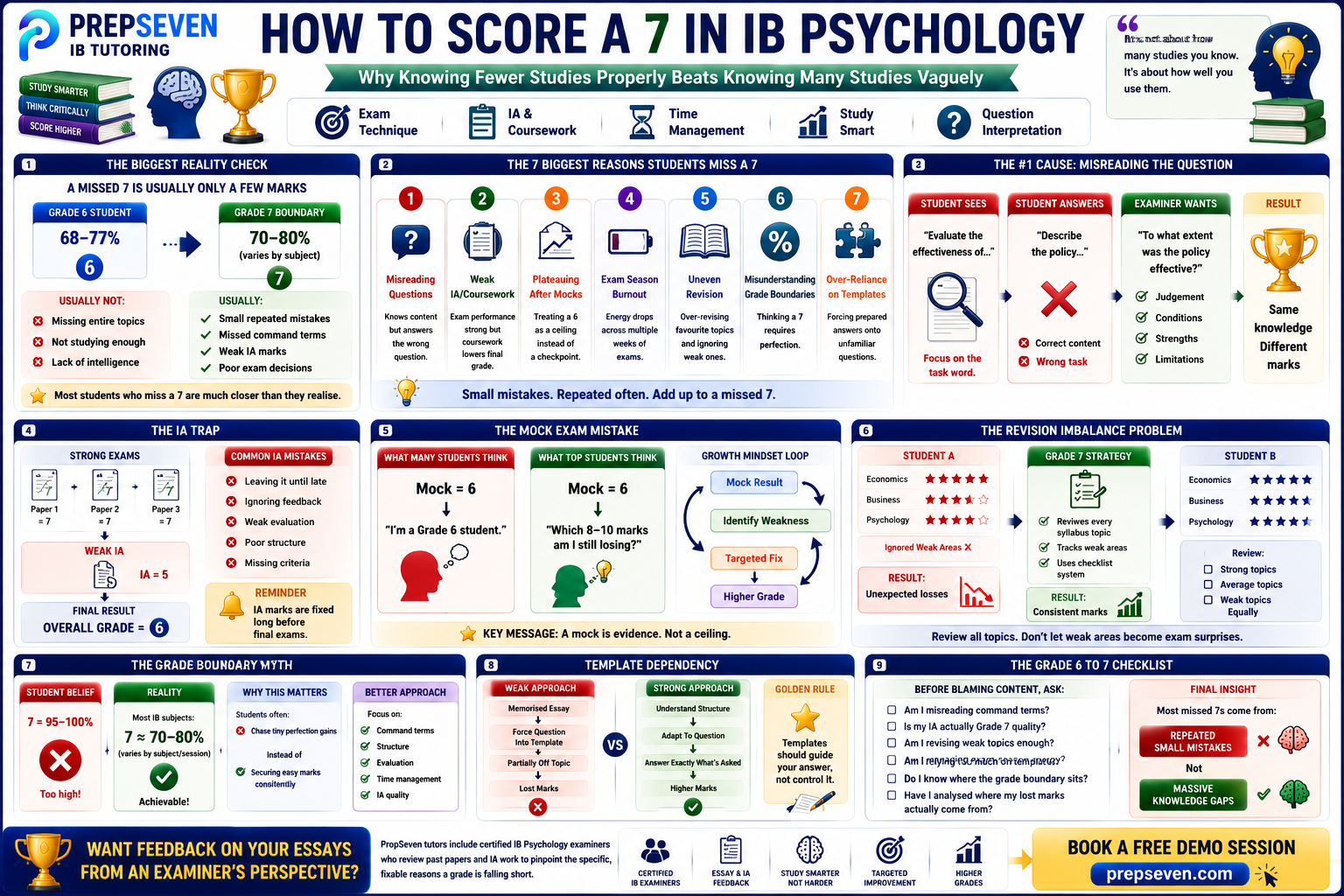
The Real Difference Between a 5 and a 7
Ask an IB Psychology student how many studies they’ve revised and the strongest answer isn’t the highest number. A student who can recall fifteen studies as a single sentence each, a researcher’s surname and a vague conclusion, performs worse on Paper 1 and Paper 2 than a student who knows six or seven studies in real depth: who ran them, how, on whom, what they actually found, and crucially, what’s questionable about them. Psychology is an evidence-based subject, and the IB rewards precision and critical use of evidence over breadth of recall.
This is the single habit worth rebuilding first if a grade has plateaued despite genuine effort. “Research has shown that stress affects memory” earns almost nothing. “Schwabe and Wolf’s 2010 study found that participants exposed to a stressor before encoding performed significantly worse on a memory recall task than a control group, though the artificial lab setting raises questions about how well this generalises to real-world stress” does the actual work the markschemes are looking for: it names the study, describes the method and finding accurately, and offers a specific, relevant critique rather than a generic one.
A useful test: if you removed the researcher’s name and the specific detail from a sentence about a study and it still made sense as a general claim, that sentence isn’t doing the evidential work a 7 requires. Specificity is what separates citing a study from genuinely using one.
Paper 1 Tests Two Different Skills, Not One
Section A and Section B of Paper 1 are often revised as if they’re the same task at different lengths, and treating them that way costs marks in both directions. Section A asks three short, compulsory questions, one on each core approach, biological, cognitive, and sociocultural, and rewards economy: a precise definition or explanation, one well-chosen study or example used briefly, and nothing extra. Students who write Section A answers like mini-essays run out of time for Section B without gaining additional marks, since these questions are capped at a small number of points regardless of length.
Section B is the opposite skill. It’s a full extended-response essay on one of the core approaches, and it needs the structure, depth, and critical evaluation of a proper argument: a clear thesis, multiple studies used as evidence and weighed against each other, and explicit engagement with the question’s specific wording, not a general tour of everything you know about that approach. At HL, a further extended response on the research methods extension topic demands the same essay discipline but applied to methodological and ethical material rather than content.
The Debates That Actually Drive Evaluation
Evaluation in Psychology rarely means simply listing a study’s strengths and limitations in isolation. The strongest answers use a small set of recurring theoretical debates as the lens for evaluation, which gives the analysis direction and makes it feel like genuine critical thinking rather than a checklist.
These debates work best when they’re chosen deliberately for the specific question asked, rather than mechanically inserted into every essay regardless of fit. A strong essay typically uses one or two of these debates with real depth rather than gesturing at all five superficially.
Paper 2: Why Depth on Fewer Studies Wins
Paper 2 tests the option or options studied, Abnormal Psychology, Developmental Psychology, Health Psychology, or the Psychology of Human Relationships, with one extended-response essay per option at SL, and two at HL. The temptation here is to prepare broadly across many possible questions within an option, but the more reliable strategy is building real depth on the small number of named studies central to each likely topic, since the essay format rewards detailed, critically evaluated evidence far more than it rewards covering many topics shallowly.
A practical way to prepare: for each major topic within your option or options, build a short list of two to three studies you know in real depth, methodology, sample, key finding, at least one specific critique, rather than a long list of studies you could only describe in a single vague sentence under exam pressure. Two studies you can discuss with precision will outperform six you can only gesture at.
Paper 3: Research Methods Under Pressure (HL Only)
Paper 3 presents an unseen description of a research study and asks structured questions about its methodology, validity, reliability, and ethical considerations. This is a genuinely different skill from the content recall the other two papers test, and it rewards students who have practised analysing unfamiliar methodology descriptions specifically, not just revised research methods as a list of definitions.
- Read the stimulus material twice before answering anything, since the specific sampling method, setting, and procedure described usually determine which methodological strengths and weaknesses are actually relevant to discuss.
- Avoid generic methodology criticism that isn’t grounded in the specific stimulus, such as noting a small sample size when the stimulus doesn’t actually specify one.
- Practise with genuinely unfamiliar research scenarios regularly throughout Year 2, not just past Paper 3 papers, since the skill being tested is flexible application of research methods knowledge, not memorised recall.
The IA: Precision in Design, Not Just Interesting Findings
The Psychology IA involves replicating an existing study, in a simplified, ethically appropriate form, collecting data from participants, and writing up the investigation. Many students focus their effort on the interestingness of their hypothesis or their findings, when the criteria are actually weighted heavily toward methodological precision: clear, well-justified operationalisation of variables, an appropriately designed and controlled procedure, and genuine, specific engagement with the ethical considerations the study raises, not a generic ethics paragraph copied across every IA.
The most common way a strong student loses marks here is replicating a well-known study without fully understanding, or fully explaining, why each methodological decision was made. A 7-level IA explains the reasoning behind the sampling method chosen, the operational definitions used for each variable, and what specifically might threaten the study’s validity, rather than simply describing what was done.
The Single Change Worth Making First
If there’s one change that moves an IB Psychology grade more reliably than any other, it’s shifting revision time away from accumulating more studies and toward knowing fewer studies properly enough to critique them with precision, tied to a small set of theoretical debates that give that critique direction. A student with seven studies they can discuss in genuine depth, linked explicitly to nature versus nurture, reductionism, or the individual versus situational debate as relevant, will consistently outperform a student with twenty studies they can only summarise in a single sentence each.
Want feedback on your Psychology essays and IA design?
PrepSeven tutors include certified IB Psychology examiners who review practice essays and IA drafts against the real grade descriptors, with a specific focus on study depth, critical evaluation, and methodological precision.
Book a Free Demo Session at prepseven.com