

How to Score a 7 in IB Chemistry
The Complete Guide for IB DP Students
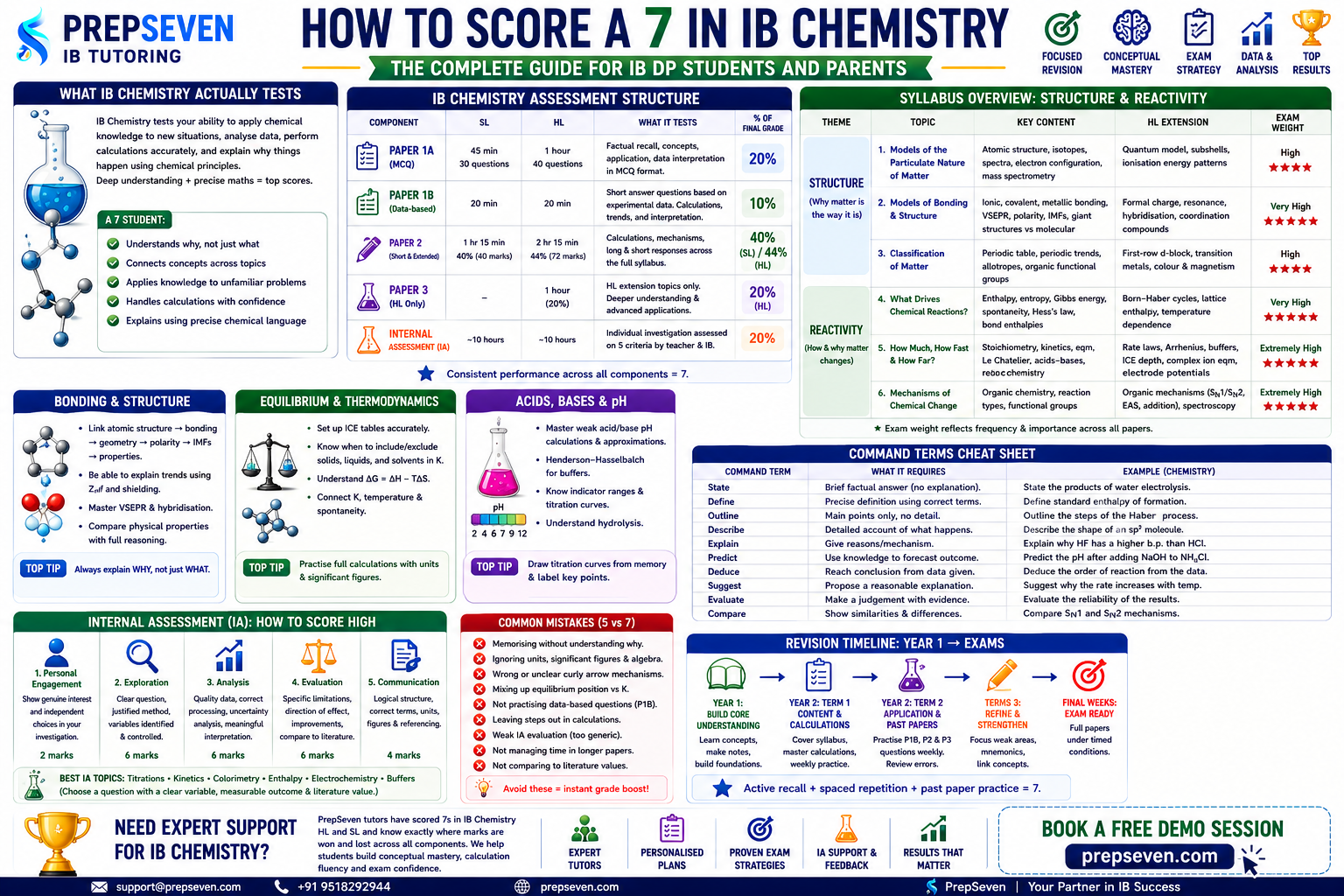
What IB Chemistry Actually Tests
IB Chemistry is the science that most consistently punishes surface-level understanding. A student who has memorised definitions, learned the formula for equilibrium constants, and practised titration calculations will hit a ceiling at around grade 5 or 6 and find it genuinely difficult to understand why they are not getting higher. The reason is that IB Chemistry, particularly at HL, is built around conceptual connections that cut across topic areas, and the questions that separate 6s from 7s almost always require applying a principle from one context to a problem in another.
The course covers five broad areas across the new 2023 first-assessment syllabus: Structure (atomic theory, periodicity, bonding, intermolecular forces), Reactivity (kinetics, thermodynamics, equilibrium, acids and bases, redox, organic chemistry), and the HL-only extension content that deepens each of these. The new syllabus is organised around conceptual understanding rather than isolated topic coverage, which means the examinations reward students who understand how atomic structure explains periodic trends, how bonding explains physical properties, and how thermodynamics and kinetics together determine whether and how fast a reaction proceeds.
Chemistry also has a significant mathematical component that surprises students who approach it primarily as a descriptive science. Equilibrium calculations, enthalpy and entropy calculations, electrochemical cell potential calculations, pH and buffer calculations, yield and atom economy calculations, and stoichiometry throughout all require mathematical fluency. Students who are strong on conceptual understanding but careless with units, significant figures, and algebraic manipulation lose marks consistently across every paper.
The single clearest predictor of whether a student will reach a 7 in IB Chemistry is whether they understand why a reaction or process happens, not just what happens. A student who knows that increasing temperature increases reaction rate, but who can also explain this in terms of the Maxwell-Boltzmann distribution and activation energy, and who can then apply that explanation to a novel graph they have never seen before, is equipped for the questions that determine whether a 6 becomes a 7. Build explanatory understanding from the start, not as an add-on to memorisation.
The Assessment Structure: What Each Paper Demands
The new syllabus introduced Paper 1B as a separate data-based component, which sits alongside the MCQ paper. Paper 1B presents a set of data, often from a real or fictionalised experiment, and asks several short answer questions that require calculations, trend identification, and experimental interpretation. This format rewards students who are comfortable working with unfamiliar data under timed conditions, which is a skill that only improves with deliberate practice on past paper materials.
Paper 2 is the highest-weight external component and the one where preparation strategy has the most impact. At HL it is 2 hours and 15 minutes covering the entire syllabus. The questions range from one-mark recall or calculation items to six or seven mark extended responses requiring sustained chemical argument. The mark distribution within Paper 2 means that students who leave any section completely unattempted, even the sections they find hardest, are giving up marks that partial responses would have earned.
Paper 3 at HL covers the extension content that deepens each topic area beyond the SL syllabus. The HL extension is not a separate bolt-on: it develops the same chemical principles to greater depth and mathematical rigour. Students who understand the SL content well and have engaged seriously with how the HL extension builds on it are better positioned for Paper 3 than those who treat HL extension as separate material to be memorised independently.
Paper 1B is where unprepared students leave the most marks on the table relative to their actual knowledge. The data provided in Paper 1B is always approachable: it does not require specialist knowledge to interpret, and the questions are designed to be answered using chemical principles the student knows. The skill being tested is scientific reasoning with unfamiliar data, not recall of additional content. Students who practise interpreting experimental data from past papers regularly will find Paper 1B significantly more manageable than those who focus all preparation on content review.
The Syllabus: Structure and Reactivity
The 2023 IB Chemistry syllabus is organised into two overarching themes: Structure and Reactivity. This organisation reflects the genuine intellectual architecture of chemistry: understanding what matter is made of and how it is bonded, and understanding how and why matter changes. Every topic in the course sits within one of these themes, and the most demanding examination questions require connecting ideas across both.
Topic Deep Dives: Where the Marks Come From
Bonding and Structure: The Most Connected Topic
Bonding and structure is the topic that connects to everything else in IB Chemistry. Understanding how atomic structure determines bonding type, how bonding determines molecular geometry, how geometry determines polarity, and how polarity determines intermolecular forces, and how intermolecular forces determine physical properties, is not just one topic among many. It is the conceptual spine of the course. Every question about melting points, solubility, conductivity, and volatility requires this chain of reasoning.
The most commonly tested bonding skill is applying VSEPR theory correctly to determine molecular geometry and polarity. Students who memorise the geometries associated with different electron domain counts will handle straightforward questions but struggle with anything requiring them to reason about a molecule they have not seen before. The student who understands why a trigonal planar molecule is non-polar if all three substituents are identical, and what changes if one substituent is replaced with a lone pair, can answer any VSEPR question regardless of the specific molecule.
At HL, formal charge, resonance, and hybridisation extend the bonding framework. Formal charge calculations and the use of formal charge to determine which resonance structure is most stable are regularly examined. Hybridisation, the connection between sp3 hybridisation and tetrahedral geometry, sp2 and trigonal planar, sp and linear, needs to be understood mechanistically not just matched to geometries. Coordination chemistry at HL introduces ligand types, coordination numbers, and the basis of colour in transition metal complexes, all of which require connecting back to electron configuration and bonding theory.
The fastest route to better marks in the bonding and structure section of Paper 2 is to practise explaining physical property differences between substances by working through the full chain: what is the bonding type, what is the structure, what intermolecular forces are present, and what does this imply for the property in question? A student who practises this chain of reasoning on ten different examples can apply it to any example that appears in an exam, because the logic is the same regardless of the specific substances involved.
Equilibrium and Thermodynamics: Calculation and Concept Together
Equilibrium and thermodynamics together account for a substantial proportion of the marks available in Papers 2 and 3, and they are the area where students most consistently lose marks through a combination of conceptual confusion and calculation error. The two topics are deeply connected: Gibbs free energy is the thermodynamic quantity that determines whether a system at equilibrium will shift, and the relationship between Gibbs free energy and the equilibrium constant connects thermodynamics directly to equilibrium chemistry.
Equilibrium calculations require precision with the ICE table method, understanding what K expressions look like for different types of equilibria including heterogeneous equilibria where pure solids and liquids are excluded, and being able to work backwards from an equilibrium constant to predict the position of equilibrium qualitatively. The common error is setting up the ICE table correctly but making an algebraic error in the calculation, or correctly calculating K but incorrectly applying Le Chatelier’s principle to a subsequent change in conditions.
Thermodynamics at HL introduces the Born-Haber cycle, which requires correctly applying the enthalpy changes involved in forming an ionic compound from its elements, including ionisation energies, electron affinities, lattice enthalpy, atomisation enthalpy, and dissociation enthalpy. The Born-Haber cycle is a reliable calculation question in HL Paper 3 and is entirely formulaic once the cycle is understood: the challenge is correctly assigning signs and including all terms. Students who practise three or four complete Born-Haber cycle calculations are prepared for any version of this question.
Gibbs free energy requires understanding not just the formula delta G equals delta H minus T times delta S, but what each combination of signs means for spontaneity and how the temperature dependence of spontaneity arises from the T times delta S term. Questions that ask under what temperature conditions a reaction becomes spontaneous are testing this understanding specifically, and they require algebraic manipulation of the Gibbs equation rather than just applying it to given values.
Acids, Bases, and pH: The Calculation-Heavy Section
Acid-base chemistry is one of the most calculation-intensive sections of IB Chemistry and one where small conceptual misunderstandings produce systematic errors across every type of question. The foundation is the relationship between pH, pOH, Ka, Kb, and Kw, and the ability to move fluently between these quantities in both strong and weak acid and base systems.
Weak acid and weak base pH calculations require the approximation method, where the equilibrium concentration of the acid is treated as unchanged because dissociation is small, and students need to know both when this approximation is valid and what to do when it is not. Buffer calculations using the Henderson-Hasselbalch equation appear regularly at HL, and the common error is applying the equation without understanding what it means: the pH of a buffer is determined by the ratio of conjugate base to weak acid, not their absolute concentrations.
Titration curves at HL require understanding the pH at each significant point: the initial pH of the acid or base, the pH at the half-equivalence point which equals the pKa for a weak acid titration, the pH at the equivalence point which depends on whether the salt formed is neutral or undergoes hydrolysis, and the pH in the excess region. Students who understand why each of these points has the pH it does, rather than just knowing the shape of the curve, can handle any titration curve question including those involving unusual acid-base pairs.
Indicator selection is a specific HL skill that examiners test regularly and students frequently get wrong. The principle is that an indicator changes colour over a range of approximately two pH units centred on its pKin value, and a valid indicator for a titration is one whose colour change range falls entirely within the near-vertical portion of the titration curve at the equivalence point. A student who can draw a titration curve, identify the near-vertical region, and use this to assess whether a given indicator is appropriate demonstrates exactly the connected understanding this topic rewards.
Organic Chemistry and Mechanisms: The Topic That Rewards Depth
Organic chemistry in IB Chemistry is built around functional groups, reaction types, and mechanisms, and it is the section of the course that most clearly rewards students who understand the underlying electron movement rather than those who have memorised reaction conditions. At SL, students need to know the major functional groups and their interconversions. At HL, mechanisms become central: nucleophilic substitution, electrophilic addition, and electrophilic aromatic substitution each require understanding why the reaction proceeds, which determines what products form and in what ratio.
The SN1 and SN2 mechanisms are contrasted in terms of substrate structure, nucleophile strength, solvent, and stereochemical outcome. A student who has memorised that SN2 reactions occur with tertiary substrates via a carbocation intermediate has confused SN1 and SN2. The systematic approach is to understand the mechanism of each pathway and then derive which substrates and conditions favour each, rather than memorising a table of conditions.
Electrophilic addition to alkenes requires understanding why the pi bond acts as a nucleophile, how the electrophile generates a carbocation intermediate, and how Markovnikov’s rule arises from the relative stability of primary, secondary, and tertiary carbocations. Electrophilic aromatic substitution requires understanding why the benzene ring acts as a nucleophile despite being aromatic, how the intermediate arenium ion differs from a regular carbocation, and why the ring is restored rather than adding a substituent permanently.
Organic synthesis questions in Paper 2 and Paper 3 require chaining multiple reactions together to convert a starting material to a target product. Students who know individual reactions but cannot sequence them logically struggle with these multi-step problems. The approach is to work backwards from the target product: identify the functional group it contains, identify which reaction produces that functional group, and identify what starting material that reaction requires, then repeat until you reach the given starting material.
Kinetics: Connecting Rate, Mechanism, and Energy
Kinetics at HL extends significantly beyond the SL treatment of factors affecting rate. The HL extension introduces rate laws and reaction order determination from experimental data, integrated rate equations and their use in determining half-life and order, and the Arrhenius equation connecting rate constant to temperature and activation energy. These are all mathematical treatments that require both algebraic fluency and conceptual understanding.
Rate law determination from experimental data is a predictable and reliable question type in HL Paper 2 and Paper 3. The approach is systematic: compare two experiments where one concentration changes and the other is constant, determine how the rate changed, and use the power relationship to determine the order with respect to that reactant. The most common error is incorrectly determining order when the rate change is not a simple integer multiple of the concentration change, which requires using logarithms. Students who understand the mathematical basis of the rate law can handle these cases correctly.
The Arrhenius equation in its logarithmic form allows the activation energy to be determined from a graph of ln(k) versus 1/T. This is examined regularly and requires knowing that the gradient of the graph equals minus Ea divided by R, and being able to calculate Ea in kJ per mole correctly with appropriate significant figures and units. The conceptual connection to the Maxwell-Boltzmann distribution, understanding why increasing temperature increases the fraction of molecules with energy exceeding the activation energy, and why the relationship is exponential rather than linear, is tested in explanation questions alongside the calculation.
Paper-by-Paper Strategy
Paper 1A: Multiple Choice
Paper 1A in IB Chemistry is the MCQ component and the one where content depth rather than exam technique determines performance. Chemistry MCQ questions are often conceptual rather than purely factual: they present a scenario or data and ask which option is chemically correct. The four options are typically designed so that three of them are plausible to a student with surface understanding and only one is correct for a student who understands the underlying chemistry.
Paper 1B: Data-Based Questions
Paper 1B presents experimental data, often a graph, table, or set of measurements from a described investigation, and asks several short answer questions. The questions are worth one or two marks each and require reading data accurately, performing calculations using the data, and offering chemical interpretations of results or limitations.
The most important discipline in Paper 1B is reading what is asked. A question asking you to state a trend wants a brief statement of the trend in the data, not an explanation of why the trend occurs unless the question specifically says suggest a reason. A question asking you to calculate a value wants a numerical answer with units, not a description of how to calculate it. Misreading the question type is the most preventable source of lost marks in Paper 1B.
Uncertainty and error analysis questions appear in Paper 1B regularly. Students need to know how to calculate absolute and percentage uncertainty for a single measurement, how uncertainties combine when values are added, subtracted, multiplied, or divided, and how to identify the dominant source of uncertainty in a multi-step calculation. These are specific skills that require practice on past Paper 1B questions and cannot be improvised under exam conditions.
Paper 2: Extended Response and Calculations
Paper 2 is the most demanding component and the one where preparation quality shows most clearly. At HL it is 2 hours and 15 minutes with questions ranging from one-mark items to six or seven mark extended responses. The key discipline is time allocation: students who spend too long on early questions and rush the later ones, or who abandon difficult calculations entirely rather than attempting partial credit, consistently underperform relative to their knowledge.
Organic mechanism questions in Paper 2 at HL require drawing curly arrow mechanisms correctly. The conventions are non-negotiable: arrows must originate from a bond or lone pair and point to where the electrons move, double-headed arrows represent two-electron movements, and all relevant intermediates must be shown with their charges. A mechanism that is conceptually correct but uses incorrect arrow conventions loses marks. Practise drawing mechanisms on paper rather than just recognising correct ones.
Extended response questions in Paper 2 reward structured answers that address each sub-point systematically. A six-mark question about how changing temperature affects the position of equilibrium and the value of K is asking for three distinct chemical ideas: the effect on the forward and reverse rates, the direction of equilibrium shift predicted by Le Chatelier’s principle, and the effect on K with an explanation of why K changes with temperature but not with concentration or pressure. Students who address all three earn all six marks. Students who write a paragraph about Le Chatelier’s principle without distinguishing between the effect on equilibrium position and the effect on K earn partial credit at best.
The single most consistent mark-saving strategy for Paper 2 is to never leave a calculation blank. Chemistry calculations involve multiple steps, and IB markschemes award method marks for setting up the calculation correctly even when the final answer is wrong. A student who writes the correct expression for the equilibrium constant and substitutes the given values, but makes an arithmetic error in evaluating it, earns most of the available marks. A student who writes nothing earns zero. Attempt every calculation in full, and show every step clearly.
Paper 3 (HL): The Extension Content Paper
Paper 3 at HL is one hour covering the HL extension content. It is weighted at 20% of the final grade and is the component that most clearly differentiates students who have engaged seriously with the HL extension from those who have treated it as supplementary. The extension content is not harder for its own sake: it develops the same chemical principles to greater mathematical and conceptual depth, and the questions reward genuine understanding of why the HL material builds on the SL foundation.
Reliable question types in Paper 3 include Born-Haber cycle calculations, Arrhenius equation and activation energy calculations, rate law determination including cases requiring logarithms, buffer and titration curve analysis, electrode potential calculations for non-standard conditions, and organic mechanism questions at greater depth than Paper 2. Students who have practised each of these question types systematically before the exam will find Paper 3 more predictable than it appears on first encounter.
The extension content questions that most frequently surprise students are those requiring them to explain the HL chemistry in terms of the SL foundations. A question asking why the lattice enthalpy of MgO is much larger than that of NaF requires connecting ionic charge and ionic radius to the magnitude of electrostatic attraction in the lattice, which requires applying the principles of ionic bonding from SL to a new quantitative context. This type of question cannot be answered by memorising HL content in isolation from the SL foundation it builds on.
The Internal Assessment: What a Strong Chemistry Investigation Looks Like
The IB Chemistry IA is an individual investigation worth 20% of the final grade, assessed on the same five criteria as all Group 4 sciences: Personal Engagement, Exploration, Analysis, Evaluation, and Communication. A strong chemistry IA has a specific, measurable research question, a methodology that generates quantitative data amenable to statistical treatment, a genuine connection to syllabus content, and an evaluation that engages critically with the specific limitations of the chosen method.
The comparison to a literature value is one of the most consistently underused tools in chemistry IAs, and it is one of the clearest routes to marks in both Analysis and Evaluation. If your investigation determines a rate constant, an equilibrium constant, an enthalpy change, or a solubility, there is almost certainly a published value for that quantity or a closely related one. Comparing your experimental value to the literature value, calculating the percentage error, and discussing whether the discrepancy is within the range that your identified uncertainties could explain, demonstrates exactly the critical evaluation the criterion rewards.
Chemistry IAs that involve titrations, colorimetry, or rate of reaction measurements generate inherently quantitative data and lend themselves to proper uncertainty analysis. The student who calculates the absolute uncertainty on their titre volume from the precision of the burette, propagates this through to an uncertainty on the molar concentration, and reports their final result as a value plus or minus a calculated uncertainty, demonstrates significantly more analytical rigour than the student who reports a number without any uncertainty consideration. This difference earns marks in Analysis and is discussed in Evaluation.
Revision Strategy: Building Chemistry Understanding That Holds Under Pressure
Chemistry revision is most effective when it alternates between building understanding and testing retrieval, with regular application to past paper questions throughout rather than only at the end. The students who enter the exam room with genuine confidence in IB Chemistry are those who have revisited the same conceptual connections multiple times across two years, not those who have covered the content once and then practised past papers intensively for four weeks.
Command Terms in IB Chemistry
IB Chemistry exam questions use specific command terms that define the type and depth of response required. These terms are consistent across all DP subjects, but their application in chemistry has specific implications that students need to understand.
The Mistakes That Separate a 5 from a 7
Getting from a 6 to a 7: The Final Adjustments
Students who are consistently scoring in the high 6 band are almost always losing marks in one or two patterns rather than across the board. Identifying these patterns specifically is more valuable than general continued revision.
The most common pattern is losing marks on explanation questions by describing rather than explaining. A student who answers an explain question about why a reaction is exothermic by stating that energy is released to the surroundings has described what happens. A student who explains that the bonds formed in the products have lower potential energy than the bonds broken in the reactants, so the excess energy is released as heat, has explained why it happens. The distinction is consistently drawn in IB Chemistry markschemes and consistently blurred in student answers.
The second pattern is arithmetic errors in calculations that cost the final answer mark while method marks are preserved. This sounds like a minor issue but it compounds across a paper and represents a consistent gap between a student’s chemical understanding and their examination performance. Developing a systematic habit of checking every arithmetic step, carrying through units explicitly at each step, and reviewing the reasonableness of each numerical answer before moving on is the most direct remedy.
The third pattern is weak IA performance, specifically on Evaluation. Students who have not engaged critically with their methodology and who have written generic limitations will have lost marks in this criterion regardless of how strong their experimental work was. The specific improvement available here is to revisit the evaluation, identify two or three specific methodological weaknesses with their precise effects on the results, and ensure each improvement proposed directly addresses the identified limitation rather than being a general gesture toward better practice.
The 7 boundary in IB Chemistry typically sits around 80 to 85 percent of the available marks, depending on the session. That means a student targeting a 7 can afford to lose 15 to 20 percent of marks across the course. Identifying where those marks are most efficiently recovered, whether in Paper 1B data interpretation, organic mechanisms in Paper 2, HL extension calculation questions in Paper 3, or the IA Evaluation criterion, and addressing them systematically in the months before the exam, is a more reliable strategy than attempting to eliminate all errors everywhere simultaneously.
Need expert support for IB Chemistry?
PrepSeven tutors have scored 7s in IB Chemistry HL and SL and know exactly where marks are available across all components. We help students build the conceptual connections and calculation fluency that the exam rewards.
Book a Free Demo Session at prepseven.com