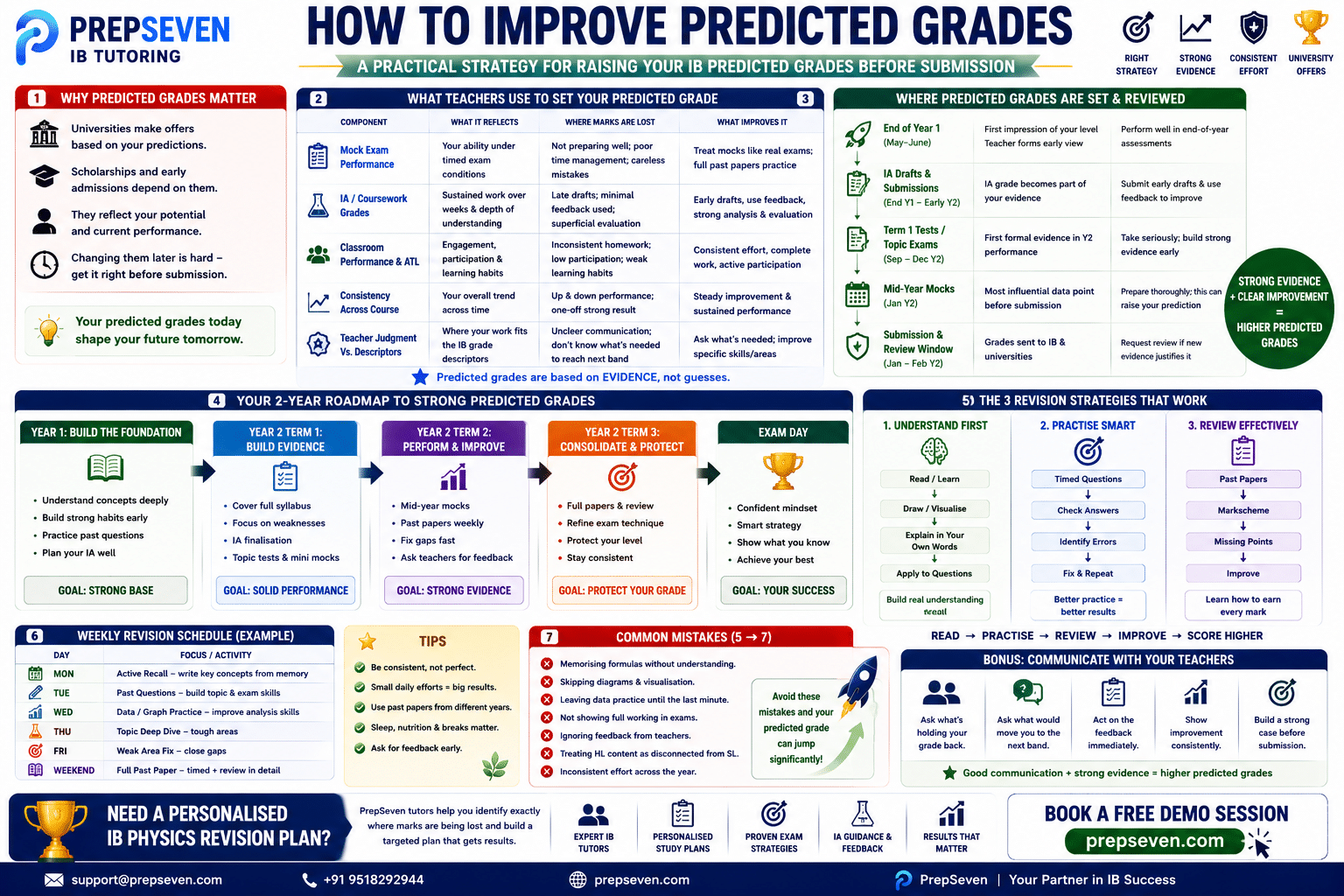
A Practical Strategy for Raising Your IB Predicted Grades Before Submission
Why Predicted Grades Matter More Than Most Students Realise
Predicted grades are the score your teachers submit to the IB and to universities before you sit a single final exam, and for most students applying to university they matter more than the final result ever will. UK universities make conditional offers on the back of predicted grades months before May exams happen. US universities weigh them heavily in early decision and regular admission rounds. Many scholarship committees use them as a first filter. By the time your actual grades arrive in July, most of the doors that predicted grades opened or closed have already swung.
A predicted grade is not a guess and it is not arbitrary. IB Coordinators and subject teachers are required to base it on evidence: mock exam performance, Internal Assessment and coursework grades, classroom assessments, and a professional judgment of where you sit against the IB’s published grade descriptors for that subject. This means a predicted grade can be improved, but only by generating the kind of evidence a teacher can point to when they sit down to make the call. Hoping a teacher will simply round up because you seem capable does not work. Building a visible, evidenced trend across the course does.
This guide sets out a practical strategy for improving predicted grades across the two years of the Diploma Programme, built around the three things teachers actually use to set them: the evidence you generate, the way you communicate about your own progress, and the trajectory your performance shows over time. Students who treat predicted grades as something earned through a deliberate two-year strategy, rather than something decided in a single meeting in December of Year 2, are consistently the ones whose predictions match or exceed their final results.
The most common misunderstanding about predicted grades is treating them as fixed once submitted. In most schools, predicted grades are reviewed and can be revised at several points before the final submission deadline, and in some cases after, if a student’s performance changes meaningfully. A strategy aimed at improving predicted grades has to target every checkpoint where that evidence gets reviewed, not just the final mock exam before the deadline.
What Actually Feeds Into a Predicted Grade: A Component Breakdown
Teachers are not assessing one thing when they set a predicted grade. They are weighing several different sources of evidence, and most students only pay close attention to one or two of them. Understanding the full picture changes where you spend your effort.
Component
What It Reflects
Where Students Lose Ground
What Improves It
Mock Exam Performance
Performance under timed, exam-style conditions, usually the single heaviest-weighted piece of evidence a teacher has
Treating mocks as low-stakes and under-preparing; running out of time due to weak exam technique rather than weak content knowledge
Preparing for mocks with the same seriousness as final exams, including full past papers under timed conditions in the weeks beforehand
Internal Assessment and Coursework Grades
Sustained, evidenced performance on work completed over weeks rather than under exam pressure
Submitting IA drafts late or with minimal feedback incorporated; treating coursework as a box to tick rather than a grade-relevant piece of evidence
Engaging seriously with every round of IA feedback, submitting drafts early enough to act on comments, and treating the final IA grade as part of your overall case
Classroom Performance and Approaches to Learning
Day-to-day engagement: homework completion, participation, formative quiz results, and the ATL skills, self-management, communication, thinking, that IB explicitly tracks
Inconsistent homework completion; disengagement in class that a teacher remembers even if it is not formally graded
Consistent, visible effort in every lesson, since teachers form an impression of reliability that directly affects how generously they round a borderline grade
Consistency Across the Course
Whether your performance has been stable, improving, or declining across both years, not just your most recent result
A single strong test result does not outweigh a pattern of inconsistency; teachers are cautious about predicting a grade a student has only achieved once
Building a track record where your strongest results are not outliers but part of a recognisable upward trend documented across multiple assessments
Teacher’s Professional Judgment Against Grade Descriptors
The teacher’s holistic read of where your work sits against the IB’s published descriptors for that grade, combined with their experience of past cohorts
Students rarely ask what specifically separates their current work from the next grade band, leaving the teacher’s judgment uninformed by a direct conversation
Asking directly and specifically what is needed to move from your current grade to the next one, and acting visibly on that feedback
Where Predicted Grades Are Set and Revised: Priority Checkpoints
Predicted grades are not decided once. Most schools review them at several points across the two years, and each checkpoint is an opportunity to shift the evidence in your favour before the number that goes to universities is locked in. A strategy that only activates in the final term before submission has already missed most of the chances to influence the outcome.
Checkpoint
Typical Timing
Why It Matters
What to Do
End-of-Year 1 Assessments
May to June, Year 1
Often the first point a teacher forms a working view of your likely final grade, even if no formal prediction is recorded yet
Treat end-of-year assessments as seriously as a real exam. The impression formed here shapes how a teacher interprets everything you do in Year 2
First IA Drafts and Submissions
Late Year 1 through early Year 2
IA grades become part of the documented evidence base, and early drafts shape how much room you have to improve them before the deadline
Submit drafts as early as your school allows and treat every round of feedback as a direct instruction for what to change, not a suggestion
Year 2 Term 1 Trial Exams or Topic Tests
September to December, Year 2
The first formal assessment period in the year predicted grades are actually decided, often weighted heavily because it is recent and exam-style
Prepare for these as if they were the mock exams that set your prediction, because in many schools they functionally are
Mid-Year Mock Examinations
January, Year 2, in most schools, often timed to precede UCAS predicted grade deadlines
This is frequently the single most influential data point a teacher has when the predicted grade is formally submitted
Prioritise mock preparation above almost everything else in the weeks before this sitting. A strong mock result is the most direct lever you control
Predicted Grade Submission and Review Window
Typically January to February for UK university applications, with some schools allowing a revision request afterward
Once submitted, grades are harder to change, though most coordinators will reconsider if new evidence strongly justifies it
If your mock result undersells your actual ability, ask your teacher directly and specifically whether a revision is possible and what evidence would support it
The mid-year mock examination period carries disproportionate weight because it is usually the most recent, most exam-realistic evidence a teacher has at the exact moment predicted grades are finalised. A student who has performed inconsistently across the year but delivers a strong mid-year mock will often see that result outweigh earlier inconsistency, because it is the clearest available evidence of where they stand right now.
The Two-Year Strategy to Raise Predicted Grades
Year 1: Building Teacher Confidence Through Consistency
Year 1 is not too early to start influencing predicted grades, because the impression a teacher forms in Year 1 colours how they interpret your performance for the rest of the course. A student who is seen as inconsistent in Year 1 has to work harder to convince a teacher that a strong Year 2 result reflects genuine improvement rather than a lucky outlier.
Year 1 Phase
Timing
Focus
Actions
Early consistency building
Term 1, Year 1
Establishing a reliable pattern of homework completion and class engagement before any formal grades are recorded
Treat the first term as the foundation of your reputation with each teacher. Submit every piece of work on time and engage visibly in class
First formal assessments
Term 2, Year 1
The first graded evidence a teacher has to form a working view of your trajectory
Prepare properly for every test, not just the ones that feel high-stakes. Each one becomes part of your documented record
IA topic selection and early planning
Term 2 to 3, Year 1
Setting up coursework that will become part of your predicted grade evidence in Year 2
Choose IA topics you can engage with genuinely rather than ones that look impressive on paper, since genuine engagement produces stronger, more defensible work
End-of-year assessments
Term 3, Year 1
The clearest single data point available before Year 2 begins, often informally referenced when predictions are eventually set
Revise for end-of-year exams with the same discipline you would apply to a real exam. A strong finish to Year 1 sets the tone for Year 2
Year 2 Term 1: Mock Exam Performance and Evidence Building
Year 2 Term 1, roughly August to December, is where the bulk of the documented evidence that determines your predicted grade gets generated. Trial exams, topic tests, and the final stages of IA work all happen in this window, and treating it as a warm-up rather than the period that actually decides your prediction is the single most common reason students are disappointed by the number they receive.
Week Range
Focus
Evidence-Building Actions
Weekly Commitment
Weeks 1 to 4
Re-establishing strong habits after the summer break across every subject
Complete every piece of homework and formative assessment with full effort, since early-term performance sets a teacher’s baseline expectation for the rest of the term
Consistent daily effort across all subjects, not concentrated in favourites
Weeks 5 to 8
First major topic tests and IA finalisation
Treat topic tests as mock-equivalent evidence; finalise IA drafts and incorporate every piece of teacher feedback before final submission
3 to 4 hours weekly per subject on test preparation, plus dedicated IA finalisation time
Weeks 9 to 12
Building toward the mid-year mock examination period
Begin past paper practice under timed conditions for every subject; identify and close the specific gaps mocks are likely to expose
5 to 6 hours weekly per subject, increasing toward the mock period
Final weeks before mocks
Mock examination preparation
Treat mock preparation exactly as you would final exam preparation, since this is frequently the decisive evidence for your predicted grade
Maximum weekly commitment of the term, with full past papers completed under realistic timed conditions
Year 2 Term 2: The Final Push Before Predicted Grades Are Submitted
Month
Focus
Weekly Actions
Specific Targets
January
Mock examinations and immediate follow-up
Sit mocks seriously in every subject; immediately after results, request a specific conversation with each teacher about what your result suggests for your predicted grade
By end of January: a clear understanding from each teacher of your likely predicted grade and exactly what would change it before submission
February
Targeted improvement and revision requests where justified
If a mock result undersells genuine ability, generate additional evidence quickly, an extra assessment, a strong piece of classwork, and request a specific review conversation
By mid-February: predicted grades submitted reflect the strongest accurate evidence available, with any justified revisions actioned before the deadline
Late February to March
Maintaining the case after submission
Continue performing consistently, since some schools and universities review predicted grades again later in the year if performance shifts significantly
Sustained performance that protects and, where possible, strengthens your case for any later review point
Year 2 Term 3: Protecting the Prediction Through to Final Exams
Once predicted grades are submitted, it is tempting to ease off, particularly once a conditional university offer has arrived. This is a genuine risk. Universities can and do revisit offers when final results fall well short of predictions, and a noticeable drop in effort after submission is exactly the pattern that produces that gap. The final term is about protecting the prediction you have earned, not coasting on it.
Weeks Before Final Exams
Focus
Actions
8 to 10 weeks before
Sustaining the standard that earned the prediction
Continue full engagement in every subject. A predicted grade is not a guarantee, and final results that fall noticeably short can affect confirmed university places
4 to 6 weeks before
Systematic exam preparation across all subjects
Shift from general revision to full past paper practice under timed conditions, closing the specific gaps each mock and topic test has revealed
Final two weeks
Consolidation and confidence
Review summary notes on your strongest and weakest topics, complete a final timed paper in each subject, and prioritise rest. The goal is to finish at or above the level your predicted grade already reflects
The Three Levers Students Actually Control
Lever One: Evidence
Predicted grades are built from evidence, which means the single most direct way to improve one is to generate stronger evidence at the moments a teacher is actually looking. This is not about appearing capable in general. It is about performing well specifically on the graded mocks, tests, and coursework that get referenced when the prediction is set. A student who is genuinely strong but underperforms on every graded assessment will be predicted lower than their ability suggests, simply because the evidence does not show it.
Practically, this means treating every mock, topic test, and IA milestone as a real opportunity rather than a formality. Prepare for topic tests the way you would prepare for a final exam. Submit IA drafts on time so there is room to act on feedback. The goal is not to perform well once, but to make sure the documented record across the course actually reflects your ability.
Lever Two: Communication
Most students never ask their teacher the single most useful question available to them: what specifically would move my grade up a band? Teachers are assessing against detailed grade descriptors, and a vague sense that you are doing fine is far less useful than a direct answer about which skill or content area is holding you back. Asking this question, and then visibly acting on the answer, does two things. It generates the targeted improvement that actually changes the evidence, and it signals to the teacher that you are engaged and coachable, which shapes how generously a borderline grade gets rounded.
This conversation works best when it is specific and timed well. Asking immediately after a graded mock or test, while the marked work is fresh and the teacher has just formed a clear view of your performance, produces a far more useful answer than a generic end-of-term check-in.
Lever Three: Trajectory
Teachers are cautious about predicting a grade a student has only achieved once. A single excellent result after a term of inconsistency reads as an outlier, not a new baseline. What moves a predicted grade most reliably is a visible upward trend across multiple pieces of evidence, several tests, an improving IA draft, consistent classroom performance, that together tell a coherent story of genuine improvement rather than a one-off.
If you are aiming to move a borderline prediction up a grade, the most persuasive thing you can show a teacher is not your single best piece of work. It is two or three consecutive pieces of evidence that are all consistent with the higher grade. A trend a teacher can point to with confidence is far more powerful than a peak they have to explain away.
Weekly Habits That Build Predicted Grade Evidence
Day
Year 1 Habit
Year 2 Term 1 Habit
Year 2 Term 2-3 Habit
Monday
Complete all homework on time and review any feedback from the previous week
Begin the week with a clear plan of which subject’s mock or test preparation takes priority
Review the previous week’s past paper results and identify the highest-priority gap to close
Tuesday
Engage actively in class, asking at least one clarifying question per subject where relevant
Dedicated past paper or topic test preparation for the subject with the nearest assessment
Timed extended-response or essay practice in a subject identified as a weak area
Wednesday
Check in briefly with a teacher about how a recent piece of work was received
IA progress check: ensure drafts are on schedule and feedback is being incorporated
Full timed paper practice in rotation across subjects
Thursday
Spaced review of content from two to three weeks earlier
Targeted revision of the topic most recently assessed, closing gaps revealed by the result
Direct conversation with a teacher about current standing and what would move the grade further
Friday
Reflect on the week: which subjects need more consistent effort going into the weekend
Weekly self-assessment against the grade descriptor for each subject’s current target grade
Light review and consolidation, avoiding new content this close to key assessments
Weekend
Catch up on any incomplete work; rest
One subject’s worth of focused mock preparation under realistic timed conditions
One full past paper under exam conditions, with markscheme review the following day
Common Mistakes Students Make When Trying to Improve Predicted Grades
Mistake
Why It Fails
What to Do Instead
Assuming the predicted grade is fixed once it appears on a report
Most schools review and revise predictions at several points, and assuming otherwise means missing genuine opportunities to influence the final number
Ask your coordinator or teacher directly when predicted grades are reviewed and whether a revision request is possible if your evidence improves
Focusing only on final exams and ignoring IA and coursework grades
IA and coursework grades are part of the documented evidence a teacher uses, and underperforming there weakens the overall case even with strong exam-style results elsewhere
Treat IA milestones and coursework deadlines with the same seriousness as a graded test, since they form part of the same evidence base
Never asking teachers what would move the grade up a band
Without a specific answer, effort gets spread evenly across everything rather than concentrated on the one or two factors actually holding the grade back
Ask directly and specifically after a graded assessment, and request a concrete example of what higher-band work looks like in that subject
Cramming only for the mock exam period and disengaging the rest of the time
A single strong mock after months of inconsistency reads as an outlier rather than a reliable baseline, and teachers are cautious about predicting based on outliers
Build consistent effort across the full term so the mock result confirms an existing trend rather than standing alone as the only strong data point
Disengaging after a predicted grade or university offer arrives
A noticeable drop in performance after submission can lead to final results that fall short of the prediction, which universities do scrutinise when confirming places
Maintain the standard of work that earned the prediction through to final exams, treating the prediction as a target to protect, not a result already banked
Not requesting a review when a mock result clearly underrepresents ability
Teachers cannot revise a prediction based on evidence they have not been shown, and staying silent after an unrepresentative result leaves an inaccurate grade unchallenged
If a result is genuinely unrepresentative, due to illness, an unusually difficult paper, or a specific identifiable issue, raise it directly and provide whatever additional evidence is available
Want help building a stronger predicted grade case?
PrepSeven tutors work with students to identify exactly which subjects and which pieces of evidence are holding a predicted grade back, and build a targeted plan to close that gap before submission deadlines.