Best IB Biology IA Ideas
A Complete Guide for IB DP Students
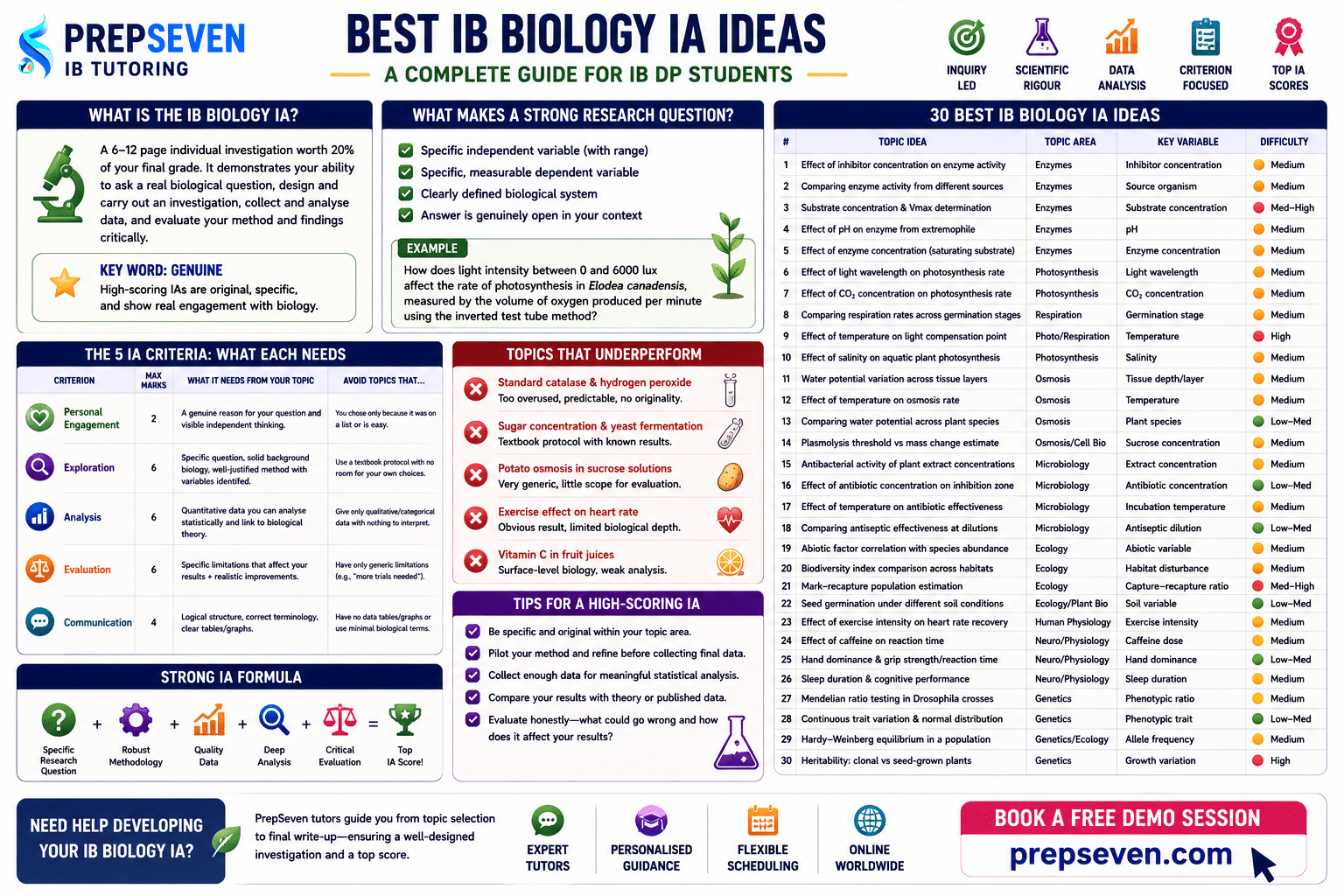
What the IB Biology IA Is Actually Asking You to Do
The IB Biology Internal Assessment is a 6 to 12 page individual investigation worth 20% of your final grade. The IB describes it as an opportunity to demonstrate scientific understanding, personal engagement, and the ability to design and carry out a genuine investigation. That description contains the most important word in the whole IA process: genuine.
The investigations that score highest are those where the student has identified a real biological question, designed an experiment specifically to answer it, and engaged critically with what the results mean and where the methodology fell short. The investigations that consistently underperform are those where the student has followed a standard protocol from a textbook, produced a result they already knew, and written up conclusions that describe what happened without engaging with why or what the limitations imply.
This matters for topic selection because some topic areas naturally generate genuine investigations while others tend to produce formulaic ones. An enzyme kinetics investigation that uses the standard catalase and hydrogen peroxide protocol can be strong or weak depending entirely on whether the student has found a genuinely interesting angle within that framework or is simply replicating a well-known result. The difference is not the topic area but the specificity and originality of the research question.
The IB Biology IA is assessed by your teacher and then moderated by an IB examiner who reads a sample of work from your school. That examiner reads dozens of investigations on similar topics every moderation cycle. The investigations that stand out are those where the research question is specific and personal, the methodology shows genuine thought about what could go wrong and how to control for it, and the evaluation engages honestly with what the results can and cannot support. These qualities are independent of topic area. A well-executed investigation on a simple topic outperforms a poorly executed investigation on an impressive-sounding one every time.
The Five Criteria and What Each One Needs from Your Topic Choice
Before choosing a topic, it helps to work backwards from the five assessment criteria and ask whether the topic you are considering gives you what each criterion needs. Some topics are naturally strong on one or two criteria but structurally weak on others, and recognising this before you commit saves you from an investigation that does well on Communication but falls apart on Evaluation.
Criterion | Max Marks | What It Needs from Your Topic | Red Flag for Topic Selection |
|---|
Personal Engagement | 2 | A genuine personal reason for choosing the question, or independent thinking visible in the design or interpretation that distinguishes your investigation from a standard protocol | If you chose the topic because it appeared on a list of recommended IA topics and you have no genuine connection to the biology, this criterion will be weak regardless of how well you write the introduction |
Exploration | 6 | A specific, focused research question; sufficient biological background to justify the design; a clearly justified experimental method with all variables identified and controlled variables explained | Topics where the background biology is too simple or too advanced, or where the only feasible experimental design is a standard textbook protocol with no room for your own methodological choices |
Analysis | 6 | Quantitative data amenable to statistical treatment; clear trends worth interpreting; the ability to connect results to biological theory rather than just describing what happened | Topics that produce categorical or qualitative data with no numerical component, or topics where the expected result is so well-established that there is nothing to interpret |
Evaluation | 6 | Methodological limitations that are specific to your design, have identifiable effects on your results, and can be addressed with realistic improvements; the ability to compare your findings with published values or established theory | Topics where the only limitations are generic ones that apply to any biology experiment, or topics where no comparison to theory or published data is possible |
Communication | 4 | A logical structure moving from question through background, method, results, analysis, and evaluation; correct biological terminology used consistently; tables and graphs formatted appropriately | Topics that do not generate tabular data or graphical representation, or topics where the biological terminology required is either trivially simple or so specialist that correct usage is very difficult |
The Evaluation criterion is where the most marks are lost across all IB Biology IAs, and it is the criterion most directly shaped by topic choice. Topics where the methodology has genuine, identifiable weaknesses that affect the results in specific and discussable ways generate strong evaluations naturally. Topics where the methodology is borrowed wholesale from a standard protocol leave students writing generic limitations that earn no marks because they are not connected to the actual investigation.
When you evaluate a potential topic, ask yourself: what could go wrong in this experiment that would affect the reliability or validity of the results in a specific and interesting way? If you can identify two or three genuine methodological issues before you begin, the topic has strong Evaluation potential. If the only things you can think of are that you should have done more repeats and used more precise equipment, the topic will produce a weak evaluation regardless of how well you execute everything else.
What Makes a Research Question Strong
The research question is the most important sentence in the entire IA. It determines the scope of the experiment, the type of data you collect, what statistical analysis is appropriate, and what your conclusion needs to address. A weak research question produces a weak investigation even with excellent execution because there is no clear question to answer well.
A strong IB Biology research question has four properties. It names a specific independent variable with a defined range or set of conditions. It names a specific, measurable dependent variable. It identifies the biological system being investigated with enough specificity to design a controlled experiment. And it is genuinely open: the answer is not known in advance in the specific context of your investigation, even if the general biological principle is well-established.
Weak Research Question | Why It Is Weak | Stronger Version |
|---|
How does temperature affect enzyme activity? | Too broad: does not specify the enzyme, the substrate, the range of temperatures, or how activity will be measured. Could describe a hundred different experiments. | How does temperature between 10°C and 60°C affect the rate of amylase-catalysed starch hydrolysis in human saliva, measured by the time taken for iodine solution to show no colour change? |
Does caffeine affect heart rate? | Does not specify the organism, the concentration range, the method of administration, or how heart rate will be measured. The answer is also so well-established that there is limited room for genuine investigation. | How does caffeine concentration between 0 and 4 mg/mL affect the heart rate of Daphnia magna, measured in beats per minute under a light microscope? |
What is the effect of light on photosynthesis? | Extremely broad: light has many properties (intensity, wavelength, duration) and photosynthesis can be measured in multiple ways. The question does not specify which aspect of either is being investigated. | How does light intensity between 0 and 6000 lux affect the rate of photosynthesis in Elodea canadensis, measured by the volume of oxygen produced per minute using the inverted test tube method? |
How does pH affect bacterial growth? | Does not specify the organism, the range of pH values, the growth medium, or how growth will be measured. Without these specifications, the investigation cannot be designed. | How does pH between 5 and 9 affect the growth rate of Escherichia coli on LB agar plates, measured by colony diameter after 24 hours of incubation at 37°C? |
Does music affect plant growth? | The causal mechanism is unclear, making biological background and evaluation very difficult. The dependent variable ‘growth’ is also not specific. | How does exposure to 60 dB of sound between 200 and 400 Hz for 8 hours per day affect the shoot length of Pisum sativum seedlings over 14 days? |
The strongest research questions are often generated by taking a well-known biological relationship and asking it in a more specific or unusual context. The general relationship between enzyme activity and temperature is well-established, but the specific behaviour of amylase from a particular source at particular temperatures under particular conditions may genuinely not be documented in the way your investigation will examine it. Specificity creates the space for genuine investigation even within familiar biological territory.
IB Biology IA Ideas by Topic Area
The ideas below are organised by the main topic areas of the IB Biology syllabus. Each entry includes the research question format, the biological background required, the experimental approach, what makes it strong across the criteria, and any practical or ethical considerations. These are starting points, not finished investigations. The specific organism, concentration range, measurement method, and context need to be made your own.
Enzymes and Biochemistry
Enzyme investigations are among the most reliably strong Biology IAs because they generate quantitative data, connect directly to syllabus content, offer genuine room for methodological variation, and produce results that can be compared to published values and interpreted mechanistically. The risk is choosing an overused protocol without adding any originality. The solution is to find a specific angle, an unusual enzyme source, an extreme substrate concentration, a specific inhibitor, or an unusual environmental variable, that distinguishes your investigation from the standard textbook experiment.
Topic Idea | Research Question Format | Biological Background Needed | Strength Across Criteria |
|---|
Effect of inhibitor concentration on enzyme activity | How does increasing concentration of [inhibitor] affect the rate of [enzyme]-catalysed [reaction], measured by [specific method]? | Competitive vs non-competitive inhibition, active site structure, Michaelis-Menten kinetics at an introductory level, the specific enzyme-substrate system being used | Strong on Analysis (quantitative data, inhibition curve) and Evaluation (type of inhibition, substrate concentration effects on competitive inhibition, enzyme purity). Personal Engagement strong if inhibitor has personal relevance. |
Comparing enzyme activity from different biological sources | How does the activity of [enzyme] extracted from [source A] compare to [source B] under identical conditions, measured by [specific method]? | Enzyme structure and function, why the same enzyme from different organisms may have different optimal conditions due to evolutionary adaptation | Strong on Personal Engagement if sources are personally chosen, strong on Evaluation (extraction efficiency, protein concentration variation between sources). Requires protein assay or assumption about concentration. |
Effect of substrate concentration at and beyond Vmax | How does substrate concentration between [low] and [high] affect the rate of [enzyme]-catalysed [reaction], and at what concentration does the rate plateau? | Enzyme kinetics, active site saturation, Vmax and Km concepts, Michaelis-Menten model | Very strong on Analysis (non-linear relationship, plateau identification, possible Lineweaver-Burk plot at HL). Strong on Evaluation (enzyme concentration constant across trials, temperature control). |
Effect of pH on enzyme from an organism with an unusual pH environment | How does pH between [range] affect the rate of [enzyme] activity in [organism that lives in acidic/alkaline environment], measured by [method]? | Active site ionisation, tertiary structure stability, extremophile biology, the organism’s natural environment and why its enzymes are adapted to unusual conditions | Strong on Personal Engagement (unusual organism context), strong on Evaluation (buffer capacity across pH range, enzyme extraction conditions affecting initial structure). |
Effect of enzyme concentration with fixed substrate | How does enzyme concentration between [range] affect the initial rate of [reaction] when substrate is present in excess, measured by [method]? | Rate dependence on enzyme concentration when substrate is not limiting, distinction from substrate concentration effects, initial rate vs overall rate | Strong on Analysis (linear relationship expected, deviations interesting). Evaluation benefits from discussion of whether substrate truly remains in excess across all enzyme concentrations tested. |
Photosynthesis and Respiration
Photosynthesis and respiration investigations generate questions that sit directly at the heart of IB Biology assessment. They are high-frequency examination topics, which means the biological background you develop for your IA revision serves double duty. The practical challenges, controlling light intensity precisely, measuring gas volumes accurately, maintaining temperature without affecting the organism, are genuine methodological problems that produce strong Evaluation sections when addressed honestly.
Topic Idea | Research Question Format | Key Methodological Consideration | What Makes It Distinctive |
|---|
Effect of light wavelength on photosynthesis rate | How does light wavelength (using coloured filters: [colours]) affect the rate of photosynthesis in [aquatic plant], measured by oxygen bubble production per minute? | Filter transmittance affects actual wavelength delivered, not just the nominal colour. Light intensity must be kept constant across wavelengths, which requires measuring it at each filter. | Connects to chlorophyll absorption spectrum, allows graph comparison with action spectrum, generates interesting discussion of why some wavelengths are more effective than others mechanistically. |
Effect of CO2 concentration on photosynthesis rate | How does CO2 concentration between [range] affect the rate of photosynthesis in [plant], measured by [leaf disc floating assay or oxygen production]? | NaHCO3 concentration is used as a proxy for CO2, but the relationship between NaHCO3 concentration and available CO2 is not perfectly linear and should be discussed. | Connects to the Calvin cycle and carbon fixation, generates clear quantitative data, allows discussion of limiting factors at high and low CO2 concentrations. |
Comparing respiration rates across germination stages | How does the stage of germination in [seed species] affect the rate of cellular respiration, measured by CO2 production using a respirometer? | Seeds at different germination stages have genuinely different metabolic rates. Controlling for seed mass rather than seed number is essential and often overlooked. | Strong personal engagement opportunity if seed species is personally chosen. Results connect to the biology of seed germination and metabolic activation. Evaluation benefits from discussion of dormancy-breaking mechanisms. |
Effect of temperature on the compensation point of a plant | How does temperature between [range] affect the light compensation point of [plant], defined as the light intensity at which photosynthesis equals respiration? | Requires measuring both photosynthesis and respiration rates at each temperature, then finding the intersection. More complex than single-rate investigations but generates richer data. | Genuinely original question that most students have not investigated. Connects photosynthesis and respiration as complementary processes. Strong on Analysis if data allows the compensation point to be calculated at each temperature. |
Effect of salinity on aquatic plant photosynthesis | How does salinity between [range] affect the rate of photosynthesis in [aquatic plant], measured by oxygen bubble production per minute? | Salinity affects water potential and therefore the osmotic environment of the plant cell, which may affect stomatal behaviour and CO2 availability. This mechanism should be explored in the background. | Connects photosynthesis to osmosis and water potential. Relevant to discussions of climate change and ocean acidification. Strong personal engagement if student has personal connection to aquatic ecology. |
Cell Biology and Osmosis
Osmosis investigations are a Biology IA staple and carry the risk of being completely generic. A student who measures water uptake in potato cylinders at different sucrose concentrations is replicating an experiment found in every IB Biology textbook. The investigation is not wrong, but it offers limited space for genuine personal engagement and the evaluation will inevitably be generic unless the student finds a specific angle that distinguishes it. The ideas below push the osmosis framework into more interesting territory.
Topic Idea | Research Question Format | What Distinguishes It | Evaluation Potential |
|---|
Comparing water potential across tissues of the same organism | How does water potential differ between the outer, middle, and inner layers of [root vegetable or fruit], estimated using sucrose concentration series and change in mass? | Most osmosis IAs treat the tissue as homogeneous. Comparing layers tests the biological prediction that water potential varies with distance from the surface due to sugar storage patterns. | Strong: allows discussion of why tissues differ, whether the methodology (assuming equilibrium is reached) is valid, and what the variation implies about the plant’s physiology. |
Effect of temperature on osmosis rate | How does temperature between [range] affect the rate of osmosis in [plant tissue], measured by rate of mass change per minute in sucrose solution of fixed concentration? | Introduces a kinetic dimension to osmosis that most students have not investigated. Temperature affects membrane fluidity and therefore permeability. | Strong: requires controlling for evaporation at higher temperatures, which is a genuine methodological challenge. Discusses membrane fluidity and its effect on permeability. |
Comparing osmotic behaviour of different plant species | How does the estimated water potential of [species A] compare to [species B], measured by change in mass across a sucrose concentration series? | Generates a comparison with biological meaning: species adapted to arid environments should have lower water potentials, which is a testable prediction. | Strong: allows comparison of results with predictions from the ecology of each species. Personal Engagement strong if species are chosen based on habitat contrast. |
Effect of prior dehydration on osmosis in plant tissue | How does the duration of prior dehydration of [plant tissue] affect the rate of water uptake when placed in distilled water, measured by change in mass per minute? | Genuinely original question. Tests the prediction that dehydrated tissue will absorb water more rapidly than fresh tissue due to greater water potential gradient. | Strong: methodological challenge of ensuring consistent dehydration conditions. Evaluation discusses whether mass change alone captures the full osmotic picture. |
Using onion epidermal cells to observe plasmolysis threshold | At what sucrose concentration does plasmolysis first become visible in [plant] epidermal cells, and how does this compare to the osmotic concentration estimated from mass change experiments? | Combines microscopy and mass change methods to approach the same question, allowing comparison of direct and indirect measurement of water potential. | Very strong: two independent methods measuring the same biological quantity. Evaluation benefits from genuine comparison of the methods’ limitations and the reasons they may give different values. |
Microbiology and Antimicrobials
Microbiology investigations are accessible with basic school lab equipment and generate clear quantitative data in the form of zone of inhibition measurements or colony counts. They connect to medically relevant biology, which creates natural personal engagement opportunities. The main practical constraint is the requirement for aseptic technique throughout, which is both a methodological necessity and a genuine evaluation consideration.
Topic Idea | Research Question Format | Biological Background Required | Practical Considerations |
|---|
Comparing antibacterial activity of natural plant extracts | How does the concentration of [plant extract] affect the zone of inhibition around a disc on an agar plate inoculated with [bacterial species], measured in mm? | Antimicrobial compounds in plants (phenolics, tannins, essential oils), mechanism of bacterial cell wall or membrane disruption, disc diffusion method and what zone of inhibition represents | Extraction method affects compound concentration and purity. Must use non-pathogenic bacteria (E. coli K-12 or Bacillus subtilis). Personal engagement strong if plant has cultural or personal significance. |
Effect of antibiotic concentration on zone of inhibition | How does the concentration of [antibiotic] between [range] affect the zone of inhibition on agar plates inoculated with [bacterial species]? | Mechanism of the specific antibiotic, minimum inhibitory concentration concept, relationship between concentration and zone size (not perfectly linear) | Antibiotic concentrations must be prepared accurately. Zone measurement requires calipers and averaging across replicates. Strong evaluation discusses whether zone of inhibition accurately reflects MIC. |
Comparing effectiveness of antiseptics at different dilutions | How does dilution of [antiseptic] between [range] affect its antibacterial activity against [bacterial species], measured by zone of inhibition? | Active compounds in common antiseptics, concentration-dependent vs threshold effects on bacterial growth, clinical relevance of antiseptic dilution in wound care | Dilutions must be prepared accurately with sterile dilution series. Strong personal engagement if connected to a personal interest in medicine or public health. |
Effect of temperature on antibiotic effectiveness | How does incubation temperature between [range] affect the zone of inhibition produced by a standard concentration of [antibiotic] on [bacterial species]? | Temperature effects on bacterial growth rate and metabolic activity, whether antibiotic mechanisms are temperature-sensitive, clinical implications of fever on antibiotic effectiveness | Requires multiple incubators or a controlled temperature gradient. Interesting because it is a question with genuine clinical relevance that is not commonly investigated at school level. |
Comparing bacterial growth on different selective media | How does the formulation of selective growth medium affect the proportion of [bacterial species] that grows compared to a mixed culture, measured by colony count ratio? | Selective media composition and mechanism of selectivity, what different media are designed to inhibit or promote, the concept of selectivity vs differential media | Requires access to multiple prepared media types. Evaluation benefits from discussion of whether observed selectivity is complete or partial and why. |
Ecology and Population Biology
Ecology investigations have a significant advantage in the Personal Engagement criterion because the choice of ecosystem or organism can be deeply personal: a local park, a school garden, a beach visited regularly, a species of personal significance. They also generate data that is genuinely collected in the field rather than manufactured in a lab, which creates authentic uncertainty and interesting evaluation. The challenge is designing an investigation that is specific enough to produce interpretable results rather than a general survey of biodiversity.
Topic Idea | Research Question Format | What Makes It Strong | Methodological Challenges Worth Evaluating |
|---|
Effect of abiotic factor on species distribution or abundance | How does [abiotic variable: light, pH, moisture, salinity] vary across [gradient or transect], and how does this correlate with the abundance of [target species]? | Generates both abiotic measurement data and biological count data. Allows genuine correlation analysis and interpretation in terms of the species’ known tolerance range. Strong on Analysis. | Correlation does not imply causation: other abiotic or biotic factors may covary with the measured variable. Sampling method affects count accuracy. Time of day affects some measurements. |
Comparing biodiversity indices across disturbed and undisturbed areas | How does the Shannon diversity index of [plant or invertebrate community] differ between [disturbed area] and [undisturbed area] of [specific habitat]? | Connects to conservation biology, human impact on ecosystems, and quantitative biodiversity measurement. Shannon index calculation gives clear quantitative output. Strong on Analysis and Evaluation. | Sampling effort must be equal across both areas. Definition of ‘disturbed’ and ‘undisturbed’ requires justification. Season and time of day affect invertebrate counts significantly. |
Population size estimation using mark-recapture | How accurately does the Lincoln-Petersen mark-recapture method estimate the population size of [invertebrate species] in [defined area], and how do violations of its assumptions affect the estimate? | The mark-recapture method itself, its assumptions (random mixing, no immigration or emigration, marks do not affect survival), and mathematical basis of the Lincoln-Petersen formula | Most interesting IA evaluation in ecology: the assumptions of the method are almost always partially violated in real field conditions, generating rich discussion of how each violation affects the estimate. |
Effect of microhabitat on invertebrate community composition | How does the invertebrate community composition differ between [microhabitat A] and [microhabitat B] within the same broader habitat, measured by species richness and relative abundance? | Microhabitat variation, niche theory, how small-scale environmental variation creates ecological heterogeneity. Strong personal engagement if microhabitats are chosen based on personal knowledge of the site. | Identification of invertebrates to species level may be difficult: the investigation should specify whether genus or family level identification is used and why this affects the analysis. |
Seed germination success under different soil conditions | How does [soil pH / soil moisture / soil salinity] between [range] affect the germination rate and radicle length of [plant species] seeds after [time period]? | Seed germination biology, the role of water potential in imbibition, how soil chemistry affects ion uptake and enzyme activation during germination | Requires controlled conditions other than the variable being tested. Strong evaluation discusses whether lab soil conditions represent the natural habitat of the species being tested. |
Human Biology and Physiology
Human physiology investigations offer strong personal engagement potential and are often the most memorable to carry out, but they require careful attention to ethics. Any investigation involving human participants must address informed consent, confidentiality, the voluntary nature of participation, and whether any procedure could cause physical or psychological discomfort. These are not bureaucratic requirements: they are genuine biological ethics that IB examiners expect to see addressed in the Exploration criterion.
Topic Idea | Research Question Format | Ethical Considerations | What Makes It Strong Scientifically |
|---|
Effect of exercise intensity on heart rate recovery | How does the intensity of exercise (measured by [metric]) affect the time taken for heart rate to return to resting rate in [participant group], measured by pulse oximetry? | Informed consent required. Participants must be able to safely perform the exercise levels tested. Anyone with cardiovascular conditions should be excluded with medical guidance. Data should be anonymised. | Heart rate recovery is a genuine physiological variable connected to cardiac output, autonomic nervous system regulation, and fitness level. Generates clear quantitative data. Strong connection to HL human physiology content on the cardiovascular system. |
Effect of caffeine on reaction time | How does the consumption of caffeine between [range: 0 mg to 200 mg] affect the mean reaction time of [participants] in a standardised reaction time task, measured in milliseconds? | Caffeine consumption must be voluntary and informed. High doses should be avoided. Participants with caffeine sensitivity or anxiety disorders should be excluded. The time since last caffeine intake before the study must be standardised. | Connects to neurotransmission, synaptic transmission, and the mechanism of adenosine receptor antagonism. Requires careful control for baseline caffeine status of participants. Double-blind design is ideal and worth discussing. |
Effect of hand dominance on grip strength and reaction time | How does hand dominance affect the grip strength and reaction time of [participant group], and is the relationship consistent across participants? | Non-invasive measurements; standard informed consent. Low ethical risk relative to other human physiology investigations. | Connects to motor cortex lateralisation, cerebral dominance, and the neuroscience of motor control. Generates paired data (dominant vs non-dominant hand) that allows within-subject comparison, which is a stronger statistical design than between-subject comparison. |
Effect of sleep duration on cognitive performance | How does self-reported sleep duration on the previous night correlate with performance on a standardised working memory task in [participant group]? | Self-reported data requires consideration of reporting accuracy. Cognitive testing should not cause distress. Data must be anonymised. No attempt should be made to manipulate sleep duration. | Connects to the biology of sleep, memory consolidation, and the prefrontal cortex. Interesting evaluation because sleep quality is not captured by duration alone, and self-reporting introduces measurement uncertainty. |
Effect of hydration status on physical performance | How does hydration status, measured by urine osmolarity or body mass change, affect [specific physical performance metric] in [participant group]? | Dehydration must not be induced deliberately. Investigation should measure naturally occurring variation in hydration status across participants or across days. Medical consultation recommended. | Connects to kidney function, osmotic regulation, and the physiology of athletic performance. Urine osmolarity measurement requires a refractometer, which is available in many school labs. |
Genetics and Evolution
Genetics investigations at school level are limited by access to molecular biology equipment, but there is still genuine investigation space using model organisms with visible phenotypic variation, statistical genetics approaches, and the analysis of published genetic data. The chi-squared test is a core skill in IB Biology that lends itself naturally to genetics investigations, and any investigation that generates a ratio of phenotypes can apply it.
Topic Idea | Research Question Format | Biological Background | Why It Works |
|---|
Mendelian ratio testing in Drosophila crosses | Do the phenotypic ratios produced by a [monohybrid or dihybrid] cross of Drosophila melanogaster with [specific traits] conform to the expected Mendelian ratio, as tested by chi-squared analysis? | Mendelian inheritance, dominance, dihybrid crosses, chi-squared test for goodness of fit, what a significant deviation from expected ratio implies | One of the few genetics investigations that generates original data rather than using published sources. Requires access to Drosophila cultures. Chi-squared analysis is a specific and scoreable skill. Evaluation discusses sources of deviation from expected ratios. |
Variation in a continuous trait within a population | How is [measurable continuous trait: height, leaf length, finger length ratio] distributed within [defined population], and does the distribution conform to a normal distribution? | Polygenic inheritance, continuous variation, normal distribution as the expected phenotypic distribution for a polygenic trait, the central limit theorem applied to genetics | Generates a large quantitative dataset. Statistical analysis tests whether the distribution is truly normal. Evaluation discusses what genetic and environmental factors contribute to variation and why perfect normality is not expected. |
Effect of environmental conditions on expression of a variable trait | How does [environmental variable: temperature, nutrient availability, light exposure] during development affect the expression of [variable trait] in [organism]? | Gene-environment interaction, phenotypic plasticity, norm of reaction concept, examples from the organism being studied | Addresses the nature-nurture question directly at an experimental level. Strong on Personal Engagement if the organism is personally chosen. Evaluation discusses what proportion of observed variation is attributable to the environmental variable. |
Hardy-Weinberg equilibrium testing in a real population | Does the frequency of [visible polymorphism: tongue rolling, earlobe attachment, ABO blood group if data is available] in [defined population] conform to Hardy-Weinberg equilibrium, and what does any deviation suggest? | Hardy-Weinberg principle and its five assumptions, allele and genotype frequency calculation, chi-squared test applied to population genetics | Applies a core HL genetics concept to real population data. Interesting evaluation because violations of Hardy-Weinberg assumptions in real populations are almost universal and worth discussing. Requires a large sample size for meaningful results. |
Heritability estimation using plant clones vs seed-grown plants | How does the variation in [trait] differ between clonally propagated and seed-grown [plant species] grown under identical conditions, and what does this imply about heritability? | Heritability concept, the distinction between genetic and environmental sources of variation, why clonal populations have identical genotypes and can be used as a control for genetic variation | Genuinely original design that most students have not used. Strong connection to quantitative genetics concepts. Evaluation discusses whether identical environmental conditions were truly maintained and how any variation in conditions affects the interpretation. |
Topics That Consistently Underperform and Why
Overused or Weak Topic | Why It Underperforms | What to Do Instead |
|---|
Standard catalase and hydrogen peroxide investigation at different temperatures | This is the most common Biology IA topic globally. The protocol is identical to the textbook experiment, the result is known in advance, and personal engagement is almost impossible to demonstrate. Examiners recognise it immediately. | Investigate a different enzyme, a less common substrate, a specific inhibitor, or compare the enzyme from two different biological sources. Any of these creates space for genuine investigation within the same biochemical framework. |
Effect of sugar concentration on yeast fermentation rate | Another extremely common protocol. The result is predictable, the methodology is borrowed directly from the textbook, and the evaluation is almost always generic. | Investigate a specific question within fermentation biology: how does the nitrogen source in the medium affect fermentation rate, how does fermentation rate change as sugar is depleted, or how does temperature interact with sugar concentration at the boundary of yeast viability. |
Osmosis in potato cylinders at different sucrose concentrations | The most generic osmosis investigation possible. Every IB Biology student has done a version of this in class. It generates no original data and the evaluation writes itself from the textbook. | Use the osmosis framework but ask a more specific question: compare water potential across different tissues of the same organism, investigate a species with known adaptation to salinity, or combine the mass change method with microscopic observation of plasmolysis to approach the question from two angles. |
Effect of exercise on heart rate during and after exercise | Generates data but the biological relationship is entirely predictable and well-established. There is nothing to discover and therefore no genuine investigation. Evaluation is limited to procedural limitations with no interesting biological interpretation. | Investigate heart rate recovery specifically as a function of fitness level or exercise type, measure a more specific variable like stroke volume estimation, or investigate the effect of a specific intervention on recovery rate rather than simply documenting the expected physiological response. |
Comparing vitamin C content of different fruit juices | A qualitative or semi-quantitative titration experiment where the result is predictable and the biology is thin. The investigation rarely connects meaningfully to syllabus content beyond a surface mention of antioxidants. | If vitamin C is personally interesting, investigate how processing conditions (temperature, pH, exposure to air over time) affect vitamin C degradation in a single juice. This generates a quantitative rate question with genuine biological mechanisms to discuss. |
Making Your Topic Genuinely Yours
The Personal Engagement criterion is worth only 2 marks out of 24, which makes it tempting to treat as an afterthought. But personal engagement influences more than just those 2 marks. An investigation that reflects genuine personal interest tends to be better executed because the student has invested real thought in the design. It tends to produce better evaluation because the student notices what is interesting about their results rather than just documenting them. And it tends to communicate better because the student is writing about something they actually care about.
Personal engagement does not require a dramatic backstory. It requires visible evidence that you made choices throughout the investigation rather than following a recipe. A student who chose to investigate the antibacterial properties of a plant used in their family’s traditional medicine, or who investigated the physiological response to a sport they compete in, or who chose an organism from an ecosystem they have personal experience with, has a genuine personal context that will naturally shape the choices they make throughout the investigation.
If you cannot identify a genuine personal reason for your topic, the most reliable substitute is methodological originality: designing something that is not a standard protocol but your own approach to a biological question. A student who designs a novel method for measuring enzyme activity, or who combines two standard techniques in a new way to approach a question that neither technique alone could answer, demonstrates personal engagement through the intellectual choices they made even without a personal narrative.
The investigations that examiners remember, and remember positively, are those where something unexpected happened and the student engaged with it honestly rather than dismissing it as experimental error. A result that deviates from the expected trend is not a failed experiment. It is an opportunity to demonstrate genuine scientific thinking: could the deviation be real? What biological mechanism might explain it? What would you need to do to determine whether it is real or artifactual? A student who asks and attempts to answer these questions in their evaluation demonstrates exactly the scientific habits of mind that IB Biology is designed to develop.
Quick Reference: 30 IB Biology IA Ideas
Topic | Area | Key Variable | Difficulty |
|---|
Effect of inhibitor concentration on enzyme activity | Enzymes | Inhibitor concentration | Medium |
Comparing enzyme activity from different biological sources | Enzymes | Source organism | Medium |
Substrate concentration and Vmax determination | Enzymes | Substrate concentration | Medium-High |
Effect of pH on enzyme from extremophile | Enzymes | pH | Medium |
Effect of enzyme concentration with saturating substrate | Enzymes | Enzyme concentration | Medium |
Effect of light wavelength on photosynthesis rate | Photosynthesis | Light wavelength | Medium |
Effect of CO2 concentration on photosynthesis rate | Photosynthesis | CO2/bicarbonate concentration | Medium |
Comparing respiration rates across germination stages | Respiration | Germination stage | Medium |
Effect of temperature on the light compensation point | Photosynthesis/Respiration | Temperature | High |
Effect of salinity on aquatic plant photosynthesis | Photosynthesis | Salinity | Medium |
Water potential variation across tissue layers | Osmosis | Tissue depth/layer | Medium |
Effect of temperature on osmosis rate | Osmosis | Temperature | Medium |
Comparing water potential across plant species | Osmosis | Plant species | Low-Medium |
Plasmolysis threshold vs mass change estimate | Osmosis/Cell Biology | Sucrose concentration | Medium |
Antibacterial activity of plant extract concentrations | Microbiology | Extract concentration | Medium |
Effect of antibiotic concentration on zone of inhibition | Microbiology | Antibiotic concentration | Low-Medium |
Effect of temperature on antibiotic effectiveness | Microbiology | Incubation temperature | Medium |
Comparing antiseptic effectiveness at different dilutions | Microbiology | Antiseptic dilution | Low-Medium |
Abiotic factor correlation with species abundance | Ecology | Abiotic variable | Medium |
Biodiversity index comparison across habitats | Ecology | Habitat disturbance level | Medium |
Mark-recapture population estimation and assumption testing | Ecology | Capture-recapture ratio | Medium-High |
Seed germination under different soil conditions | Ecology/Plant Biology | Soil chemistry variable | Low-Medium |
Effect of exercise intensity on heart rate recovery | Human Physiology | Exercise intensity | Medium |
Effect of caffeine on reaction time | Human Physiology/Neuroscience | Caffeine dose | Medium |
Hand dominance and grip strength/reaction time | Human Physiology/Neuroscience | Hand dominance | Low-Medium |
Sleep duration and cognitive performance correlation | Human Physiology/Neuroscience | Sleep duration | Medium |
Mendelian ratio testing in Drosophila crosses | Genetics | Phenotypic ratio | Medium-High |
Continuous trait variation and normal distribution | Genetics | Measurable phenotypic trait | Low-Medium |
Hardy-Weinberg equilibrium testing in a population | Genetics/Ecology | Allele frequency | Medium |
Heritability estimation using clonal vs seed-grown plants | Genetics | Growth/phenotypic variation | High |
Need help developing your IB Biology IA?
PrepSeven tutors have guided students to top IA scores across all areas of IB Biology. We help you develop a strong research question, design a methodology that holds up to scrutiny, and write an evaluation that earns full marks.
Book a Free Demo Session at prepseven.com