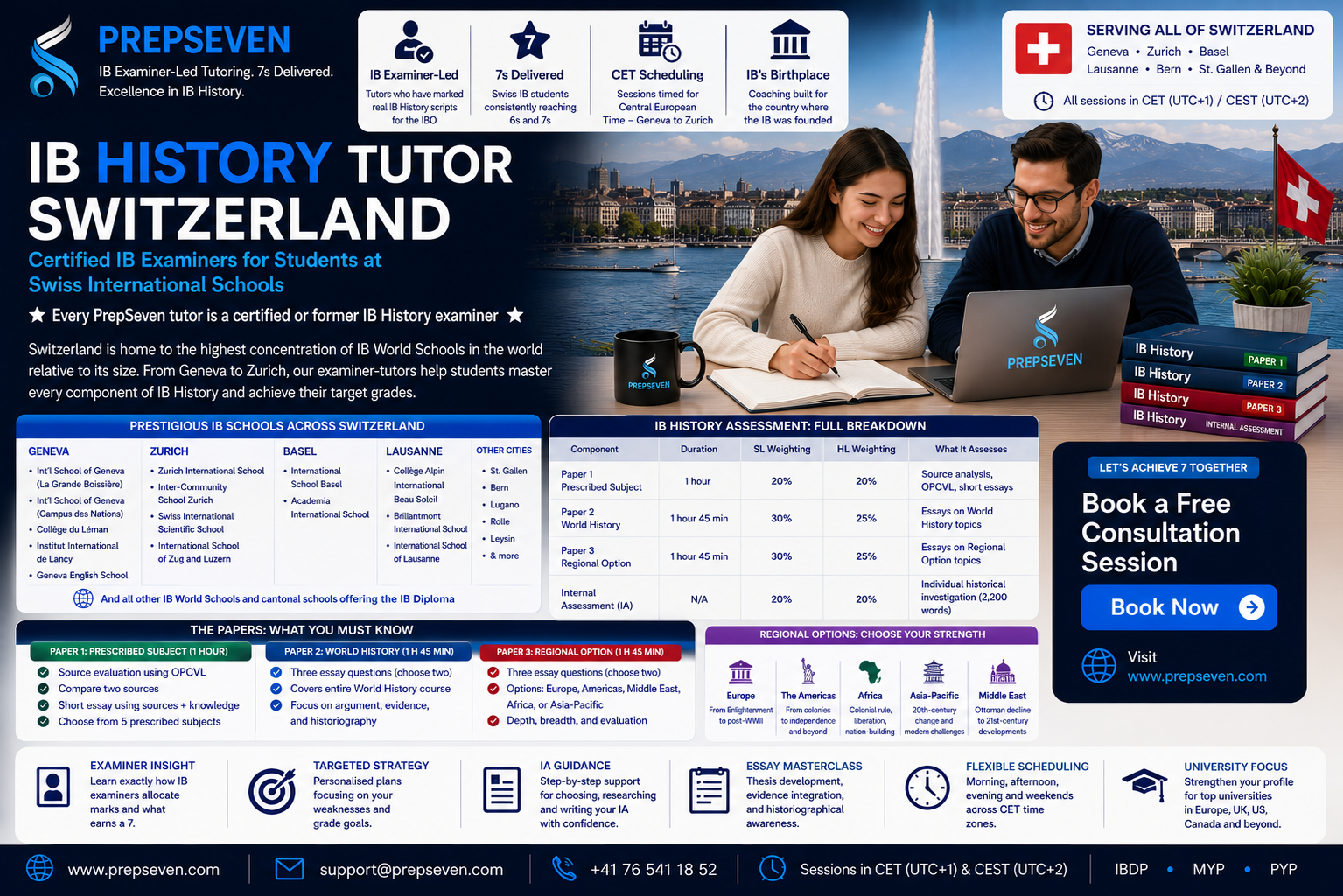
Certified IB Examiners for Students at Swiss International Schools — Geneva, Zurich, Basel, Lausanne
★ Every PrepSeven tutor is a certified or former IB History examiner ★
✓ IB Examiner-Led
Tutors who have marked real IB History scripts for the IBO
✓ 7s Delivered
Swiss IB students consistently reaching 6s and 7s
✓ CET Scheduling
Sessions timed for Central European Time — Geneva to Zurich
✓ IB’s Birthplace
Coaching built for the country where the IB was founded
IB History Tutoring in Switzerland — Where the IB Was Born
Switzerland occupies a position in the IB world unlike any other country. The International Baccalaureate was founded in Geneva in 1968 — in part to serve the children of international civil servants and diplomats working at organisations such as the United Nations, the World Health Organisation, and the International Red Cross. More than five decades later, Switzerland remains one of the most IB-dense countries on earth relative to its size, home to some of the world’s most prestigious IB World Schools and a student population that is extraordinarily internationally diverse.
Swiss IB History students are not a homogeneous group. At a school like the International School of Geneva — the world’s oldest international school — a History class might contain students from thirty different nationalities, each bringing their own national historical perspective to the same IB syllabus. At Zurich International School or Institut Le Rosey, students are the children of global executives and diplomats who will go on to Ivy League universities, Oxbridge, EPFL, ETH Zurich, and Sciences Po. In this environment, IB History is not just an academic subject — it is a lens through which students from every corner of the world make sense of a shared global past.
PrepSeven brings examiner-standard coaching to this exceptional environment. Every IB History tutor on our platform is a certified or former IB History examiner — someone who has marked real student scripts, attended IB standardisation training, and applied the chief examiner’s mark scheme to genuine examinations. For Swiss IB students targeting the world’s most selective universities, the difference between a 6 and a 7 in IB History is the difference between meeting a conditional offer and missing it. PrepSeven closes that gap with precision.
The IB Landscape in Switzerland — An Exceptional Concentration of Excellence
Switzerland hosts over 50 IB World Schools — a remarkable density for a country of its size, reflecting the extraordinary concentration of international organisations, multinational corporations, and diplomatic missions that make Geneva, Zurich, Basel, Lausanne, and Bern among the most internationally cosmopolitan cities in the world. Swiss IB schools serve a genuinely global student body, with students from Europe, the Americas, Asia, the Middle East, and Africa all represented within single cohorts.
Swiss IB School
Location
International School of Geneva (Ecolint) — La Grande Boissière
Geneva
International School of Geneva — La Châtaigneraie
Founex / Geneva Canton
International School of Geneva — Campus des Nations
Geneva
Institut Le Rosey
Rolle, Vaud
Collège du Léman International School
Versoix, Geneva
Institut auf dem Rosenberg
St. Gallen
Zurich International School — Lower School / Middle / Upper
Zurich / Wädenswil
Inter-Community School Zurich
Zurich
International School Basel
Basel
Leysin American School
Leysin, Vaud
Ecole d’Humanité
Hasliberg, Bern Canton
International School of Lausanne
Lausanne
American School in Switzerland (TASIS)
Lugano, Ticino
Brillantmont International School
Lausanne
Switzerland’s IB schools operate in four national languages — German, French, Italian, and Romansh — but instruction in IB History is almost exclusively in English, which introduces a unique dynamic: many Swiss IB History students are writing analytical essays in English as an additional language, often their third or fourth language. PrepSeven’s examiners are trained to distinguish between linguistic imprecision and analytical weakness — a critical distinction for EAL students who may think with analytical sophistication but express it in English that is not yet fully fluent.
IB History Syllabus — Full Paper-by-Paper Guide for Swiss Students
The IB History course is identical in structure globally. Swiss students sit all three papers and the IA, typically in the May session. What varies is the topic selection and the regional option — and in Switzerland, with its uniquely European and international character, these choices carry particular significance.
Paper 1 — Prescribed Subject (SL & HL | 1 Hour)
Paper 1 is a one-hour source-based examination on a single Prescribed Subject. Students answer four questions testing source evaluation (OPCVL), source comparison, and short analytical essays integrating sources with historical knowledge. The five Prescribed Subject options are:
Prescribed Subject
Core Content
Swiss School Context
Military leaders
Caesar, Genghis Khan, Napoleon, Shaka
High — Napoleon’s European campaigns resonate strongly in Swiss-European context
Conquest and its effects
Spanish Americas, Mongol conquests
Medium
The move to global war
Japan in Asia, Germany/Italy in Europe (1931–41)
Very High — European fascism and WWII origins are central to Swiss IB school curricula
Rights and protest
Civil Rights USA, Apartheid South Africa
High — human rights resonates deeply in Geneva, home of the UN Human Rights Council
Conflict and intervention
Kosovo, Somalia, Timor-Leste
Very High — Swiss neutrality and humanitarian diplomacy give this unique contextual relevance; ICRC is headquartered in Geneva
Two Prescribed Subjects carry exceptional resonance for Swiss students. Conflict and Intervention — with its focus on humanitarian intervention in Kosovo, Somalia, and East Timor — connects directly to Switzerland’s unique position as the home of the International Committee of the Red Cross (ICRC), the Geneva Conventions, and the global humanitarian law framework. The Move to Global War connects to Switzerland’s extraordinary position of neutrality during WWII — a neutrality that has been the subject of sustained historical debate regarding Swiss banking, refugee policy, and trade with Nazi Germany. PrepSeven’s examiners bring this Swiss contextual depth to source evaluation coaching.
PrepSeven Examiner Insight — Paper 1 in Swiss Schools
Swiss IB students often have exceptional contextual sophistication — studying history in a country that sits at the centre of European history and hosts the world’s major international organisations gives them a naturally multi-perspectival view of historical events. The challenge is converting this contextual awareness into the precise evaluative language that IB Paper 1 requires. Being aware that the ICRC exists does not automatically produce strong OPCVL analysis. Our examiners bridge this gap — helping Swiss students leverage their extraordinary contextual positioning while developing the specific evaluative technique that earns marks.
Paper 2 — World History Topics (SL & HL | 1 Hour 30 Minutes)
Paper 2 requires two essays from two different World History Topics. Swiss IB History students bring genuinely international perspectives to these topics — their classmates come from across the world, their teachers are internationally experienced, and their daily environment is one of the most internationally diverse on earth. The most commonly chosen topics at Swiss IB schools include:
World History Topic
Swiss Context and Selection Pattern
Authoritarian states (20th century)
Hitler, Mussolini, Stalin, Franco — the European authoritarian states of the 20th century are deeply embedded in Swiss IB school History teaching, given Switzerland’s position surrounded by fascist and Nazi regimes during WWII
The Cold War: Superpower tensions and rivalries (1947–1991)
Switzerland’s Cold War neutrality — Cold War Geneva as a diplomatic hub, Swiss intelligence history, the role of Geneva in arms control negotiations — gives students extraordinary contextual depth
Causes and effects of 20th century wars
WWI and WWII from a uniquely Swiss perspective — Swiss neutrality, the St. Gotthard route, Switzerland as a refuge for Jewish assets and as a diplomatic intermediary
Evolution and development of democratic states (1848–2000)
Switzerland’s own direct democracy model — referenda, federalism, cantonal sovereignty — provides a fascinating domestic parallel to the comparative content of this topic
Independence movements (1800–2000)
European national movements connect to Swiss cantonal confederation history; decolonisation relevant to the international student body at Swiss schools
Societies in transition (1400–1700)
Swiss Confederation formation, the Reformation (Zwingli in Zurich, Calvin in Geneva) — Switzerland sits at the centre of early modern European transformation
Early Modern states (1450–1789)
The Old Swiss Confederacy, absolutism in surrounding states, Swiss mercenary tradition in European wars
PrepSeven Examiner Insight — Paper 2 for Swiss Students
Swiss IB students frequently write sophisticated, multi-perspectival essays that demonstrate genuine international awareness — a reflection of their uniquely diverse educational environment. The challenge is that multi-perspectival awareness does not automatically produce analytical argument. An essay that thoughtfully presents six different national perspectives on the Cold War without committing to a sustained interpretation of its own does not score a 7. Our examiners teach Swiss students to move from presenting perspectives to arguing a position — a shift that requires intellectual confidence as well as technical skill.
Paper 3 — History of Europe (HL Only | 2 Hours 30 Minutes)
Paper 3 is the HL-only paper requiring three extended essays on a single regional option. Swiss IB schools almost universally choose the History of Europe regional option — the natural choice given Switzerland’s position at the heart of the European continent, its four national languages, and the European cultural backgrounds of most of its student population. The twelve History of Europe topics are:
History of Europe Topic
Swiss Historical Resonance
Absolutism and enlightenment (1650–1800)
Voltaire lived in Ferney, near Geneva; Rousseau was Genevan; the Enlightenment has deep Swiss geographical roots
The French Revolution and Napoleon (1774–1815)
Napoleon reorganised Switzerland as the Helvetic Republic; the Confederation’s modern form emerged from this period
Congress of Vienna, international relations (1815–1900)
The Congress of Vienna (1815) guaranteed Swiss neutrality in international law — foundational to Swiss identity
European states in the inter-war years (1919–1939)
The League of Nations was headquartered in Geneva; Switzerland’s neutrality during the rise of fascism
Causes and effects of World War One (1870–1918)
Switzerland surrounded by belligerents; Swiss humanitarian role through ICRC; Lenin’s exile in Zurich
Causes and effects of World War Two (1919–1945)
Swiss neutrality — the most historically contested topic in modern Swiss history; Nazi gold, refugee policy, Reduit strategy
The Soviet Union and post-Soviet Russia (1924–2000)
Cold War Geneva as a superpower negotiation hub; Swiss intelligence; USSR collapse and European transformation
Post-war western and northern Europe (1945–2000)
Switzerland’s deliberate non-membership of the EU; Marshall Plan (Switzerland not a recipient); European integration viewed from outside
Post-war central and eastern Europe (1945–2000)
Iron Curtain European history; Switzerland’s reception of Eastern European refugees
Cold War in Europe (1945–1991)
Geneva Summits; Swiss diplomacy; Arms control negotiations hosted in Geneva
European integration and cooperation
Switzerland’s unique position — not an EU member, not in NATO, yet deeply integrated economically and culturally with Europe
20th century Europe — social and cultural change
Switzerland’s own social transformations — women’s suffrage only achieved in 1971; immigration debates
No country in the IB’s History of Europe regional option has a more distinctive or more debated historical position than Switzerland. Swiss neutrality — its origins in the Congress of Vienna, its survival through two world wars, its contested role during the Holocaust, and its unique status vis-à-vis European integration — runs through multiple Paper 3 topics. PrepSeven’s History of Europe examiners help Swiss students engage analytically with their own country’s historical complexity, transforming local awareness into examiner-quality argument.
The IB History Internal Assessment — Swiss Student Guide
The Historical Investigation is worth 25% of the final IB History grade. It is a 2,200-word structured analytical essay assessed across three sections. Swiss IB students are in a uniquely privileged position for IA research: Geneva alone hosts the UN archives, the ICRC archives, the League of Nations historical collection, and the archives of dozens of major international organisations. Zurich hosts one of Europe’s finest university library systems. For students who know how to use them, Swiss institutions offer source access that is extraordinary.
IA Section
Mark Allocation and Examiner Focus
Section A — Identification and Evaluation of Sources (500–600 words)
Criterion A: 6 marks. Two sources evaluated for origin, purpose, value, and limitation. Swiss students with access to primary sources in multiple languages should evaluate sources that enable genuine analytical insight, not merely sources that are conveniently available.
Section B — Investigation (1,100–1,400 words)
Criterion B: 15 marks. A sustained analytical argument in response to the research question. Evidence deployed as proof. Counter-argument integrated and analytically addressed.
Section C — Reflection (400–500 words)
Criterion C: 4 marks. Methodological reflection on what the student learned about how historians construct knowledge — not a summary of findings or a conclusion.
PrepSeven Switzerland — IA Coaching Programme
Research question development — many Swiss students have access to exceptional archival resources but need help framing a question that is genuinely debatable and analytically tractable at 2,200 words
Swiss-topic IA support — IAs on Swiss neutrality, WWII Switzerland, the League of Nations in Geneva, ICRC history, or Swiss Cold War diplomacy benefit from PrepSeven’s contextual familiarity with Swiss historical sources
Multilingual source evaluation — Swiss students sometimes wish to use sources in German, French, or Italian; our examiners provide guidance on citing and evaluating non-English sources within the IB framework
Section A evaluation coaching — producing genuine OPCVL analysis rather than formulaic source description
Section C coaching — ensuring the reflection engages with methodological challenges historians face rather than summarising investigation findings
From a 5 to a 7 — The Swiss IB History Student’s Path
Swiss IB students are among the most internationally aware in the world. Their daily environment — studying alongside peers from thirty-plus nationalities, in a country that is the home of international diplomacy and humanitarian law — gives them a naturally sophisticated relationship with historical perspective. The challenge is converting that sophistication into the specific analytical form that IB History examiners reward. Multi-perspectival awareness is not the same as analytical argument.
Assessment Area
Common Swiss Student Pattern
What PrepSeven Develops
Essay thesis
Balanced overview of multiple historical perspectives
A specific, debatable analytical claim the student commits to and defends
Evidence use
Wide-ranging references demonstrating international knowledge
Precise, selected evidence deployed as proof of a specific argument
Counter-argument
Multiple alternative views presented neutrally
Counter-position engaged analytically and refuted within the argument
Source evaluation (P1)
Contextual awareness used to describe a source’s content
Evaluative analysis of how origin and purpose affect a source’s value and limitation
IA research question
Too broad given access to rich source material
Precisely scoped question appropriate to 2,200 words and debatable in nature
Paper 3 stamina
Intellectually ambitious first essay; declining quality across three
Pre-planned argument frameworks ensuring consistent analytical quality in all three essays
The PrepSeven Four-Stage Programme for Swiss Students
Examiner Diagnostic — Your tutor marks a recent essay or past paper response exactly as an IB examiner — producing a band score, descriptor justification, and precise analysis of the patterns preventing you from reaching the next band. Swiss students often discover that their essays demonstrate broad knowledge and international perspective but lack sustained, committed argument.
Targeted Analytical Development — Sessions address the specific gaps identified: constructing and committing to a debatable thesis, deploying evidence as proof rather than illustration, integrating counter-argument analytically, and evaluating sources as historical documents rather than as contextual information.
Examiner-Marked Written Practice — Every essay submitted between sessions is returned with an official-style examiner mark, band descriptor justification, and specific improvement guidance — replicating the feedback of the IB marking process.
Full Mock Examination Programme — Timed simulations of Paper 1, Paper 2, and Paper 3 under genuine exam conditions, followed by complete examiner debriefs targeting remaining weaknesses before the May examination session.
IB History in Switzerland — The Unique Swiss Academic Context
Studying IB History in Switzerland is unlike studying it anywhere else. The country’s neutrality, its multi-lingual character, its extraordinary concentration of international organisations, and its position at the centre of European history for five centuries all shape the way Swiss IB students encounter and engage with the subject. PrepSeven’s coaching is attuned to this context.
Swiss-Specific Context
PrepSeven Response
Highly multilingual student body — many students write IB History essays in English as a third or fourth language
Examiners distinguish carefully between linguistic imprecision and analytical weakness; coaching prioritises clear analytical structure in academic English without penalising non-native fluency
Exceptional diversity of national backgrounds within single Swiss IB cohorts
PrepSeven’s coaching acknowledges and leverages multi-national perspectives while developing the analytical commitment required for top marks
Access to world-class archives in Geneva and Zurich for IA research
Examiner guidance on how to identify the most analytically valuable sources from rich archival collections, and how to evaluate them effectively in Section A
Swiss neutrality and WWII history as a uniquely debated national topic
PrepSeven examiners are familiar with the historiography of Swiss neutrality and can guide students writing IAs or Paper 3 essays on this topic
University targets include ETH Zurich, EPFL, Sciences Po, LSE, Oxbridge, Ivy League
Grade-targeted preparation calibrated to the IB score requirements for Switzerland’s most competitive university destinations
CET time zone — sessions needed in European morning/afternoon hours
All PrepSeven sessions available in CET — morning through evening — accommodating Swiss school schedules
Why PrepSeven for IB History in Switzerland?
PrepSeven
Other Swiss IB Tutoring Services
✓ Every tutor is a certified or former IB History examiner
✗ Tutors are commonly IB graduates or subject teachers without IB marking experience
✓ Feedback applies actual IB mark band descriptors — the same ones used in official marking
✗ Feedback reflects tutor opinion rather than official examiner criteria
✓ History of Europe Paper 3 — all twelve topics including Swiss-relevant content
✗ Generic IB History support without contextual depth in Swiss and European history
✓ Coaching for multilingual Swiss students — EAL analytical writing support
✗ One-size-fits-all approach not calibrated to the EAL challenge common in Swiss schools
✓ Swiss-topic IA coaching — neutrality, WWII, League of Nations, ICRC, Cold War Geneva
✗ IA guidance without familiarity with Swiss historical sources or archival collections
✓ IA reviewed by someone who has physically marked IB History IAs for the IBO
✗ IA feedback from tutors without IB Organisation marking or moderation experience
IB History Preparation Timeline — Swiss May Examinations
Swiss IB History students sit examinations in May. The Swiss academic year runs from late August through June, with autumn half-term, Christmas, winter break, and spring (Easter) holidays. The following preparation structure is calibrated to the Swiss school calendar:
Period
Recommended Preparation Focus
September–October (Year 2 start)
Syllabus diagnostic; confirm Paper 2 topic choices; establish baseline essay score with examiner marking; begin IA research question development
October autumn break
Intensive block — Paper 1 OPCVL technique foundation; IA Section A first draft
November–December
Paper 2 timed essay practice on both topics with examiner marking; IA Section B first draft submitted for review
Christmas / New Year break
Paper 3 intensive (HL) — argument frameworks for History of Europe topics; three-essay stamina sessions
January–February
Full Paper 2 mock under timed conditions; examiner debrief; IA Section C coaching
February / Carnival break
Paper 1 timed practice under exam conditions; IA finalisation and submission
March–April (Easter break)
Full past-paper simulations for all components; comprehensive examiner debriefs; targeted revision of remaining gaps
April–May (pre-exam)
Light consolidation — review examiner feedback themes; rest before examinations
Frequently Asked Questions — IB History Tutor Switzerland
Switzerland is where the IB was founded. Does that affect how IB History is taught there?
It affects the environment more than the curriculum — the IB History syllabus is identical globally. What is distinctive about Swiss IB schools is the exceptional quality and international diversity of the teaching environment: teachers recruited from across the world, students from thirty-plus nationalities in a single classroom, and a cultural atmosphere shaped by the international organisations, diplomatic missions, and multinational corporations that define Swiss cities. This environment produces History students with genuine global perspective — but perspective alone does not produce top marks. PrepSeven's examiners help Swiss students convert their exceptional multi-perspectival awareness into the sustained analytical argument that IB History examiners reward.
My child studies at Ecolint / ISG in Geneva. How does PrepSeven work with Ecolint's IB programme?
PrepSeven's coaching is completely independent of and complementary to school instruction at any Swiss IB school. The International School of Geneva is one of the world's oldest and most distinguished IB institutions, and its History teaching is excellent. PrepSeven supplements school instruction with something schools cannot provide at the individual level: examiner-standard one-to-one feedback on every essay and every IA section, delivered by someone who has sat on the marking side of the IB process. Students at Ecolint who work with PrepSeven receive the same examiner-precision feedback they would receive if an IB examiner reviewed their work directly — because their tutor is, or was, exactly that.
Can PrepSeven help with an IB History IA on Swiss history — neutrality, WWII, or the League of Nations?
Yes — and Swiss historical topics produce some of the most intellectually interesting IAs in the entire IB programme, when approached with the right analytical framework. Swiss neutrality during WWII is a particularly rich topic: the historiographical debate — from the Bergier Commission report to revisionist accounts of Swiss gold transactions and refugee policy — provides exactly the kind of contested historical evidence base that Section A evaluation rewards. Similarly, the League of Nations in Geneva, Swiss Cold War diplomacy, and the role of the ICRC in shaping international humanitarian law all offer strong research question possibilities. PrepSeven's examiners are familiar with this historiography and can guide the full IA process from research question development through to Section C reflection.
My student writes IB History essays in English but thinks in German / French / Italian. Does PrepSeven help with this?
This is one of the most common situations PrepSeven works with in Swiss schools. Many students at Zurich International School, ISB, or French-speaking Geneva schools are processing historical ideas in their dominant language and translating into academic English for their essays. PrepSeven's coaching for these students focuses on analytical structure first — ensuring that the thesis, evidence-argument relationship, and counter-position are conceptually clear — before addressing the register and precision of the English expression. IB History examiners are instructed to assess historical thinking and argument, not linguistic elegance; a structurally sound analytical essay in imperfect English will consistently outperform a beautifully written descriptive essay.
How does Swiss neutrality during WWII feature in the IB History syllabus?
Swiss WWII neutrality appears most directly in the History of Europe Paper 3 topic 'Causes and Effects of World War Two (1919–1945)' and is also relevant to the inter-war European states topic. The historiographical debate around Swiss neutrality — the extent to which it was genuine, principled, and humane versus expedient, complicit, or profitable — provides excellent material for analytical essays. Swiss students writing on this topic have the advantage of direct connection to primary sources and a historiography that has been significantly shaped by the Bergier Commission (1996–2002). PrepSeven's examiners can guide both Paper 3 essay preparation and IA work on Swiss WWII topics.
What are the most common university targets for Swiss IB History students, and how does PrepSeven help?
Swiss IB students are among the most internationally mobile in the world in terms of university destinations. Common targets include ETH Zurich and EPFL (for science and engineering students using IB as a pathway), Sciences Po Paris, the University of Geneva, the University of Zurich, LSE and UCL in London, universities in the Netherlands (Leiden, Maastricht, Amsterdam), Oxbridge, and Ivy League institutions in the US. For competitive humanities and social science programmes at any of these destinations, strong IB History performance is a meaningful part of the academic profile. PrepSeven's 6–7 range target for IB History is calibrated to support Swiss students' competitive university aspirations across all of these destinations.
Does PrepSeven cover the History of Europe Paper 3 topics that are most commonly examined at Swiss schools?
Yes, comprehensively. PrepSeven's History of Europe examiner specialists cover all twelve Paper 3 topics. For Swiss schools, the most frequently taught and examined topics are: European states in the inter-war years, Causes and Effects of WWI, Causes and Effects of WWII (including Swiss neutrality), The Soviet Union and post-Soviet Russia, Cold War in Europe, and Post-war Western and Northern Europe. Your tutor will be matched based on your specific topic selection, not assigned generically, ensuring depth rather than breadth in every Paper 3 coaching session.
Book Your Free Diagnostic Session — Switzerland
Certified IB History examiners. Available in CET across Geneva, Zurich, Basel, Lausanne and all of Switzerland.
IB History Tutoring Across Switzerland — Cities and Schools We Serve
PrepSeven provides online IB History tutoring to students across Switzerland. Our most commonly requested services include:
IB History tutor Geneva
IB History tutor Zurich
IB History tutor Basel
IB History tutor Lausanne
IB History tutor Bern
IB History tutor Lugano
IB History tutor Ecolint / International School of Geneva
IB History tutor Zurich International School
IB History tutor Institut Le Rosey
IB History tutor TASIS Switzerland
IB History tutor International School of Basel
IB History Paper 3 tutor Switzerland — History of Europe
IB History IA tutor Switzerland
IB History examiner tutor Switzerland
IB History Swiss neutrality WWII IA topic
Online IB History tutor for Swiss international school students
All sessions are conducted online. PrepSeven serves students at all Swiss IB World Schools — from the oldest international school in the world (Ecolint) to Le Rosey, TASIS, ZIS, ISB, and international schools across all Swiss cantons.
PrepSeven — IB History Tutor Switzerland
All tutors are certified or former IB History examiners. PrepSeven is an independent tutoring service and is not affiliated with the International Baccalaureate Organization (IBO).