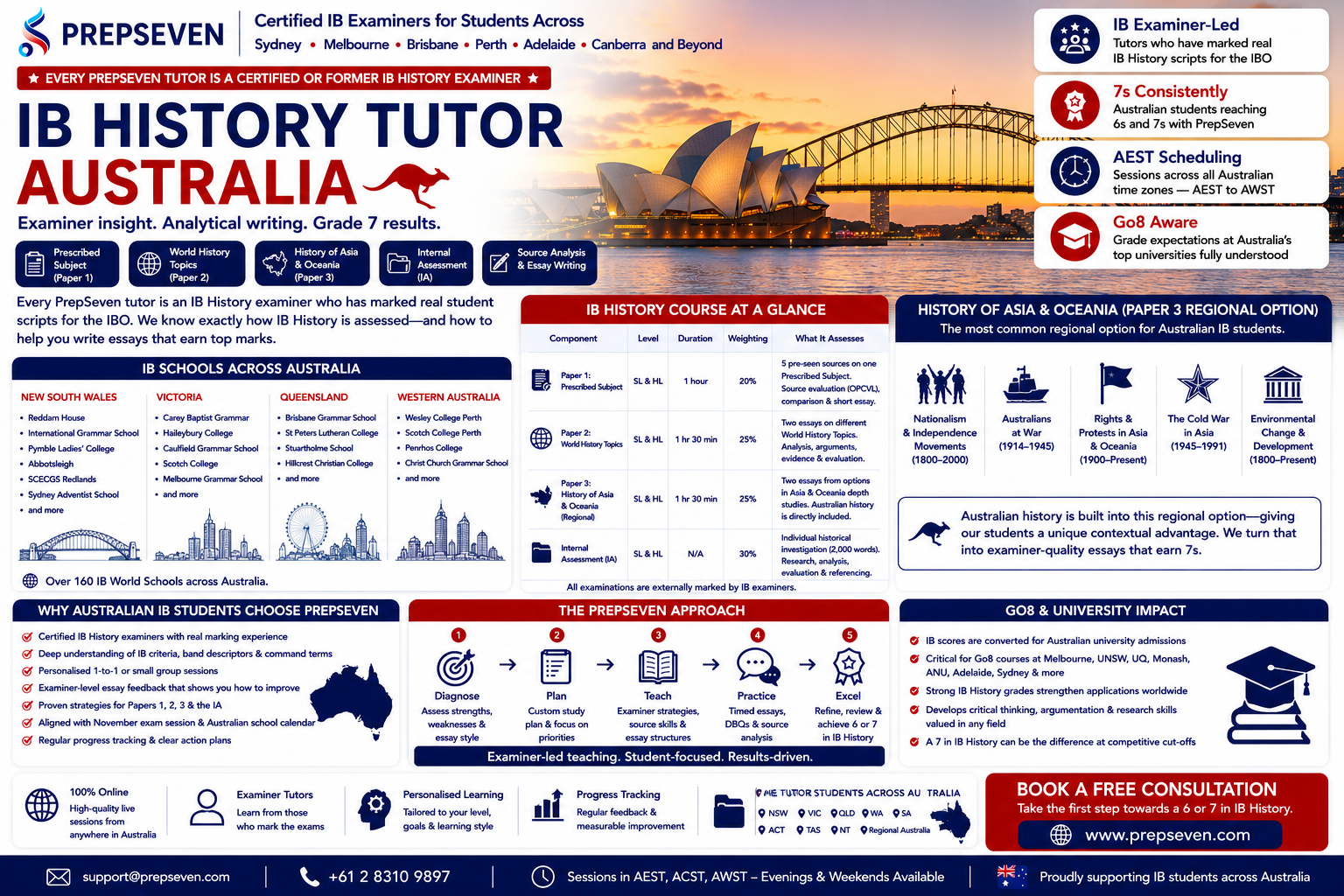
Certified IB Examiners for Students Across Sydney, Melbourne, Brisbane, Perth and Beyond
★ Every PrepSeven tutor is a certified or former IB History examiner ★
✓ IB Examiner-Led
Tutors who have marked real IB History scripts for the IBO
✓ 7s Consistently
Australian students reaching 6s and 7s with PrepSeven
✓ AEST Scheduling
Sessions across all Australian time zones — AEST to AWST
✓ Go8 Aware
Grade expectations at Australia’s top universities fully understood
IB History Tutoring in Australia — The Examiner Difference
Australia occupies a distinctive position in the global IB community. While the vast majority of Australian students sit state-based Year 12 credentials — the HSC in New South Wales, the VCE in Victoria, the QCE in Queensland, the WACE in Western Australia — a growing and high-achieving cohort of Australian students choose the IB Diploma, concentrated in the country’s leading independent schools, international schools, and select state IB schools. These students are academically ambitious, typically targeting places at Australia’s Group of Eight universities or top institutions overseas, and IB History is one of the most demanding subjects on their programme.
The tutoring market in Australia is well-developed for HSC, VCE, and QCE students but significantly thinner when it comes to examiner-quality IB History support. Most IB tutors in Australia are strong students who performed well in the IB themselves — a valuable but fundamentally different credential from having been an IB examiner. PrepSeven changes this equation entirely. Every IB History tutor on our platform is a certified or former IB History examiner: someone who attended IB standardisation training, applied the chief examiner’s mark scheme to real student scripts, and awarded official marks. For Australian IB History students targeting 6s and 7s, this distinction is not a detail — it is the foundation of effective preparation.
Australian IB History students typically sit the History of Asia and Oceania regional option for Paper 3 — a regional option that includes Australian history directly, from colonial settlement to the White Australia Policy to Australia’s involvement in the Pacific War and Southeast Asian conflicts. PrepSeven’s Asia and Oceania examiner specialists are fluent in this content and understand exactly how examiners approach Australian historical topics within the regional option framework.
The IB Landscape Across Australia — State by State
Australia hosts over 160 IB World Schools, concentrated in major metropolitan centres but with representation across regional areas as well. IB schools in Australia span elite private schools, international schools, and a smaller number of state government IB schools. The student body is predominantly Australian domestic students targeting Go8 universities, alongside a significant international student cohort at major city schools.
State / Territory
Key IB History Schools
New South Wales (Sydney)
Reddam House, International Grammar School, Pymble Ladies’ College, Abbotsleigh, SCECGS Redlands, Sydney Adventist School
Brisbane Grammar School, St Peters Lutheran College, Stuartholme School, Hillcrest Christian College
Western Australia (Perth)
Wesley College Perth, Scotch College Perth, Penrhos College, Christ Church Grammar School
South Australia (Adelaide)
Pembroke School, Scotch College Adelaide, St Peter’s College
Australian Capital Territory (Canberra)
Canberra Grammar School, Radford College, Canberra Girls Grammar School
Northern Territory / Tasmania
Darwin High School (IB), Launceston Church Grammar School
Most Australian IB History students sit their examinations in November — the Southern Hemisphere examination session. This is a critical distinction for preparation planning: the November session means Australian students have the Southern Hemisphere summer (December–January) as revision time, and their Year 12 school year runs February through October. PrepSeven’s preparation calendar for Australian students is built around the November session, not the global May session.
IB History Syllabus — Complete Paper-by-Paper Guide for Australian Students
The IB History course is assessed across three written examinations and one internal assessment. Australian students sit all components in November. The structure is identical globally, but the topics Australian students select and the regional option they sit for Paper 3 give Australian preparation a distinct character.
Paper 1 — Prescribed Subject (SL & HL | 1 Hour)
Paper 1 is a one-hour source-based examination presenting five pre-seen sources on one Prescribed Subject. Students answer four questions testing source evaluation, cross-source comparison, and analytical writing integrating sources with historical knowledge. The five Prescribed Subject options are:
Prescribed Subject
Core Content
Australian School Selection
Military leaders
Caesar, Genghis Khan, Napoleon, Shaka
Moderate — selected at a range of school types
Conquest and its effects
Spanish Americas, Mongol conquests
Moderate
The move to global war
Japan in Asia (1931–41), Germany/Italy in Europe
Very High — Japan’s Pacific War is directly relevant to Australian WWII history
Rights and protest
Civil Rights USA, Apartheid South Africa
High — Indigenous Australian rights provides strong contextual resonance
Conflict and intervention
Kosovo, Somalia, Timor-Leste
High — Australia’s military involvement in East Timor gives this exceptional local relevance
Two Prescribed Subjects carry particular relevance for Australian students. The Move to Global War — with its focus on Japanese expansion across Asia and the Pacific from 1931 to 1941 — maps directly onto Australian historical consciousness around the Pacific War, the fall of Singapore, and the Kokoda campaign. Conflict and Intervention — with its focus on the East Timor crisis — is the only Prescribed Subject anywhere in the IB curriculum that directly involves Australian military and diplomatic history. PrepSeven’s examiners leverage this Australian historical context in teaching source evaluation technique.
PrepSeven Examiner Insight — Paper 1 for Australian Students
Australian students frequently arrive at IB History with strong contextual knowledge — particularly of WWI (Gallipoli, Western Front) and WWII (Pacific theatre, Kokoda) — but struggle to convert that contextual awareness into evaluative source analysis. IB Paper 1 does not reward knowing what happened; it rewards evaluating sources as historical documents. A student who knows the Pacific War in depth still needs to learn to evaluate why a Japanese military communiqué from 1942 is valuable for certain purposes and limited for others. Our examiners make this distinction explicit and build source evaluation as a distinct analytical skill.
Paper 2 — World History Topics (SL & HL | 1 Hour 30 Minutes)
Paper 2 requires two analytical essays from two different World History Topics. Australian IB History students choose topics that typically reflect their school’s teaching strengths and the Asia-Pacific lens their Paper 3 regional option encourages. The most commonly selected topics at Australian IB schools include:
World History Topic
Australian Context and Selection Pattern
Authoritarian states (20th century)
Hitler, Stalin, Mao, Tojo — Mao and Japan’s militarist leaders connect to the Asia-Pacific context Australian students study for Paper 3
The Cold War: Superpower tensions and rivalries (1947–1991)
Australia’s Cold War experience — ANZUS, the Korean War, Vietnam — gives students genuine contextual depth for this topic
Causes and effects of 20th century wars
WWI (Gallipoli, Western Front, Australian Imperial Force) and WWII (Pacific theatre, North Africa) are core areas of Australian national historical memory
Independence movements (1800–2000)
Asian decolonisation — India, Indonesia, Vietnam, Malaya — directly relevant to History of Asia and Oceania Paper 3
Origins, development and impact of industrialization (1750–2005)
The social consequences of industrialisation; connections to Australian labour movement history
Dynasties and rulers (750–1500)
Selected by students seeking content distance from the Asia-Pacific Paper 3 regional option
Evolution and development of democratic states (1848–2000)
Australian parliamentary democracy; post-war welfare state; Menzies era as contextual backdrop
PrepSeven Examiner Insight — Paper 2 for Australian Students
Australian students writing about WWII or the Cold War often bring genuine personal connection to the material — family histories, national commemoration culture, and strong school teaching in these areas. The examiner challenge is that personal connection can produce empathetic narrative rather than analytical argument. A deeply felt account of Kokoda or the Korean War does not score a 7 unless it sustains a specific historical argument with precise evidence deployed analytically. PrepSeven’s examiners channel Australian students’ historical engagement into the form IB marking criteria reward.
Paper 3 — History of Asia and Oceania (HL Only | 2 Hours 30 Minutes)
Paper 3 is the HL-only extended essay paper requiring three analytical essays on the History of Asia and Oceania regional option — the near-universal choice at Australian IB schools. This regional option covers the history of Asia and the Pacific from the late 19th century through the late 20th century, including Australian history directly. The twelve History of Asia and Oceania topics are:
History of Asia and Oceania Topic
Australian Relevance
Decline and fall of the Qing dynasty
China’s transformation — sets context for 20th-century Asia that Australian students study throughout P3
China and Korea (1910–1950)
Japanese colonisation of Korea; Chinese nationalist and communist movements leading to Korea War (Australia participated)
Japanese expansion and the Asia-Pacific War (1931–1945)
Australia’s most directly relevant P3 topic — fall of Singapore, Kokoda, Darwin bombing, Australian POWs
The People’s Republic of China (1949–2005)
Mao era, Cultural Revolution, Deng reforms — China as Australia’s largest trading partner gives this contemporary resonance
Conflict in Indochina (1954–1979)
Vietnam War — Australia’s military involvement, conscription debate, anti-war movement at home
Pathways to independence: Asia (1942–1965)
Indonesian independence (Australia recognised early), Indian independence, Malayan Emergency
Social and political developments in South Asia (1947–1964)
Partition, Nehru, Kashmir — foundational content for South Asian context
Post-war developments in South and Southeast Asia (1945–1993)
ASEAN formation, Indonesia under Suharto, Australia’s regional engagement
Governance and challenges in Australia and New Zealand
The only topic explicitly focused on Australian history — White Australia Policy, Indigenous rights, Menzies to Whitlam
The ‘Governance and Challenges in Australia and New Zealand’ topic within the History of Asia and Oceania regional option is unique in the IB History curriculum: it is the only Paper 3 topic focused on Australian history. It covers the White Australia Policy and its dismantling, the 1967 referendum on Indigenous Australians, the Whitlam era, and Australia’s evolving relationship with Asia. PrepSeven’s examiners coaching Australian students on this topic provide both examiner-standard analytical guidance and deep familiarity with the Australian primary source landscape.
The IB History Internal Assessment — Australian Student Guide
The Historical Investigation accounts for 25% of the final IB History grade. It is a 2,200-word structured essay assessed across three sections against specific IB criteria. In the Australian IB context, the IA often sits alongside significant Year 12 extracurricular commitments — school production, sports leadership, Duke of Edinburgh — meaning students frequently begin it late and submit it under pressure. PrepSeven’s IA coaching provides structure and examiner-standard feedback at every stage.
IA Section
Mark Allocation and Examiner Focus
Section A — Identification and Evaluation of Sources (500–600 words)
Criterion A: 6 marks. Two sources evaluated for origin, purpose, value, and limitation. Not a summary — genuine evaluative commentary on the source as a historical document.
Section B — Investigation (1,100–1,400 words)
Criterion B: 15 marks. A sustained analytical argument responding to the research question. Evidence deployed as proof. Counter-argument acknowledged and analytically addressed.
Section C — Reflection (400–500 words)
Criterion C: 4 marks. Methodological reflection on what the student learned about how historians construct knowledge — not a conclusion or summary of findings.
PrepSeven Australia — IA Coaching Programme
Research question development — scoping a debatable, analytically tractable question appropriate to 2,200 words and available source material
Australian-topic IA support — many Australian students write IAs on Australian history (Gallipoli, Kokoda, the White Australia Policy, the 1967 referendum, Vietnam conscription, the Whitlam dismissal). PrepSeven examiners understand these primary sources and their IB suitability.
Section A evaluation coaching — teaching genuine OPCVL analysis beyond the formulaic responses that earn low Criterion A marks
Section B argument structure — building from thesis through evidence and counter-position to analytical conclusion
Section C coaching — consistently the most misunderstood section by Australian students; our examiners specify precisely what methodological reflection requires
From a 5 to a 7 — The Australian IB History Student’s Path
Australian IB History students are typically well-read, historically engaged, and arrive at exam preparation with genuine content knowledge — particularly of Australian, Pacific, and Asian history. The consistent gap between their preparation and their results lies in analytical writing technique. IB History examiners reward argument, not narrative. PrepSeven’s examiners close this gap systematically.
Assessment Area
Typical Australian Pattern
What PrepSeven Develops
Essay opening
Historical overview or background paragraph
A sharp, debatable analytical claim stated in the opening
Evidence use
Rich factual content, chronologically ordered
Precise evidence selected and deployed as proof of a specific argument
Counter-argument
Acknowledged separately or absent
Integrated into the essay and analytically refuted
Source evaluation (P1)
Contextual knowledge used to describe what the source shows
Evaluative judgement on how origin and purpose affect value and limitation
IA Section C
Summary of investigation findings
Genuine methodological reflection on historians’ methods and constraints
Paper 3 pacing
Strongest first essay, weakest third
Pre-planned argument frameworks enabling consistent quality across all three
The PrepSeven Four-Stage Programme for Australian Students
Examiner Diagnostic — Your tutor marks a recent essay or past paper response exactly as an IB examiner would — producing a mark, band justification, and precise pattern analysis. Australian students typically discover their essays display strong historical knowledge but lack sustained analytical argument.
Targeted Skill Development — Sessions address the specific gaps identified: thesis construction, evidence framing, counter-argument integration, OPCVL technique, or Paper 3 stamina. Skills are taught with examiner-informed examples and practised through immediate written application.
Examiner-Marked Written Practice — Every essay submitted between sessions is returned with an official-style examiner mark, band descriptor justification, and specific improvement guidance — replicating the feedback of an official IB marking process.
Full November Mock Programme — Timed simulations of Paper 1, Paper 2, and Paper 3 under genuine exam conditions, followed by complete examiner debriefs targeting any remaining weaknesses before the November examination session.
IB History in the Australian School Context — Unique Challenges
Australian IB students face a distinctive academic environment shaped by the coexistence of the IB Diploma and strong state credentials (HSC, VCE, QCE, WACE). Many Australian IB schools also offer the relevant state credential, creating a complex environment where students may encounter different essay conventions and assessment standards simultaneously. PrepSeven’s examiners understand this context and address the specific challenges it creates.
Australian Challenge
PrepSeven Response
November examination session — opposite to global May session
All preparation calendars built around November examinations, not May; holiday periods and school terms accounted for Australian academic year
State credential essay habits (HSC, VCE) conflict with IB analytical essay requirements
Explicit coaching on the differences between state credential and IB essay conventions — a transition as significant as the UK A-Level crossover
History of Asia and Oceania Paper 3 — limited commercial resources outside school
PrepSeven’s Asia and Oceania specialists provide curated topic materials, past paper analysis, and examiner commentary unavailable through standard publishers
IA supervision varies significantly between schools
PrepSeven’s examiner-standard IA coaching fully independent of school supervision quality
Go8 universities (Melbourne, Sydney, ANU, QUT, Monash, UWA, Adelaide, UQ) competitive for IB students
Grade-targeted preparation calibrated to the IB score requirements for competitive Go8 programmes
Wide geographic spread — students in Perth operate in AWST, three hours behind Sydney
All Australian time zones covered — AEST, ACST, AWST — morning through evening availability
Why PrepSeven for IB History in Australia?
PrepSeven
Other Australian IB Tutoring Services
✓ Every tutor is a certified or former IB History examiner
✗ Tutors are typically high-achieving IB graduates or experienced teachers without marking credentials
✓ Feedback applies official IB mark band descriptors — the same standard used in real examinations
✗ Feedback based on tutor judgement, not official IB examiner criteria
✓ History of Asia and Oceania Paper 3 — including Australian history topic specialists
✗ Generic IB History support without dedicated Asia and Oceania or Australian History expertise
✓ Preparation calendar built around the November examination session
✗ Services designed for the global May session, creating misalignment for Australian students
✓ IA reviewed by someone who has marked and moderated IB History IAs for the IBO
✗ IA feedback from tutors without IB Organisation marking or moderation experience
✓ Australian-topic IA coaching — Kokoda, White Australia Policy, 1967 referendum, Vietnam
✗ Generic IA guidance without familiarity with Australian primary sources and their IB suitability
IB History Preparation Timeline — Australian November Examinations
Australian IB History students sit examinations in November. The Australian school year runs late January through late October, with term breaks in April, June/July, and September. The following preparation structure is calibrated specifically to the Australian academic calendar:
Period
Recommended Preparation Focus
February–March (Year 12 start)
Syllabus diagnostic; confirm Paper 2 topic choices; begin IA research question development; establish baseline essay score
April school holidays
Intensive block — IA Section A first draft for examiner review; Paper 1 OPCVL technique foundation sessions
May–June (Term 2)
Paper 2 timed essay practice on both chosen topics with examiner marking; IA Section B first draft
June/July school holidays
Paper 3 intensive (HL) — argument frameworks per Asia and Oceania topic; three-essay stamina sessions
July–August (Term 3)
Full Paper 2 mock under timed conditions with examiner debrief; IA finalisation
September school holidays
Full past-paper simulations for all components — the last major preparation block before examinations
October (Term 4)
Targeted revision of remaining weak areas; light review of examiner feedback themes
November (exam weeks)
Consolidation only — rest and perform
Frequently Asked Questions — IB History Tutor Australia
How does IB History differ from HSC or VCE History?
The differences are substantial and directly affect how students should approach their writing. NSW HSC Modern History and Ancient History reward structured essays organised around multiple analytical points with strong evidence, assessed through a Levels of Response rubric. VCE History similarly assesses through multiple-factor essays with source analysis components. IB History demands something more specific: a single sustained argument with integrated counter-position, where evidence is used as proof for a specific claim rather than as comprehensive coverage of relevant factors. Source analysis in IB Paper 1 is also more formally evaluative than in most state credentials — assessing origin, purpose, value, and limitation as distinct analytical operations. Students who move from state credentials to IB History, or who study both simultaneously, need deliberate coaching in the IB analytical approach. This is one of PrepSeven's core specialisations for Australian students.
Does PrepSeven cover the History of Asia and Oceania Paper 3 option in depth?
Yes — this is one of PrepSeven's most developed specialist areas for Australian students. The History of Asia and Oceania regional option includes topics directly relevant to Australian history and national consciousness: the Pacific War, Australia's involvement in Vietnam, Indonesian independence, the Whitlam era, and the Governance and Challenges in Australia and New Zealand topic that explicitly covers Australian domestic history from the White Australia Policy through to the 1970s. PrepSeven's Asia and Oceania examiner specialists understand the marking patterns of this regional option, the most consistently examined sub-topics, and the specific depth of analysis required to achieve top marks across three extended essays in 2.5 hours.
My school sits examinations in November. Does PrepSeven accommodate this?
Absolutely — and this is one of the most important ways PrepSeven differentiates itself for Australian students. Many international IB tutoring services are designed around the global May examination session, with preparation calendars that do not align with the Australian academic year. PrepSeven builds every Australian student's preparation programme around the November session, with milestones calibrated to Australian school term dates, the April and July holiday blocks, and the September holidays as the final intensive preparation period before examinations.
Can PrepSeven help with an IB History IA on an Australian historical topic?
Yes — and Australian history topics produce some of the strongest IAs when approached with the right analytical framework. Popular Australian IB History IA topics include: the causes and significance of the Gallipoli campaign for Australian national identity, the factors behind the dismantling of the White Australia Policy, the historical significance of the 1967 referendum, Australia's decision to commit forces to the Vietnam War, the Whitlam dismissal and constitutional convention, and the Kokoda campaign's strategic and symbolic significance. PrepSeven's examiners are familiar with the primary source landscape for Australian historical research questions and provide complete examiner-standard marking of all three IA sections.
How does PrepSeven serve students in Western Australia, given the time zone difference?
Western Australian students operate in AWST (UTC+8), three hours behind Sydney and Melbourne. PrepSeven's scheduling accommodates this fully — sessions are available across AEST, ACST, and AWST time zones from early morning through to late evening local time. Perth students frequently schedule sessions in the late afternoon or evening AWST, which aligns with tutors operating in European morning hours. Your PrepSeven academic consultant handles scheduling during onboarding and ensures your session times are consistent with your school timetable and your time zone.
What Go8 university grade requirements does PrepSeven help Australian students meet?
Australia's Group of Eight universities — the University of Melbourne, University of Sydney, Australian National University, University of Queensland, Monash University, University of Western Australia, University of Adelaide, and UNSW Sydney — use IB Diploma scores as a primary admissions metric for international students and as one component for domestic students. Competitive programmes in Law, Medicine, Arts, and International Relations at Go8 institutions typically require total IB scores in the 36–42 range, with strong individual subject performance. PrepSeven's IB History coaching targets the 6–7 range consistently — the contribution IB History makes to a competitive Go8 application profile.
My child is at an Australian IB school that also offers HSC. How do they balance both?
Some Australian IB students sit a mixed programme — IB subjects alongside HSC subjects — or are at schools where IB and HSC students share teaching resources. This creates specific challenges because the essay conventions, assessment criteria, and even the type of historical thinking rewarded differ between the two credentials. PrepSeven's sessions for students in this situation explicitly distinguish between the IB analytical essay approach and the HSC or VCE approach, ensuring students can code-switch appropriately between the two without confusing the conventions. This is a challenge unique to Australian students in mixed-credential environments, and one PrepSeven addresses directly.
Does PrepSeven offer IB History Extended Essay supervision for Australian students?
Yes. Australian IB students frequently write History Extended Essays on Australian, Pacific, or Asian topics — the Gallipoli campaign, Japan's Pacific War strategy, Australian Cold War policy, Indonesia's independence. PrepSeven provides full EE supervision including research question development, source methodology guidance, argument structure coaching, and complete draft review. History EE supervision is available as an add-on to a standard IB History tutoring programme or as a standalone service. Contact support@prepseven.com to discuss EE supervision arrangements.
Book Your Free Diagnostic Session — Australia
Certified IB History examiners. November session preparation. All Australian time zones.
IB History Tutoring Across Australia — Cities and Schools We Serve
PrepSeven provides online IB History tutoring to students across all Australian states and territories. Our most commonly requested services include:
IB History tutor Sydney
IB History tutor Melbourne
IB History tutor Brisbane
IB History tutor Perth
IB History tutor Adelaide
IB History tutor Canberra
IB History tutor Gold Coast
IB History Paper 3 tutor Australia — History of Asia and Oceania
IB History IA tutor Australia
IB History Extended Essay supervisor Australia
IB History examiner tutor Australia
IB History November session tutor Australia
IB History tutor New South Wales
IB History tutor Victoria
IB History tutor Queensland
IB History tutor Western Australia
Online IB History tutor for Australian students
All sessions are conducted online. PrepSeven serves students at independent schools, international schools, and state IB schools across every Australian state and territory — from major cities to regional areas.
PrepSeven — IB History Tutor Australia
All tutors are certified or former IB History examiners. PrepSeven is an independent tutoring service and is not affiliated with the International Baccalaureate Organization (IBO).