
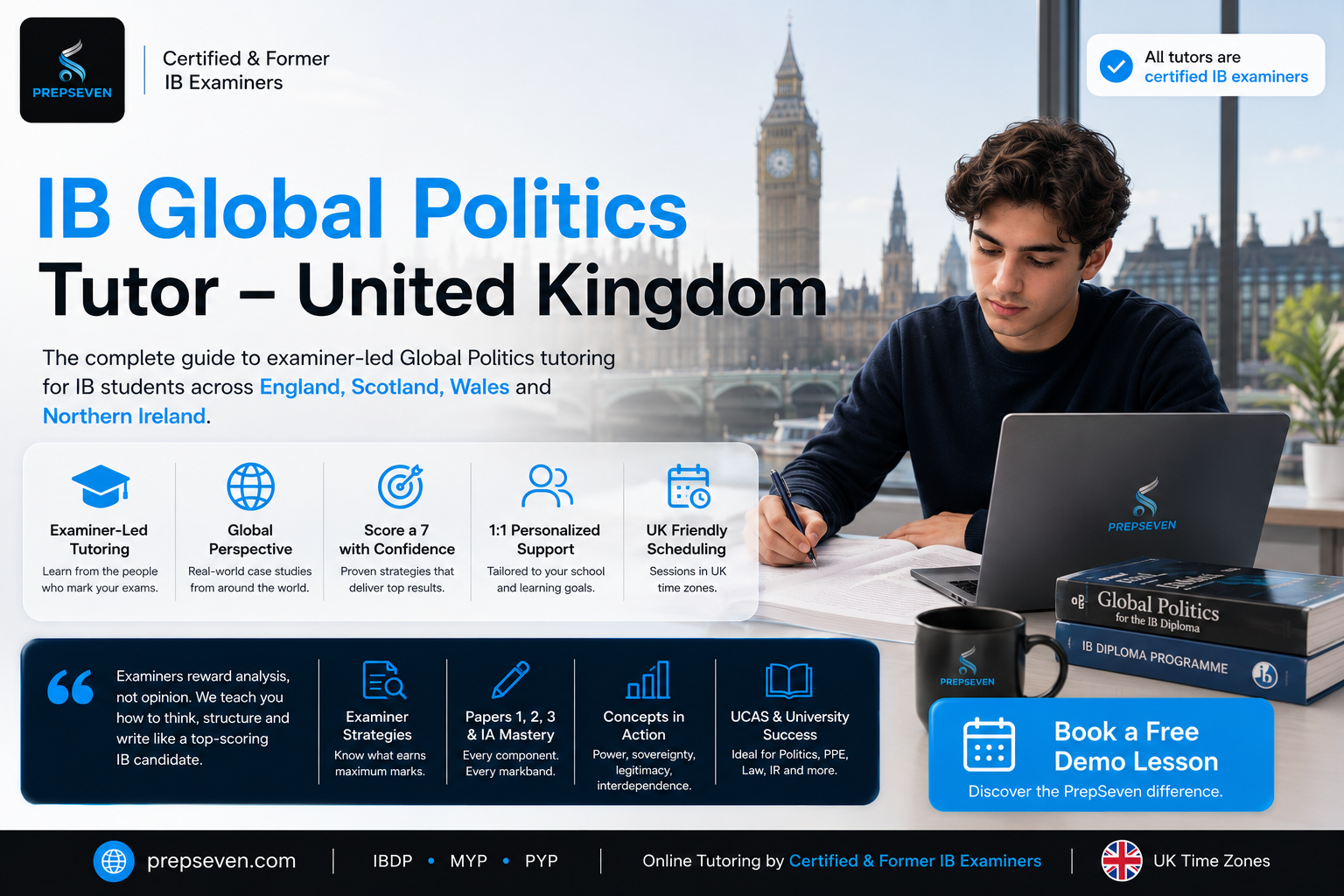
The IB Diploma is growing steadily across the United Kingdom — and Global Politics has become one of its most sought-after Group 3 subjects, prized by students targeting PPE, Law, International Relations and Politics degrees at the country’s most selective universities. PrepSeven provides one-to-one online tutoring for this subject delivered exclusively by certified IB examiners: the people who mark the papers your final grade depends on.
In This Guide
01 Why UK IB students choose Global Politics — and why it demands specialist support
02 Global Politics vs A-Level Politics: an honest comparison
03 The complete syllabus: four core units and the HL extension, in depth
04 Assessment anatomy: Papers 1, 2, 3 and the Internal Assessment
05 How PrepSeven’s examiner-tutors work with UK students
06 UCAS, Oxbridge and Russell Group: where Global Politics takes you
07 Frequently asked questions
01 — Why UK IB Students Choose Global Politics
Roughly 120 schools across the UK offer the IB Diploma, spanning historic independent schools in Kent, Surrey and London, state sixth forms in Cambridgeshire and the Midlands, and international sixth-form colleges in Wales and Scotland. Within these programmes, Global Politics has carved out a distinctive position: it is the subject that speaks most directly to the questions dominating British public life — sovereignty after Brexit, the future of NATO, migration policy, the UK’s role in climate diplomacy, and the strains on the post-1945 international order.
For students, that relevance is a double-edged sword. The subject feels accessible — everyone has opinions about politics — but the IB does not award marks for opinions. It awards marks for theoretically grounded, conceptually precise, evidence-rich analysis. The gap between having views and constructing arguments is exactly where most candidates lose their 7. And it is exactly the gap PrepSeven’s examiner-tutors are trained to close.
02 — Global Politics vs A-Level Politics: An Honest Comparison
Many UK families weighing sixth-form options ask how IB Global Politics compares to A-Level Politics. They are related but genuinely different courses, and understanding the difference clarifies what preparation the IB version demands.
The practical implication: students cannot prepare for IB Global Politics with A-Level techniques or A-Level tutors. The assessment architecture, the command terms, and the markbands are IB-specific. This is why PrepSeven staffs this subject exclusively with IB examiners and senior IB teachers rather than generalist politics tutors.
03 — The Complete Syllabus, In Depth
Global Politics is offered at Standard Level and Higher Level. Both levels study four compulsory core units across two years, structured around four key concepts — power, sovereignty, legitimacy and interdependence — which examiners expect to see actively deployed, not merely mentioned.
Core Unit 1 — Power, Sovereignty and International Relations
The course’s theoretical foundation. Students build a working vocabulary of power and learn to analyse the international system through competing theoretical traditions.
- Forms of power: hard, soft, smart and structural power; how power is measured, projected and contested
- Theoretical traditions: realism, liberalism, constructivism and critical theories as analytical instruments
- Sovereignty in question: the Westphalian settlement, supranational pooling (with the EU and Brexit as first-order case material for UK students), intervention and contested statehood
- Actors: states, IGOs (UN, NATO, EU, Commonwealth), NGOs, multinational corporations and violent non-state actors
- Global governance: the UN system, P5 politics and the reform debate; legitimacy deficits in international institutions
Core Unit 2 — Human Rights
A unit of live legal and philosophical contest, where the best UK candidates draw on rich domestic material — from the Human Rights Act debates to the UK’s role in the European Convention system.
- Architecture: the UDHR, ICCPR, ICESCR, treaty bodies and monitoring mechanisms
- The ECHR system: the European Court of Human Rights and the recurring UK political debate over its jurisdiction — premium comparative evidence
- Core debates: universalism versus relativism; individual versus collective rights; rights versus security trade-offs
- Enforcement: the ICC, ad hoc tribunals, R2P and the persistent codification-compliance gap
- Case studies: genocide determination, humanitarian intervention and the politicisation of rights claims in international forums
Core Unit 3 — Development
Development treated as a political process — contested, power-laden and historically conditioned — rather than a purely economic outcome.
- Measurement: GDP and GNI, HDI, MPI and the Gini coefficient, with critical attention to what each conceals
- Theories: modernisation theory, dependency theory, neoliberalism and the Washington Consensus, the developmental state and capability approaches
- Barriers: colonial legacies, debt, institutional weakness, the resource curse and asymmetric trade regimes
- Aid politics: DFID’s absorption into the FCDO and the UK aid budget debate as ready-made evaluative case material
- Sustainability: the SDGs, climate-development trade-offs and just transition politics
Core Unit 4 — Peace and Conflict
The unit demanding the sharpest conceptual precision, beginning with Galtung’s distinction between negative and positive peace.
- Typologies: interstate, intrastate, asymmetric and protracted social conflict
- Causes: greed versus grievance, structural violence, securitisation and escalation dynamics
- Resolution: negotiation, mediation, UN peacekeeping, peacebuilding and transitional justice — with the Good Friday Agreement as a world-class domestic case study for UK candidates
- Contemporary evidence: Ukraine, the Sahel, Sudan and Middle East conflicts as high-currency examination material
HL Extension — Global Political Challenges
Higher Level candidates study two of six thematic challenges in depth, assessed through Paper 3: Environment, Poverty, Health, Identity, Borders and Security. Theme selection is strategic — our tutors advise UK students toward pairings that maximise case study overlap with the core units, reducing revision load while deepening analytical range. Environment and Security, or Identity and Borders, are frequently powerful combinations for UK-based candidates given the domestic salience of climate policy and migration politics.
04 — Assessment Anatomy: Where Your Grade Is Decided
Paper 1 — The Stimulus Paper
Four questions of rising demand built on source material: text, data, cartoons or infographics. The final evaluative question carries the heaviest marks and requires synthesis of the stimulus with the candidate’s own knowledge. Our tutors install a four-step deconstruction protocol — perspective, framing, omission, integration — and drill it under timed conditions until it is automatic.
Paper 2 — The Grade-Maker
Forty percent of the final mark at both levels, and the purest test of essay craft in the humanities suite. Two essays in 2 hours 45 minutes, each demanding a theory-anchored thesis, claim-and-counterclaim development, precise case evidence and a conclusion that adjudicates rather than summarises. PrepSeven runs continuous essay cycles: plan, write, examiner-mark against the official markbands, rewrite. Candidates learn to predict their own band within one mark — the definition of exam readiness.
Paper 3 — HL Depth
Essay questions on the two chosen extension themes. We construct a four-lens framework (political, economic, social, environmental) per theme, loaded with case detail deep enough to meet any question the paper can set.
The Internal Assessment
At SL, the Engagement Activity: genuine engagement with a political issue — attending a constituency surgery, working with a campaign, interviewing a local councillor — followed by a 1,500 to 2,000 word analytical report. At HL, two video-recorded oral presentations of around ten minutes analysing a global political challenge. In both formats, the top band is separated from the middle by analytical framing: connecting the specific to the conceptual. Our tutors have moderated real IAs and coach precisely that connection, always within IB academic integrity rules.
05 — How PrepSeven’s Examiner-Tutors Work With UK Students
Every PrepSeven Global Politics tutor is a certified IB examiner or senior IB World School teacher with direct assessment experience. That single staffing rule drives everything else in the method:
06 — UCAS, Oxbridge and the Russell Group: Where Global Politics Takes You
HL Global Politics is a strong facilitating choice for the UK’s most competitive social science and law pathways. Admissions tutors treat a high grade in it as direct evidence of the analytical essay-writing ability their courses demand.
- Oxford PPE and Cambridge HSPS — HL Global Politics maps naturally onto both courses’ politics and international relations components, and IA or Extended Essay work in the subject provides genuine interview material
- LSE International Relations and Government — among the most IB-literate admissions environments in the country, with typical offers in the 38–42 range and high expectations in HL humanities
- Law at Russell Group universities — the subject’s emphasis on human rights law, treaty architecture and argumentation is directly relevant preparation
- King’s College London War Studies, Durham, Warwick, St Andrews International Relations — all regard HL Global Politics as core preparation
- UCAS tariff — the IB Diploma converts generously into UCAS points, and a 7 at HL carries maximum subject-level weight in offer-making
Beyond the offer itself, the subject compounds: a strong Engagement Activity, a Global Politics Extended Essay and a 7 at HL together form a coherent narrative for personal statements — precisely the joined-up profile selective admissions rewards.