

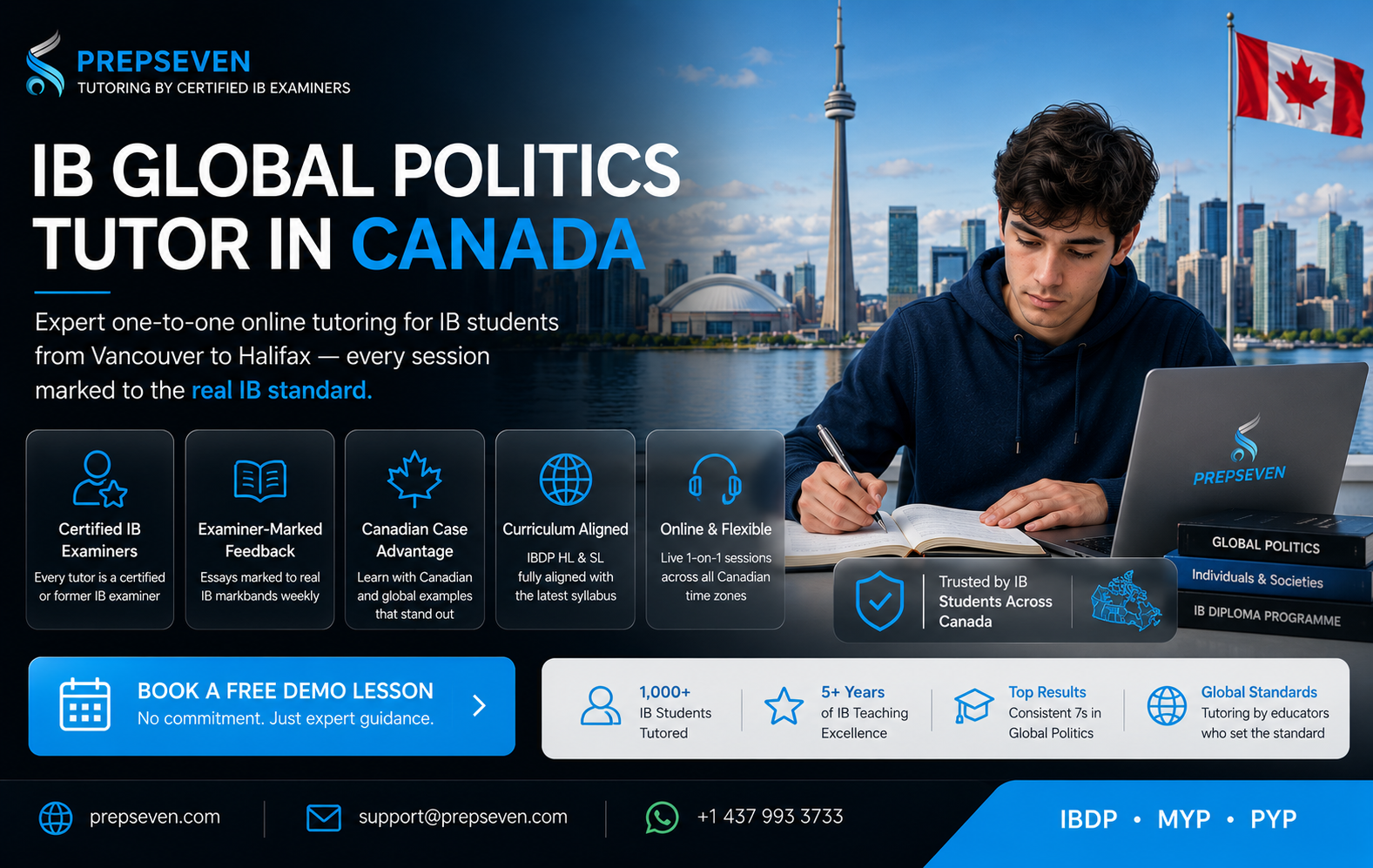
Canada is one of the world’s great IB nations. More than 350 IB World Schools operate across the country — the highest concentration in the Americas after the United States — and Canadian public school boards were among the earliest adopters of the diploma anywhere in the world. From the IB powerhouses of the Lower Mainland and Greater Toronto to French-immersion IB programmes in Quebec and long-established schools across the Prairies and Atlantic Canada, tens of thousands of Canadian students carry the IB workload every year.
Within that landscape, Global Politics occupies a special place. It is the Group 3 subject most closely aligned with what Canadian universities’ top programs actually teach — international relations, public policy, global affairs, and law — and the one most likely to distinguish an application to those programs. It is also a subject in which strong classroom teaching alone rarely produces a 7, because the final grade turns on individual essay technique and internal assessment quality that only one-to-one examiner feedback can reliably build.
That is what PrepSeven provides. Every one of our Global Politics tutors is a certified IB examiner or a senior teacher at an IB World School with direct assessment experience. Your child’s essays are marked weekly against the same markbands, at the same standard, by the same kind of professional who will mark them in the real examination.
A Subject Made for Canadian Students
Canadian students bring natural assets to Global Politics that students in few other countries possess, and a well-run tutoring programme converts each of them into examination currency:
- A middle-power vantage point: Canada’s entire foreign policy tradition — multilateralism, peacekeeping, NATO and NORAD membership, G7 participation — is a live seminar in how states without superpower resources exercise influence. This is Unit 1 evidence of the highest quality.
- Human rights depth at home: The Charter of Rights and Freedoms, the Truth and Reconciliation Commission, and Canada’s evolving relationship with Indigenous peoples give Canadian candidates rare, sophisticated material for Unit 2 essays on rights, recognition and justice — material examiners almost never see handled well.
- Peacekeeping heritage: From Pearson’s Suez innovation to modern debates about Canada’s reduced UN deployments, Unit 4’s peacebuilding content connects directly to national history.
- Immigration and identity politics: Canada’s points-based immigration system and official multiculturalism policy are premium case studies for the HL Identity and Borders themes.
- Climate and Arctic politics: Carbon pricing battles, pipeline politics and Arctic sovereignty questions supply distinctive evidence for the Environment theme and development-sustainability debates.
The Full Syllabus: What Two Years of Global Politics Covers
Global Politics sits in Group 3 (Individuals and Societies) and runs at Standard Level and Higher Level. Both levels share four compulsory core units, taught through four key concepts — power, sovereignty, legitimacy and interdependence — that examiners expect to see working in every response.
Unit 1 — Power, Sovereignty and International Relations
The theoretical spine of the course. Students learn to treat power as something analysable: hard, soft, smart and structural forms; realist, liberal and critical traditions for explaining state behaviour; and the architecture of global governance. Content spans the Westphalian state system and its modern stresses, state and non-state actors (from the UN and NATO to NGOs, multinationals and armed groups), Security Council politics, and the legitimacy problems of international institutions. Canadian anchor cases: middle-power diplomacy, NORAD and continental defence, and Canada’s UN Security Council campaigns.
Unit 2 — Human Rights
The course’s most philosophically demanding unit. Students master the international legal architecture — the UDHR, the two Covenants, treaty bodies — then engage the live debates: universalism versus relativism, individual versus collective rights, and the persistent gap between codification and enforcement. Coverage includes the ICC, R2P and humanitarian intervention, and regional rights systems. Canadian anchor cases: the Charter, the notwithstanding clause debate, and Indigenous rights and the UNDRIP implementation process — genuinely world-class comparative material.
Unit 3 — Development
Development analysed as politics: who defines it, who directs it, who pays for it. Students work through measurement (GDP/GNI, HDI, MPI, Gini) and its blind spots; the major theoretical traditions from modernisation and dependency theory through neoliberalism and capability approaches; barriers including debt, institutions and the resource curse; and the sustainability turn — the SDGs and climate-development trade-offs. Canadian anchor cases: resource-economy politics, equalisation and regional development, and Canada’s international assistance policy.
Unit 4 — Peace and Conflict
Anchored in Galtung’s distinction between negative and positive peace, this unit covers conflict typologies (interstate, intrastate, asymmetric, protracted), causal frameworks (greed versus grievance, structural violence, securitisation), and the full resolution toolkit — negotiation, mediation, peacekeeping, peacebuilding and transitional justice. Canadian anchor cases: the Pearson peacekeeping legacy, Canada’s Afghanistan mission and its lessons, and the TRC as a transitional justice model applied domestically.
HL Extension — Global Political Challenges
Higher Level candidates take two of six themes to case-study depth for Paper 3: Environment, Poverty, Health, Identity, Borders and Security. For Canadian students we frequently recommend Environment (carbon pricing, Arctic governance) paired with Identity (multiculturalism policy, Quebec nationalism, Indigenous recognition) — combinations rich in distinctive domestic evidence while remaining fully global in scope.
Assessment Structure and Weightings
Read the table strategically. Paper 2 alone is worth 40% at both levels — more than any other single component — and the IA is worth up to 30%. Together, essay craft and IA quality decide roughly two-thirds of the final grade. Both are individual skills, built through individual feedback. This is the structural reason classroom teaching alone plateaus most students at a 5 or 6, and the structural reason examiner-led tutoring moves them.
The PrepSeven Path to a 7 — Eight Stages
Serving IB Students Across Every Province
PrepSeven’s fully online model reaches every Canadian time zone, from Pacific to Atlantic. Sessions are scheduled locally — after school, on weekends, and intensively through examination season.
Where Global Politics Takes Canadian Students
A strong HL Global Politics grade is direct preparation — and a direct signal — for Canada’s most competitive social science pathways, and for the US and UK applications many Canadian IB students run in parallel.
- University of Toronto — International Relations and the Munk-affiliated pathways prize exactly the analytical essay profile this subject certifies
- UBC — Political Science and International Relations, where IB applicants benefit from strong HL humanities grades and transfer credit policies
- McGill — Political Science and the joint honours programmes, a natural destination for strong Global Politics candidates
- Queen’s, Western, McMaster, uOttawa — public affairs, political studies and conflict studies programmes across the U15
- Law-track preparation — the subject’s human rights law and argumentation content is the closest thing the IB offers to pre-law training
- US and UK applications — the IA and Extended Essay generate distinctive personal statement and interview material for Ivy League, Oxbridge and LSE applications