

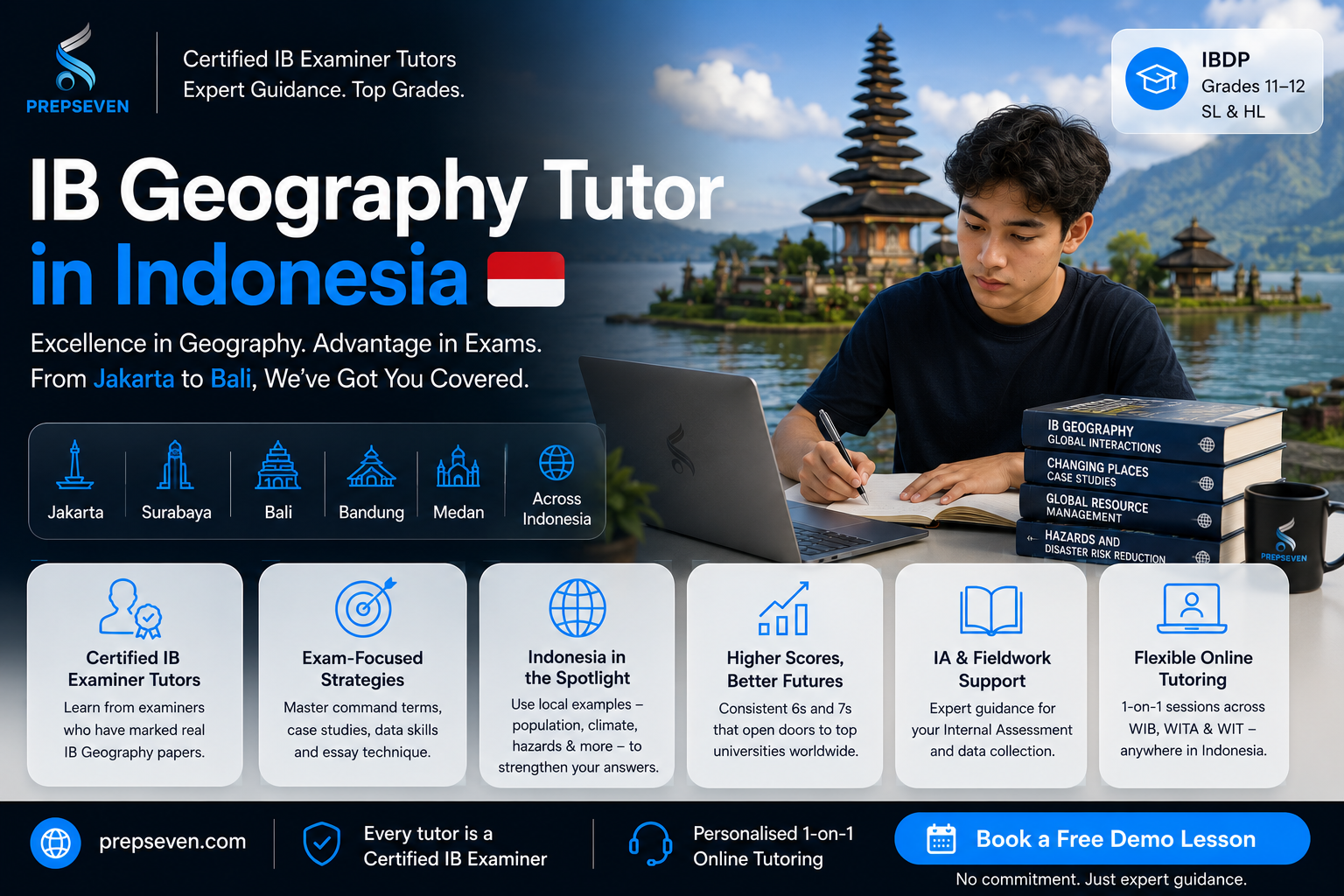
IB Geography in Indonesia: A Rapidly Growing IB Market
Indonesia’s IB school sector has grown dramatically over the past decade. With over 100 IB World Schools concentrated primarily in Jakarta, Surabaya, Bali, Bandung, and Medan — and with a growing number of bilingual national-plus schools adopting IB pathways — Indonesia now has one of the largest IB student populations in Southeast Asia. The children of Indonesia’s expanding upper-middle class and professional families, as well as expatriate students at international schools serving diplomatic and corporate communities, increasingly choose the IB Diploma for its global university recognition and intellectual rigour.
Despite this growth, the IB tutoring market in Indonesia remains dominated by mathematics and science tutoring. IB Geography — one of the most popular Group 3 choices at Indonesian IB schools — is severely underserved by specialist tutors. Most tutoring available to Indonesian IB Geography students is delivered by generalist geography teachers who may have strong subject knowledge but no IB examiner experience. The gap between classroom teaching and examiner-level preparation is where most Indonesian students lose marks they should be earning.
PrepSeven closes this gap with direct access to certified IB Geography examiners — available online to students across all Indonesian cities, time zones, and island groups. For Indonesian IB students targeting top universities in the UK, Australia, the Netherlands, USA, or Singapore, this level of preparation is not a luxury; it is a strategic necessity.
IB Geography Syllabus: A Full Course Breakdown for Indonesian Students
IB Geography is a Group 3 (Individuals and Societies) subject at SL and HL. Its three-tier structure — Core theme in Paper 1, Optional themes in Paper 2, and HL Extension in Paper 3 — is built around the Four Ps framework: Place, Process, Power, and Possibilities. Indonesia’s geography provides some of the most powerful and exam-ready illustrations of all four concepts available to any IB student worldwide.
Core Theme: Three Compulsory Units
The Core theme is studied by all students and examined in Paper 1. Indonesia’s geography aligns with all three core units with exceptional relevance:
- Population Distribution and Changing Population: Examines demographic transition, migration, urbanisation, and population policy. Indonesia is the world’s fourth most populous nation, with approximately 275 million people distributed across a 5,100-kilometre archipelago in one of the most spatially uneven population distributions in the world — over 56% of Indonesians live on the island of Java, which covers only 7% of Indonesia’s land area. Jakarta’s status as one of the world’s largest and most rapidly growing megacities, the government’s ambitious plan to relocate the national capital to Nusantara in East Kalimantan (one of the most significant capital relocation projects in modern geographic history), and Indonesia’s demographic dividend as a young-median-age nation transitioning through its demographic window — all provide Grade 7-level case study material for Paper 1.
- Global Climate — Vulnerability and Resilience: Examines climate change science, vulnerability patterns, and adaptive and mitigative responses. Indonesia is one of the world’s most climate-vulnerable nations. Jakarta — until recently the world’s fastest-sinking city, with parts of North Jakarta subsiding at over 25 centimetres per year due to groundwater extraction — faces a compound hazard of land subsidence and sea-level rise that has driven the capital relocation decision. Indonesia’s vast tropical forest estate (third largest in the world) makes it a critical actor in global carbon cycling, while the annual haze crises driven by peat and forest fires in Sumatra and Kalimantan generate one of the world’s most studied transboundary air pollution geography cases.
- Global Resource Consumption and Security: Addresses food, water, and energy security through a systems lens. Indonesia’s resource geography is exceptional in its complexity and global significance: it is one of the world’s largest producers of palm oil, coal, nickel, and tin; it faces critical deforestation pressure as agricultural expansion competes with tropical forest conservation; and its energy transition from coal dependency to renewable development (geothermal energy — Indonesia has the world’s second largest geothermal potential — solar, and hydro) represents one of the most geographically consequential energy transitions occurring anywhere in the developing world.
HL Extension: Three Advanced Units
HL students study three additional units examined in Paper 3, requiring integrative synthesis at the highest conceptual level. Indonesia’s global geographic significance makes it an exceptional HL extension case study resource:
- Global Interactions, Power, and Networks: Indonesia’s role as the world’s largest Muslim-majority democracy, its position as a founding member of ASEAN, its place in global commodity supply chains (palm oil, coal, nickel for EV batteries), and its strategic location astride the Malacca and Lombok Straits — through which approximately 40% of global trade passes — make it one of the most geographically significant middle powers in the contemporary world. Indonesian HL students who deploy this material analytically have access to case study depth that most of their global peers cannot match.
- Human Development and Diversity: Indonesia’s internal development geography is staggering in its diversity: HDI scores range from near-European levels in Jakarta and Bali to some of the lowest in Asia in parts of Papua and East Nusa Tenggara. The country’s 300 ethnic groups, 700 distinct languages, and four constitutionally recognised religions create a human diversity landscape that directly illustrates this unit’s core themes. The politics of regional autonomy (otonomi daerah) and the uneven geography of development across the archipelago provide rich analytical material.
- Global Risks and Resilience: Indonesia sits on the most seismically active portion of the Pacific Ring of Fire. It experiences more earthquakes, volcanic eruptions, and tsunamis annually than almost any other nation. The 2004 Boxing Day Tsunami, the 2006 Yogyakarta earthquake, the 2018 Lombok and Palu earthquake-tsunami sequences, and the ongoing activity of Merapi, Krakatau, and Sinabung volcanoes make Indonesia one of the world’s most studied natural hazard geographies. Combined with climate-driven flood risk, peat fire hazard, and coastal erosion vulnerability, Indonesia’s risk profile is arguably the most complex of any nation on Earth — and an extraordinary resource for HL extension work.
Optional Themes: Full Coverage for Indonesian IB Schools
Paper-by-Paper Examination Strategy for Indonesian Students
Paper 1 — Core Theme Examination
Paper 1 assesses the three core units through structured questions culminating in an extended essay. SL students sit 1 hour 30 minutes; HL students 2 hours 15 minutes.
Indonesian students have extraordinary geographic content available for Paper 1 — but the most common failure mode is narrating Indonesia’s geography rather than analysing it through the Four Ps framework. An examiner marking a Paper 1 response on population distribution does not want a factual description of Java’s population density. They want an analysis that evaluates the processes driving hyperconcentric population distribution on Java, assesses the power dynamics between central government, local authorities, and communities in shaping spatial population patterns, and projects the geographic possibilities and risks of the Nusantara capital relocation as a spatial rebalancing strategy — all written with geographic precision and current data.
PrepSeven tutors train Indonesian students to make this analytical shift. The geographic knowledge is already exceptionally rich; the framework is what converts it from a competent response to a Grade 7 response.
Paper 2 — Optional Theme Examination
Paper 2 examines the optional themes studied at the student’s school. SL students answer from two themes; HL from three. Indonesia’s relevance across multiple optional themes is unmatched in Southeast Asia: Bali for Leisure and Tourism, the Java coast for Oceans and Coastal Margins, Merapi and the 2018 Palu sequence for Geophysical Hazards, Jakarta for Urban Environments.
The critical discipline PrepSeven tutors instil for Indonesian Paper 2 is evaluation over narration. Bali’s overtourism is one of the most vivid cases in IB Geography — but a response that narrates tourism growth without evaluating the geographic consequences for local communities, the environment, and the Balinese cultural landscape, and without assessing the power dynamics between international tourism corporations, the Indonesian government, and local stakeholders, will not reach Grade 7. The Four Ps framework is what elevates Indonesian geographic examples from vivid to analytically powerful.
Paper 3 — HL Extension (Higher Level Only)
Paper 3 demands the highest level of geographic synthesis. For Indonesian HL students, the combination of Indonesia’s Global Interactions significance (Malacca Strait, ASEAN, commodity supply chains), its extraordinary Human Development diversity (Papua to Jakarta HDI range), and its unparalleled natural hazard risk profile creates a Paper 3 case study resource of exceptional depth.
Indonesian HL students who can argue, for example, that Indonesia’s nickel export geography represents a strategic Power intervention in the global EV battery supply chain — and evaluate the Possibilities this creates for Indonesia’s economic development trajectory versus the environmental and social costs it imposes on Sulawesi’s mining regions — are writing Paper 3 responses at the very top of the IB Geography mark range. PrepSeven tutors help Indonesian HL students develop this level of geographic argumentation from the start of their HL extension work.
IB Geography Internal Assessment: The Indonesian Student’s Guide
The IB Geography IA is a fieldwork-based investigation required of every student. Indonesia offers some of the most geographically distinctive IA fieldwork environments in the world — from coastal erosion mapping on Java’s north coast to volcanic hazard risk perception surveys near Merapi, from mangrove extent change analysis in Kalimantan to urban microclimate comparisons across Jakarta’s diverse districts, from tourism impact assessment in Bali to agricultural land use change mapping in periurban Bandung.
PrepSeven tutors experienced with Indonesian IA submissions help students select topics that are geographically original, practically feasible for primary data collection in Indonesian environments, and structured to score well across all five IB moderation criteria. We are particularly experienced supporting IAs involving volcanic hazard geography, coastal and mangrove geography, urban heat island studies in Indonesian cities, and tourism impact investigations in Bali and Lombok.
Most Common IA Errors Among Indonesian IB Geography Students
- Writing the IA in a style influenced by Indonesian academic conventions — more descriptive and less analytical than IB moderators expect; IB requires geographic evaluation, not encyclopaedic description
- Choosing fieldwork topics that are geographically dramatic but methodologically weak — Indonesia’s volcanoes are extraordinary, but a descriptive write-up about Merapi without primary hazard perception data or spatial analysis does not constitute a geographic investigation
- Exceeding the 2,500-word limit — IB digital parsing tools are strict; content beyond the limit is not assessed regardless of quality
- Missing the environmental ethics and safety declaration — critical for Indonesian fieldwork environments where natural hazard, environmental sensitivity, and community permissions may be relevant
- Over-relying on Indonesian government statistical data (BPS Badan Pusat Statistik) without collecting genuine primary field data
- Writing research questions that are too broad or too socially framed — IB Geography IA requires a geographically specific investigation with spatial and scalar dimensions
The Four Ps Framework Applied to Indonesian Geography
Indonesia’s geography provides some of the world’s richest illustrations of all four IB Geography conceptual pillars. PrepSeven tutors train Indonesian students to deploy these as active analytical lenses — making it impossible to write a merely descriptive IB Geography response.
IB Schools Across Indonesia: Who PrepSeven Serves
All PrepSeven tutoring is delivered 100% online. Whether a student is at Jakarta Intercultural School in South Jakarta, Green School Bali, or an international school serving a remote resource extraction community in Kalimantan or Papua, PrepSeven’s examiner-tutors are accessible without geographic constraint.
IB Geography and University Admissions for Indonesian Students
For Indonesian IB students, strong performance in IB Geography carries significant weight in university admissions across the primary destination countries: Australia, the UK, the Netherlands, Singapore, and the USA.
Australian universities — particularly the Group of Eight institutions including ANU, Melbourne, Sydney, and UQ — are the most common international university destination for Indonesian IB graduates. IB Geography HL at Grade 6 or 7 is accepted for social science, environmental science, and humanities programmes at all Go8 universities, and many offer course credit exemptions that reduce first-year unit requirements. The University of Melbourne’s generous IB credit transfer policy is particularly well-known among Indonesian IB families.
For students targeting the UK, IB Geography HL at Grade 6 or 7 meets the subject requirements for Geography, Development Studies, Environmental Policy, and related programmes at UCL, LSE, Edinburgh, Bristol, and Exeter. Dutch universities — including Amsterdam, Leiden, and Utrecht — are growing in popularity among Indonesian IB graduates and accept IB Geography HL for social science and environmental programmes.
PrepSeven tutors discuss specific university grade targets with Indonesian students and families, helping calibrate IB Geography preparation toward the precise score thresholds that matter for each student’s university ambitions.
How PrepSeven IB Geography Tutoring Works for Indonesian Students
How Indonesian Students Can Score a Grade 7 in IB Geography
Indonesian IB Geography students hold a remarkable natural advantage: they live in one of the most geographically significant, diverse, and globally important countries on Earth. The gap between Grade 5 and Grade 7 is almost never about content — it is about analytical framework and academic English precision. PrepSeven’s examiner-tutors identify these as the decisive factors:
- Deploy the Four Ps in every extended response — Indonesia’s geography is vivid and complex; the Four Ps framework is what converts vivid description into Grade 7 geographic analysis
- Use Indonesian examples with precise current data — BPS population statistics, BNPB disaster data, Ministry of Energy renewable targets, KLHK deforestation rates — signal examiner-ready evidence quality
- Write at multiple geographic scales simultaneously — connect an Indonesian example (Jakarta’s subsidence, a specific Bali resort, a Kalimantan palm oil concession) to ASEAN regional and global geographic patterns within the same response
- For EAL students, prioritise analytical clarity over linguistic complexity — precise, accurate geographic analysis in clear English consistently outperforms elaborate writing that obscures geographic thinking; examiners reward geographic understanding, not vocabulary sophistication
- For HL Paper 3, build a genuine geographic thesis and sustain it — the Nusantara relocation, Indonesia’s nickel export strategy, or ASEAN’s regional development geography all offer thesis-rich Paper 3 material that most global peers cannot access
- Complete your IA within 2,500 words and include the environmental ethics declaration — particularly important for Indonesian fieldwork environments involving natural hazards, protected forests, or Indigenous community interactions
- Master all IB command terms under timed conditions — Indonesian students from national curriculum backgrounds sometimes conflate evaluate, examine, and discuss; these require distinct argumentative structures that must be rehearsed explicitly
- Complete at least five full IB Geography past papers under timed conditions before your exam session