

IB French Tutor in Germany — Certified IB Examiners for German IB Students
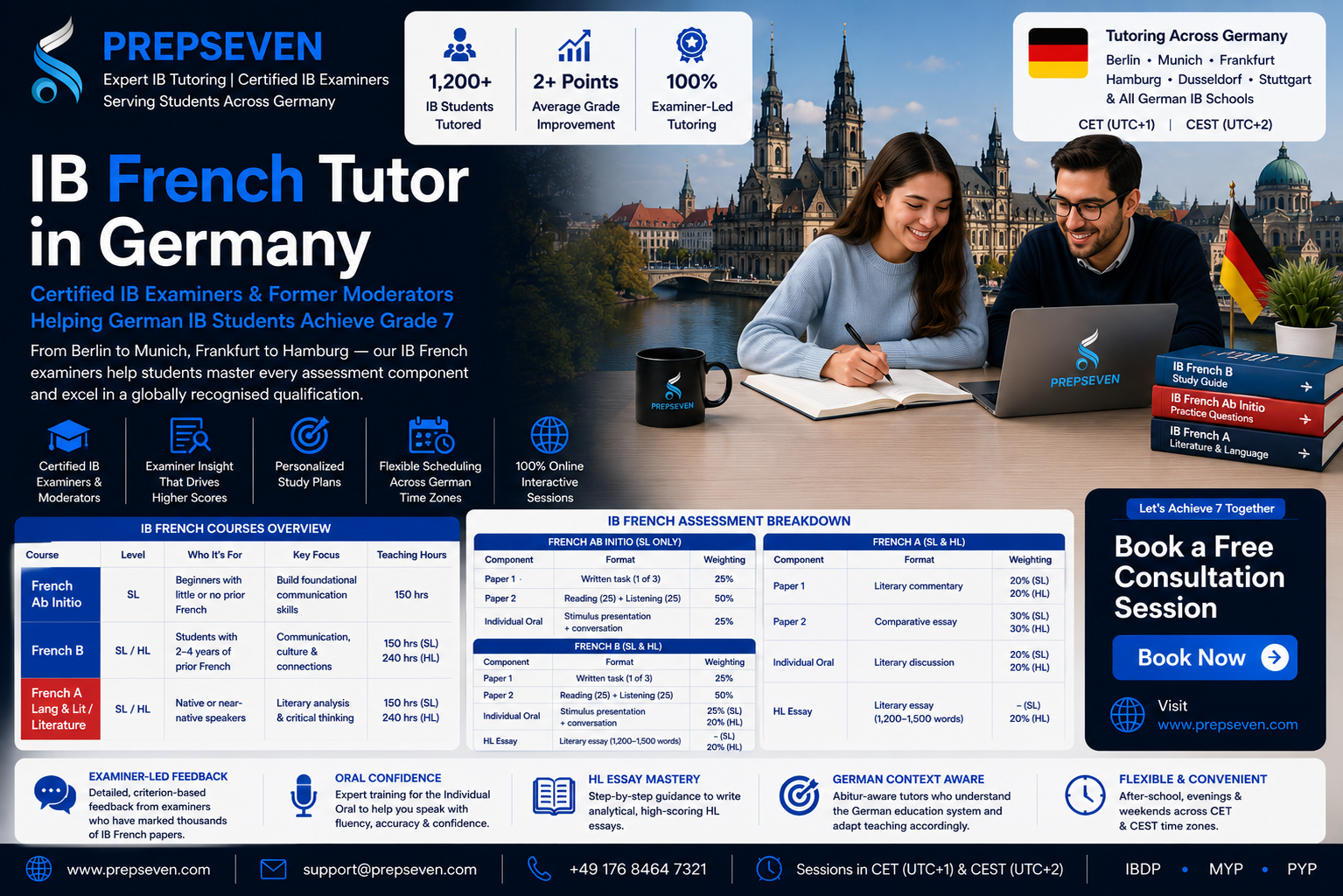
Germany presents one of Europe’s most rigorous and rapidly growing IB markets. Across Berlin, Munich, Frankfurt, Hamburg, and Dusseldorf, a well-established network of international schools serves the children of expatriate professionals, diplomatic families, and an increasing number of German families who choose the IBDP over the Abitur for its international recognition and its distinct pedagogical approach. Within this landscape, IB French carries particular strategic weight — not despite Germany’s own strong tradition of foreign language education, but because of it.
Germany’s education system places heavy emphasis on foreign language competency, and German students are frequently multilingual by the time they reach secondary school — commonly proficient in German, English, and often French or Spanish through the Gymnasium system. This creates an unusual profile for IB French students in Germany: many arrive with a genuinely strong European language learning foundation and specific expectations, shaped by the German school tradition, about how language courses should be structured and assessed. The IB’s descriptor-based, communicatively focused assessment framework often differs meaningfully from what German students and families expect from a language qualification — and understanding this difference is central to effective preparation.
PrepSeven connects German IB students with certified IB examiner-tutors who understand both the IBO’s global assessment framework and the specific expectations and prior learning that German students bring to IB French. This dual fluency — in the IB system and in the German educational context — is what makes PrepSeven’s preparation distinctly effective for this market.
IB French in Germany: Context, the Abitur Comparison, and Preparation Gaps
Germany has more than 100 IB World Schools, with the largest concentrations in Berlin, Munich, Frankfurt, and the international school corridor around Frankfurt’s financial and corporate sector. Many of these schools serve a genuinely international population — expatriate families connected to Germany’s banking, automotive, pharmaceutical, and engineering industries — alongside a growing cohort of German national families who specifically choose the IBDP as an alternative or complement to the German Abitur system.
For German national families, the decision to pursue the IBDP instead of, or alongside, the Abitur is often made with an eye toward international university admissions — particularly to universities in the UK, US, Netherlands, and increasingly universities in Germany itself that now accept the IB Diploma as an equivalent qualification to the Abitur (Hochschulzugangsberechtigung). This equivalence recognition means that a strong IB Diploma, including a strong IB French grade, functions as a genuine alternative pathway into competitive German universities like LMU Munich, Humboldt University Berlin, and the Technical University of Munich.
Within German IB schools, French is typically the second or third foreign language most students encounter, following English (near-universal from primary school in Germany) and often preceding or following Spanish. This means German IB French students frequently have more developed metalinguistic awareness and general language-learning strategy than students in less multilingual markets — an advantage PrepSeven tutors build on directly.
IB French vs Abitur Foreign Language Assessment: What German Families Should Understand
A significant number of German IB families have direct or indirect exposure to the Abitur system through relatives, prior schooling, or general cultural familiarity. Understanding how IB French differs from Abitur foreign language assessment is essential for setting accurate preparation expectations — because the two systems assess fundamentally different things in fundamentally different ways.
The Abitur’s foreign language components (Franzosisch as a Leistungskurs or Grundkurs) typically emphasise textual analysis of literary and non-literary texts, structured written examinations testing comprehension and composition, and an oral examination component that varies by federal state (Bundesland). The IB’s French B and French A courses share some superficial similarity — written papers, oral assessment — but the underlying assessment philosophy, the specific text types required, the descriptor-based marking criteria, and the Individual Oral format are all distinctly different from any German Bundesland’s Abitur framework.
The practical implication for German families is significant: a tutor experienced with Abitur Franzosisch preparation is not automatically well-prepared to teach IB French, even though both are advanced European language qualifications. PrepSeven tutors are IB specialists first — every session is calibrated to the IBO’s specific assessment framework, not adapted from Abitur preparation habits.
IB French Course Pathways in German Schools
French Ab Initio — For Students New to French
Ab Initio is taken by German IB students who have not studied French previously — often students who took Spanish or another language as their second foreign language in the German school system, or international students who arrived in Germany without prior French exposure. Available at SL only, the course covers the five IBO themes over 150 teaching hours and is assessed through two written papers and a recorded Individual Oral.
German Ab Initio students often bring strong general language-learning skills from their English and German bilingual foundation, which accelerates certain aspects of French acquisition — particularly grammatical pattern recognition, since German’s case system and gendered nouns share some conceptual similarity with French’s gender and agreement system (even though the specific rules differ substantially). PrepSeven tutors leverage this existing grammatical awareness explicitly, which is often a faster path to competency than starting from a purely English-speaking foundation.
French B SL and HL — The Standard German IB Pathway
French B is the most common IB French course in German schools, typically taken by students who studied French for several years in the German Gymnasium system before transitioning to the IBDP, or by students who chose French as their Language B from the start of the Diploma Programme. At HL, the course demands 240 teaching hours and includes the HL Essay — a component that has no direct equivalent in the German Abitur system and that consistently proves to be the most conceptually unfamiliar element of French B HL for German students.
For German French B HL students, the HL Essay’s requirement for sustained independent literary argument, submitted without teacher correction, differs from the more structured and teacher-guided approach typical of German language instruction. PrepSeven’s HL Essay preparation addresses this directly, building the independent analytical capability the IBO rewards through a structured multi-draft process.
French A Language & Literature and Literature — For Francophone Students in Germany
French A is taken in Germany by native or near-native French speakers — typically students from French expatriate families connected to Germany’s Franco-German business and diplomatic relationships, students from French-German bilingual households, or students who attended French-medium schooling (including the Lycee Francais in several German cities) before entering an IB World School. The course treats French as a literary and analytical discipline, assessed through close textual analysis and comparative essay writing.
Complete IB French Assessment Structure for German Students
The IBO applies an identical assessment framework to German students as to students in every other country. Below is the full component-by-component breakdown across all three course pathways.
French Ab Initio — Component Breakdown
French B SL and HL — Component Breakdown
French A Language & Literature — Component Breakdown
German-French Language Transfer: What Makes German Students’ Preparation Distinct
German is grammatically closer to French than English is, in specific and useful ways — but the differences are equally specific and require targeted correction. Understanding these transfer patterns is one of the most valuable things a PrepSeven examiner-tutor brings to a German IB French student.
Where German Helps French Acquisition
- Grammatical gender awareness: German’s three-gender system (der/die/das) means German students already understand the concept of grammatical gender, even though French’s two-gender system (le/la) does not map directly onto German gender assignments — the conceptual foundation transfers even when specific word genders do not
- Case system familiarity: German’s four-case system develops sensitivity to word function within a sentence that supports understanding of French pronoun placement and object agreement, even though French does not have a case system in the same form
- Compound and formal register: German’s tradition of formal written register (particularly in academic and Abitur-style writing) supports the formal register the IBO’s Paper 1 tasks and HL Essay require
Where German Creates Specific Interference in French
- Verb position: German’s verb-second (V2) word order and verb-final subordinate clause structure create specific and predictable errors in French sentence construction, where verb position rules differ substantially
- Gender mismatches: Many German-French cognates have different genders (e.g., ‘die Sonne’ is feminine in German, but the French cognate structure does not always align) — this creates specific, correctable transfer errors rather than a general gender-blindness
- False friends (faux amis): German and French share many Latin-derived vocabulary items with different meanings — a systematic source of Paper 1 and Paper 2 vocabulary errors that requires explicit vocabulary instruction rather than assumption of transparency
- Formality register transfer: German formal register conventions (particularly the Sie/du distinction) do not map directly onto French’s tu/vous system in all contexts, particularly in the specific text types the IBO Paper 1 requires
PrepSeven tutors run a German-French transfer diagnostic in the first session, identifying which of these patterns are actively affecting each student’s French production, and building targeted correction into the preparation plan from day one.
The IB French Individual Oral: What German Students Must Prepare For Differently
German IB French students frequently approach the Individual Oral with the assumption, shaped by German language-learning culture, that grammatical precision is the primary determinant of a strong oral performance. This assumption is only partially correct — and understanding the gap is one of the fastest routes to grade improvement for German students.
The IBO’s IO descriptor table assesses five distinct criteria: language accuracy, vocabulary range, message development, register appropriateness, and interactive responsiveness. German students frequently score well on language accuracy (Criterion A) — a reflection of the German education system’s strong grammatical instruction tradition — but underperform on interactive skills (Criterion D), which rewards spontaneous idea development and natural conversational responsiveness rather than grammatically perfect but rehearsed-sounding responses.
IO Structure Across All Three Courses
IB French HL Essay in Germany: Building Independent Analytical Argument
The HL Essay is 20% of the final IB French grade for French B HL and French A HL students. It requires a 1,200 to 1,500 word independent literary analysis submitted as coursework and marked externally by the IBO. For German students accustomed to the more structured, teacher-guided approach to written literary analysis common in the Gymnasium tradition, the HL Essay’s requirement for independent thesis development and argument construction, without teacher correction, represents a genuine pedagogical shift.
German IB schools typically schedule the HL Essay internal deadline in the winter term of Year 2 (Januar/Februar), coinciding with the intensive preparation period for the May external examinations and, for students at schools offering both IB and German qualifications, potential overlap with Abitur-track deadlines for peers. PrepSeven recommends beginning HL Essay preparation in the summer term of Year 1 (Mai/Juni) to build the independent analytical skill progressively rather than under year-end pressure.
IB French Syllabus Themes: German Contexts as Vocabulary Anchors
The five IBO prescribed themes structure all IB French courses. For German students, connecting these themes to familiar national, European, and Franco-German contexts accelerates vocabulary retention and gives students authentic material to draw on for Paper 1 writing tasks and IO presentations.
The Franco-German relationship — from the Elysee Treaty to joint Airbus projects to shared EU governance — provides Germany’s IB French students with uniquely rich, authentic material for Paper 1 tasks and IO presentations on themes like Human Ingenuity and Social Organisation. PrepSeven tutors help students draw on this genuinely bilateral context, which few other national contexts can offer as naturally.
Paper 2 Listening: Building on Germany’s Strong Language Education Foundation
Paper 2 carries 50% of the IB French grade for Ab Initio and French B students. German students often have a stronger listening comprehension starting point than students in less multilingual markets, given Germany’s strong tradition of foreign language instruction and, for many students, direct exposure to French through school exchange programmes, geographic proximity to France, and media availability.
Even with this advantage, German students benefit significantly from structured, examiner-aligned listening preparation. The specific gap PrepSeven tutors most commonly identify is in processing authentic spoken French at natural pace with regional accent variation — as opposed to the more standardised, textbook-style spoken French typical of German school instruction.
- Diagnostic assessment: identifying whether comprehension gaps are at the gist, detail, or inference level, or a specific accent-recognition issue
- Accent range exposure: systematic practice with Metropolitan French, Belgian French, Swiss French, and Quebec French — accent varieties that appear across IBO listening materials
- Natural speech pace calibration: moving from textbook-pace audio to natural conversational speed with structured comprehension tasks
- Past paper practice: full IBO Paper 2 listening under timed exam conditions with examiner review of response patterns
IB French Grade Descriptors: The Global Standard German Students Are Assessed Against
The IBO applies identical descriptor criteria to German students as to students anywhere else in the world — there is no accommodation for prior Abitur-track expectations or German pedagogical norms. Understanding precisely what separates each grade band is the central strategic contribution PrepSeven’s examiner-tutors make.
A specific insight PrepSeven tutors share with German students: strong Criterion A (language accuracy) scores do not automatically produce strong overall grades. A student who is grammatically flawless but produces underdeveloped ideas (Criterion C) or rehearsed-sounding interaction (Criterion D) will plateau below a 7 despite excellent grammar. PrepSeven’s feedback explicitly separates these criteria so German students understand exactly where their strong grammatical foundation needs to be paired with other skills.
IB French and German + International University Admissions
For German IB students, the IB Diploma’s recognition as equivalent to the Abitur (Hochschulzugangsberechtigung) means that strong IB grades, including IB French, support applications to both German universities and international destinations. This dual-pathway relevance makes IB French performance doubly consequential for German IB students.
For German university applications — LMU Munich, Humboldt University Berlin, Technical University of Munich, Heidelberg University, and others — the IB total score is evaluated against the Numerus Clausus (NC) admission thresholds that many competitive German programmes require. A strong IB French grade contributes to the total score that determines NC eligibility.
For international applications — UK Russell Group universities, Dutch universities, and US institutions — IB French is read alongside the rest of the IB profile as evidence of the well-rounded, multilingual academic profile that competitive international admissions offices look for. German students with strong French alongside their native German and fluent English present a distinctly strong trilingual profile that resonates particularly well with European and international humanities, social science, and business programmes.