

IB French Tutor in Canada — Certified IB Examiners for Canadian Students
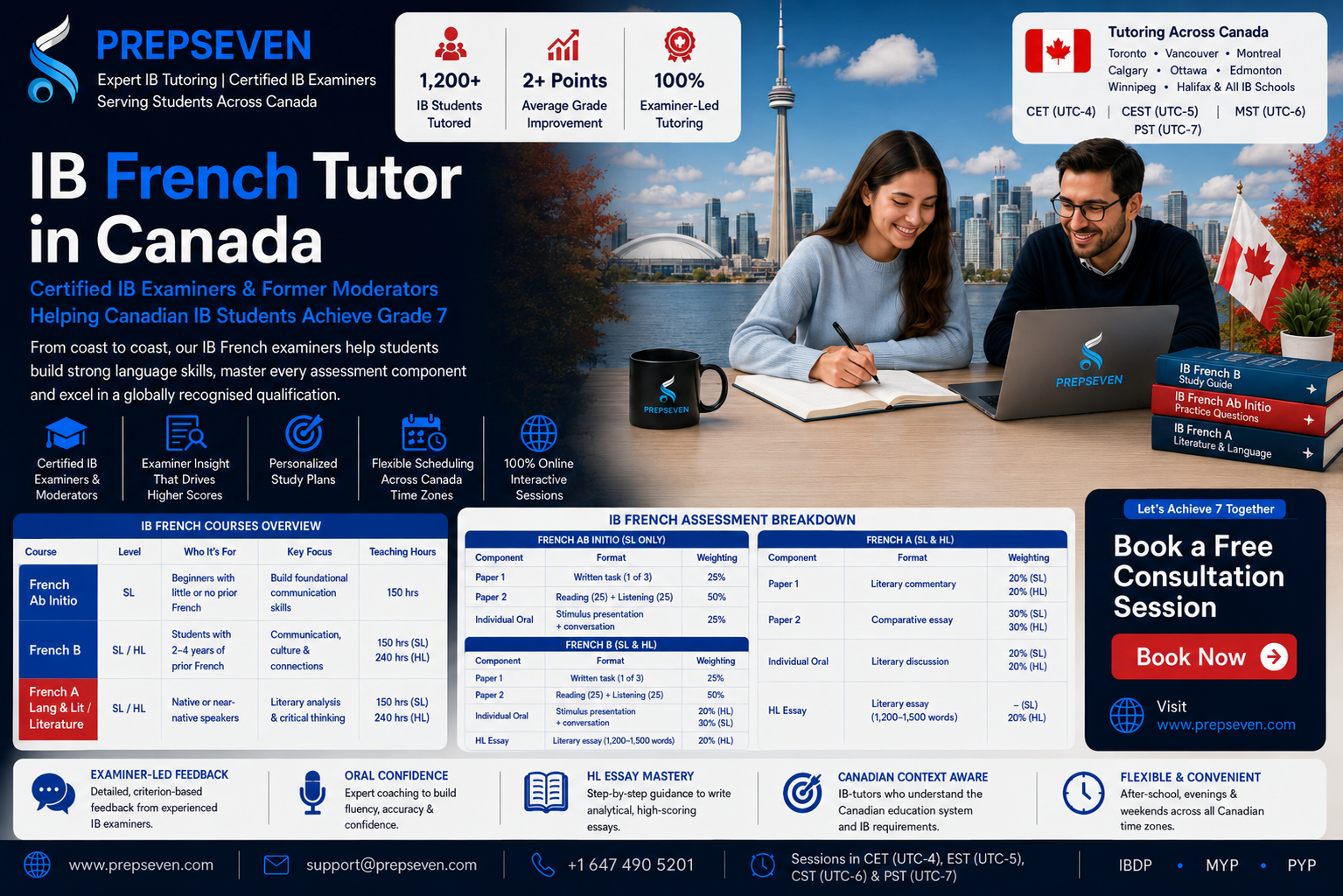
Canada occupies a genuinely unique position in the global IB French landscape. As one of two officially bilingual countries in the G7, Canada is the only major IB market where French is a working language of government, education, and daily life for a significant portion of the population. Quebec, large parts of New Brunswick, Eastern Ontario, and francophone communities across the country mean that Canadian IB students encounter French in a context that no other English-speaking IB market replicates.
Yet despite — and in some ways because of — this bilingual context, Canadian IB French students face preparation challenges that are distinct from those in the UK, Singapore, or the UAE. Students from anglophone households in Toronto, Vancouver, or Calgary approach IB French B with very different prior exposure than students in Montreal or Ottawa. Students from francophone households often find themselves in IB French A — a course that assesses literary and analytical sophistication rather than language acquisition. And students from allophone households (Chinese, Punjabi, Tagalog, Arabic, and many others) face the challenge of French as a third or fourth language in a country that officially positions it as a second.
PrepSeven connects Canadian IB students with certified IB examiner-tutors who understand all three of these student profiles and can deliver targeted preparation calibrated to the IBO assessment framework — not the Ontario Secondary School Diploma, not the Quebec education system, but the global IB standard that will determine the final grade on your child’s diploma.
IB French in Canada: A Bilingual Country’s Complex Relationship With the Course
Canada has over 350 IB World Schools — one of the largest national IB communities globally. The distribution is geographically wide: major concentrations in Toronto, Vancouver, Montreal, Calgary, Ottawa, and Victoria, with additional schools in mid-sized cities across every province.
The bilingual national context creates a pronounced bifurcation in how IB French is experienced. In Ontario and British Columbia, where the majority of IB World Schools operate in English-medium environments, IB French B is the standard choice for students who have completed Core French at the provincial level — typically several years of instruction with widely varying quality. In Quebec, where French is the language of instruction in public schools, the IB French profile is quite different: many students take French A Language & Literature, and the course functions as a literary discipline rather than a language acquisition exercise.
This split matters for preparation strategy. A student in Vancouver taking French B HL after years of Core French in BC schools has a very different preparation profile than a student in Montreal taking French A HL after completing secondary school in French. PrepSeven tutors are experienced with both profiles — and with the many hybrid cases in between.
The Canadian Bilingual Advantage — and Its IB Complications
Canada’s official bilingualism is a genuine asset for IB French students in some respects and a complicating factor in others. Understanding both sides of this dynamic is important for effective preparation.
The Advantage: More Authentic French Exposure
Canadian students — particularly those in provinces with strong Core French programmes, French immersion schools, or proximity to francophone communities — often have more authentic exposure to spoken and written French than their counterparts in the UAE or Singapore. This means that Paper 2 listening comprehension is less of a foreign skill, and that the vocal register required for the Individual Oral may develop more naturally through everyday exposure.
Additionally, Canadian students are often familiar with Quebec French — a distinct regional variety that occasionally appears in IBO listening materials. Students who recognise Quebec French as a legitimate and familiar accent, rather than an unexpected deviation from Metropolitan French, are not disoriented by it in the exam.
The Complication: Overconfidence in Core French Students
The most common preparation error PrepSeven tutors identify among English-Canadian IB French students is overconfidence rooted in Core French instruction. Years of provincial Core French — which typically prioritises communicative fluency in simple contexts — can create the impression that the student is well prepared for IB French B. In practice, Core French does not develop the text-type production skills, the thematic analytical vocabulary, or the literary engagement that IB French B (and especially HL) requires.
A student who can hold a comfortable conversation in French but has never written a formal letter, a report, or a persuasive speech in French — in the specific text-type conventions the IBO mandates — will struggle on Paper 1. PrepSeven tutors address this gap directly from the first session, mapping the student’s Core French foundation against IBO expectations and identifying the specific production skills that need development.
The Quebec Context: French A Students in Canada
Quebec students taking IB French A Language & Literature or Literature occupy a position unlike almost any other IB French cohort globally: they are native speakers of French in a society where French is the dominant public language, taking a course that treats French as a literary discipline. The preparation challenges for these students are not about language acquisition — they are about analytical precision, the specific conventions of IB literary essay writing, and the global issue framing required in the Individual Oral. PrepSeven’s French A tutors are specifically equipped for this profile.
IB French Course Pathways for Canadian Students
French Ab Initio — For Canadian Students With No Prior French
Ab Initio is less common in Canada than in most other IB markets, precisely because provincial Core French programmes mean that most students entering the IBDP have had some French instruction. However, it is the right choice for students who moved to Canada from non-Francophone countries and have no French background, or for students in provinces with very limited Core French provision who genuinely lack foundational French exposure.
Canadian Ab Initio students benefit from the ambient French environment to some degree — French-labelled products, bilingual signage, and French media exposure are unavoidable in many Canadian contexts. PrepSeven tutors build on this ambient exposure systematically, using familiar Canadian French contexts as vocabulary anchors for the five IBO themes.
French B SL and HL — The Standard Canadian Pathway
French B is by far the most common IB French course at Canadian IB schools. At Standard Level, it serves students with solid but not advanced Core French foundations. At Higher Level — the course PrepSeven most frequently supports — it demands 240 teaching hours and includes the HL Essay: a 1,200 to 1,500 word independent literary analysis submitted as coursework and marked externally.
For Ontario students, the HL Essay submission timeline typically falls in January or February of Year 2, coinciding with university application deadlines for Ontario University Application Centre (OUAC) submissions. This scheduling pressure is one of the most common reasons Canadian French B HL students underperform on the HL Essay — and one of the most predictable reasons PrepSeven tutors recommend starting HL Essay preparation in June of Year 1.
French A Language & Literature and Literature — The Quebec and Bilingual Stream
French A is taken by native or near-native French speakers in Canada. This includes Quebec students in IB schools, students from French immersion backgrounds who reach near-native proficiency, and students from Francophone families in New Brunswick, Eastern Ontario, and other bilingual regions. French A is assessed through literary analysis, comparative essays, and an Individual Oral that requires sophisticated engagement with a global issue through both literary and non-literary texts.
Complete IB French Assessment Structure for Canadian Students
The IBO assessment framework is identical for Canadian students and students everywhere else in the world. What differs is the preparation context. Below is the full component-by-component breakdown, with examiner commentary on what each component requires.
French Ab Initio
French B SL and HL
French A Language & Literature
The IB French Individual Oral: What Canadian Students Must Know
The Individual Oral is the highest-variance component of IB French for Canadian students. Students from French immersion backgrounds or Francophone households often approach it with confidence — and that confidence can mask a preparation gap. The IO is not simply a test of spoken French fluency. It is assessed against a detailed descriptor table that rewards specific analytical skills, vocabulary precision, and interactive responsiveness. A fluent French speaker who does not know the descriptor criteria will consistently underperform a less fluent student who does.
For anglophone Canadian French B students, the IO presents the mirror challenge: anxiety about spoken production often leads students to prepare only the presentation phase and neglect the follow-up and general conversation phases, which together account for more than half the IO’s duration.
IO Structure Across All Three French Courses
IB French HL Essay in Canada: The OUAC Collision Problem
The HL Essay is worth 20% of the IB French grade for all Higher Level students in French B and French A. It is submitted as independent coursework and marked externally by the IBO. In Canada, the HL Essay creates a specific scheduling problem that PrepSeven tutors have observed consistently across Canadian student cohorts.
In Ontario, the OUAC (Ontario Universities Application Centre) deadline falls in mid-January of Year 2. In British Columbia, university application deadlines for UBC, SFU, and the University of Victoria cluster in the same window. The IB French HL Essay internal deadline at most Canadian schools falls in December or January of Year 2. These two deadlines compete directly, and in almost every case, the university application takes priority — with predictable consequences for the HL Essay’s quality.
The solution is straightforward, but it requires starting early. PrepSeven recommends that Canadian French B HL and French A HL students begin HL Essay preparation in June of Year 1 — before the OUAC and university application season begins. This allows five to six months of structured preparation before the submission window, removing the December-January collision entirely.
IB French Syllabus Themes: Canadian Contexts as Vocabulary Bridges
The five IBO prescribed themes are the organising framework for all IB French courses. For Canadian students, each theme intersects with familiar national, regional, and community contexts — which PrepSeven tutors use as vocabulary acquisition anchors. Learning the French for ‘national identity’ is more efficient when anchored to the specific Canadian debates about bilingualism, multiculturalism, and Quebec sovereignty that students already know and have opinions on.
PrepSeven tutors build theme-specific vocabulary notebooks with each Canadian student, linking IBO thematic vocabulary to Canadian contexts the student already understands. This approach is significantly more efficient than teaching thematic vocabulary in the abstract — it leverages existing conceptual knowledge and creates durable retrieval pathways.
Paper 2 Listening in Canada: A Different Challenge Than in Other Markets
Canada’s bilingual context gives some IB French students a genuine listening comprehension advantage over peers in Asia, the Middle East, or the UK — but this advantage is frequently overestimated, and it evaporates entirely for anglophone Canadian students from provinces with weak Core French programmes.
IBO listening materials use a range of authentic French accents, including Metropolitan French, Belgian French, Swiss French, and Quebec French. Canadian students from French immersion backgrounds or Quebec schooling are typically comfortable with the Quebec accent but may be less prepared for Belgian or Swiss French varieties. PrepSeven listening preparation ensures that students are not caught off guard by any authentic French accent in the exam.
For anglophone Canadian students with Core French backgrounds — typically the largest group — listening preparation requires the same systematic approach as for students in any other English-dominant IB market:
- Diagnostic listening to identify specific comprehension failure modes (gist, detail, inference, vocabulary gaps)
- Graduated authentic audio exposure from 85% to 110% of natural speech pace with guided tasks
- Past IBO Paper 2 listening under timed exam conditions with examiner review of responses
- Distractor management training — understanding how IBO listening questions construct plausible wrong answers
IB French Grade Descriptors: The Examiner Standard Canadian Students Are Held To
Canadian students are assessed against the same IBO descriptor criteria as every other IB student in the world. There is no regional adjustment, no consideration of Core French quality, and no acknowledgement of the OUAC timeline collision. The IBO rubric is the only standard that matters — and PrepSeven tutors are the only category of tutor who has applied it in an official capacity.
IB French and Canadian University Admissions: What Admission Officers Look For
Canada’s leading universities — University of Toronto, McGill, UBC, Queen’s, Western, Waterloo, McMaster, and others — are experienced evaluators of IB grades. Admissions offices at these institutions understand the IB grading scale well, and a strong IB French grade carries real weight — particularly for applications to Faculties of Arts, Modern Languages, Education, and Law.
For students applying to French-medium programmes at McGill’s Faculty of Arts, the University of Ottawa’s bilingual programmes, or Quebec’s CEGEP-to-university pathway, IB French performance is directly relevant to admissions criteria. A 7 in French B HL or French A SL/HL from an IB World School is read by Quebec universities as strong evidence of the linguistic and analytical competency their programmes require.
For students applying to English-medium programmes, IB French contributes to the overall IB total score that universities use in their conditional offer calculations. At University of Toronto (St. George) and UBC’s most competitive faculties, every point in the IB total score is material. An improvement from a 5 to a 7 in IB French — achievable with structured examiner-level preparation — adds two points to the IB total, which can be the difference between a conditional offer and a rejection at cutoff-competitive programmes.