

PrepSeven
IB ESS Tutor in Germany
Expert Online IB Environmental Systems and Societies Tutoring for Students Across Germany’s International Schools
Every tutor is a certified or former IB examiner. SL & HL. Fully online.
IB ESS Tutoring in Germany: Examiner Precision Meets Europe’s Environmental Ambition
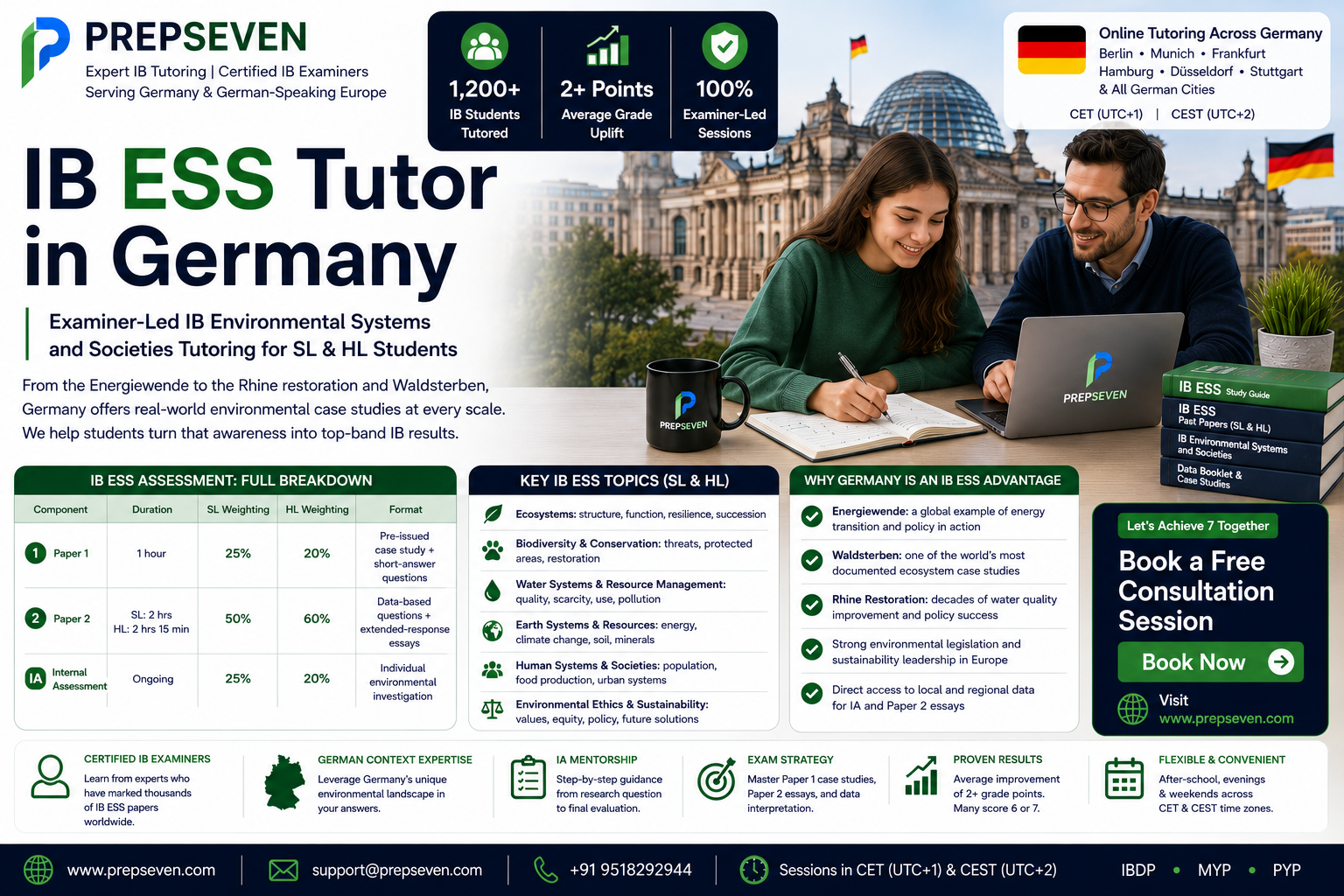
Germany occupies a unique position in the global environmental conversation. As the largest economy in Europe and one of the world’s most significant industrial powers, Germany has also produced some of the most ambitious and carefully engineered environmental policy frameworks of the modern era. The Energiewende — Germany’s structural transition from fossil fuels to renewable energy — is studied in environmental policy courses worldwide. The country’s forest dieback crisis, known as Waldsterben, is one of the most documented cases of atmospheric pollution’s impact on terrestrial ecosystems. Germany’s river systems — the Rhine, Elbe, Danube, and Weser — have been subjects of landmark environmental restoration programmes. The Wadden Sea, a UNESCO World Heritage Site along the North Sea coast, represents one of Europe’s most significant coastal wetland ecosystems.
For students at Germany’s international schools studying IB Environmental Systems and Societies, this national environmental context is not background reading — it is live, specific, and examination-ready material. The challenge is not awareness; it is the disciplined translation of that awareness into the analytical writing style that IB examiners reward with top marks.
PrepSeven provides that translation. Our IB ESS tutors are certified or former IB examiners who have marked the papers German-based students will sit. They know what a 7 requires — precisely — and they train students to write at that standard, using Germany’s rich environmental landscape as both the laboratory and the case study bank.
Germany’s Energiewende, Waldsterben, and Rhine restoration programmes are not just national stories — they are among the most cited environmental case studies in IB ESS examinations worldwide. PrepSeven tutors help German students use them with examiner-level precision.
IB ESS in Germany: Schools, Students, and Academic Culture
Germany’s International School IB Community
Germany hosts a substantial international school community serving the children of diplomats, international business families, expatriate professionals, and German families pursuing English-medium international education. IB World Schools are found across all major German cities, with the strongest concentrations in Berlin, Frankfurt, Munich, Hamburg, and Düsseldorf.
Frankfurt International School and Munich International School are among the most established and prestigious IB schools in continental Europe, regularly producing students who go on to top universities worldwide. Berlin Brandenburg International School serves one of Germany’s most internationally diverse student populations. Students at these institutions bring a wide range of national backgrounds and prior curriculum experiences — and PrepSeven tutors are experienced in working across this diversity.
The IB in the German Academic Context
Germany’s national education system — centred on the Abitur — is one of the most rigorous in Europe. IB students in Germany therefore exist in an environment that takes academic achievement extremely seriously. Many families choosing the IB over the Abitur do so deliberately, seeking the international portability and university recognition that the Diploma provides. This creates a student profile that is highly motivated and academically capable — but that may encounter IB ESS’s open-ended evaluative essay format as a genuinely new challenge.
The Abitur’s essay tradition, while demanding, tends to reward comprehensive structured argument within clearly defined parameters. IB ESS essays require something more fluid: the ability to construct an evaluative argument in response to an open command term, drawing on named case studies and specific data, and reaching a justified conclusion. PrepSeven tutors bridge this gap precisely, training the specific IB technique on top of the strong academic foundation German students typically bring.
German Environmental Culture as an ESS Asset
Germany’s Umweltbewusstsein — environmental consciousness — runs deep. It is the country that pioneered the Green Party as a major political force, that has the world’s most ambitious renewable energy transition programme underway, and that has passed some of Europe’s most stringent environmental legislation. Students growing up in this culture arrive at IB ESS with genuine familiarity with environmental policy debates, renewable energy systems, and ecological conservation — a significant asset that PrepSeven tutors channel directly into examination preparation.
IB ESS Assessment: A Complete Guide for Students in Germany
How IB ESS Is Examined
IB ESS is assessed through two externally marked papers and one internal assessment. Students in Germany typically sit the May session. The table below summarises the assessment structure for both SL and HL — understanding the mark distribution is essential for building a strategic revision plan.
Paper 1: Case Study Reasoning
Paper 1 is based on a pre-issued case study — a detailed environmental dossier of 10 to 15 pages covering a specific real-world scenario, complete with maps, data, graphs, and contextual text. In the one-hour examination, students answer structured short-answer questions that require them to apply ESS concepts from across the syllabus to this specific context.
For students in Germany accustomed to Abitur-style structured essay questions, Paper 1 presents a distinctive challenge: it rewards systems thinking and contextual application over comprehensive coverage. There is no formula. Students must identify which ESS concepts apply to the case, apply them with precision, and construct responses that match the specific mark-scheme command terms. PrepSeven tutors build this skill through repeated timed practice with real past case study documents.
PrepSeven Paper 1 approach: Timed case study practice with authentic past papers, systematic annotation strategy, systems diagram construction under exam conditions, and mark-scheme comparison after each attempt to develop disciplined self-assessment.
Paper 2: Extended Response and Data Analysis
Paper 2 determines 50% of the final grade at SL and 60% at HL. Section A presents data-based short-answer questions requiring graph interpretation, statistical reasoning, and quantitative environmental analysis. Section B presents four extended-response essay questions from which students choose two — these are where the largest blocks of marks are won or lost.
Students in Germany who bring strong Abitur-style essay discipline sometimes find IB Section B counterintuitive at first. The IB does not reward comprehensive coverage of a topic — it rewards a specifically structured evaluative argument addressing both sides of an environmental question and reaching a justified conclusion. A student who writes three detailed paragraphs on one side of a debate and none on the other will consistently score lower than a student with less content but better evaluative structure. PrepSeven tutors recalibrate this from the very first session.
PrepSeven Paper 2 approach: Command-term precision training, mark-scheme-aligned essay architecture, data graph interpretation drills, German and European environmental case study banks built into practice responses, and full timed past papers with written examiner commentary.
Internal Assessment: Germany as a World-Class Investigation Environment
The ESS IA is a 30-mark individual investigation — 25% of final marks at SL, 20% at HL — assessed against five criteria. For students in Germany, the IA represents a genuine opportunity to conduct locally grounded environmental research in one of Europe’s most environmentally significant and well-documented landscapes. The methodological resources available — public environmental data sets, proximity to forest, river, and coastal ecosystems — are exceptional.
PrepSeven tutors actively help students in Germany design IA investigations rooted in their local environment. Water quality testing in a Rhine or Elbe tributary near their school, tree health assessment across Waldsterben-affected vs. healthy forest sections, urban biodiversity transects comparing green space with built environment in Berlin, Munich, or Hamburg, soil compaction comparison in managed vs. unmanaged woodland, particulate air quality monitoring along a major road corridor, or plant species diversity in rewilded vs. farmed agricultural land — all are methodologically feasible, scientifically significant, and produce strong Personal Engagement scores.
IB ESS Syllabus: What Students in Germany Need to Master
Seven Topics, Two Levels
The revised IB ESS syllabus (first examined 2025) covers seven major topics. Approximate teaching hours at SL and HL are shown below — actual examination weighting varies by session, but these figures provide a reliable guide to content depth and revision priority.
Topics Where German Context Delivers the Greatest Examination Advantage
Atmospheric Systems and Climate Change: The highest-yield topic across both papers — and one where Germany provides outstanding, examination-ready examples. The Energiewende, Germany’s coal phase-out timeline, the impact of atmospheric pollution on the Black Forest (Waldsterben), and Germany’s role in EU climate policy negotiations are all specific, citable cases. PrepSeven tutors ensure students can deploy these with analytical precision, not just general familiarity.
Ecosystems and Ecology: Germany’s temperate deciduous and mixed forests, river floodplain ecosystems, Baltic and North Sea coastal systems, and agricultural landscapes provide direct access to multiple ecosystem types. PrepSeven tutors connect syllabus theory — trophic levels, nutrient cycling, succession, population dynamics — to these environments, making abstract models concrete and memorable.
Biodiversity and Conservation: Germany’s rewilding initiatives, species reintroduction programmes (wolf and lynx recovery in German forests), the Natura 2000 network, and the Wadden Sea conservation framework all provide highly specific, examiner-impressive case study material for Paper 2 essays. PrepSeven tutors build these into each student’s case study bank alongside international examples.
Water and Aquatic Systems: The ecological restoration of the Rhine — one of the most heavily industrialised rivers in Europe — is one of the most compelling freshwater conservation success stories available for IB ESS essay purposes. Alongside river restoration, Germany’s role in the Baltic Sea Action Plan and Wadden Sea management provides rich aquatic systems material. PrepSeven tutors help students use these examples with scientific precision.
Human Systems and Resource Use: Germany’s Energiewende is arguably the world’s most studied example of a large industrial economy attempting a structural transition away from fossil fuels. Its successes, failures, and economic tensions provide exceptional evaluative essay material — a topic that can be argued from multiple environmental value system positions. PrepSeven tutors train students to use this example with the analytical nuance that distinguishes a 7 from a 5.
Soil and Terrestrial Systems: Germany’s agricultural soils — particularly in the North German Plain — are under documented pressure from intensive farming, nitrogen loading, and biodiversity loss. Soil health comparisons between conventional and organic farming systems, or between managed and ancient woodland soils, are methodologically feasible IA investigations for students in rural or semi-rural school locations.
IB ESS and University Admissions from Germany
Where German IB Students Go to University
Students at Germany’s international schools pursue a genuinely global range of university destinations. Many apply to German universities — where the IB Diploma is formally recognised as equivalent to the Abitur (Hochschulzugangsberechtigung) — but also to universities in the Netherlands, UK, Switzerland, and the United States. The IB’s international portability is one of the primary reasons families in Germany choose the Diploma over the national qualification.
For students targeting German universities with strong environmental science programmes — LMU Munich’s Geosciences faculty, Heidelberg University’s Environmental Sciences Institute, or the University of Freiburg’s renowned Forestry and Environmental Sciences programme — IB ESS HL provides directly relevant subject preparation. Freiburg in particular is worth noting: the city is considered one of Europe’s greenest and has an internationally recognised tradition of environmental research and policy, making it a natural destination for IB ESS graduates.
For students looking beyond Germany, Wageningen University in the Netherlands is the world’s leading agricultural and environmental sciences institution, with a strong track record of accepting IB graduates. ETH Zurich and EPFL in Switzerland are world-class for environmental and earth sciences. UK universities including UCL, Edinburgh, and Exeter have strong environmental science programmes with established IB admissions processes.
How PrepSeven Delivers IB ESS Tutoring in Germany
Structured, Examiner-Calibrated, Germany-Contextualised
PrepSeven’s tutoring approach reflects the precision and structure that families in Germany — accustomed to a rigorous national education system — expect from any academic support service. Sessions are outcomes-focused, systematically organised, and calibrated to the exact standard of the IB mark scheme.
Session One: The Examiner Diagnostic
Every PrepSeven engagement begins with an examiner diagnostic. The tutor reviews a piece of the student’s written work — a past paper essay, a class assignment, or an IA draft — against the official IB mark scheme, and walks the student through precisely where marks are being awarded and lost. For most students in Germany, this is a genuinely clarifying experience: they discover that their analytical capability is stronger than their ESS marks suggest, and that specific, correctable changes in essay structure and command-term execution can move them up one or two grade bands rapidly.
Content Delivery: Systematic and Germany-Relevant
Content sessions work through the seven syllabus topics in a logical sequence, integrating German and Central European environmental examples throughout. The Energiewende, Rhine restoration, Waldsterben, Wadden Sea ecology, and German renewable energy policy are woven into content sessions as teaching examples and case study material. Students practise command-term questions after every major topic block and receive written feedback on each response.
Paper-Specific Examination Technique
PrepSeven treats examination technique as a teachable skill, not an innate ability. Paper 1 sessions develop systematic annotation strategy and case study reasoning speed. Paper 2 sessions focus on essay architecture, evaluative argument construction, and disciplined use of named examples from Germany and internationally. Every practice essay receives written examiner-style feedback: specific, criteria-referenced, and directly comparable to what the actual mark scheme would award. Students are not left to guess why a response scores what it does.
IA Support: Using Germany’s Documented Environment
For students in Germany undertaking the ESS IA, PrepSeven tutors help identify and develop investigations using Germany’s exceptionally well-documented environmental landscape. Germany’s extensive environmental monitoring networks, public data repositories (including Umweltbundesamt data), and accessible natural habitats make it one of the best countries in the world for methodologically sound IA research. PrepSeven tutors guide the full IA process from research question through to final submission, with criteria-referenced feedback at every stage.
Academic English for German-Speaking Students
Many students at Germany’s international schools have German as a first or co-first language and are studying IB ESS in English. PrepSeven tutors are experienced in supporting students to develop the precise academic register — the evaluative vocabulary, argument construction, and essay clarity — that IB examiners reward. Language support is integrated into content and technique sessions, not treated as a separate activity. Feedback on written work is specific and constructive, identifying the language patterns that cost marks and providing targeted alternatives.
Germany produces some of the most important environmental case studies in the IB ESS curriculum — Energiewende, Waldsterben, Rhine restoration. PrepSeven tutors help students use these with the examiner-level precision that earns 7s.
Why Families in Germany Choose PrepSeven
The PrepSeven Advantage in Germany
- IB Examiner-Only Tutors: Every PrepSeven ESS tutor holds current or former IB examiner certification. There are no exceptions. This is PrepSeven’s non-negotiable standard — and the primary reason our students consistently achieve stronger outcomes than they do with generalist tutors or subject teachers.
- German and European Environmental Context Built In: Energiewende, Waldsterben, Rhine restoration, Wadden Sea ecology, rewilding in German forests — these are integrated throughout the tutoring programme, making ESS content immediately relevant and examination responses more distinctive and specific.
- CET Time Zone Scheduling: Sessions for students in Germany are scheduled in Central European Time (CET in winter, CEST in summer). Morning, after-school, and evening slots are available across weekdays and weekends — accommodating the demanding schedules of Germany’s international school students.
- Abitur-to-IB Technique Bridge: PrepSeven tutors understand the specific transition challenge for students with German academic backgrounds — strong structured writing habits that need to be recalibrated to the IB’s open-ended evaluative essay format. This bridging is built into the diagnostic and every subsequent session.
- Academic English Support: Targeted support for students studying IB ESS in English as an additional language is integrated into every session — building the evaluative vocabulary, essay register, and argument precision that IB examiners reward.
- Full Assessment Coverage: PrepSeven supports Paper 1, Paper 2, IA, and EE. Students in Germany never face a component of IB ESS without expert examiner-level guidance.
- Global University Admissions Awareness: PrepSeven tutors understand the university landscape that Germany’s IB graduates navigate — from LMU Munich and Heidelberg to Wageningen, ETH Zurich, UCL, and US institutions — and help students perform at the grade levels their target programmes require.
PrepSeven IB ESS Tutoring Options for Students in Germany
PrepSeven offers flexible tutoring arrangements suited to students in Germany at every stage of the IB Diploma Programme — from foundational concept-building in Year 1 through to intensive pre-May examination preparation in Year 2.
All sessions are delivered online via Zoom or Google Meet with shared digital whiteboards — accessible from Berlin, Frankfurt, Munich, Hamburg, Düsseldorf, Dresden, or anywhere in Germany. To book a free demo lesson or discuss your child’s needs, visit prepseven.com or email support@prepseven.com.
Frequently Asked Questions: IB ESS Tutoring in Germany