

IB Economics Tutor in Australia — Examiner-Led Tutoring Across Every State and Territory
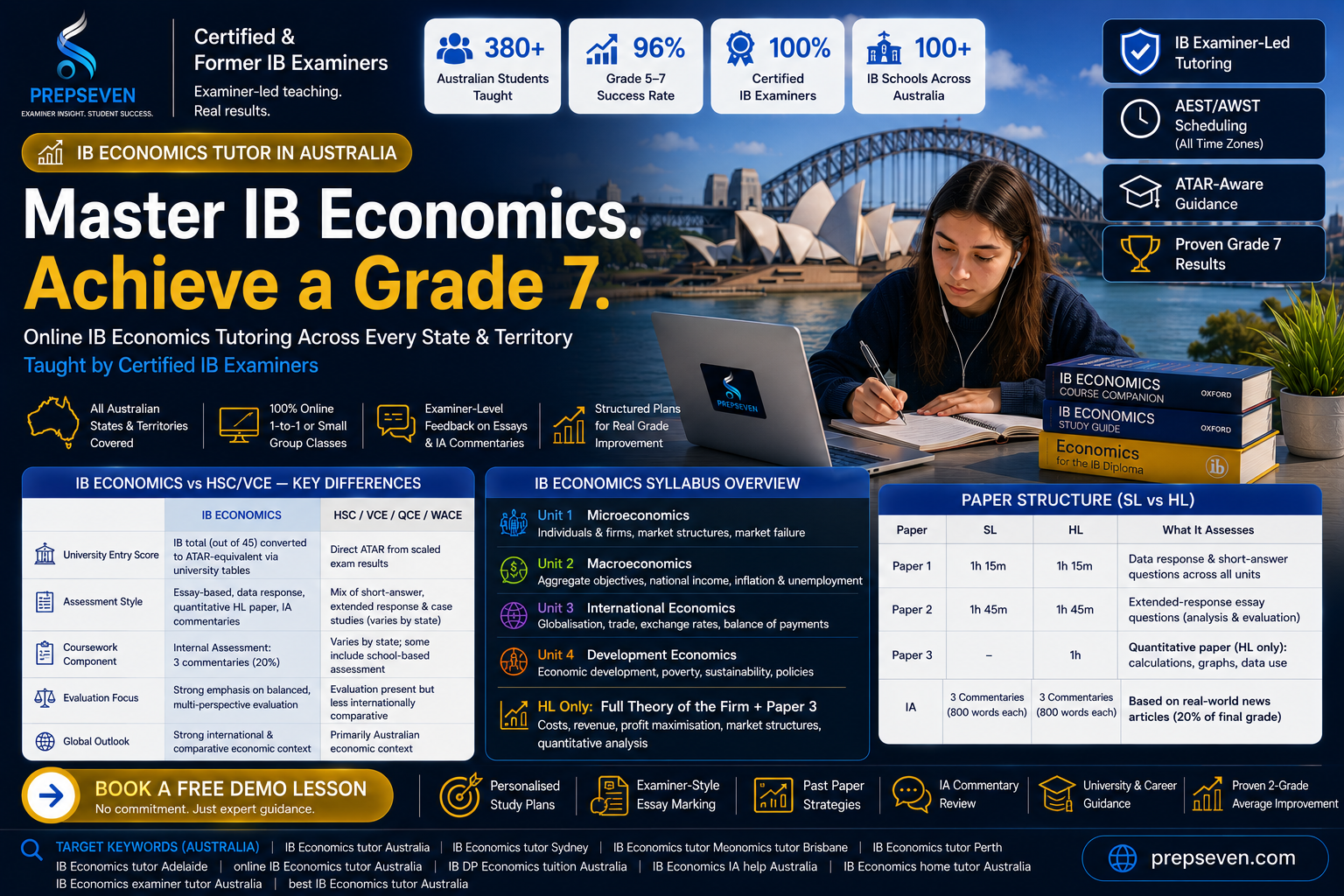
Australia has a well-established and growing IB World School network, with strong representation in New South Wales, Victoria, Queensland, Western Australia, and South Australia. Australian IB students sit alongside the much larger cohort completing the HSC, VCE, QCE, WACE, or SACE, and as a result, families often arrive at the IB Diploma with limited local familiarity around how IB Economics is structured, assessed, and ultimately converted into a university entry score. This unfamiliarity makes genuinely informed, examiner-grounded tutoring particularly valuable for Australian IB Economics students.
PrepSeven was founded on one uncompromising hiring standard: every Economics tutor is a certified or former IB examiner. For Australian families, this means access to the same calibre of assessment expertise used to mark real IB scripts each May and November session, delivered entirely online with scheduling built around Australian Eastern, Central, and Western time.
IB Economics vs HSC/VCE Economics — What Australian Families Should Know
Australian students choosing between the IB Diploma and a state curriculum such as the HSC, VCE, QCE, or WACE are making a decision that affects far more than just Economics, but the subject is a useful lens for understanding the broader differences between the two systems.
Most Australian universities — including the Group of Eight — publish clear IB-to-ATAR conversion scales, and a strong IB total, supported by a solid HL Economics grade, generally converts very favourably. PrepSeven tutors help Australian families understand exactly how their target universities convert IB results, removing much of the uncertainty families feel when comparing the two systems.
IB Economics SL vs HL — Choosing the Right Level in Australia
Australian IB schools typically offer both Standard Level and Higher Level Economics, and the choice between them carries real weight for university admission. Programmes such as the University of Sydney’s Bachelor of Commerce, Melbourne’s Bachelor of Commerce, and UNSW’s Business School often favour strong HL results in quantitative subjects within their entry profiles. PrepSeven tutors routinely advise Australian families through this decision based on target degrees, overall Diploma subject combination, and a student’s comfort with the additional quantitative demands of HL.
HL Economics adds the full theory of the firm to the microeconomics unit and introduces Paper 3, a dedicated quantitative paper requiring calculation-based responses and graph construction from data. SL Economics covers the same four units at a slightly less technical depth and is assessed purely through Papers 1 and 2. Both levels share the same Internal Assessment structure: three 800-word commentaries based on published news extracts.
Full IB Economics Syllabus Breakdown
Before choosing a tutor, it helps to understand exactly what the two-year IB Economics course covers. The syllabus, last revised in 2022, is organised into four units that apply consistently across both Standard Level and Higher Level study. PrepSeven tutors begin every new student relationship with a full syllabus walkthrough so that families understand precisely how their tutoring sessions map onto the official course structure.
Unit 1: Introduction to Economics
This opening unit establishes the foundational logic of economics as a discipline. Students encounter the core problem of scarcity — the condition from which all economic decision-making derives — and are introduced to the nine key concepts that serve as analytical lenses throughout the entire course: scarcity, choice, efficiency, equity, economic well-being, sustainability, change, interdependence, and intervention. Australian students moving into IB Economics from a state-curriculum background generally adjust well to the conceptual material, but the distinction between positive and normative economic statements still requires deliberate, dedicated practice for higher-level evaluation marks.
Unit 2: Microeconomics
Microeconomics forms the largest component of the IB Economics syllabus and covers market dynamics from both theoretical and applied perspectives. Topics at Standard Level include demand and supply analysis with full diagram application, price elasticities (PED, PES, YED, XED), market failure, externalities, public goods, and government interventions such as taxes, subsidies, and price controls. At Higher Level, the unit expands to include the full theory of the firm — covering cost and revenue curves, profit maximization, and detailed analysis of market structures including perfect competition, monopoly, monopolistic competition, and oligopoly. Australian HL students consistently find the theory of the firm to be the most technically demanding section of the entire course, particularly the cost curve derivations and long-run equilibrium conditions under different market structures.
Unit 3: Macroeconomics
The macroeconomics unit examines the national economy through the lens of aggregate demand and aggregate supply, exploring objectives such as economic growth, full employment, price stability, and sustainable development. Key policy tools — fiscal policy, monetary policy, and supply-side structural reform — are analyzed both theoretically and through real-world case evidence. Australian students have access to highly relevant material for this unit: the Reserve Bank of Australia’s cash rate decisions, federal budget announcements, and ongoing debates around Australian housing affordability and productivity growth all provide locally grounded, well-documented examples that translate directly into strong Internal Assessment commentaries.
Unit 4: The Global Economy
The final unit addresses international trade, exchange rates, balance of payments, and economic development. Students examine comparative advantage, protectionism policies such as tariffs and import quotas, the role of institutions like the IMF and World Bank, and the developmental challenges facing lower-income economies. Australian students benefit from rich, accessible material here: Australia’s trade relationship with China and the broader Asia-Pacific region, the Australian dollar’s commodity-linked exchange rate movements, and regional trade agreements such as AUKUS-adjacent and ASEAN-linked arrangements all provide locally grounded, examiner-relevant evidence for both Paper 2 and Internal Assessment commentaries.
IB Economics Exam Papers — Full Breakdown by Paper and Grade Level
Understanding the structure of each examination paper is fundamental to strategic preparation. PrepSeven tutors focus heavily on paper-specific technique — not just content knowledge — because the majority of marks lost in IB Economics come from misapplication of exam technique rather than gaps in subject knowledge.
Paper 1 — Extended Response (SL & HL)
Paper 1 is a 1 hour 15 minute extended-response paper that tests microeconomics (Section A) and macroeconomics (Section B). Students choose one question from each section. Each question is divided into two parts: a shorter part (a) worth approximately 10 marks requiring diagram-supported explanation, and a longer evaluative part (b) worth 15 marks requiring a full analytical essay with diagram, evidence, and a structured evaluation. The Part (b) 15-mark responses are where the vast majority of grade differentiation occurs at the top end. A Grade 7 student at HL writes a Part (b) that includes a fully labeled diagram, a structured argument with two to three theoretical angles, real-world evidence, and a genuine evaluative conclusion that weighs competing perspectives. PrepSeven tutors provide students with a proven framework for these responses and assess student writing against the actual IB markbands used in examiner training.
Paper 2 — Data Response (SL & HL)
Paper 2 runs for 1 hour 45 minutes and draws on Units 3 and 4 — macroeconomics and the global economy. Students are presented with two structured case studies, each consisting of three to four news excerpts and a set of stimulus-response questions. Question types progress from definitional and diagrammatic tasks at the lower end (2–4 marks) to evaluative multi-paragraph responses at the top (8 marks). The key skill tested in Paper 2 is the ability to apply economic theory to unfamiliar data. Australian students often underestimate Paper 2 because the individual questions look shorter than Paper 1 essays — but the breadth of content, the need to interpret data accurately, and the volume of questions within a time-constrained format make it one of the most technically demanding papers to perform consistently well on.
Paper 3 — Quantitative Extension (HL Only)
Paper 3 is exclusive to Higher Level students and runs for 1 hour. It is the paper that most HL Economics students in the US find the most intimidating, yet with the right preparation it can become a significant source of marks. The paper draws on content from across the entire syllabus and requires students to perform calculations, construct graphs from quantitative data, and apply numerical analysis to economic scenarios. Questions test skills such as calculating price elasticity from data, deriving revenue and cost figures for firm analysis, computing balance of payments adjustments, and reading exchange rate tables. PrepSeven’s HL Economics tutors dedicate structured sessions specifically to Paper 3 technique — building the mathematical fluency and diagrammatic precision that this paper demands.
IB Economics Internal Assessment — Complete Guide for US Students
The IB Economics Internal Assessment is a portfolio of three commentaries written across the two-year course. Each commentary is based on a published news media extract and must analyze the economic content of the article using relevant IB Economics theory, diagrams, and key concepts from the syllabus. The IA is internally marked by the student’s own teacher and then externally moderated by an IB examiner — which means the final moderated mark can differ significantly from the school’s initial assessment, either upward or downward.
Each commentary has a strict 800-word limit (not including diagrams, references, and bibliography), must be linked to a different unit of the syllabus, and must apply a different key concept to each of the three articles. The assessment criteria reward accurate theory application, quality of diagram construction, depth of analysis, and genuine evaluation — not descriptive summary of the news article. Many students make the fundamental error of describing what happened in the article rather than using the article as a springboard for rigorous economic analysis.
The 9 Key Concepts in IB Economics — What They Mean for Exam Performance
The 2022 IB Economics syllabus places significant emphasis on nine overarching key concepts that students must apply as analytical lenses throughout their work. These concepts appear explicitly in Internal Assessment criteria, in Paper 1 part (b) evaluative responses, and in the broader evaluative framing of Paper 2 answers. Understanding how to deploy these concepts precisely — rather than just mentioning them superficially — is a major differentiator between a Grade 5 and a Grade 7 student.
Why PrepSeven is the Right Choice for IB Economics Tutoring in Australia
Families across Australia searching for IB Economics support encounter a market largely built around HSC, VCE, and QCE tuition — most large tutoring agencies and online platforms are organised around these state curricula, with IB support often treated as a secondary offering staffed by generalist tutors. PrepSeven differentiates itself through one structural fact rather than marketing positioning: every tutor on the platform holds or has held certified IB examiner status, with genuine IB-specific expertise rather than adapted state-curriculum teaching methods.
Examiner-Level Mark Scheme Knowledge
IB examiners participate in extensive annual standardization exercises before marking begins. They work through specimen answers, annotate mark schemes collaboratively, and develop a precise understanding of what distinguishes a Level 5 response from a Level 6 or 7. When PrepSeven tutors teach exam technique, they are not extrapolating from textbooks — they are sharing the exact knowledge they used to assess real student scripts. For Australian students, this means every piece of written work completed during tutoring sessions is evaluated to the same standard as an actual IB examination.
Scheduling Across Every Australian Time Zone
PrepSeven tutors schedule sessions natively across Australia’s three time zones — Eastern, Central, and Western Standard Time. Families in Sydney, Melbourne, Brisbane, Perth, Adelaide, and beyond can book consistent after-school, evening, or weekend sessions that fit naturally around school timetables and extracurricular commitments, with no travel required to a physical tutoring centre.
Structured Grade Improvement Programme
PrepSeven does not offer unstructured ‘help sessions.’ Every student begins with a diagnostic assessment that maps their current performance against IB assessment criteria across Paper 1, Paper 2, Paper 3 (for HL students), and the Internal Assessment. A personalised learning roadmap is then built around the student’s specific grade targets, exam timeline, and identified skill gaps. Progress is reviewed at regular intervals and the programme is adjusted accordingly.
Internal Assessment Specialist Support
The IB Economics IA is often the most overlooked high-leverage opportunity in the entire course. With only 800 words per commentary, every sentence must earn marks against specific criteria — and students who submit poorly structured or under-analyzed commentaries can lose as many as 8–10 marks across the portfolio. PrepSeven tutors work with students from article selection through to final submission, applying examiner-level feedback at every draft stage.
How PrepSeven Online IB Economics Tutoring Works in Australia
PrepSeven operates as a fully online tutoring platform, allowing Australian families to access examiner-qualified instruction regardless of location — from Sydney and Melbourne to regional towns and remote communities where local IB tutor availability is extremely limited. Sessions are conducted through video call, shared digital whiteboard, and screen-sharing tools that replicate the interactivity of an in-person classroom.
IB Economics Exam Preparation Tips — Insights from IB Examiners
The following strategies are drawn directly from examiner experience — these are the patterns that consistently distinguish the highest-scoring student responses from those that plateau at Grade 5 or 6.
Diagram Quality Matters More Than Students Realize
IB Economics diagrams are not illustrations — they are assessed components. A poorly labeled supply and demand diagram with missing axis labels, an unlabeled equilibrium point, or a missing welfare triangle costs real marks. PrepSeven tutors enforce strict diagram standards from the very first session: every axis must be labeled, every curve must be identified, every shift must be annotated with a directional arrow, and every welfare area must be shaded and labeled where relevant.
Evaluation Requires a Genuine Conclusion
The most common mistake at the top end of IB Economics is writing evaluative ‘points’ without reaching a genuine analytical conclusion. IB examiners consistently note that students list counterarguments and qualifying factors but fail to synthesize these into a reasoned judgment. A Grade 7 Part (b) response arrives at a conclusion that takes a position — for instance, arguing that monetary policy effectiveness depends critically on the prevailing inflationary environment — rather than simply listing ‘on the other hand’ considerations indefinitely.
Use Real-World Examples with Specificity
Vague references to ‘a country’ or ‘a recent recession’ earn fewer marks than specific, named examples with approximate data. IB Economics examiners reward students who can reference the Reserve Bank of Australia’s post-2022 cash rate decisions, the economic effects of Australia’s trade relationship with China, named federal budget interventions, or specific global trade disputes — showing genuine engagement with the global economic landscape rather than abstract theoretical discussion.
Paper 3 Is a Skills Paper, Not Just a Knowledge Paper
Many US HL students under-prepare for Paper 3 because they approach it as content revision rather than skills practice. Paper 3 requires fluency with calculations — not just conceptual understanding of the formulas. Students must be able to compute PED values, derive profit-maximizing output from cost and revenue data, interpret balance of payments tables, and construct diagrams from numerical inputs — all under time pressure. Regular timed practice is the only reliable preparation method.
IB Economics and Australian University Admissions
Australian-based IB students apply via state university admission centres — UAC in New South Wales, VTAC in Victoria, QTAC in Queensland, and equivalents elsewhere — all of which convert IB total scores to an ATAR-equivalent using published conversion tables. The University of Sydney, the University of Melbourne, UNSW, Monash, and the broader Group of Eight all publish IB grade equivalency requirements, with their most competitive commerce, economics, and business programmes generally favouring strong HL grades in quantitative subjects including Economics.
Many Australian universities also offer course credit or advanced standing for strong IB HL Economics performance, allowing students to access higher-level units of study from their first year. Beyond Australia, IB Economics performance carries equal weight for Australian students applying internationally to the UK, US, or Canada, making it one of the more universally recognised subjects within the Diploma for students with global ambitions.