

PREPSEVEN
Expert IB Tutoring | Certified IB Examiners | Serving Switzerland and the IB’s Home Country
IB Computer Science Tutor in Switzerland
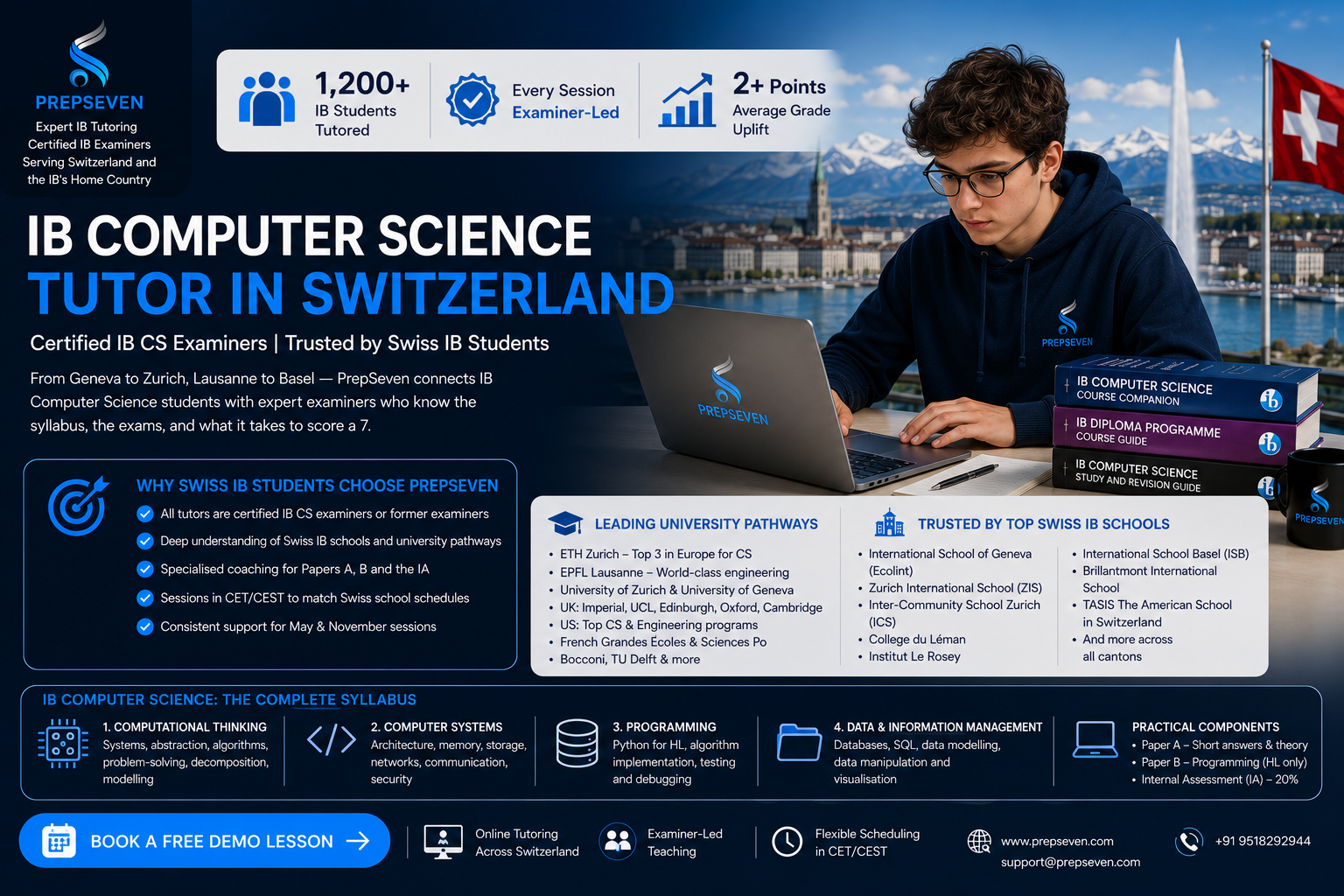
Switzerland is not merely a country where the IB is offered — it is where the International Baccalaureate was founded. Geneva’s International School (Ecolint) hosted the first IB students, and Switzerland today remains one of the densest concentrations of IB World Schools anywhere on earth. From Zurich International School and Inter-Community School Zurich to College du Leman and the International School of Geneva, Swiss IB students are educated in an environment where academic rigour is a baseline expectation — not an aspiration.
For Swiss IB students studying Computer Science, the stakes are particularly clear. ETH Zurich — ranked among the world’s top three universities for Computer Science — accepts IB graduates directly, and EPFL in Lausanne is one of Europe’s premier engineering institutions. A grade 7 in IB CS HL is not merely a strong academic result in this context; it is an entry credential to programmes that shape global technology careers. PrepSeven connects Swiss IB students with certified IB CS examiners who understand this environment and deliver sessions calibrated to its demands.
Switzerland’s Unique IB Landscape: Global Families, Elite Universities
Switzerland’s international school community is unlike almost anywhere else in the world. The student body at schools like ZIS, Ecolint, ISB, and ICS Zurich is drawn from diplomatic families, UN and NGO staff, international banking and finance professionals, and the global talent that gravitates to Switzerland’s tech, pharmaceutical, and financial sectors. The result is a student population with exceptionally diverse academic backgrounds — students who may have transferred from the French baccalaureat, the German Abitur, the British A-level system, or from IB schools in other countries — combined with uniformly high university ambitions.
IB Computer Science in this context is a genuinely demanding undertaking. Many Swiss IB schools offer strong CS instruction, but the subject spans theoretical computing (hardware, networks, databases), programming under exam conditions, and a substantial documented software project — components that require different skills from different student profiles. Students with strong coding backgrounds often underestimate the theoretical Paper A. Students with strong academic writing skills often underestimate the difficulty of handwritten Paper B programming. The IA demands project management discipline that few school programmes teach explicitly.
PrepSeven tutors understand the specific profile of Swiss international school students — their multicultural backgrounds, the pressure of ETH and EPFL ambitions, and the multilingual academic environments in which they study — and calibrate their sessions accordingly.
IB CS and Swiss University Admissions: ETH Zurich, EPFL, and Beyond
Beyond ETH and EPFL, Swiss IB students commonly target:
- University of Zurich and University of Geneva — strong CS and Information Systems programmes that accept IB diplomas with specific grade requirements
- UK universities — Imperial College London, UCL, Edinburgh, Warwick, and Oxford/Cambridge for the highest-achieving students; Swiss-educated IB students are well-regarded in the UK system
- US universities — for students at schools like TASIS and the American School in Switzerland who are oriented toward the US system; IB CS HL at grade 7 is a strong credential for US CS and Engineering admissions
- French grandes ecoles and Sciences Po — Geneva’s proximity to France makes Parisian universities a genuine option for Francophone students; the IB is well-recognised at Sciences Po and some grande ecole feeder paths
- Bocconi and other European business/technology schools — increasingly relevant for Swiss IB students interested in technology management or digital business
IB Computer Science Across Swiss Cantons: School Context
Switzerland’s IB schools are concentrated in Geneva, Zurich, and Lausanne, with significant presence in Basel, Bern, and the Ticino canton. PrepSeven works with students from all of these schools — all sessions are fully online and operate in Central European Time.
One feature of the Swiss IB landscape is the frequency of mid-programme transfers. Students at international schools in Geneva or Zurich may have joined in Year 1 from a completely different curriculum — French lycee, German Gymnasium, British GCSE — and may carry gaps in the specific skill sets IB CS demands. PrepSeven diagnostic sessions identify these gaps immediately and address them before they become exam-day liabilities.
Why Swiss IB Families Choose PrepSeven
The Multilingual IB Student: A Swiss-Specific Challenge
Switzerland’s official languages are German, French, Italian, and Romansh. Its international schools add English as a primary language of instruction. The result is a student population where many IB CS students are working in their second or third language — English — when writing examination responses and IA documentation.
This has specific implications for IB CS performance that PrepSeven tutors address directly:
- Command term precision suffers in second-language writers. Students who understand the content thoroughly may still write responses that use ‘describe’ language when the question demands ‘evaluate’ — a mark-costing error that has linguistic as much as conceptual roots.
- IA documentation quality depends on clear, precise English writing — particularly in Criterion A (planning), Criterion B (design), and Criterion E (evaluation), where analytical writing quality determines whether the examiner awards full or partial marks.
- Paper A extended response questions require structured argument in English, not just factual recall. For students whose strongest written language is German or French, building this response structure requires explicit practice.
PrepSeven tutors work with multilingual students to build IB-specific English writing skills as part of the subject tutoring — not as a separate task but as an integrated component of exam preparation. This is not general English tutoring; it is the specific command term and analytical writing competence that IB CS examiners assess.
IB CS Syllabus: Complete Coverage for Swiss Students
Theme A — Concepts of Computer Science (Paper A)
Theme A covers the theoretical foundations of computing assessed in Paper A. Swiss students — many of whom come from strong mathematics and science backgrounds — sometimes find the written expression requirements of Paper A more challenging than the content itself. Building precise, examiner-readable responses in English is a core preparation goal.
- A.1 Computer Organisation: CPU architecture and component roles (ALU, control unit, registers, program counter, MAR, MDR, cache), machine instruction cycle in full (fetch-decode-execute with bus and memory interactions), memory hierarchy (register, L1/L2/L3 cache, RAM, ROM, virtual memory, secondary storage), I/O device categories, and CPU performance factors — clock speed, number of cores, bus width, cache capacity and levels
- A.2 Networks: Network types (LAN, WAN, WLAN, MAN, PAN), topologies and trade-offs, hardware roles (router, switch, hub, bridge, NIC, access point), protocol stack (TCP/IP layers and assigned protocols at each layer), key protocols in depth (HTTP, HTTPS, DNS, DHCP, FTP, SMTP, IMAP, POP3), IPv4 and IPv6 addressing, subnetting, cybersecurity threats (malware taxonomy, phishing, social engineering, DoS/DDoS variants, man-in-the-middle, SQL injection), and defence mechanisms (firewalls, IDS/IPS, antivirus, encryption types, VPN, certificate authorities, 2FA)
- A.3 Databases: Relational database theory (relations, tuples, attributes, domains), entity-relationship modelling, primary and foreign key theory, normalisation to 3NF with fully worked examples, SQL commands in full (SELECT, INSERT, UPDATE, DELETE, CREATE, DROP, ALTER, all JOIN types, subqueries, GROUP BY, HAVING, ORDER BY, aggregate functions), DBMS architecture and services, ACID transaction properties, concurrency control (locking, timestamping), and data integrity constraints
- A.4 Computer Science in Context: Ethical frameworks applied to computing scenarios, Swiss data protection law (nDSG — the revised Federal Data Protection Act, effective 2023) and its relationship to GDPR, digital privacy and surveillance debates, intellectual property in the digital economy, computing and sustainability, and the social impact of automation — all assessed through extended analytical responses in Paper A
Theme B — Computational Thinking and Problem-Solving (Paper B)
Theme B is the programming and algorithms component. Paper B requires handwritten Java or Python code under timed exam conditions. Students from Swiss IB schools frequently have strong programming foundations from school instruction — the challenge is converting that foundation into precise, examiner-readable handwritten code.
- B.1–B.5 Computational Thinking: Abstraction, procedural decomposition, logical reasoning, thinking ahead (preconditions, caching), and concurrent thinking — each assessed as vocabulary for structuring algorithmic responses in Paper B questions
- B.6 Programming: All data types, 1D and 2D arrays, ArrayList and collection classes, complete object-oriented programming (encapsulation, inheritance hierarchies, polymorphism, abstract classes, interfaces), constructors and method signatures, recursion with call stack tracing, and the full set of standard IB algorithms: binary search, sequential search, bubble sort, selection sort, tree traversal algorithms in Java and Python
HL Extensions
- Abstract Data Structures: Full linked list operations (singly and doubly linked — insertion, deletion, traversal with pointer manipulation), stack and queue operations in both array-based and linked-list-based implementations, binary tree structure and operations (insertion, deletion, all traversal algorithms) — all requiring code implementation in Paper B
- Resource Management: Process lifecycle, scheduling algorithms (FCFS, Round Robin, SJF, Priority — with worked scheduling examples), memory management strategies, garbage collection, deadlock theory and the four necessary conditions (mutual exclusion, hold-and-wait, no preemption, circular wait), deadlock prevention and avoidance strategies, and virtual memory paging
- Control Systems: Embedded systems architecture, sensor and actuator types and interfaces, open-loop and closed-loop system design, feedback mechanisms, PID controller concepts, and autonomous system case studies relevant to the IB exam context
- Paper 3 Case Study: Released approximately three months before the exam session. Swiss HL students typically receive this in February for the May session. Preparation must begin immediately — not in the final weeks. Our tutors run structured Paper 3 preparation using previous case studies as training material, focusing on command term application to case-specific questions
Assessment Structure: Paper by Paper
Standard Level
Higher Level
The Internal Assessment in Switzerland: Project Discipline in a High-Standards Environment
Swiss international school students are accustomed to high expectations. The IB CS Internal Assessment is an opportunity to demonstrate exactly the kind of disciplined, documented, client-focused project work that ETH Zurich, EPFL, and top international universities value — but it requires a level of organisational rigour that is distinct from exam performance.
The five criteria and what they demand of Swiss IB students:
- Criterion A — Planning (6 marks): A specific, named client with a real and documented computing problem. Success criteria that are measurable and testable. Swiss students at elite international schools sometimes choose technically ambitious projects without adequately defining client need — a mismatch that costs marks before development begins.
- Criterion B — Design (6 marks): Complete pre-development design records. Wireframes or UI mockups, class and data structure diagrams, algorithm flowcharts, and a structured testing plan. The design must be produced before the build — not retrospectively. Multilingual students need particular care here that their design documentation is written in precise, unambiguous English.
- Criterion C — Development (12 marks): The highest-weighted criterion. Annotated code that explains design decisions — not just what the code does, but why each significant choice was made. OOP architecture should be demonstrably intentional. Code quality consistent with a developer writing for a maintainer, not just for the compiler.
- Criterion D — Functionality and Extensibility (4 marks): A screen-recorded video demonstrating the product working and systematically testing each success criterion. The video must be purposeful and explicit — moderators assess whether it addresses the specific criteria defined in Criterion A, not whether the product looks impressive.
- Criterion E — Evaluation (6 marks): Evidence-based assessment against each success criterion. Genuine client feedback included and referenced. Realistic, specific improvement recommendations with justification. Swiss students from academically strong environments sometimes write evaluations that are too positive — a thorough, balanced evaluation earns more marks than a positive one.
PrepSeven IA tutors review every criterion of Swiss students’ IAs with examiner-level precision. We provide written feedback at each milestone — planning, design, development, and pre-submission — and specifically address the English writing quality requirements in Criteria A, B, and E for multilingual students.
How PrepSeven Works for Swiss Students
- Free Diagnostic Consultation — 30 minutes assessing syllabus coverage, programming proficiency, IA stage, and target universities (ETH, EPFL, UK, US). No charge.
- Personalised Study Plan — Written plan aligned to the Swiss school calendar (typically September to June with two-week breaks), exam session (May), target university requirements, and weekly available hours around extra-curricular commitments.
- Weekly One-on-One Sessions — Zoom sessions in CET or CEST. Shared digital whiteboard, code environment, and screen sharing. Recordings available with student consent.
- Command Term and Written Response Training — Dedicated instruction in IB command term application. Particular attention for multilingual students to structuring analytical English responses in extended response questions.
- Past Paper Practice with Markscheme Feedback — Systematic past paper work after every topic. Feedback delivered in IB markscheme language — the exact vocabulary the real examiner uses.
- IA Milestone Reviews — Criterion-by-criterion written feedback at planning, design, development, and pre-submission stages. For multilingual students, additional review of English writing precision in documentation.
- Paper C Preparation (HL) — Structured 4-session preparation module using previous IB case studies. Timed practice responses with examiner-standard feedback.
- Monthly Progress Reports — Written summaries for students and parents, covering syllabus progress, predicted grade trajectory, and recommended focus for the following month.