

PREPSEVEN
Expert IB Tutoring | Certified IB Examiners | Singapore & Southeast Asia
IB Computer Science Tutor in Singapore
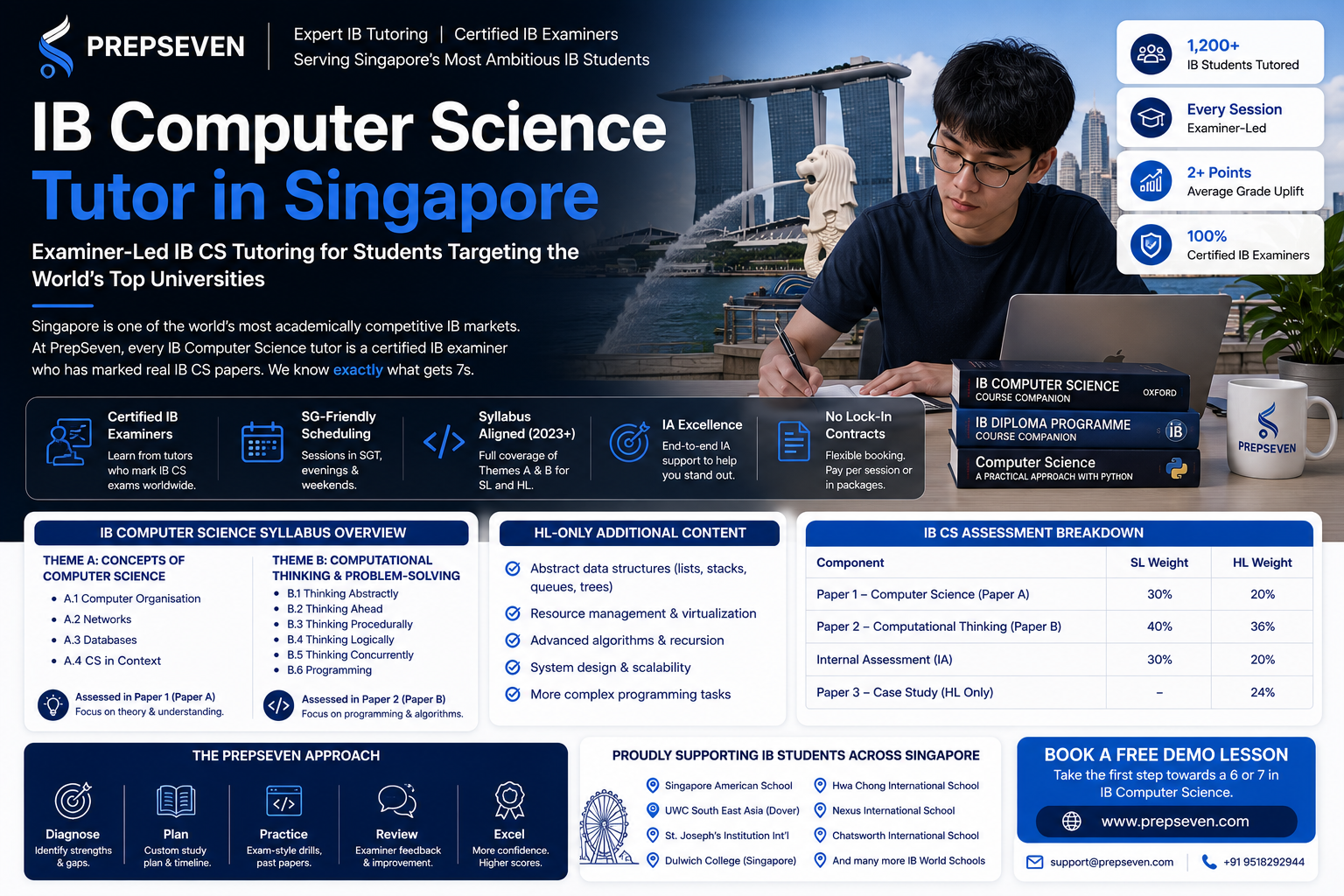
Singapore is one of the world’s most demanding academic environments, and IB Computer Science within that context carries a particular weight. PrepSeven offers Singapore-based IB students access to certified IB CS examiners — tutors who have sat on the examination side of the table, marked real student papers, and know precisely what separates a grade 5 from a grade 7 at both Standard Level and Higher Level.
From ACS International to United World College, Canadian International School, Tanglin Trust, SAS, Stamford American, and the full spectrum of IB World Schools across Singapore, PrepSeven tutors work with students at every stage of the IB CS journey: building theoretical foundations in Year 1, sharpening exam technique in Year 2, completing the Internal Assessment with examiner-level rigour, and tackling the HL Paper 3 case study with structured analytical precision.
IB Computer Science in Singapore: The Academic Pressure Context
Singapore’s education culture is defined by rigorous standards, a strong emphasis on STEM excellence, and intense competition for university places at NUS, NTU, SMU, and elite institutions overseas. For IB students in Singapore, every grade point matters — and IB CS is a subject where the gap between understanding content and actually scoring 7 can be wider than students expect.
The subject is assessed through three components (two for SL): written theory, programming under exam conditions, and a substantial software development project. Singapore students often arrive in IB Year 1 with strong coding backgrounds from prior school exposure or personal interest — but IB CS tests far more than the ability to write working code. It demands:
- Precise use of IB command terms in written answers — a ‘describe’ and an ‘evaluate’ require fundamentally different responses, and mixing them up costs marks regardless of knowledge
- Theoretical computing knowledge across hardware, networks, databases, and social implications — areas that programming-focused students often neglect
- Hand-written code under timed exam conditions, without an IDE or autocomplete
- A meticulously documented software IA that satisfies five distinct assessment criteria, each with its own examiner expectations
- For HL students: command of abstract data structures, resource management, control systems, and the ability to apply these concepts analytically to a pre-published case study in Paper 3
Singapore students who thrive in IB CS are those who build habits early — in how they approach written questions, how they annotate their code, how they maintain IA documentation. PrepSeven tutors establish these habits from the first session.
PrepSeven: Examiner-Led IB CS Tutoring Built for Singapore Students
IB CS Syllabus Breakdown: Every Topic Singapore Students Must Master
The IB CS syllabus is organised into two themes assessed across two papers (three for HL). Below is a complete topic map that PrepSeven tutors use to structure coverage across the two-year programme.
Theme A: Concepts of Computer Science
Theme A is the theoretical core of IB CS. It is assessed in Paper A (written theory). Singapore students with strong STEM backgrounds sometimes treat this as the ‘easy’ component — a mistake that shows up as lost marks on extended response questions.
- A.1 Computer Organisation: Von Neumann architecture, CPU components (ALU, CU, registers, cache), primary memory (RAM, ROM), secondary storage, input/output devices, machine instruction cycle (fetch-decode-execute), and factors affecting processing speed including clock speed, bus width, cache size, and cores
- A.2 Networks: Network types (LAN, WAN, WLAN, SAN), topologies (bus, ring, star, mesh), hardware components (routers, switches, access points, NICs), protocols (TCP/IP, DNS, DHCP, HTTP, HTTPS, FTP, SMTP, POP, IMAP), IP addressing, subnetting basics, cybersecurity threats (malware, phishing, DoS, MITM), and protective measures (firewalls, antivirus, encryption, 2FA)
- A.3 Databases: Relational database design, primary keys, foreign keys, composite keys, entity-relationship diagrams, normalisation (1NF, 2NF, 3NF with examples), SQL (SELECT with WHERE, JOIN, GROUP BY, ORDER BY, aggregate functions), DBMS roles, ACID properties, and data integrity constraints
- A.4 Computer Science in Context: Ethical frameworks (utilitarian, deontological) applied to computing issues, privacy and data protection legislation, digital divide, intellectual property, and environmental impact of computing — tested through extended response questions that require structured argument, not just factual recall
Theme B: Computational Thinking and Problem-Solving
Theme B covers algorithmic thinking and programming. Paper B requires students to write Java or Python by hand. For Singapore students with coding experience, the challenge is less about knowing the language and more about exam-specific technique.
- B.1 Thinking Abstractly: Decomposing real-world problems into computational models; identifying objects, attributes, and methods; levels of abstraction in system design
- B.2 Thinking Ahead: Identifying preconditions, caching strategies, pre-fetching, and planning algorithms for efficiency before implementation
- B.3 Thinking Procedurally: Modular design, subroutine decomposition, top-down design, and structured programming conventions
- B.4 Thinking Logically: Boolean expressions, truth tables, conditional structures (if-else, switch), nested conditionals, and loop structures (for, while, do-while) with loop invariants
- B.5 Thinking Concurrently: Parallel processing concepts, multi-threading, shared resource conflicts, and concurrency in modern systems
- B.6 Programming: Primitive and reference data types, arrays (1D and 2D), ArrayList and collection classes, OOP fundamentals (encapsulation, abstraction, inheritance, polymorphism), constructors, method overloading and overriding, recursion (base case, recursive case, call stack), and standard algorithms: binary search, sequential search, bubble sort, selection sort, insertion sort, tree traversal (pre-order, in-order, post-order)
HL-Only Extensions
- Abstract Data Structures: Linked lists (insertion, deletion, traversal for singly and doubly linked), stacks (push, pop, peek using arrays and linked lists), queues (enqueue, dequeue using arrays and linked lists), binary trees (insertion, deletion, traversal) — all requiring implementation in Java or Python for Paper B
- Resource Management: Operating system roles, process scheduling algorithms (FCFS, SJF, Round Robin, Priority), memory allocation strategies, garbage collection, deadlock conditions (mutual exclusion, hold-and-wait, no preemption, circular wait), and virtual memory
- Control Systems: Microcontroller vs microprocessor, sensors and actuators, open-loop vs closed-loop control, feedback mechanisms, PID concepts, and autonomous system applications
- Paper 3 Case Study: Annually released before each exam session. HL students must analyse the case using IB CS concepts, apply command terms analytically, and produce structured responses under timed exam conditions. Case studies have historically covered areas such as robotics, social media platforms, IoT ecosystems, and healthcare computing
Assessment at a Glance: SL and HL Side by Side
Note: The weighting difference means HL students must perform consistently across all three papers. A weak Paper 3 at HL can significantly impact the final grade. PrepSeven HL tutors run dedicated Paper 3 simulation sessions using previous case studies as preparation material.
Paper 3: The HL-Specific Exam Singapore Students Often Underestimate
Paper 3 is unique to HL and unlike any other IB exam paper. The case study is released approximately three months before the exam, giving students time to prepare — but many Singapore students do not use this window effectively.
What examiners expect in Paper 3 responses:
- Direct application of IB CS concepts to the specific scenario described in the case study — not generic knowledge
- Structured use of command terms: ‘discuss’, ‘evaluate’, ‘to what extent’ questions require balanced arguments, not one-sided answers
- Specific examples drawn from the case study text itself, not from general computing knowledge
- Evidence of understanding the social, ethical, and technical dimensions of the system described
What examiners consistently penalise:
- Generic responses that could apply to any computing system rather than the specific case
- Command term confusion — writing a description when the question asks for an evaluation
- Superficial coverage of multiple points instead of deep, mark-earning analysis of fewer points
PrepSeven tutors run structured Paper 3 preparation sessions. We take previous case studies, model the examiner marking approach, and train students to produce responses that address the specific marks allocated to each question part.
The Internal Assessment: Singapore Students’ Most Significant Opportunity
The IB CS IA is worth 30% at SL and 20% at HL. Given the level of academic competition in Singapore, this is a component that students should be optimising — yet it is also the component where the most marks are needlessly lost.
The IA is assessed across five criteria:
PrepSeven’s IA mentorship covers every criterion. Our tutors review each draft against the official markscheme and provide specific, actionable feedback before submission. For Singapore students aiming at the full 34 marks, this structured support is what makes the difference.
The PrepSeven Tutoring Process for Singapore Students
- Initial Assessment — A free 30-minute diagnostic session to evaluate current syllabus knowledge, programming ability, and IA stage. No obligation.
- Custom Study Plan — A written plan aligned to the student’s school, exam session (May or November), target grade, and weekly schedule including CAS commitments.
- Weekly One-on-One Sessions — Live online sessions in SGT via Zoom. Shared whiteboard, code editor, and screen-sharing for real-time programming exercises.
- Systematic Past Paper Work — Every topic covered is followed by relevant past paper questions marked with official criteria. Students build command term fluency session by session.
- IA Milestone Reviews — For IA-stage students, scheduled criterion-by-criterion reviews with written feedback before submission to the school teacher.
- Paper 3 Preparation Block — For HL students, a dedicated 4-session Paper 3 preparation module using released case studies, timed under exam conditions.
- Progress Reports — Monthly written summaries of topics covered, predicted grade movement, and recommended focus areas for the following month.