

PREPSEVEN
Expert IB Tutoring | Certified IB Examiners | Serving Indonesia and Southeast Asia
IB Computer Science Tutor in Indonesia
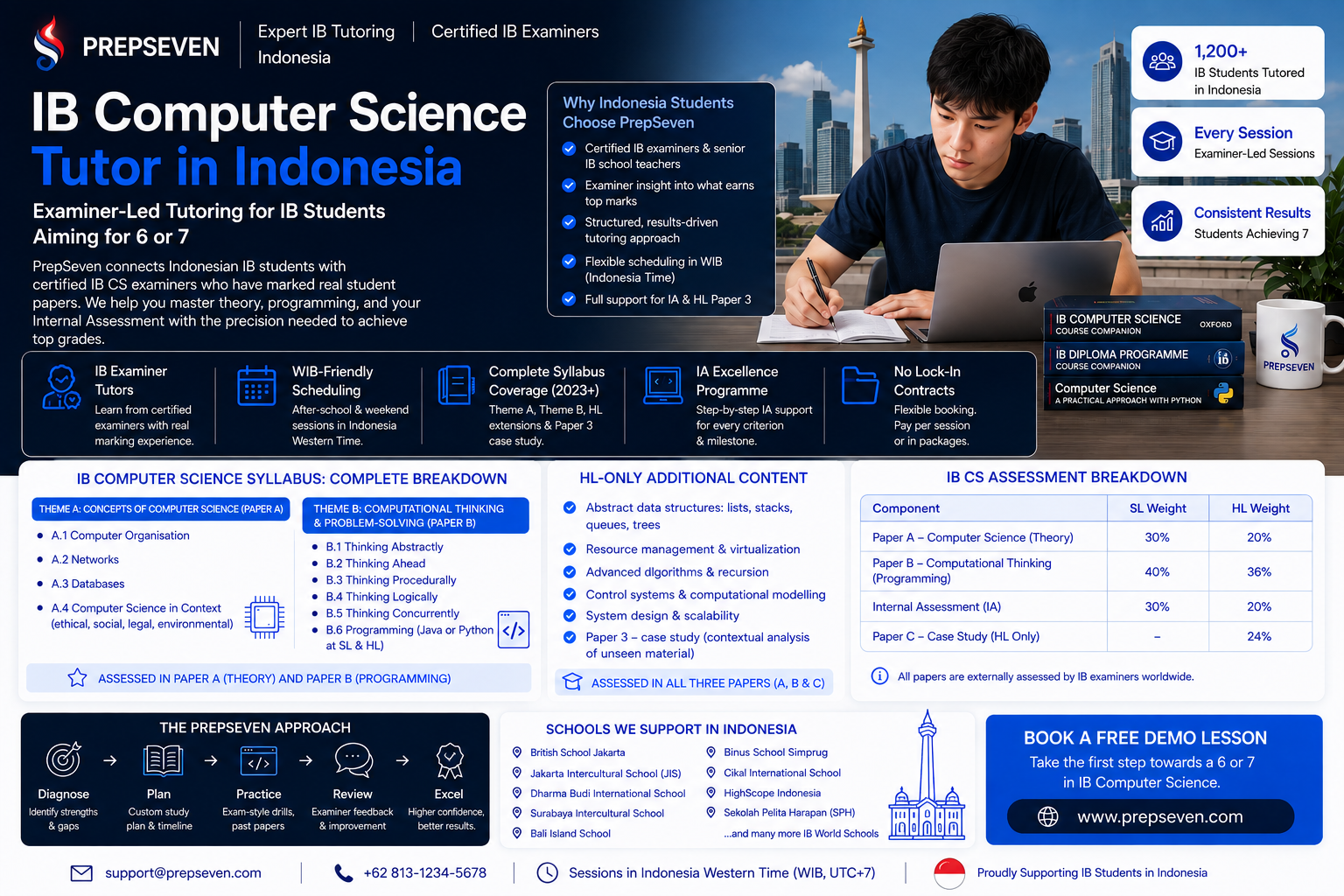
Indonesia is home to a rapidly expanding network of IB World Schools, concentrated in Jakarta but extending to Surabaya, Bali, Bandung, Medan, and beyond. For Indonesian IB students studying Computer Science, the subject has become one of the most strategically significant choices in the Diploma Programme — carrying direct implications for admission to universities in Singapore, Australia, the United Kingdom, the Netherlands, and, for the highest achievers, the United States.
PrepSeven connects Indonesian IB students with certified IB Computer Science examiners: tutors who have marked real IB CS papers, understand precisely how marks are awarded at the examination level, and deliver sessions that close the gap between school instruction and examiner-level expectations. All sessions are conducted online, fully accessible to students across the Indonesian archipelago without the need to travel to Jakarta or any other city.
Whether you are at Jakarta Intercultural School, British School Jakarta, Global Jaya School, Surabaya International School, Bina Bangsa School, Green School Bali, or any other IB World School in Indonesia — PrepSeven tutors are ready to work with you in WIB, WITA, or WIT time zones.
The IB Landscape in Indonesia: A Growing Community with Global Ambitions
Indonesia’s IB community has grown significantly over the past decade. Jakarta alone hosts some of Southeast Asia’s most internationally recognised IB schools, drawing expatriate families, Indonesian elite families, and internationally mobile professionals whose children are educated toward the world’s most competitive universities. The pressure to perform is real — and the competition for places at NUS, the University of Melbourne, UCL, and equivalent institutions is intense.
IB Computer Science sits at a critical intersection for Indonesian students. Technology entrepreneurship is one of Indonesia’s fastest-growing sectors — Go-Jek, Tokopedia, Traveloka, and Bukalapak are among Southeast Asia’s most prominent technology companies, all founded by Indonesians with strong technical foundations. Indonesian families increasingly recognise that IB CS, done well, is a passport to the computing and engineering programmes at overseas universities that train the next generation of technology leaders.
The challenge is that IB CS is a genuinely difficult subject — broader in theoretical scope than most Indonesian national curriculum computing subjects, more rigorous in its written assessment than most local alternatives, and demanding in its Internal Assessment requirements. Students at even the strongest Jakarta international schools frequently find that school instruction alone is not sufficient to reach the grade 6 or 7 that competitive overseas university applications require.
Where Indonesian IB CS Students Are Headed: University Destinations
Indonesian IB CS graduates target a wide range of international universities. Understanding what each destination values helps shape how students should approach their IB CS preparation:
- National University of Singapore (NUS) and NTU Singapore: The most common first choice for top Jakarta IB students. NUS Computing and NTU’s School of Computer Science and Engineering are highly competitive. A strong IB total (typically 38 or above) with HL CS at grade 6 or 7 is the expected profile. Singapore’s proximity and lower cost relative to the West makes it the default aspiration for many Indonesian families.
- Australian universities — University of Melbourne, UNSW, University of Sydney, ANU, Monash: Australia is the second most common destination. Strong IB CS HL grades translate well to Australian ATAR equivalents, and Indonesian students have a long-established pathway into Australian CS and Engineering programmes.
- UK universities — Imperial, UCL, University of Edinburgh, King’s College London, Warwick: UK universities are increasingly targeted by top-performing Indonesian IB students. IB CS HL at grade 6 or 7 is a competitive credential for these programmes, and UK universities are familiar with the IB from Indonesian applicants.
- Netherlands universities — Delft University of Technology (TU Delft), Eindhoven University of Technology: The Netherlands has become a significant destination for Indonesian students, partly because many Dutch-language programmes now offer English-taught bachelor degrees. TU Delft’s Computer Science programme is internationally ranked and well-matched to strong IB CS profiles.
- US universities: A smaller but growing cohort of top Indonesian IB students targets US universities. IB CS HL at grade 7 is a strong credential for US CS admissions, particularly when combined with strong SAT/ACT scores and a compelling personal statement.
IB Computer Science Across Indonesian Cities and Schools
PrepSeven serves IB CS students across all of Indonesia — online sessions eliminate geographic barriers for students outside Jakarta. Below is an overview of the school landscape and university aspirations by city:
A significant feature of Indonesia’s IB landscape is the diversity of school quality and resource. Students at Jakarta’s top international schools (JIS, BSJ) often have strong school-based CS instruction but benefit from examiner-level feedback. Students at smaller schools in Surabaya, Bandung, or Bali may have more limited specialist CS support and gain the most from structured, examiner-led external tutoring. PrepSeven adapts to both situations.
Why Indonesian IB Families Choose PrepSeven
English as the Examination Language: A Key Challenge for Indonesian Students
IB Computer Science examinations are conducted entirely in English. For Indonesian students — including those at English-medium international schools — the precision of written examination responses in a second language is one of the most consequential skill gaps in IB CS performance.
The specific challenges our tutors address:
- Command term application: The IB uses specific command terms (define, describe, explain, analyse, evaluate, discuss, to what extent) that require different response structures. Indonesian students frequently write ‘describe’ responses to ‘evaluate’ questions — not because they do not understand the content, but because the command term distinction requires explicit English academic writing training.
- Extended response structure: Paper A extended responses require a structured argument — evidence, analysis, conclusion — in English prose. Building this structure explicitly is a core preparation task for Indonesian students whose strongest academic language may be Indonesian (Bahasa Indonesia).
- IA documentation: Criterion A (planning), Criterion B (design), and Criterion E (evaluation) all require precise, unambiguous English writing. Moderators cannot award marks for content they cannot follow. Indonesian students benefit from explicit review of their IA documentation for English clarity as well as technical accuracy.
- Precise technical vocabulary: IB CS examiner reports consistently note that students lose marks by using imprecise technical language — for example, writing ‘memory’ when the question requires distinction between RAM and ROM, or ‘computer’ when the question refers to CPU architecture. Building precise vocabulary is part of every PrepSeven session.
Our tutors integrate English academic writing development into every CS tutoring session — not as a separate English lesson, but as the applied writing practice that IB CS examination performance requires.
IB CS Syllabus: Complete Coverage for Indonesian Students
Theme A — Concepts of Computer Science (Paper A)
Theme A covers theoretical computing. It is examined in Paper A through short-answer and extended-response questions. Indonesian students with strong mathematics backgrounds often find the theoretical content manageable — the challenge is writing precise, command term-appropriate responses in English under exam conditions.
- A.1 Computer Organisation: CPU components and functions (ALU, control unit, registers, MAR, MDR, program counter, cache), machine instruction cycle (fetch-decode-execute in full with bus operations), memory hierarchy (registers through to secondary storage, virtual memory concepts), I/O devices and interfaces, and performance factors — clock speed, cores, bus width, cache levels
- A.2 Networks: Network classifications (LAN, WAN, WLAN, MAN, PAN), physical topologies and their trade-offs (bus, ring, star, mesh, hybrid), hardware components and roles (routers, switches, hubs, bridges, NICs, access points, firewalls), protocol stack (TCP/IP model with layer functions), key protocols (HTTP, HTTPS, DNS, DHCP, FTP, SMTP, POP3, IMAP), IP addressing (IPv4 and IPv6), cybersecurity threats (malware taxonomy, phishing and social engineering variants, DoS/DDoS, SQL injection, MITM), and protective measures (firewalls, antivirus, encryption — symmetric and asymmetric, VPN, 2FA, intrusion detection systems)
- A.3 Databases: Relational database design (relations, attributes, tuples, domains), entity-relationship modelling, primary keys, foreign keys, composite keys, normalisation (1NF through 3NF with full worked examples), SQL command set (SELECT with multiple clauses and conditions, all JOIN types, GROUP BY, HAVING, ORDER BY, aggregate functions, subqueries, INSERT, UPDATE, DELETE), DBMS roles and services, ACID properties, and data integrity constraints
- A.4 Computer Science in Context: Ethical frameworks applied to computing (privacy, surveillance, algorithmic bias, automation and employment displacement, digital rights), Indonesian data protection legislation (UU PDP — Indonesia’s Personal Data Protection Law, enacted 2022), intellectual property in the digital economy, the digital divide in the Indonesian context (urban-rural connectivity gaps, digital literacy), and environmental impact of computing infrastructure — all assessed through structured analytical extended responses
Theme B — Computational Thinking and Problem-Solving (Paper B)
Theme B is the programming and algorithms component. Paper B requires students to write Java or Python by hand under timed conditions. Indonesian students with prior programming experience from school need to transition from IDE-supported coding to precise, handwritten exam code — a specific discipline that requires targeted practice.
- B.1–B.5 Computational Thinking Strands: Abstraction (identifying and modelling relevant attributes), procedural decomposition (breaking problems into subroutines), logical reasoning (Boolean expressions, conditional and iterative structures), thinking ahead (preconditions, caching, pre-fetching), and concurrent thinking (parallel processes, shared resources, race conditions) — each assessed as both conceptual vocabulary and an applied problem-solving framework
- B.6 Programming: Primitive and reference data types, 1D and 2D array operations (declaration, traversal, searching, sorting), ArrayList and collection classes, complete object-oriented programming (encapsulation, inheritance hierarchies, polymorphism, abstract classes and methods), constructors and method design, recursion (base case identification, recursive case, call stack tracing, recursive vs iterative trade-offs), and standard IB algorithms — binary search, sequential search, bubble sort, selection sort, tree traversal (pre-order, in-order, post-order) — all in Java or Python
HL Extensions
- Abstract Data Structures: Singly and doubly linked list operations (node structure, traversal, insertion at head/tail/arbitrary position, deletion with pointer management), stack operations (push, pop, peek — array-based and linked-list-based), queue operations (enqueue, dequeue, front — circular array and linked-list-based), and binary tree operations (insertion, deletion, all three traversal algorithms) — all requiring code implementation in Paper B
- Resource Management: Process lifecycle and state transitions, scheduling algorithm comparison (FCFS, Round Robin with time quantum, SJF preemptive and non-preemptive, Priority — with Gantt chart examples), memory allocation strategies (fixed partitioning, dynamic partitioning, fragmentation), virtual memory and paging, garbage collection mechanisms (reference counting, mark-and-sweep), deadlock theory (four necessary conditions) and prevention/avoidance strategies
- Control Systems: Microcontroller vs microprocessor distinction, sensor categories and actuator types, open-loop and closed-loop control system design, feedback loops and error signals, PID control concepts, embedded system programming considerations, and autonomous system case examples
- Paper 3 Case Study: Released approximately three months before each exam session. Indonesian HL students typically receive this in February for the May session. Structured preparation — concept mapping, response practice, timed simulation — should begin immediately on release, not in the final weeks before the exam
Assessment Overview: How Every Mark Is Allocated
Standard Level
Higher Level
The Internal Assessment: Indonesia’s Most Overlooked Mark Opportunity
For Indonesian IB CS students, the Internal Assessment is consistently the most under-prepared component — and therefore the most available source of grade improvement. At SL, it is worth 30% of the final grade. A well-executed IA can lift a student from a grade 5 to a grade 6, or from a grade 6 to a grade 7, without any change in their exam performance.
The five criteria and what Indonesian students must understand about each:
- Criterion A — Planning (6 marks): A specific, named real client with a documented computing problem. Not a hypothetical client. Not ‘a school student’ — a real person whose need is evidenced through consultation records. Success criteria must be measurable. Indonesian students frequently write success criteria that are aspirational rather than testable — a pattern that costs marks before a single line of code is written.
- Criterion B — Design (6 marks): Complete pre-development design documentation including UI wireframes, data structure diagrams, class diagrams, algorithm flowcharts, and a structured test plan. The documentation must be produced before the build, not retrospectively. For Indonesian students writing design documentation in their second language, English clarity in this criterion directly affects marks.
- Criterion C — Development (12 marks): The most heavily weighted criterion. Code must be clean, well-structured, and annotated with explanations of design decisions — not line-by-line comments. OOP should be demonstrably intentional. Evidence of systematic testing should be embedded in the code or in accompanying documentation.
- Criterion D — Functionality and Extensibility (4 marks): A screen-recorded video demonstrating the product and explicitly testing it against each success criterion from Criterion A. The video must be purposeful — moderators assess whether it demonstrates systematic testing, not whether the product looks polished.
- Criterion E — Evaluation (6 marks): An honest, evidence-based evaluation of how well the product satisfied each success criterion. Genuine client feedback must be included and referenced. Recommended improvements must be specific, justified, and realistically achievable. Indonesian students often write evaluations that describe product features rather than measuring outcomes against criteria — a common pattern that costs 3 to 4 marks.
PrepSeven IA tutors provide milestone-by-milestone reviews for Indonesian students. We review criterion A before development begins, criterion B design records before coding starts, criterion C code and annotation before submission to the school teacher, and a full pre-submission audit across all five criteria. For multilingual students, we also review the English precision of written documentation at each stage.
How PrepSeven Works for Indonesian Students
- Free Diagnostic Consultation — 30 minutes assessing current syllabus coverage, programming ability, IA stage, English academic writing confidence, and target university requirements. No charge.
- Personalised Study Plan — Written plan aligned to the Indonesian school year, exam session (May or November), target universities (NUS, Melbourne, UK, TU Delft), and the student’s weekly schedule including extracurricular commitments.
- Weekly One-on-One Sessions — Zoom sessions in WIB, WITA, or WIT. Shared digital whiteboard, code environment, and screen sharing. Typical after-school slot: 4pm to 8pm WIB on weekdays.
- Command Term Training — Explicit instruction in IB command term application in English. This is integrated into every Paper A question and IA documentation review — not treated as a separate English lesson.
- Past Paper Practice with Examiner Feedback — Systematic past paper work after each topic, marked using official IB criteria. Students learn to read their responses through the examiner’s lens.
- IA Milestone Reviews — Written criterion-by-criterion feedback at each IA stage. English documentation clarity reviewed alongside technical accuracy.
- Paper C Preparation (HL) — Structured 4-session case study module using previous IB case studies. Timed practice responses with examiner-standard feedback on command term application and case-specific argument quality.
- Monthly Progress Reports — Written summaries for students and parents covering syllabus completion, predicted grade trajectory, and recommended focus areas for the following month.