

PREPSEVEN
Expert IB Tutoring | Certified IB Examiners | Serving Germany and German-Speaking Europe
IB Computer Science Tutor in Germany
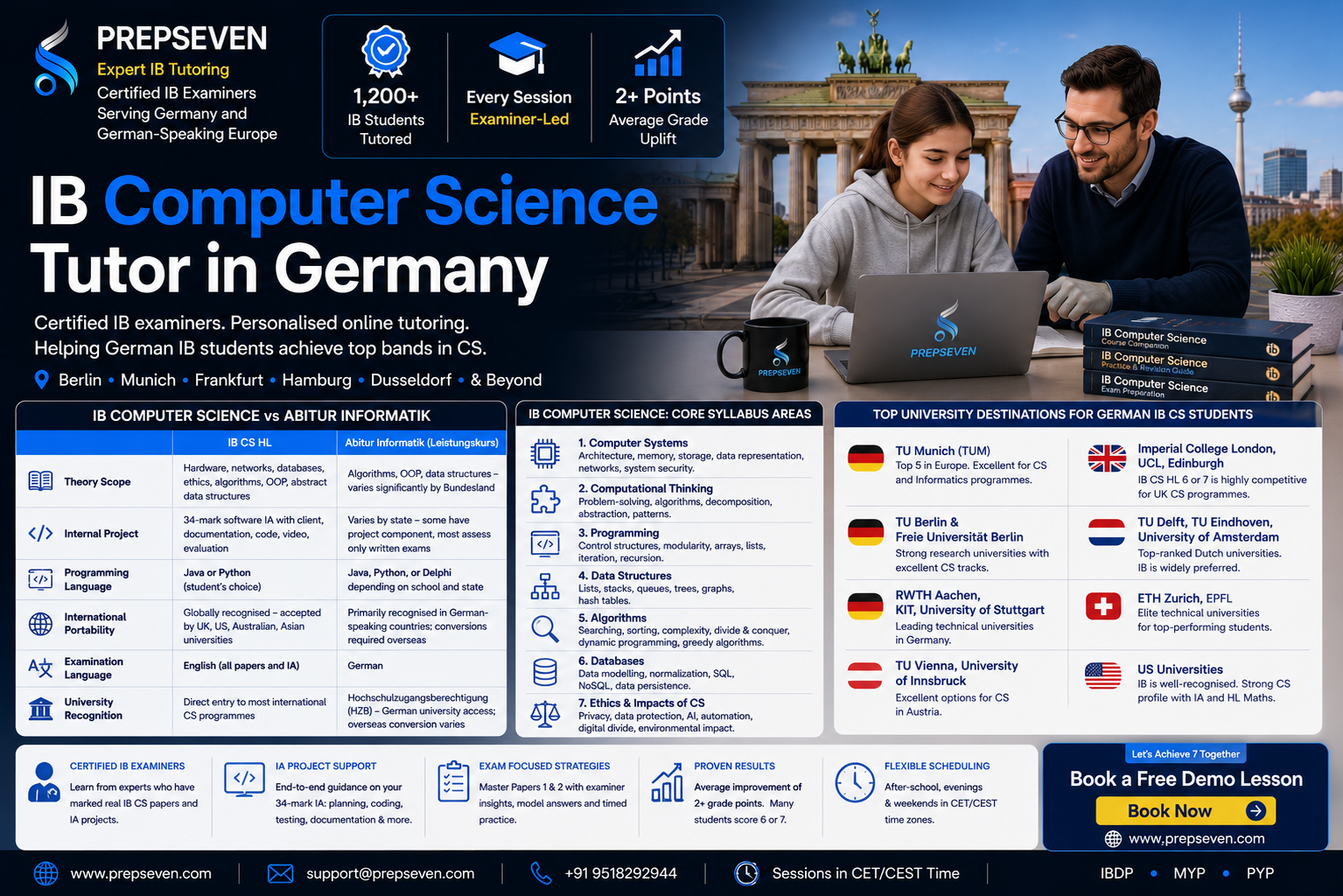
Germany’s international school landscape spans Berlin, Munich, Frankfurt, Hamburg, Dusseldorf, and dozens of smaller cities, with IB World Schools serving a student population of expatriate families, internationally mobile German professionals, and domestic families who have chosen the IB Diploma over the Abitur as a more globally portable credential. For these students, IB Computer Science is one of the most strategically consequential subject choices — carrying implications for university admissions not just in Germany, but across the UK, the Netherlands, Switzerland, Austria, and further afield.
PrepSeven connects German-based IB students with certified IB Computer Science examiners: tutors who have applied IB markschemes to real student papers, understand the exact criteria that separate a grade 5 from a grade 7, and deliver sessions calibrated to the full IB CS programme. All sessions are conducted online, in Central European Time, accessible to IB students across Germany without geographic constraints.
Whether you are at Munich International School, Berlin Brandenburg International School, Frankfurt International School, International School of Hamburg, or any of the IB Gymnasien (state schools offering the IB) across Germany — PrepSeven tutors are available to work with you from after school through the weekend.
IB Computer Science vs Abitur Informatik: What German Students Need to Know
Germany’s IB community includes both students at private international schools and a growing number at state Gymnasien that offer the IB alongside or instead of the Abitur. For families navigating this landscape, understanding how IB CS compares to Abitur Informatik (Leistungskurs) is a foundational question.
For German students targeting UK universities, US universities, ETH Zurich, EPFL, or competitive programmes in the Netherlands, the IB’s international portability is the decisive advantage. IB CS HL at grade 6 or 7 is recognised directly by Imperial College, UCL, University of Edinburgh, TU Delft, and ETH Zurich as a rigorous computing credential. The Abitur, while respected within Germany, requires conversion processes for overseas applications that the IB does not.
For students targeting German universities — TU Munich, TU Berlin, RWTH Aachen, KIT — both credentials are accepted. However, IB students at German universities bring an additional asset: the IA, which demonstrates a level of independent software project management that Abitur-educated peers rarely have documented evidence of.
University Destinations for German IB CS Students
German IB CS students target a distinctive mix of domestic and international universities, shaped by their school location, language background, and international family context:
- TU Munich (TUM) — Consistently ranked among Europe’s top five technical universities. TUM’s Computer Science and Informatics programmes accept IB students and assess them alongside Abitur applicants. A strong IB CS HL grade (6 or 7) combined with Maths AA HL is an excellent profile for TUM admission. TUM’s English-taught master’s programmes are also a destination for non-German-speaking IB graduates.
- TU Berlin and Freie Universitat Berlin — Berlin’s research universities attract internationally mobile students. TU Berlin’s CS programme is strong in theory and has English-taught components. IB students in Berlin often combine local university options with UK or Dutch alternatives.
- RWTH Aachen — One of Germany’s most prestigious engineering universities. RWTH’s Computer Science and Electrical Engineering programmes are strong and accept IB applicants. The location near the Dutch and Belgian border means Dutch university options (TU Eindhoven, TU Delft) are also within commuting distance.
- UK universities (Imperial, UCL, Edinburgh, Warwick, Bristol) — German international school students with strong English proficiency frequently target the UK. IB CS HL at grade 6 or 7 is a competitive credential for these programmes, and UK universities are very familiar with IB applicants from Germany.
- Netherlands (TU Delft, TU Eindhoven, University of Amsterdam) — The Netherlands is the most popular international destination for German IB students after the UK. English-taught bachelor programmes at TU Delft are world-class in CS and Engineering. IB is well-recognised and frequently preferred by Dutch admissions offices over Abitur for international students.
- ETH Zurich and EPFL — Switzerland’s elite technical universities are a natural target for top-performing German IB CS students, particularly those at Bavarian or southern German schools. The geographic proximity and the institutions’ global reputation make them compelling options for students with IB CS HL at grade 7 and Maths AA HL at grade 6 or 7.
IB Computer Science Across German Cities: School and University Overview
PrepSeven serves IB CS students across all German states. Online sessions mean that students in Hamburg have the same access to a certified IB CS examiner as students in Munich. Below is an overview of the IB landscape by city:
A notable feature of Germany’s IB landscape is the presence of state-funded IB Gymnasien in several Bundeslaender. Students at these schools have the IB available at significantly lower cost than private international schools but may have less specialist CS resource. PrepSeven’s examiner-led tutoring is particularly valuable for students at IB Gymnasien where the CS teacher may have limited IB examining experience.
Why German IB Families Choose PrepSeven
The German IB Student Profile: Specific Challenges PrepSeven Addresses
German IB CS students have a distinctive academic profile shaped by their educational background. Regardless of whether they come from a private international school or a state IB Gymnasium, several patterns recur consistently:
- Strong mathematics foundations: German students typically bring excellent mathematical preparation to IB CS — a genuine advantage for the algorithmic thinking components of Theme B. However, this can create overconfidence in Paper B and underpreparation for the theoretical writing demands of Paper A.
- German as primary academic language: For students at IB Gymnasien, German may be the dominant language of instruction outside IB CS. This affects command term application in Paper A and documentation quality in the IA. Our tutors address IB-specific English academic writing as an integrated component of CS preparation.
- Abitur comparison pressure: Students at IB Gymnasien often have peers sitting the Abitur in the same school. The structural differences between Abitur Informatik and IB CS — particularly the IA requirement and the written examination format — mean that advice from Abitur-track peers is often misleading. Our tutors explicitly address what is different about IB CS preparation.
- High ETH / TUM ambitions: Many top-performing German IB CS students are targeting ETH Zurich or TU Munich — institutions that attract the best technical minds in the German-speaking world. The grade expectations for these programmes are unforgiving, and the preparation required for IB CS grade 7 at HL demands systematic, examiner-level coaching.
- Precision culture: German students tend to be precise thinkers who respond well to clear, structured feedback. PrepSeven tutors work in exactly this mode — specific, criterion-referenced feedback on every practice answer, not general encouragement.
IB CS Syllabus: Complete Coverage for German Students
Theme A — Concepts of Computer Science (Paper A)
Theme A covers theoretical computing. Paper A assesses this through short-answer and extended-response questions in English. German students with strong technical backgrounds often find the content accessible but underestimate the command term requirements — particularly the distinction between ‘describe’, ‘explain’, and ‘evaluate’ in extended responses.
- A.1 Computer Organisation: Full CPU architecture (ALU, control unit, registers — MAR, MDR, program counter, accumulator, instruction register, cache), machine instruction cycle with bus interactions (address bus, data bus, control bus), memory hierarchy (L1/L2/L3 cache, RAM, ROM, flash, virtual memory, secondary storage types), I/O categories and interfaces, and CPU performance factors — clock speed, pipeline depth, number of cores, bus width, cache hierarchy
- A.2 Networks: Network types and classifications, physical topologies and their performance trade-offs, hardware component functions at each OSI/TCP-IP layer, detailed protocol behaviour (DNS resolution process, DHCP handshake, HTTP request-response cycle, TLS handshake for HTTPS), IP addressing and CIDR notation, cybersecurity threat taxonomy with technical mechanisms, and layered defence strategies
- A.3 Databases: Full relational theory, ER modelling and notation, normalisation theory and worked examples through 3NF, SQL in depth (all clauses, all JOIN types, subqueries, aggregate functions, transactions, constraints), DBMS architecture (query processor, transaction manager, buffer manager, storage engine), ACID properties with conflict scenarios, and concurrent access control
- A.4 Computer Science in Context: Ethical frameworks, GDPR and the German Federal Data Protection Act (BDSG — Bundesdatenschutzgesetz) in the computing context, digital rights and surveillance, intellectual property frameworks, environmental impact of data centres and cloud computing, and the social implications of AI and automation — assessed through extended analytical responses requiring structured argument in English
Theme B — Computational Thinking and Problem-Solving (Paper B)
Theme B is the programming and algorithms component, assessed through handwritten Java or Python code. German students with prior programming experience from school — many Gymnasien teach Java — have a foundational advantage, but IB Paper B requires exam-specific technique that goes beyond IDE-based programming competence.
- B.1–B.5 Computational Thinking Strands: Abstraction, procedural decomposition, logical reasoning, thinking ahead, and concurrent thinking — examined both as conceptual vocabulary and as applied frameworks for structuring algorithmic responses
- B.6 Programming in Full: All primitive and reference data types, 1D and 2D array operations, ArrayList and collection classes, complete OOP (encapsulation, inheritance with multi-level hierarchies, polymorphism, abstract classes and methods, interfaces), constructors, method design and signatures, recursion with call stack analysis, and all standard IB algorithms — binary and sequential search, bubble sort, selection sort, and tree traversal algorithms — in Java or Python
HL Extensions
- Abstract Data Structures: Linked list operations (singly and doubly linked — all insertion and deletion cases with pointer management), stack and queue implementations (array-based and linked-list-based, all operations with boundary conditions), binary tree structure and all operations including traversal algorithms — all assessed as code writing tasks in Paper B
- Resource Management: Process scheduling with worked examples (FCFS, Round Robin, SJF, Priority, Multilevel Feedback Queue), memory allocation strategies, virtual memory and demand paging, garbage collection mechanisms, deadlock theory (four conditions, resource allocation graph, Banker’s Algorithm concepts), and operating system kernel services
- Control Systems: Embedded systems architecture and constraints, sensor and actuator interfacing, open-loop vs closed-loop control with diagrams, feedback and error correction, PID control concepts, real-time system requirements, and autonomous system applications
- Paper 3 Case Study: Released approximately three months before the May exam session. German HL students receive this in February. Preparation requires structured analytical reading, concept mapping, and timed response practice — not passive reading. PrepSeven tutors run a dedicated 4-session Paper 3 preparation module.
Assessment Structure for German IB CS Students
Standard Level
Higher Level
The Internal Assessment: A Distinctive Advantage for German IB Students
The IB CS Internal Assessment is an opportunity that the Abitur does not offer: a fully documented, client-facing software development project that serves as a permanent record of independent computing capability. For German IB students applying to UK or Dutch universities, the IA is evidence — not just a grade — of project management, analytical documentation, and software development maturity.
The five criteria and what they demand of German students:
- Criterion A — Planning (6 marks): A specific, named client with a real, documented computing problem. Success criteria that are measurable and testable. German students with strong analytical backgrounds sometimes write technically sophisticated Criterion A documentation but fail to identify a genuine, specific client — a foundational mistake that moderators dock marks for consistently.
- Criterion B — Design (6 marks): Complete pre-development design records — wireframes, class diagrams, data flow diagrams, algorithm flowcharts, and a structured test plan. The design must be produced before building, not retrospectively. For German students accustomed to solving problems first and documenting second, this sequencing discipline is a key adjustment.
- Criterion C — Development (12 marks): Clean, annotated code explaining design decisions. German students with Java backgrounds from Gymnasium often write technically excellent code but under-annotate — assuming the code speaks for itself. IB CS examiners cannot award marks for undocumented decisions. Annotation is not optional.
- Criterion D — Functionality and Extensibility (4 marks): A video recording systematically testing the product against each success criterion from Criterion A. The video must be purposeful and explicit — not a demo, but a test. German students who build strong products sometimes lose marks here by submitting a walkthrough video that does not reference the original success criteria.
- Criterion E — Evaluation (6 marks): An honest, evidence-based evaluation of how well the product satisfied each success criterion. Client feedback must be obtained and referenced. Improvement recommendations must be specific and justified. The evaluation rewards critical thinking — a product that partly satisfied its criteria, evaluated rigorously, scores higher than a product claiming full success without evidence.
PrepSeven IA tutors provide milestone-by-milestone reviews calibrated to IB CS examiner standards. For German students at IB Gymnasien where the CS teacher may have limited moderation experience, this examiner-level IA review is particularly valuable.
How PrepSeven Works for German Students
- Free Diagnostic Consultation — 30 minutes assessing syllabus coverage, programming proficiency (including any Java background from Gymnasium), IA stage, English academic writing confidence, and target university requirements. No charge.
- Personalised Study Plan — Built around the German school year (typically September to July with regional holiday variation), exam session (May), target universities, and the student’s available weekly hours.
- Weekly One-on-One Sessions — Zoom sessions in CET or CEST. Shared digital whiteboard, code environment, and screen sharing. Typical weekday slot: 4pm to 8pm CET. Saturday morning: 9am to 12pm CET.
- Abitur-to-IB Technique Transition — For students with Abitur Informatik or Gymnasium CS backgrounds, explicit sessions on what is different about IB CS assessment — command terms, written response structure, IA documentation sequencing.
- Past Paper Practice with Examiner Feedback — Systematic past paper questions after each topic. Feedback delivered in IB markscheme language — the exact vocabulary the real examiner uses.
- IA Milestone Reviews — Criterion-by-criterion written feedback at planning, design, development, and pre-submission stages. English documentation clarity reviewed alongside technical accuracy.
- Paper C Preparation (HL) — 4-session structured case study module using previous IB case studies. Timed practice with examiner-standard feedback.
- Monthly Progress Reports — Written summaries for students and parents covering syllabus progress, predicted grade trajectory, and recommended focus areas.