
PREPSEVEN
IB Chemistry Tutor in the UK
Examiner-Certified Tutoring for the IB Diploma’s Most Demanding Science
Built for Russell Group and Oxbridge Applicants: Book a Free Demo Lesson
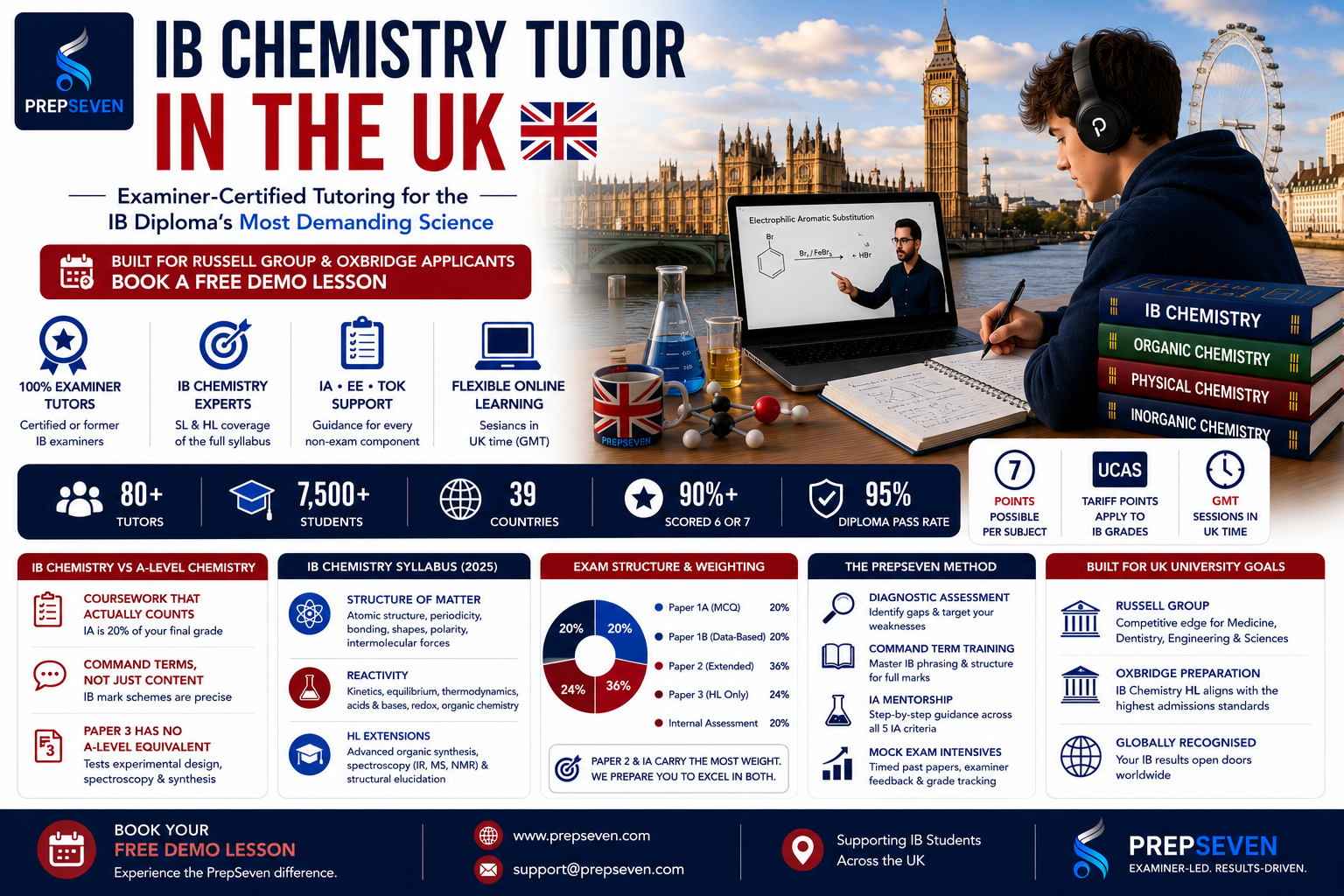
The UK is unusual among IB markets in that most British schools still default to A-Levels, which means the families who choose the IB Diploma have made a deliberate decision to pursue a broader, more rigorous qualification, often at schools such as Sevenoaks, Wycombe Abbey, ACS International, or one of the UK’s growing number of IB World Schools. This decision raises the stakes around Chemistry considerably, because IB Chemistry HL sits at the centre of UK university admissions for medicine, dentistry, veterinary science, and engineering.
Unlike A-Level Chemistry, which UK admissions tutors have decades of familiarity with, IB Chemistry is assessed through a fundamentally different structure: command-term-based mark schemes, an Internal Assessment carrying real weight, and a Paper 3 component with no A-Level equivalent. PrepSeven exists to bridge exactly this gap. Every tutor on our platform is a certified or former IB examiner, with direct, hands-on experience of how the IB Organisation actually marks Chemistry papers.
IB Chemistry vs A-Level Chemistry: What UK Families Need to Understand
Parents who have only encountered A-Level Chemistry through older siblings, relatives, or their own schooling often underestimate how differently the IB approaches assessment. Understanding these structural differences is the first step toward effective preparation.
The PrepSeven Method for UK Students
PrepSeven’s UK tutoring is structured around the specific reality of British IB schools: students who are often academically capable but unfamiliar with how the IB’s assessment philosophy differs from the GCSE and A-Level systems most of their peers experience nationally.
- Diagnostic Assessment: A focused first session establishing exactly where the student’s current understanding sits against the IB syllabus, with particular attention to command term fluency and exam technique gaps inherited from a GCSE-style approach to answering questions.
- Command Term Training: Systematic training on how to decode IB command terms and structure answers that capture every available mark point, directly addressing the most common reason UK students underperform relative to their content knowledge.
- Internal Assessment Mentorship: Hands-on IA mentorship across all five criteria, with particular focus on the open-ended research design process that many UK students have not encountered in their prior schooling.
- Mock Exam Intensives: Full timed past papers under exam conditions in the run-up to May or November exams, marked against real IB criteria with grade-boundary tracking toward the student’s target university requirements.
IB Chemistry Syllabus: Complete Breakdown
The current IB Chemistry course, first examined in 2025, organises content into two structural pillars, Structure of Matter and Reactivity, with additional depth at Higher Level. For UK students, PrepSeven tutors pay particular attention to the conceptual overlap with GCSE and A-Level content, since this overlap can create a false sense of security: students often recognise the topic names but have not been trained to answer questions in the IB’s distinctive style.
Structure of Matter
This strand covers atomic structure, the periodic table, and the major bonding models. UK students with strong GCSE Chemistry backgrounds typically find the factual content familiar, but the IB requires deeper conceptual explanation than GCSE mark schemes demand, particularly around VSEPR theory, polarity, and intermolecular forces, where ‘describe’ answers that would score well at GCSE fall short of IB standards.
Reactivity
Reactivity spans kinetics, equilibrium, thermodynamics, acid-base chemistry, redox processes, and organic chemistry, and carries the bulk of marks across the IB Chemistry papers. PrepSeven’s UK tutors devote significant session time to equilibrium calculations and organic mechanism questions, both of which require a level of quantitative and mechanistic precision well beyond GCSE expectations.
Higher Level Extensions
HL students must additionally master advanced organic synthesis pathways and structural elucidation using IR, mass spectrometry, and NMR spectral data. For UK students applying to competitive medicine, dentistry, and engineering courses, strong performance in this area is frequently the difference between meeting and missing a university’s typed offer.
Exam Structure: Paper-by-Paper Breakdown
Why Paper 2 Catches A-Level-Trained Students Off Guard
UK students used to A-Level mark schemes, which are often more forgiving of approximate phrasing, frequently lose marks on IB Paper 2 not because they lack chemistry knowledge but because their answers are not structured the way IB examiners require. PrepSeven’s Paper 2 clinics specifically retrain this habit, teaching students to write answers that hit every available mark point explicitly rather than relying on general scientific competence.
Paper 3: The Component Without an A-Level Equivalent
Paper 3 tests experimental design and spectral interpretation skills that simply have no direct counterpart in A-Level Chemistry. UK students, even strong ones, often need dedicated, ground-up instruction in this area, since there is no prior exam experience to draw on. PrepSeven runs structured Paper 3 workshops using genuine past IB material to build this skill from scratch.
Internal Assessment: A UK Tutor’s Guide
The Chemistry IA is worth 20% of the final grade, and for UK students this is often the single most unfamiliar component of the entire IB Diploma. British students rarely encounter independently designed coursework at this level prior to the IB, which means the IA’s open-ended nature, choosing a topic, designing a methodology, and conducting genuine scientific evaluation, can feel disorienting without proper guidance.
PrepSeven’s IA mentorship includes three formal checkpoints: a research question and methodology review, a first-draft analysis review, and a final pre-submission evaluation check. Each checkpoint is conducted by an examiner-trained tutor who applies the same standards used in real IB moderation, giving UK families confidence that the final submission genuinely reflects top-band quality.
HL or SL? Guidance for UK Families
UK families weighing Chemistry HL against SL should think primarily in terms of UCAS course requirements. Russell Group universities publish specific subject and grade requirements for medicine, dentistry, veterinary science, and engineering, and many explicitly require Chemistry at Higher Level. PrepSeven advises families against actual UCAS-listed requirements, not general assumptions.
Topic Difficulty Map for UK IB Students
IB Chemistry and UK University Applications
UK universities, particularly within the Russell Group, increasingly publish explicit IB grade requirements for competitive courses. Medicine and dentistry programmes at institutions such as UCL, Imperial College London, Edinburgh, and King’s College London typically require IB totals of 38 to 40 points with HL Chemistry at 6 or 7. Oxbridge science colleges generally expect HL Chemistry alongside HL Mathematics, with admissions tutors scrutinising both predicted and achieved grades closely given the competitiveness of the applicant pool.
How PrepSeven Tutoring Works for UK Families
PrepSeven delivers all tutoring online, which suits the geographic spread of UK IB World Schools, from London and the Home Counties to schools across Scotland, Wales, and Northern Ireland. Sessions are scheduled in UK time, with flexibility around school terms, half-term breaks, and the demanding extracurricular schedules typical of UK independent schools.
- Platform: All sessions delivered via a secure online platform with shared whiteboard and document annotation tools.
- Scheduling: Flexible scheduling in UK time, accommodating school terms, half-term breaks, and busy extracurricular commitments.
- Tutor Standard: Every tutor is a certified or former IB examiner with direct experience marking Chemistry papers for the IB Organisation.
- Parent Communication: Regular progress reports sent to parents summarising topics covered, performance trends, and progress against UCAS-relevant targets.
- Session Recordings: Sessions recorded on request so students can revisit explanations independently ahead of mock exams.
Frequently Asked Questions: IB Chemistry Tutoring in the UK