

PREPSEVEN
IB Chemistry Tutor in Australia
Examiner-Certified Tutoring for ATAR-Equivalent Excellence
Built for Group of Eight University Applicants: Book a Free Demo Lesson
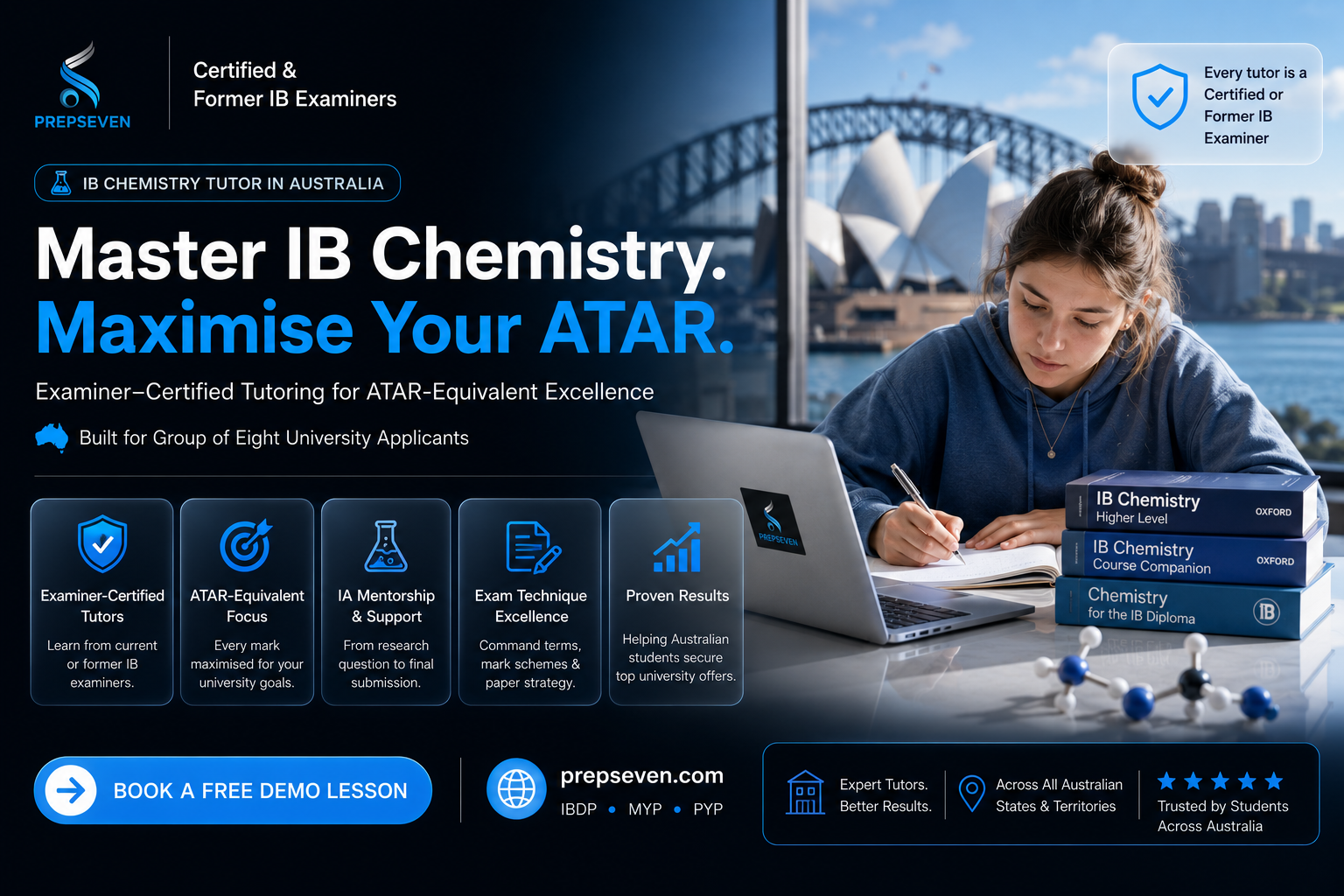
Australia presents a unique challenge for IB students that families from ATAR-based systems often underestimate: the IB Diploma score must be converted into an ATAR-equivalent figure for university admissions purposes, using conversion tables published by individual states and territories. This conversion process means that every single mark in IB Chemistry carries amplified weight, since small differences in raw IB performance can translate into noticeably different ATAR-equivalent outcomes when competing for places at Group of Eight universities.
PrepSeven exists to make sure Australian IB students are never left guessing about what a given grade actually means for their university prospects. Every tutor on our platform is a certified or former IB examiner, with direct experience marking real IB Chemistry papers for the IB Organisation, and our Australian student support is built around a clear understanding of how ATAR-equivalent conversions work across Australian states.
PrepSeven’s Coverage Across Australia
State / Territory | Major IB Hubs | ATAR Conversion Body | PrepSeven Focus |
New South Wales | Sydney | UAC (Universities Admissions Centre) | Maximising IB score for UAC ATAR-equivalent conversion |
Victoria | Melbourne | VTAC (Victorian Tertiary Admissions Centre) | Strategic Chemistry grade targets for VTAC conversion bands |
Queensland | Brisbane, Gold Coast | QTAC (Queensland Tertiary Admissions Centre) | Aligning HL Chemistry performance with QTAC requirements |
Western Australia | Perth | TISC (Tertiary Institutions Service Centre) | Supporting WA students applying to UWA and Curtin |
South Australia / ACT | Adelaide, Canberra | SATAC / ANU direct entry | Tailored support for SA and ACT university pathways |
Why Every Mark Matters More for Australian IB Students
The ATAR Conversion Multiplier Effect Because IB results are converted into ATAR-equivalent scores through state-specific tables, even small improvements in IB Chemistry, particularly at Higher Level, can shift a student’s competitive position more significantly than they would under a points-based system alone. A tutor who understands exactly where marks are won and lost in Chemistry is therefore disproportionately valuable in the Australian context. |
Group of Eight Competition Pressure Australia’s most selective universities, including the University of Sydney, University of Melbourne, ANU, UNSW, and Monash, set demanding entry requirements for medicine, engineering, and science degrees. These places are highly competitive, and a strong HL Chemistry result is frequently the deciding factor between an offer and a missed place. |
Limited Local IB Examiner Tutors Australia has a smaller and more geographically scattered IB community than countries like the UK or Singapore, meaning the pool of genuinely IB-examiner-qualified tutors available locally is limited. PrepSeven’s fully online model gives Australian students, whether in Sydney, Perth, or regional areas, equal access to this level of expertise. |
The PrepSeven Method for Australian Students
Given how directly IB grades translate into ATAR-equivalent outcomes in Australia, PrepSeven’s approach for Australian students places heavy emphasis on maximising every available mark, with a particular focus on the exam components most students underprepare for.
- Diagnostic Assessment: A diagnostic session establishing current performance against the IB Chemistry syllabus, with specific reference to the ATAR-equivalent impact of the student’s current trajectory based on their target state’s conversion methodology.
- Command Term Training: Systematic command term training so conceptual understanding translates fully into mark-scheme-aligned answers on Papers 1 and 2, where small technique improvements often yield the largest ATAR-equivalent gains.
- Internal Assessment Mentorship: Structured IA mentorship across all five assessment criteria, since the IA’s 20% weighting represents a substantial, controllable component of the final grade and ATAR-equivalent outcome.
- Mock Exam Intensives: Full timed mock papers in the lead-up to the May exam session, marked against genuine IB criteria, with explicit tracking of how mock performance translates to ATAR-equivalent positioning for target universities.
IB Chemistry Syllabus: Complete Breakdown
The current IB Chemistry course, first examined in 2025, organises content into two structural pillars, Structure of Matter and Reactivity, with additional depth at Higher Level. PrepSeven’s Australian tutors map every student’s revision against this exact framework, with particular attention to the topics most heavily represented in past papers, since maximising performance in high-frequency topic areas has a disproportionate effect on the final ATAR-equivalent outcome.
Structure of Matter
This strand covers atomic structure, the periodic table, and the major bonding models. Australian students with strong senior secondary science backgrounds generally find the factual content approachable, but the IB’s emphasis on extended written explanation, particularly around VSEPR theory and intermolecular forces, requires more developed scientific writing than many Australian state curricula demand at an equivalent stage.
Reactivity
Reactivity spans kinetics, equilibrium, thermodynamics, acid-base chemistry, redox processes, and organic chemistry, and carries the majority of marks across the IB Chemistry papers. PrepSeven’s Australian tutors concentrate significant tutoring time on equilibrium calculations and organic mechanism questions, both of which require quantitative precision that directly affects ATAR-equivalent positioning at the margins.
Higher Level Extensions
HL students must additionally master advanced organic synthesis and structural elucidation using IR, mass spectrometry, and NMR spectral data. For Australian students targeting medicine, dentistry, or engineering at Group of Eight universities, strong performance in this area is frequently the deciding factor in reaching the ATAR-equivalent threshold required for highly competitive programmes.
Exam Structure: Paper-by-Paper Breakdown
Paper | Format | Duration | Weighting | PrepSeven Focus |
Paper 1A | Multiple choice (30 SL / 40 HL) | 45 / 60 min | 20% | Distractor analysis, rapid recall accuracy |
Paper 1B | Data-based questions | 45 / 60 min | 10% | Unfamiliar data interpretation, graph skills |
Paper 2 | Structured & extended response | 2h 15m / 2h 30m | 40% | Command term decoding, structured answer writing |
Paper 3 (HL) | Option & experimental skills | 1h 15m | 20% | Spectroscopy, synthesis routes, error analysis |
Internal Assessment | Independent investigation | 10 hrs | 20% | Research design, statistical treatment, evaluation |
Why Paper 2 Has the Largest ATAR-Equivalent Impact
Because Paper 2 carries the heaviest weighting of all IB Chemistry components, it also has the largest single influence on a student’s ATAR-equivalent outcome. Australian students who are strong in Australian state curriculum chemistry assessments sometimes underperform here simply because IB mark schemes reward precise, complete answers structured around command terms rather than broadly correct scientific content. PrepSeven’s Paper 2 clinics directly target this gap.
Paper 3: Building HL-Specific Skills
Paper 3 tests experimental design and spectral interpretation skills that have limited overlap with most Australian senior secondary chemistry syllabi. Students, even academically strong ones, often need dedicated, ground-up instruction in this area. PrepSeven runs structured Paper 3 workshops using genuine past IB material to build these skills systematically, since this is frequently where ATAR-equivalent points are most easily gained through targeted preparation.
Internal Assessment: An Australian Tutor’s Guide
The Chemistry IA is worth 20% of the final grade, a substantial and largely controllable component of a student’s overall IB result. Given how directly the final IB score feeds into ATAR-equivalent calculations across Australian states, the IA represents one of the clearest opportunities for Australian students to secure marks through careful, well-guided preparation rather than exam-day performance alone.
Criterion | Marks | Common Australian Student Mistakes | PrepSeven Fix |
Exploration | 6 | Research question modelled too closely on a standard school practical | Guided process for developing an independently conceived, testable research question |
Analysis | 6 | Data treatment lacks the statistical rigour expected at IB standard | Training in uncertainty propagation and IB-appropriate data treatment |
Evaluation | 6 | Generic limitations sections with no specific connection to the student’s own data | Coaching toward specific, quantified evaluation tied directly to the student’s results |
Communication | 4 | Report structured informally rather than following IB’s expected scientific format | Templates and formatting guidance aligned to official IB conventions |
Personal Engagement | 2 | Topic chosen for convenience rather than genuine curiosity | Coaching toward authentic, student-led topic selection that reflects real interest |
PrepSeven’s IA mentorship includes three formal checkpoints: a research question and methodology review, a first-draft analysis review, and a final pre-submission evaluation check. Each checkpoint is conducted by an examiner-trained tutor who applies the same standards used in real IB moderation, helping Australian students secure the full value of this significant component before it converts into their final ATAR-equivalent outcome.
HL or SL? Guidance for Australian Families
Australian families weighing Chemistry HL against SL should consider both the ATAR-equivalent impact and specific university prerequisite requirements. Competitive medicine, dentistry, and engineering programmes at Group of Eight universities often list Chemistry as an assumed knowledge subject, and HL performance carries particular weight given how it factors into ATAR-equivalent conversions.
Consideration | SL Chemistry | HL Chemistry |
Suitable for | Non-STEM degrees, arts, commerce, social sciences | Medicine, dentistry, engineering, biomedical science, pharmacy |
Content load | Core syllabus | Core plus advanced organics, deeper thermodynamics, spectroscopy |
Group of Eight relevance | Acceptable for non-science faculties | Frequently listed as assumed knowledge or preferred for STEM programmes |
ATAR-equivalent impact | Lower ceiling on overall score contribution | Stronger potential ATAR-equivalent contribution given HL weighting |
Paper 3 | Not applicable | Mandatory, weighted 20% |
PrepSeven guidance | Choose if pursuing non-science degrees | Choose if targeting competitive STEM programmes at Group of Eight universities |
Topic Difficulty Map for Australian IB Students
Topic | Difficulty for Australian Students | Exam Frequency | Recommended Focus |
Atomic Structure & Periodicity | Low-Moderate | High | Standard revision |
Bonding & Molecular Geometry | Moderate | Very High | Deep focus |
Energetics | High | Very High | Deep focus |
Kinetics | Moderate-High | High | Deep focus |
Equilibrium | High | Very High | Intensive focus |
Acids & Bases | Moderate-High | Very High | Deep focus |
Redox & Electrochemistry | Moderate | High | Standard revision |
Organic Chemistry (SL) | High | High | Deep focus |
Advanced Organics (HL) | Very High | High | Intensive focus |
Spectroscopy (HL) | Very High | Very High | Intensive focus |
IB Chemistry and Australian University Applications
Australia’s Group of Eight universities, including the University of Sydney, University of Melbourne, ANU, UNSW, Monash, and the University of Queensland, maintain highly competitive entry requirements for medicine, dentistry, and engineering programmes. Because IB results are converted into ATAR-equivalent scores for admissions purposes, a strong HL Chemistry result has a measurable, calculable impact on a student’s competitive standing, often more directly visible than in points-based systems elsewhere. Many Australian IB students also apply to UK and US universities, where HL Chemistry results are assessed on their own terms rather than through ATAR conversion.
University of Sydney: Medicine and Engineering programmes set demanding ATAR-equivalent thresholds influenced heavily by HL Chemistry University of Melbourne: Competitive Science and Biomedicine pathways reward strong HL Chemistry performance ANU: Direct entry science programmes scrutinise HL Chemistry alongside HL Mathematics UNSW & Monash: Engineering and Medicine programmes set high ATAR-equivalent benchmarks where Chemistry is decisive PrepSeven Australian students have secured offers at University of Sydney, Melbourne, ANU, and UCL |
How PrepSeven Tutoring Works for Australian Families
PrepSeven delivers all tutoring online, which is particularly valuable for Australian students given the country’s vast geography and the limited number of genuinely IB-examiner-qualified tutors available locally, especially outside Sydney and Melbourne. Sessions are scheduled across Australian Eastern, Central, and Western time zones, with flexibility around school terms and the demanding co-curricular schedules typical of Australian IB World Schools.
- Platform: All sessions delivered via a secure online platform with shared whiteboard and document annotation tools.
- Scheduling: Flexible scheduling across Australian Eastern, Central, and Western time zones, accommodating school terms and co-curricular commitments.
- Tutor Standard: Every tutor is a certified or former IB examiner with direct experience marking Chemistry papers for the IB Organisation.
- Parent Communication: Regular progress reports sent to parents summarising topics covered, performance trends, and progress against target ATAR-equivalent outcomes.
- Session Recordings: Sessions recorded on request so students can revisit explanations independently ahead of mock exams.
Frequently Asked Questions: IB Chemistry Tutoring in Australia
Q: How does the ATAR conversion process affect IB Chemistry preparation?
A: Because IB results are converted into ATAR-equivalent scores using state-specific conversion tables published by bodies such as UAC, VTAC, and QTAC, every mark gained or lost in IB Chemistry has a calculable downstream effect on a student's competitive position for university admission. This makes precise, examiner-informed exam technique particularly valuable in the Australian context.
Q: My child's school is in a regional area with limited IB-specific tutoring options. Can PrepSeven help?
A: Yes. This is one of the most common reasons Australian families choose PrepSeven. Because our platform is fully online, students in regional Australia have the same access to examiner-certified tutors as students in Sydney or Melbourne, removing the geographic limitation that often constrains specialist IB support.
Q: Does PrepSeven help students understand how their IB grades translate to ATAR-equivalent scores?
A: PrepSeven tutors are familiar with the general structure of ATAR-equivalent conversion processes used by Australian states and can help families understand how improvements in IB Chemistry performance are likely to influence overall standing, though families should always confirm exact figures with their relevant state admissions body, such as UAC, VTAC, QTAC, TISC, or SATAC.
Q: How does PrepSeven support the IB Chemistry Internal Assessment specifically?
A: PrepSeven provides structured IA mentorship through three formal checkpoints: research question and methodology design, first-draft data analysis review, and a final evaluation check before submission. Each review is conducted against the actual IB assessment criteria by an examiner-trained tutor, helping Australian students secure full marks on this significant, controllable component.
Q: Is Chemistry HL necessary for Group of Eight medicine or engineering applications?
A: For most competitive medicine, dentistry, and engineering programmes at Group of Eight universities, HL Chemistry is frequently listed as assumed knowledge or strongly preferred. SL Chemistry is generally sufficient only for non-STEM degree pathways. PrepSeven helps families confirm specific requirements against their target programmes.
Q: What time zone do PrepSeven sessions run in for Australian students?
A: PrepSeven schedules sessions across Australian Eastern, Central, and Western time zones, with flexibility to accommodate school terms and the demanding co-curricular schedules typical of Australian IB World Schools.
Q: How quickly can PrepSeven help an Australian student improve their Chemistry grade?
A: This depends on the starting point and time remaining before examinations, but Australian students who begin systematic, examiner-led tutoring at least one to two terms before their final exams typically see measurable improvement within the first 8 to 10 weeks, with continued gains during mock exam preparation.
Book Your IB Chemistry Tutor in Australia
PrepSeven works with IB Chemistry students across Australia, from Sydney, Melbourne, Brisbane, and Perth to regional areas where local IB-specific tutoring is harder to find. Our examiner-certified tutors understand both the global IB framework and the specific ATAR-equivalent conversion dynamics that shape Australian university admissions.
Whether your child needs to maximise every available mark for ATAR-equivalent competitiveness, requires intensive IA mentorship, or wants examiner-level exam technique ahead of competitive Group of Eight applications, PrepSeven is built to deliver that result.
Start with a free demo lesson. There is no obligation, only a clear, honest assessment of where your child currently stands and the concrete steps required to reach their target grade.
Book a Free Demo Lesson | support@prepseven.com | +91 9518292944
