

How Top Scorers Study for IB Exams
It’s Rarely About How Many Hours They Put In
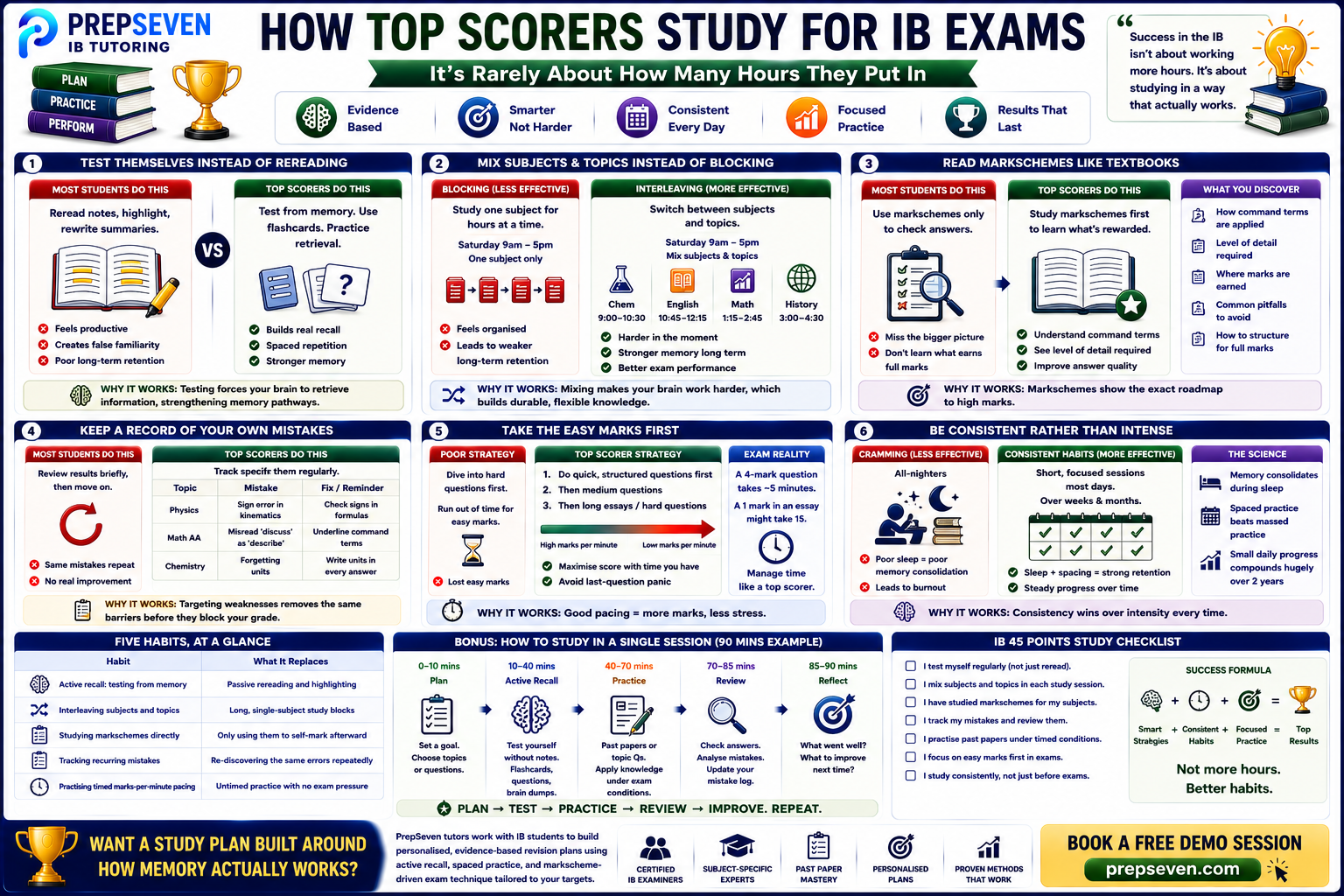
It’s Not About How Many Hours They Study
Picture two students preparing for the same set of IB exams. One spends every evening for three months rereading notes, highlighting textbooks, and rewriting summaries that already exist in a slightly different font. The other studies noticeably less in total hours, but spends almost all of that time testing themselves from memory, working through past papers, and deliberately returning to the topics that gave them trouble last week. The second student is, on average, the one who ends up with the higher grade, and it has very little to do with talent.
What separates students who consistently score near the top isn’t raw study time, motivation, or some innate gift for the subject. It’s a specific set of habits, almost all of them backed by decades of research into how memory and learning actually work, that most students have simply never been taught explicitly. None of these habits require more hours in the day. They require spending the hours you already have differently.
They Test Themselves Instead of Rereading
Rereading notes feels productive because the material feels familiar by the second or third pass, but familiarity is a poor measure of whether you can actually retrieve that information under exam conditions, without the notes in front of you. This is the well-documented gap between recognition and recall: you can recognise a concept as true the moment you see it written down, while still being completely unable to produce it yourself from a blank page, which is exactly what an exam asks you to do.
Top scorers default to active recall almost without thinking about it. Instead of rereading a topic, they close the book and try to write out everything they remember, then check what they missed. Instead of rereading flashcards until the answer feels obvious, they test themselves repeatedly, spacing the hardest cards more frequently than the easy ones. This single shift, testing rather than reviewing, is consistently one of the most well-evidenced study techniques available, and it’s also one of the most uncomfortable, since it constantly confronts you with what you don’t yet know rather than letting familiarity paper over the gaps.
They Mix Subjects and Topics Instead of Blocking Them
It’s tempting to spend a whole Saturday on one subject, working through every topic in order, because it feels organised and thorough. But studying this way, one long, unbroken block on a single subject, tends to produce weaker long-term retention than interleaving: switching between subjects and topics in shorter, mixed sessions across the same period of time. Interleaving feels less tidy in the moment, and it often feels harder, but that difficulty is largely the point. The brain has to actively retrieve the right approach for each new problem rather than coasting on momentum from the previous one, and that retrieval effort is what builds durable memory.
In practice, this means a top scorer’s Saturday revision session is more likely to move between three subjects in ninety-minute blocks, with topics deliberately mixed within each block, than to plough through a single subject from nine until five. Spacing the same topic across multiple sessions over several weeks, rather than mastering it once and moving on permanently, has a similar effect: it feels less efficient in the short term and produces meaningfully better retention by the time exams actually arrive.
They Read Markschemes the Way Other Students Read Textbooks
Most students treat a markscheme as something you check after finishing a past paper, purely to find out whether you got the right answer. Top scorers treat markschemes as a primary source of information about what’s actually being rewarded, studied almost as carefully as the syllabus content itself. Reading several markschemes for the same command term across different past papers reveals patterns that aren’t obvious from a syllabus document alone: what “evaluate” actually needs to include to earn full marks, how much detail “explain” requires compared to “describe,” and where partial credit tends to be available even when a final answer is wrong.
This habit changes how students approach revision more broadly, since it shifts the underlying question from “do I understand this topic” to “could I write or calculate an answer that would earn full marks on this exact kind of question.” Those are related questions, but they’re not the same one, and the second is the one the exam is actually testing.
They Keep a Record of Their Own Mistakes
Almost every strong student reviews their past paper results. What separates top scorers is what they do with that review: rather than simply noting a percentage and moving on, they keep some form of running record, a notebook, a spreadsheet, a simple list, of the specific errors they keep making, and they return to that record deliberately before the next round of practice. A recurring sign error in mechanics, a habit of misreading “discuss” as “describe,” a consistent tendency to run out of time on the final question, each of these is a specific, fixable pattern, but only if it’s actually being tracked rather than re-discovered fresh after every test.
This is a small habit that compounds significantly over two years. A student who has been logging and correcting specific error patterns since the start of Year 1 enters final exams with most of their recurring mistakes already eliminated, while a student encountering the same patterns for the first time during study leave is trying to fix them with far less time to make the correction stick.
They Take the Easy Marks First
Under real exam conditions, not every mark costs the same amount of time to earn. A short, structured question worth four marks might take five minutes to answer fully, while a single mark buried inside a long extended response might take fifteen minutes of writing to reach. Top scorers tend to have an instinctive, practised sense of this marks-per-minute reality, and they sequence their exam accordingly: securing the reliable, quick marks first, then spending the remaining time where the marks are harder won but where there’s actually enough time left to do them justice.
This isn’t about cutting corners. It’s about recognising that running out of time on a paper, leaving an entire final question blank because the earlier ones took too long, is one of the most common and most avoidable ways strong students lose marks. Practising full papers under realistic timed conditions, repeatedly, is what builds this instinct, far more reliably than untimed topic practice ever can.
They’re Consistent Rather Than Intense
The image of a student cramming through the night before a major test is common, and it’s also a poor model for how top scorers actually operate across the two years of the Diploma. Memory consolidation, the process by which newly learned material becomes durable long-term knowledge, depends heavily on sleep, and it depends on spaced repetition over days and weeks rather than concentrated repetition over a single sitting. A short, focused session most days consistently outperforms an occasional long, exhausting one, both because of how memory actually consolidates and because consistency is simply easier to sustain across a genuinely long course without burning out.
This is also, practically, why starting early matters so much more than it seems to in the moment. A habit built in Year 1, even a modest one, compounds across two years in a way that no amount of last-minute intensity in the final weeks before exams can realistically replicate.
Five Habits, At a Glance
None of This Requires More Time, Just a Different Approach
The genuinely encouraging part of all this is that none of these habits demand more hours in the day than a student is already spending on revision. They demand a different relationship with discomfort: choosing to test yourself rather than reread, choosing to mix subjects rather than settle into one comfortable block, choosing to read a markscheme as carefully as a textbook chapter. Each of these feels slightly harder in the moment than the more familiar alternative, and that discomfort is, almost without exception, exactly where the actual learning is happening.
Want a study plan built around how memory actually works?
PrepSeven tutors work with students to build genuinely evidence-based revision plans, active recall, spaced practice, and markscheme-driven exam technique, tailored to each subject and grade target.
Book a Free Demo Session at prepseven.com