

How to Score a 7 in IB Physics
The Complete Guide for IB DP Students
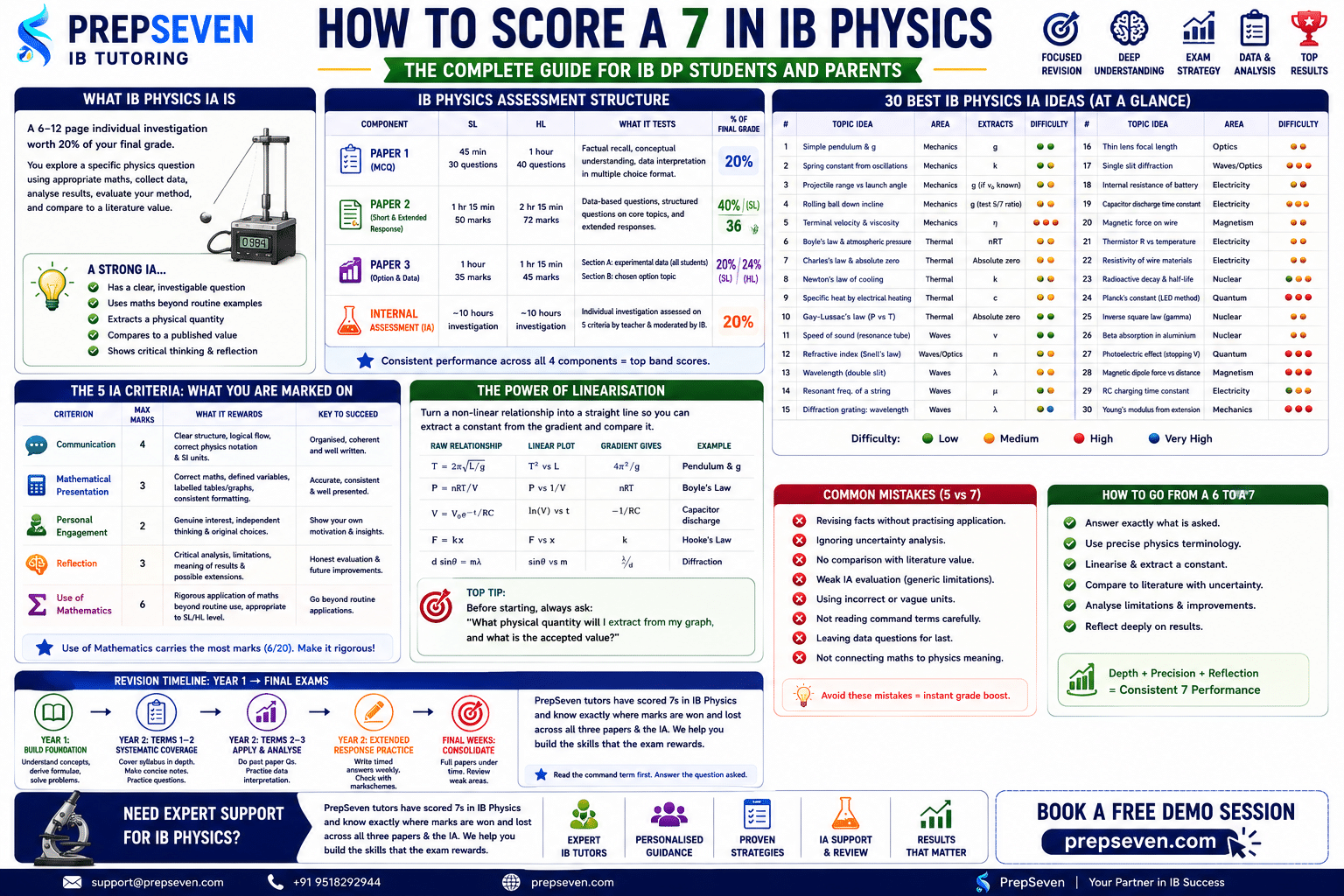
What IB Physics Actually Tests
IB Physics is the most mathematically demanding of the three Group 4 sciences, and it is the subject where the gap between what students think they understand and what the exam actually tests shows up most starkly. A student who can substitute values into equations correctly will score somewhere around 4 or 5 in IB Physics. A student who understands what those equations are describing physically, when they apply and when they do not, and how to set up a problem from first principles when no equation directly matches the scenario, is in range for a 7.
The current IB Physics syllabus, first assessed in 2025, is organised around five core topics: Space, Time, and Motion; The Particulate Nature of Matter; Wave Behaviour; Fields; and Nuclear and Quantum Physics. Each of these contains both SL and HL content, with HL going significantly deeper mathematically and conceptually. The course also includes a set of Nature of Science and inquiry skills that are threaded throughout, reflected particularly in Paper 1B and the Internal Assessment.
What distinguishes physics from the other sciences at IB level is the density of mathematical relationships and the expectation that students can work with them flexibly. This is not the same as being good at maths. It means being able to look at a physical situation, identify the relevant relationships, set up the algebra, and arrive at a physically meaningful answer, including checking whether the answer makes sense dimensionally and in magnitude. Students who approach physics as a collection of equations to memorise and apply will consistently be wrong-footed by questions that present familiar physics in an unfamiliar mathematical or physical setup.
The most reliable indicator of whether a student will reach a 7 in IB Physics is not their maths ability but their physical intuition: the ability to look at a situation and have a reasonable expectation of what will happen before doing any calculation. A student who can predict that a heavier pendulum has the same period as a lighter one, that doubling the distance from a point source quarters the intensity, or that a charged particle moving parallel to a magnetic field experiences no force, without reaching for the formula, has the kind of physical understanding that the exam rewards in its hardest questions. This intuition is built through genuinely thinking about physics, not through drilling calculations.
The Assessment Structure
Paper 1A is where physics MCQ differs most from the other sciences. Physics MCQ questions frequently require mental calculation without a calculator, which demands both equation recall and numerical fluency. A student who needs to reach for the formula sheet for every equation in Paper 1A will struggle to complete it in time. The equations that appear most frequently in MCQ, kinematics relationships, energy conservation, wave relationships, Coulomb’s law, gravitational and electric field strength, need to be known without reference to the formula sheet so that cognitive capacity is available for the physical reasoning rather than the formula retrieval.
Paper 1B is the data-based component and is shared across SL and HL in terms of the time allocation and question format, though HL questions may probe the data more deeply. The questions in Paper 1B require students to read graphs accurately, calculate gradients and intercepts with correct units, propagate uncertainties through calculations, identify whether a trend is linear or non-linear, and suggest modifications to experimental design. These are skills that only develop through deliberate practice on past Paper 1B questions. Content knowledge is almost irrelevant for Paper 1B; what matters is scientific reasoning and data handling.
Paper 2 is the highest-weight component at both SL and HL and the one where the full range of physics understanding is tested. At HL it is 2 hours and 15 minutes with questions spanning every topic area. The structure typically moves from shorter, more routine questions early in the paper to longer, more conceptually demanding multi-part questions later. Students who manage time poorly and spend too long on the early questions often arrive at the extended response questions with insufficient time, which costs disproportionate marks.
Paper 3 at HL covers content that many students approach as entirely separate from the rest of the course: relativity, electromagnetic induction in depth, and advanced nuclear and quantum physics. This is a mistake. The special relativity content builds directly on the kinematics and energy concepts from Topic 1. Electromagnetic induction builds on the fields content from Topic 4. The connections are real and understanding them makes the HL extension content significantly more accessible. Students who treat Paper 3 topics as isolated modules to memorise are making the exam harder for themselves than it needs to be.
The Syllabus: Five Topics and Where the Marks Are
Topic Deep Dives: Where Marks Are Won and Lost
Mechanics: The Foundation That Everything Else Builds On
Mechanics is Topic A and it is genuinely the foundation of the entire course. The kinematic equations, Newton’s laws, conservation of energy and momentum, and the treatment of circular motion and gravitation are all used in later topics, and a student who has not internalised these principles will find each subsequent topic incrementally harder. More immediately, mechanics generates a large proportion of Paper 2 marks at both SL and HL, and the questions range from straightforward kinematic calculations to multi-step problems involving energy conservation, projectile motion, and circular dynamics simultaneously.
The two mechanics areas that most consistently separate mid-range from high-range scorers are projectile motion and circular motion. Projectile motion questions require students to resolve motion into independent horizontal and vertical components, treat each independently using kinematics, and then combine results. The systematic error is treating the problem as one-dimensional. A student who knows that horizontal velocity is constant throughout the flight and vertical acceleration is always g downward, and who sets up the two independent kinematic analyses before attempting any calculation, will handle any projectile question reliably.
Circular motion requires understanding that centripetal acceleration is always directed toward the centre of the circle, that the net force toward the centre provides this acceleration, and that different physical forces provide this centripetal force in different contexts: tension in a pendulum, gravity for orbital motion, normal force for a car on a banked track, friction for a car on a flat curve. Questions that present an unfamiliar circular motion scenario are testing whether the student can identify which force or combination of forces provides the centripetal acceleration, not whether they have memorised the specific scenario.
At HL, special relativity is examined in Paper 3 and requires a genuinely different conceptual framework from classical mechanics. Time dilation and length contraction are not just mathematical relationships to memorise: they describe a physically different relationship between time and space than everyday experience suggests. Students who engage with the paradoxes, the twin paradox, the pole-barn paradox, and understand how they are resolved using the relativity of simultaneity, develop the conceptual framework that makes HL relativity questions manageable. Students who memorise the Lorentz factor formula without this conceptual foundation will be unable to apply it to non-standard scenarios.
Energy conservation is the most powerful tool in IB Physics mechanics and the one that students most consistently underuse. Many problems that appear to require kinematics, or Newton’s law analysis, or circular dynamics, are most efficiently solved by identifying the initial and final energy states and applying conservation of energy between them. Before setting up a mechanics problem using forces and kinematics, ask whether you can solve it using energy conservation instead. If you can, the energy approach is almost always faster and less error-prone.
Waves: The Most Consistently Examined Topic
Wave behaviour is Topic C and is the most consistently examined area across all three external papers. The breadth of wave phenomena covered, from the basic properties of transverse and longitudinal waves through superposition, standing waves, resonance, the Doppler effect, single and double slit diffraction, and the HL extension into thin film interference and the Rayleigh criterion, means that almost any Paper 2 or Paper 3 question about waves can draw on material from across this entire topic.
Standing waves are a particularly reliable examination topic and one where precision in drawing and labelling diagrams matters as much as the physics. A student who can correctly draw a standing wave pattern for a given harmonic, label the nodes and antinodes, identify the wavelength in terms of the string or pipe length, and calculate the frequency using the wave speed relationship, is prepared for the standing wave questions that appear in every session. The common error is confusing open and closed pipe boundary conditions: an open end of a pipe is always an antinode, a closed end is always a node. A student who understands why this is the case, because the pressure variation at an open end must be zero while the displacement is maximum, will never confuse these conditions.
Single slit and double slit diffraction and interference is the area of waves where students most commonly confuse the two phenomena. Single slit diffraction produces a central maximum with subsidiary maxima on either side, with the minima given by the condition m times lambda equals d times sin(theta). Double slit interference produces equally spaced bright fringes with spacing proportional to lambda times D divided by d. The HL extension requires understanding what happens when both effects are present simultaneously: the double slit interference pattern is modulated by the single slit diffraction envelope, which produces the distinctive pattern with missing orders where a double slit maximum coincides with a single slit minimum.
The Doppler effect generates questions at all levels of complexity, from straightforward calculation of observed frequency for a moving source, to qualitative explanation of why the observed frequency changes, to the relativistic Doppler effect at HL. The key to Doppler questions is identifying clearly who is the source, who is the observer, and in which direction each is moving relative to the other before applying any formula.
Fields: The Mathematically Demanding Core
Fields is Topic D and is both the most mathematically demanding topic and the one that generates the most marks in Paper 2 extended responses. The parallel between gravitational and electric fields is one of the most conceptually elegant features of the IB Physics course: both follow an inverse square law, both have associated potential energy that follows an inverse law, and the relationship between field strength and potential is the same in both cases. Students who understand this parallel are equipped for questions about either field type because the mathematical structure is identical.
Electric potential and electric potential energy are the areas within fields where students most consistently lose marks, and they are tested heavily at HL. The distinction between electric field strength E, electric potential V, and electric potential energy Ep is essential: E is force per unit charge, V is potential energy per unit charge, and Ep is the actual energy of a charge in the field. The relationship E equals negative dV/dx at HL connects field strength to the gradient of the potential, which is tested both as a calculation and as a graphical interpretation. Students who can interpret a V-r graph and correctly identify the corresponding E-r graph are demonstrating exactly the mathematical understanding this section requires.
Electromagnetic induction is the HL extension of the magnetic fields content and is one of the most examination-heavy topics in HL Paper 3. Faraday’s law connects the rate of change of magnetic flux to the induced EMF, and Lenz’s law specifies the direction of the induced current as opposing the change that causes it. Questions on electromagnetic induction require students to calculate the flux through a changing area or through a fixed area in a changing field, apply Faraday’s law to find the induced EMF, use Lenz’s law to determine the direction of the induced current, and often connect this to the power dissipated in a connected circuit. This is a four-step analysis that requires systematic working rather than intuition.
Magnetic fields are the area of IB Physics where the most marks are lost through diagram errors. The direction of the force on a moving charge in a magnetic field, the direction of the induced current in a moving conductor, and the direction of the magnetic field around a current-carrying wire all require applying the right-hand rule correctly. Students who are uncertain about the right-hand rule under exam pressure and try to remember the result rather than applying the rule consistently will make errors that cascade through multi-part questions. Practise applying the right-hand rule until it is automatic, not just familiar.
Thermal Physics and Thermodynamics: Concept Plus Calculation
The particulate nature of matter, Topic B, covers thermal physics, kinetic theory, and the laws of thermodynamics. At SL the content focuses on specific heat capacity, latent heat, gas laws, and the kinetic theory explanation of gas behaviour. At HL it extends into thermodynamic cycles, entropy, and the second law expressed quantitatively.
Kinetic theory questions require students to connect the macroscopic behaviour of gases to the microscopic motion of particles. The key relationships are that the pressure of a gas results from particle collisions with the container walls, that the average kinetic energy of particles is proportional to the absolute temperature, and that these two facts together explain the ideal gas law. Questions that ask students to explain why increasing temperature increases pressure, or why a gas in a smaller container has higher pressure at the same temperature, require this microscopic explanation rather than just quoting the ideal gas law.
Thermodynamic cycles at HL involve calculating the work done by or on a gas in each stage of a cycle, using the first law of thermodynamics to find the heat transferred in each stage, and calculating the efficiency of the cycle. The most common cycle examined is the Carnot cycle, and the efficiency formula for Carnot requires understanding both the mathematical result and why no real engine can exceed Carnot efficiency, which connects to the second law. Students who understand the second law in terms of entropy, that the total entropy of an isolated system never decreases, and who can apply this to evaluate whether a proposed thermodynamic process is possible, are prepared for the conceptual questions that accompany the calculations in this section.
Nuclear and Quantum Physics: Precision Over Breadth
Nuclear and quantum physics is Topic E and covers radioactive decay, nuclear reactions, mass-energy equivalence, and the foundational concepts of quantum mechanics. The calculations in this topic, binding energy per nucleon, Q values for nuclear reactions, activity calculations from decay constants, are formulaic once the equations are understood and practised. The conceptual questions, particularly around wave-particle duality, the photoelectric effect, and the implications of quantum uncertainty at HL, require a different kind of preparation.
The photoelectric effect is examined in every session at some level and is the topic where conceptual understanding matters most. The key results are that photoemission requires the photon energy to exceed the work function, that increasing intensity increases the number of emitted electrons but not their maximum kinetic energy, and that the maximum kinetic energy depends only on the frequency of the incident radiation. Questions that ask why these results cannot be explained by a wave model of light and how the photon model accounts for them require genuine conceptual engagement with the historical argument rather than just knowing the formula.
Nuclear binding energy calculations require careful attention to units. The mass defect is typically calculated in atomic mass units and then converted to energy using E equals mc squared, which requires the conversion factor 1 u equals 931.5 MeV. Students who attempt these calculations in SI units without the conversion factor invariably produce answers that are dimensionally correct but numerically wrong by a factor of approximately 10 to the power of 13. Establish the habit of working in atomic mass units and MeV for all nuclear energy calculations.
Paper-by-Paper Strategy
Paper 1A: Physics Multiple Choice Without a Calculator
Paper 1A in IB Physics is the most cognitively demanding MCQ paper of the three Group 4 sciences because it frequently requires calculation without a calculator. Students who approach it by attempting every question fully from first principles will not complete it in time. The strategy that works is to categorise questions quickly: which ones can be answered immediately from physical intuition or direct recall, which require short calculation, and which require more extended analysis. Answer the immediate ones first, do the short calculations in the second pass, and allocate remaining time to the harder questions.
Paper 1B: Data Handling and Experimental Reasoning
Paper 1B provides experimental data, typically graphs and tables, and asks a series of short answer questions requiring data extraction, calculation, uncertainty analysis, and experimental evaluation. This component is entirely about scientific reasoning skills rather than physics content, and it improves dramatically with deliberate practice on past Paper 1B materials.
Graph gradient questions are among the most reliably tested skills in Paper 1B. To calculate a gradient correctly in IB Physics, draw a large triangle on the graph using two points on the best-fit line that are not data points, read the coordinates of those two points from the graph axes including units, calculate rise over run, and report the result with units. The uncertainty on the gradient is found by drawing the steepest and shallowest plausible lines through the error bars and calculating the gradient of each. Students who calculate the gradient from two data points rather than from the best-fit line, or who omit units, or who calculate gradient uncertainty by propagating the uncertainties on individual data points rather than from the range of plausible gradients, will lose marks on questions that are otherwise straightforward.
Identifying systematic errors from data is a specific skill tested in Paper 1B. A systematic error shifts all measurements in the same direction by a consistent amount. On a graph, a systematic error in the independent variable shifts the graph horizontally; a systematic error in the dependent variable shifts it vertically. A graph that shows a non-zero intercept when the physics predicts zero intercept is indicating a systematic error, and identifying what could cause this specific offset in this specific experiment is what the question is asking for. Generic answers about systematic errors earn no marks.
The linearisation of data is tested frequently in Paper 1B and is one of the most powerful tools in IB Physics data analysis. When a physical relationship is not linear, it can often be transformed into a linear form: y equals kx squared becomes y vs x squared; y equals k divided by x becomes y vs 1/x; y equals k times e to the power of ax becomes ln(y) vs x. Recognising which transformation is appropriate, plotting the linearised graph, and extracting the physical quantity from the gradient or intercept is a skill that appears in Paper 1B, Paper 2, and the Internal Assessment. Students who can do this fluently have a significant advantage in all three components.
Paper 2: The Full Range of Physics
Paper 2 is the most important external component and the one where the quality of physics understanding shows most clearly. At HL it spans 2 hours and 15 minutes with questions across every topic area. The most important tactical decision in Paper 2 is time allocation: the mark distribution is not uniform, and a student who spends 25 minutes on a 4-mark question has made a costly error. As a rough guide, allocate approximately 1.5 minutes per mark in Paper 2, with slightly more time for the conceptual explanation questions that require structured writing.
Extended response questions in Paper 2 require structured physical argument, not just correct final answers. A question asking you to explain the shape of a particular graph, or to account for an observed physical phenomenon in terms of underlying principles, requires a logical chain of reasoning in which each step follows from the previous one. Examiners mark these questions by identifying specific physical statements that must be present, and a response that contains all the correct physics but expresses it in a disorganised way that obscures the logical chain will lose marks that a more structured response with the same content would earn.
Multi-step calculation questions in Paper 2 require showing every step. IB Physics markschemes award method marks throughout, which means a student who sets up the problem correctly but makes an arithmetic error in the middle of a calculation earns most of the marks. A student who writes only the final answer earns one mark or zero. The method marks exist precisely because the IB is testing whether students can set up and structure a physics problem, not just whether they can arithmetic correctly. Use this structure to your advantage: never skip steps, never combine multiple physical relationships into a single line of algebra without showing each separately.
Paper 3 (HL): Relativity, Induction, and Advanced Quantum
HL Paper 3 covers the extension content that deepens each topic area. The three areas most heavily examined are special relativity from Topic A, electromagnetic induction and AC circuits from Topic D, and nuclear and quantum physics extensions from Topic E. Students who have engaged with these areas as natural extensions of the SL content rather than as separate modules find Paper 3 significantly more manageable.
Special relativity questions in Paper 3 require both calculation and conceptual reasoning. Time dilation and length contraction calculations using the Lorentz factor are routine and should be practised to fluency. The more demanding questions require drawing or interpreting spacetime diagrams, identifying which events are simultaneous in which reference frames, and applying the invariant spacetime interval. Students who understand what spacetime diagrams represent geometrically, that the slope of a worldline represents velocity, and that the invariant interval is the same in all frames, can handle relativity questions that students who have memorised formulae without this geometric understanding cannot.
Electromagnetic induction questions in Paper 3 require systematic working through Faraday’s law and Lenz’s law. The most common question type presents a conductor or coil moving in a magnetic field and asks for the induced EMF, the direction of the induced current, and the force on the conductor. Working through these systematically: calculate the flux change per unit time, apply Faraday’s law to find the EMF, apply Lenz’s law to determine the direction, and then apply F equals BIL to find the force, produces the correct sequence of answers reliably.
The Internal Assessment: What the Physics IA Needs
The IB Physics IA is assessed on the same five criteria as the other Group 4 sciences. Physics IAs have a particular advantage in the Analysis criterion because physics investigations typically produce data that can be linearised and graphed with a gradient that gives a physical quantity with a known literature value. The comparison of the experimentally determined value to the literature value is one of the most direct routes to strong Evaluation marks in any science IA, and physics offers more opportunities for this than most.
The most powerful structure for a physics IA is one where the research question generates a relationship between two variables that can be linearised, the linearised graph has a gradient that equals a known physical quantity, and the experimental value of that quantity can be compared to a literature value. For example, an investigation of how the period of a simple pendulum depends on its length generates a T squared versus L relationship, with a gradient of 4 pi squared divided by g. Extracting g from the gradient, calculating its uncertainty from the uncertainty on the gradient, and comparing it to 9.81 m/s squared with a discussion of why the discrepancy is in a specific direction, produces a physics IA with strong Analysis and Evaluation almost automatically.
The uncertainty analysis in a physics IA should be connected throughout: the raw measurement uncertainties determine the size of the error bars on the graph, the range of plausible gradients through those error bars determines the uncertainty on the gradient, and the uncertainty on the gradient propagates to the uncertainty on the physical quantity extracted from it. Students who calculate uncertainties at each stage independently, without connecting them through this chain, produce an uncertainty analysis that looks complete but lacks the internal consistency that distinguishes genuine quantitative reasoning from performed quantitative reasoning.
Revision Strategy: Building Physics Understanding That Works Under Pressure
Command Terms in IB Physics
The Mistakes That Separate a 5 from a 7
Getting from a 6 to a 7: The Targeted Adjustments
Students scoring consistently in the high 6 band are typically performing well on content recall and routine calculations but losing marks in a small number of specific patterns. Identifying those patterns and addressing them directly is a more efficient route to a 7 than attempting to cover additional content or increase the volume of practice without changing what is being practised.
The most common pattern is losing marks on explanation questions by describing what happens without explaining why. A student who answers a question about why a charged particle moving through a magnetic field follows a circular path by saying that the magnetic force is perpendicular to the velocity has described a feature of the force without explaining why this produces circular motion. The explanation requires connecting the perpendicular force to the definition of centripetal force and then to the consequence that speed remains constant while direction continuously changes. The IB markscheme distinguishes between these two levels of response, and the student who consistently produces description instead of explanation is leaving marks on the table in almost every Paper 2 extended response question.
The second pattern is inconsistent performance on Paper 1B, where data handling errors, particularly gradient calculation from data points rather than from the best-fit line, and failure to propagate uncertainties correctly, cost marks that the student would earn if they applied the correct technique. The remedy is entirely mechanical: practise gradient calculation with uncertainty estimation from past Paper 1B materials until the technique is automatic. This is not a physics understanding problem. It is a procedural fluency problem that improves quickly with targeted practice.
The third pattern is IA evaluation weakness. Physics IAs that do not include a comparison of the experimental value to a literature value, or that include it but do not discuss whether the discrepancy falls within the calculated experimental uncertainty, consistently score below maximum on Evaluation. This is the most directly fixable issue in a physics IA because it requires adding a specific two-paragraph analysis, not a complete reconceptualisation of the investigation.
The boundary between a 6 and a 7 in IB Physics typically falls in a range where the student has demonstrated solid understanding of the physics and has performed reliably on the calculation-heavy questions, but has lost marks through explanation depth, data handling procedure, and IA evaluation specificity. These are all addressable through targeted practice rather than additional content learning. A student who is scoring 68 to 72 percent on past papers and addresses these three patterns systematically is well-positioned to cross the 7 boundary before the exam session.
Need expert support for IB Physics?
PrepSeven tutors have scored 7s in IB Physics HL and SL and know exactly where marks are available across all components. We help students build the physical intuition, mathematical fluency, and exam strategy that the course rewards.
Book a Free Demo Session at prepseven.com