

How to Score a 7 in IB Math AA HL
The Complete Guide for IB DP Students
What IB Math AA HL Actually Tests
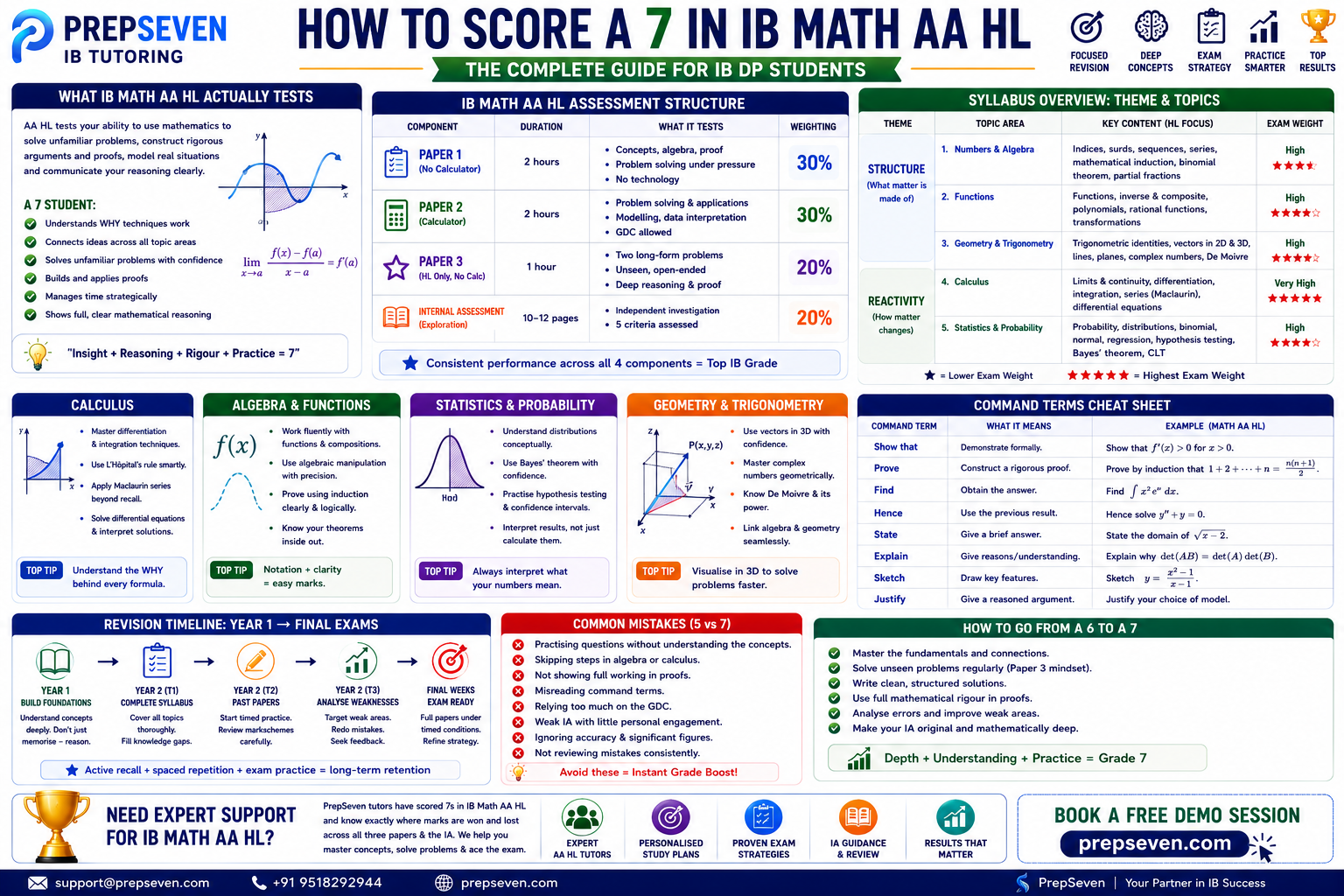
IB Mathematics Analysis and Approaches Higher Level is the most demanding mathematics course in the Diploma Programme, and the gap between what students expect it to be and what it actually requires is where most 7s are lost. It is not a course that rewards speed, formula memorisation, or the ability to grind through similar problems quickly. It rewards mathematical reasoning: the ability to understand why a technique works, to recognise which approach fits a problem you have not seen before, and to construct a rigorous argument that demonstrates your thinking, not just your answer.
The course covers seven topic areas: Number and Algebra, Functions, Geometry and Trigonometry, Statistics and Probability, Calculus, and the HL-only content that extends each of these. But the real architecture of the course is built around mathematical proof, limits, and abstraction. AA HL students are expected to engage with mathematics at a fundamentally different level than AA SL or AI HL, and the Paper 1 and Paper 2 questions reflect that. The questions do not look like textbook exercises. They look like problems.
The single most common reason students underperform in AA HL is that they revise by doing practice problems without genuinely understanding the underlying concepts. A student who has completed 200 integration problems but cannot explain why integration by parts works will hit a ceiling in Paper 1 that they cannot break through by doing problem 201.
The Assessment Structure and What It Means for You
AA HL has three external exam papers and one internal assessment. Understanding the structure precisely matters because the three papers test different things, and your revision strategy should reflect that.
Paper 1 is where mathematical fluency matters most. Without a calculator, you need to be able to manipulate algebraic expressions confidently, apply calculus techniques accurately, work with complex numbers and proof, and handle trigonometric identities and transformations without reaching for technology. The questions in Paper 1 are often elegant, which is another way of saying they require insight rather than computation. A brute force approach in Paper 1 is both slower and less reliable than a student who recognises the structure of the problem.
Paper 2 allows the GDC but is not a paper about using your calculator. The questions that genuinely differentiate high scorers from mid-scorers in Paper 2 are the ones that require you to set up a model or formulate an approach correctly before the calculator becomes useful. A student who does not understand what they are computing gets no benefit from the technology.
Paper 3 is the component that most clearly separates the AA HL cohort from every other IB mathematics course. It presents two extended problems that students have never seen before, often pulling techniques from across the syllabus, and requires them to work through several layers of a mathematical argument within the exam time. The IB deliberately designs Paper 3 so that no student will have encountered the specific problem before. What they are testing is mathematical thinking, not preparation for a specific question type.
Paper 3 is the most honest assessment in AA HL. You cannot prepare for the specific questions. You can only develop the mathematical maturity and the problem-solving habits that allow you to engage with unfamiliar material confidently. Students who have genuinely understood the HL content, who have practised working through multi-step problems they have not seen before, and who are comfortable sitting with uncertainty at the start of a problem before clarity emerges, consistently outperform those who have memorised more but understood less.
Topic by Topic: Where the Marks Actually Are
Calculus
Calculus is the largest and most heavily examined topic in AA HL. The SL content, differentiation and integration of standard functions, continuity, and the Fundamental Theorem, is extended at HL to include differential equations, integration by parts and by substitution at greater complexity, L’Hopital’s rule, Maclaurin series, and the deeper treatment of limits. Calculus questions appear in every paper and at every mark range from straightforward technique application to multi-step proof.
The two HL extensions that most students find genuinely difficult are Maclaurin series and differential equations. Maclaurin series are examined both as a technique for approximating functions and as a tool in proofs and limit problems. The key to doing well on series questions is understanding the derivation, not just the formula. A student who knows that sin(x) has a specific Maclaurin expansion but does not understand how it is derived from repeated differentiation at zero will struggle with any question that requires them to adapt or apply the series in a non-standard context.
Differential equations appear in Paper 2 and Paper 3. Separable differential equations, integrating factor for first-order linear ODEs, and the interpretation of slope fields, are all examinable. The Paper 3 problem on differential equations, when it appears, typically requires setting up an equation from a described situation before solving it, which means understanding the relationship between rates of change and the variables being modelled.
Functions and Algebra
Functions is the topic that appears most consistently in Paper 1 at the mid-mark level, and it is an area where precision in notation and reasoning determines whether answers land in the top band. Inverse functions, composite functions, the relationship between a function and its inverse, transformations, and the graph of derived functions are all heavily tested. The HL extension adds polynomial functions, the Rational Root Theorem, and partial fractions.
Proof by induction is an HL algebra topic that reliably divides students. Those who understand the structure of induction proofs, the base case, the assumption step, the proof that the assumption implies the next case, and the conclusion, produce clean correct proofs. Those who have memorised the template but do not understand the logic produce proofs that are structurally recognisable but logically flawed in ways examiners penalise. The trick to doing proof by induction well under exam pressure is understanding what you are actually doing, not what you are writing.
Geometry and Trigonometry
The HL extension of this topic introduces vectors in three dimensions, the vector equation of a line and a plane, angles between planes and lines, and the more advanced treatment of complex numbers including de Moivre’s theorem and roots of unity. The complex numbers content is among the most beautiful mathematics in the AA HL course and also among the most mechanically reliable marks available to students who have genuinely understood it.
De Moivre’s theorem, the relationship between complex exponential form and trigonometric identities, and the geometric interpretation of complex number operations in the Argand plane, are all examined at HL. Students who can connect the algebraic and geometric representations of complex numbers, who understand why multiplying by e^(i*theta) represents a rotation, and who can derive trigonometric identities using de Moivre’s theorem, are equipped for the complex numbers questions that appear in both Paper 1 and Paper 3.
Statistics and Probability
Statistics is the topic most frequently underrevised by AA HL students, who often prioritise calculus and assume statistics will take care of itself. The HL extension covers Bayes’ theorem, Poisson and binomial distributions beyond SL level, the central limit theorem, confidence intervals, and hypothesis testing at greater depth. These topics appear regularly in Paper 2 and Paper 3 and reward students who have engaged with them systematically rather than treating them as supplementary.
The conceptual difficulty in HL statistics is that the underlying probability theory requires genuine understanding rather than pattern recognition. A student who can perform a hypothesis test by following a procedure but does not understand what a p-value actually represents, or what a confidence interval is actually claiming, will produce correct answers on familiar questions and fall apart on any question that frames the same concept in an unfamiliar way. Statistical understanding at AA HL requires thinking about what the mathematics is modelling, not just how to perform the calculation.
Bayes’ theorem is an HL topic that produces disproportionate marks on the papers where it appears. It is not conceptually difficult, but it requires careful setup, and students who have practised setting up tree diagrams and applying the theorem to worded problems consistently outperform those who have only seen Bayes in the textbook formula form. If you can draw the probability tree correctly, the calculation follows. If you cannot, no amount of formula knowledge will rescue you.
Paper 1 Strategy: How to Approach a No-Calculator Paper
Paper 1 is two hours with no GDC. The questions are designed to be solvable by hand, which means they are designed to be elegant rather than computationally intensive. If you find yourself in the middle of a Paper 1 question doing long division or evaluating a messy integral by brute force, you have almost certainly missed a simpler approach.
The most useful mindset for Paper 1 is to read the question fully before beginning and spend thirty seconds identifying the mathematical structure. What type of object is the problem about? What do I know about that type of object? What techniques exist for this kind of problem? Students who begin writing immediately without this pause often commit to an approach that works but is unnecessarily slow, or commit to an approach that does not work at all and lose time recognising this.
Mark distribution in Paper 1 follows a pattern: questions worth two or three marks test direct application of a concept or technique. Questions worth six or more marks test multi-step problems where the final answer depends on several intermediate results, and where method marks are available throughout. On a multi-step problem you are not solving, the correct strategy is to earn every method mark available rather than spending the remaining time on a problem that is beyond your reach that session.
Paper 3: The Component That Makes or Breaks a 7
Paper 3 is unique in the IB mathematics suite. It is one hour, no calculator, and presents two extended problems typically spanning four to eight parts each. The problems are designed to be accessible at the entry level, with earlier parts worth two or three marks each asking you to apply or verify something relatively straightforward, before building into deeper and more open-ended questions where you are expected to generalise, prove, or extend the result.
The entry-level parts of each Paper 3 problem are marks that every well-prepared AA HL student should earn. A student who scores six out of twelve available marks on the first four parts of both problems before the questions become genuinely difficult has already secured a meaningful chunk of the Paper 3 marks. The strategy in Paper 3 is not to complete both problems perfectly. It is to harvest every available mark on the parts you can do, and to engage thoughtfully with the harder parts rather than giving up.
Paper 3 problems often require you to recognise that a technique you know applies in a context you have not seen before. A problem built around sequences may require calculus. A problem built around geometry may require complex numbers. The best preparation for Paper 3 is not practising more Paper 3 questions, because the questions are unique each year. It is developing comfort with working across topic areas and with beginning a problem without knowing where it will end.
The students who score 15 or above on Paper 3 out of 55 available marks are those who have engaged with the problems honestly rather than writing nothing when stuck. Partial marks on Paper 3 are genuine marks. A student who writes a correct setup for a proof that they cannot complete earns marks for the setup. A student who correctly identifies the technique required but makes an error in execution earns marks for the method. Engage with every part of every question you can, even partially.
The Internal Assessment: What a Strong Exploration Looks Like
The AA HL Internal Assessment is a 10-12 page mathematical exploration worth 20% of the final grade, assessed against five criteria: Communication, Mathematical Presentation, Personal Engagement, Reflection, and Use of Mathematics. The last criterion is the most heavily weighted at 6 marks, and it is where the distinction between an IA that earns 16 or 17 and one that earns 20 is made.
A strong exploration investigates a genuine mathematical question with rigour, introduces mathematics that is beyond the standard syllabus in a way that is appropriate for AA HL, and demonstrates personal engagement through the choices the student makes rather than through statements about how much they enjoyed the topic. Examiners distinguish between a student who selected a topic and then followed a textbook exposition of it, and a student who selected a question, genuinely investigated it, and produced mathematical insight that reflects their own thinking.
The most common IA error at AA HL is choosing a topic that is mathematically rich but treating it at SL depth. A student exploring the mathematics of the Fibonacci sequence needs to engage with the characteristic equation, the closed-form Binet formula, its derivation, its connection to the golden ratio, and ideally some extension beyond this, to earn full marks on Use of Mathematics. A student who produces graphs and calculates ratios between terms without introducing the HL-level mathematics of why this works produces an exploration that communicates well but does not demonstrate the mathematical sophistication the criterion requires.
The best IA topics are specific rather than broad. An exploration titled ‘the mathematics of music’ is an essay. An exploration titled ‘why equal temperament tuning requires irrational frequency ratios and the mathematical consequences for harmonic intervals’ is a mathematical investigation. Specificity allows you to go deep on a genuine mathematical question rather than shallow on many related ideas. Depth on a specific question is what earns marks on Use of Mathematics.
A Realistic Revision Plan for AA HL
Getting to a 7 in AA HL requires two years, not two months. The students who score in the top band are those who have built genuine understanding of the HL content progressively across the course, used Year 1 to master the SL-level foundations that HL extends, and entered Year 2 with the ability to focus on Paper 3 problem-solving practice and IA refinement rather than catching up on content they never fully understood.
The Mistakes That Separate a 5 from a 7
The gap between a 5 and a 7 in AA HL is not usually about knowing more mathematics. It is about how students use the mathematics they know. These are the patterns that consistently separate top scorers from competent ones.
Command Terms and What They Actually Mean
IB exam questions use specific command terms that define exactly what type of response earns marks. Misreading a command term and producing the wrong type of answer is one of the most preventable ways to lose marks in AA HL.
Getting from a 6 to a 7: The Final 10%
If you are scoring consistently in the high 5 or low 6 range and want to reach 7, the adjustment required is rarely about learning more material. It is almost always about one of three things.
The first is algebraic accuracy. AA HL students who lose marks in Paper 1 most frequently lose them to sign errors, missed negative signs in differentiation, errors in algebraic simplification, and inconsistency in notation. These are not content errors. They are execution errors that compound across a paper. The solution is to develop a checking habit: after completing each step, read it back. Not at the end of the problem, which is too late, but after each transformation.
The second is Paper 3 engagement. Students who reach the grade 6 boundary have typically performed well across Papers 1 and 2 and the IA but have not maximised their Paper 3 marks. If your Paper 3 score is below 60% of the available marks, this is where working smarter on exam technique, specifically the strategy of harvesting all accessible early-part marks before engaging with harder parts, will move your overall grade.
The third is IA depth. If your IA has received feedback indicating that the Use of Mathematics is not sufficiently sophisticated, addressing this before final submission is one of the clearest routes to an additional mark. Identify one section where you can introduce a more advanced technique, derive a result rather than stating it, or extend the investigation to a deeper mathematical question. One additional mark on the IA Use of Mathematics criterion is worth the equivalent of several correct responses on an exam paper.
The 7 in AA HL is not reserved for students who find mathematics effortless. It is available to students who understand the course deeply, manage their time and examination strategy well, and have built the habit of showing rigorous mathematical reasoning rather than just correct answers. Every component of the course, Papers 1, 2, and 3, the IA, and every topic from calculus to statistics, contributes to the final grade, and students who approach all of them with the same seriousness are the ones who reach the top band.
Need 1:1 support for IB Math AA HL?
PrepSeven offers expert IB Math tutoring designed around the actual exam. Our tutors have scored 7s in AA HL and know exactly where marks are won and lost.
Book a Free Demo Session at prepseven.com