

How to Score a 7 in IB English
Why Spotting Literary Devices Isn’t the Same as Analysing Them
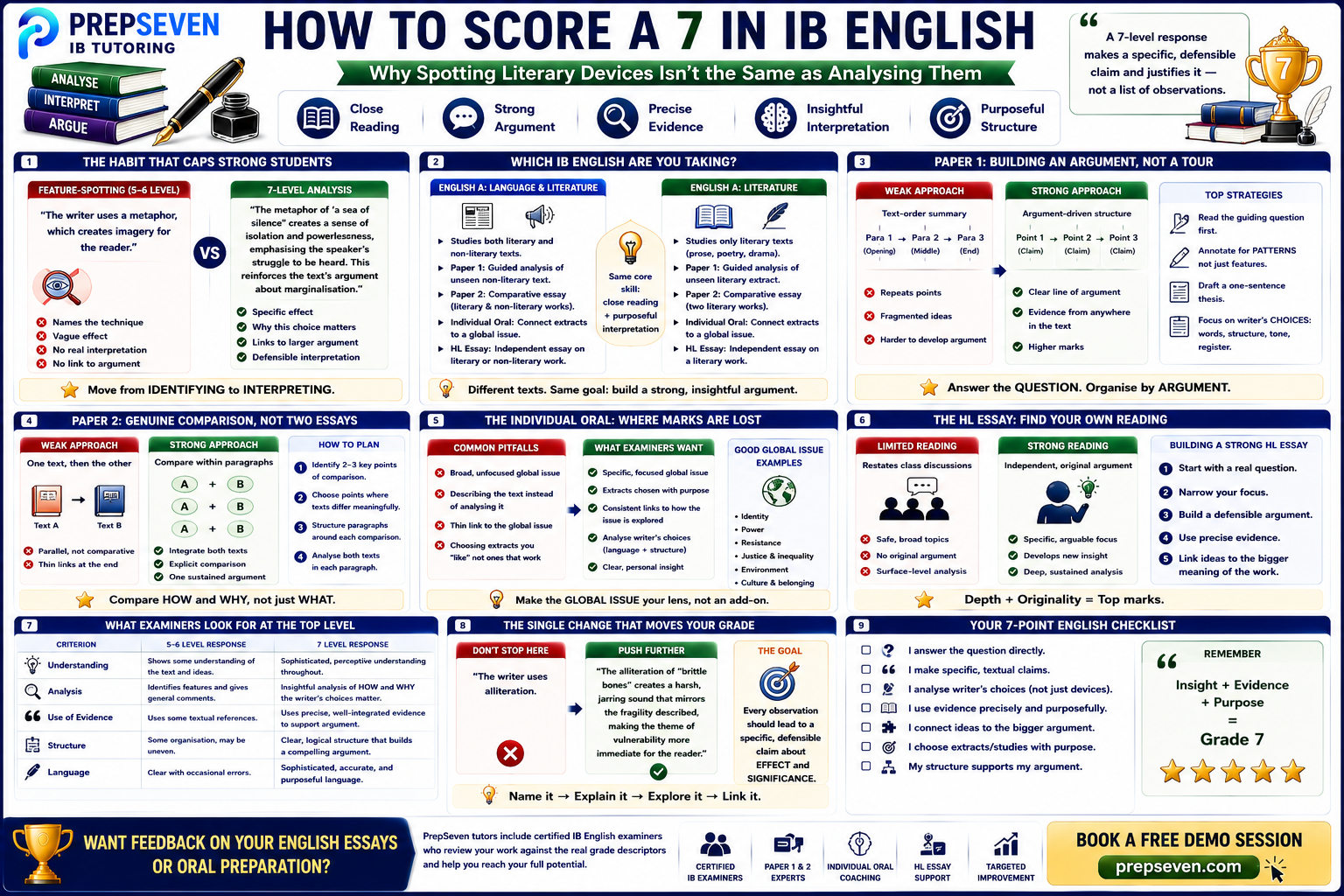
The Habit That Quietly Caps Strong English Students
There’s a particular sentence pattern that shows up constantly in mid-range IB English responses: “the writer uses a metaphor, which creates imagery for the reader.” It’s not wrong, exactly, but it’s also not really saying anything. It identifies a feature and gestures vaguely at an effect without ever explaining what that effect actually is, why the writer chose this specific image rather than another, or how it connects to the larger argument the essay is supposed to be building. This is feature-spotting, and it’s the single most common reason students with genuinely strong reading instincts plateau below a 7.
A 7-level sentence does something different. It names the technique, yes, but then it commits to a specific, defensible claim about what that technique does in this particular moment of the text, why it matters for how a reader experiences that moment, and how it serves the writer’s larger purpose. The difference isn’t really about knowing more terminology. It’s about being willing to make an actual interpretive claim and then justify it, rather than listing observations and hoping the significance is self-evident.
A quick diagnostic for your own writing: read back a paragraph of analysis and ask whether it could be summarised as “this technique is here, and it has an effect.” If so, push further. What specifically does the reader feel or understand differently because of this choice, and why does that matter for the argument of the whole essay, not just this one paragraph?
Which IB English Are You Actually Taking?
This matters more than students often realise when they’re searching for general advice, because English A: Language and Literature and English A: Literature are assessed somewhat differently, even though the underlying analytical skill, close, purposeful reading, is the same in both. Language and Literature students work with both literary and non-literary texts, advertisements, speeches, articles, alongside literary works, and Paper 1 asks for guided analysis of unseen non-literary material. Literature students work exclusively with literary texts, and Paper 1 asks for guided literary analysis of unseen literary extracts, poetry or prose. The advice in this guide applies to both courses, since the core skill, moving from identification to interpretation, is identical, but it’s worth knowing which course you’re in before assuming every detail transfers directly.
Paper 1: Building an Argument, Not a Tour of the Text
The biggest structural mistake in unseen commentary writing is working through the text in the order it appears, paragraph one covers the opening, paragraph two covers the middle, and so on, rather than organising the essay around an actual argument that answers the guiding question. A text-order structure forces the same point to be repeated in fragments throughout the essay instead of being developed properly once, and it makes it much harder for an examiner to see a clear, sustained line of interpretation.
The stronger approach is to read the text and the guiding question carefully, decide on two or three genuine interpretive claims the text supports, and then organise the essay around those claims, drawing evidence from wherever in the text supports each one, regardless of where it appears. This produces an essay that reads as a developed argument rather than a running commentary, and it’s exactly the structure the top mark band is looking for.
- Read the guiding question first and let it shape what you’re looking for on your first read of the text, rather than reading the whole text generically and then trying to retrofit it to the question afterward.
- Annotate for pattern, not just for individual features. A single striking word choice matters less than noticing that the same kind of imagery, or the same shift in tone, recurs across the text, since patterns are what support a sustained argument.
- Draft a one-sentence thesis before writing the full response: what is this text doing, and how, in a way that directly answers the guiding question? Every paragraph should visibly serve that thesis.
- Spend real time on the writer’s specific choices: word order, sentence length, structural shifts, register, not just the more obvious devices, since these subtler choices are often where the most original, highest-scoring interpretation comes from.
Paper 2: Genuine Comparison, Not Two Essays Stitched Together
The comparative essay is meant to compare, but a very common pattern in weaker responses is writing several paragraphs about one work, then several paragraphs about the other, with a thin, late connecting sentence trying to tie them together. This earns meaningfully less credit than an essay that integrates both works within the same paragraphs, genuinely thinking about how they handle a shared idea, theme, or technique differently, and why that difference matters.
The fix is mostly about planning before writing. Choose a small number of points of comparison, ideally ones where the two works genuinely diverge in an interesting way rather than ones where they’re simply similar, and structure each paragraph around one point of comparison addressed in both works together, not around one work at a time. An essay built this way reads as a single sustained argument about both texts, which is what the comparative format is actually designed to reward.
The Individual Oral: Where Confident Readers Lose Marks
The Individual Oral asks students to connect an extract or extracts to a global issue of their choosing, and the most common way strong readers underperform here isn’t weak textual knowledge, it’s a global issue connection that feels bolted on rather than genuinely explored. Students sometimes choose a broad, fashionable-sounding global issue, identity, power, environment, and then spend the oral mostly describing the text with only a thin, gestural link back to the issue itself, rather than using the issue as a genuine lens that shapes the whole analysis.
A stronger approach treats the global issue as something the analysis is actually in service of throughout, not a label attached at the start and the end. This means choosing extracts specifically because they illuminate that issue in a particular, examinable way, and consistently returning to how the writer’s specific choices, not just the content, but the language and structure, shape how that issue is being explored. Extract selection matters more than students often expect: an extract chosen because it’s a favourite passage, rather than because it offers the richest material for the chosen global issue, makes the rest of the oral harder to sustain at a high level.
The HL Essay: Finding Your Own Reading
The HL Essay asks for an independent, sustained piece of analytical writing on a text studied in class, and the most common limitation here isn’t poor writing, it’s a reading that simply restates what was discussed in class without pushing it any further. Examiners are explicitly looking for a degree of original interpretation, not necessarily a wildly unconventional reading, but a genuine, specific argument that the student has developed and defended in their own right, rather than a competent summary of the class discussion.
The strongest HL Essays usually start from a real question the student is curious about in the text, something that felt genuinely unresolved or interesting on a close reading, rather than a safe, broad topic chosen because it seemed manageable. A narrower, more specific argument that’s pursued with real depth and textual evidence consistently outperforms a broader, safer topic addressed only at a surface level.
The Single Change Worth Making First
If there’s one habit worth fixing before any other, it’s this: every time you name a technique in your writing, treat that as the start of the sentence, not the end of it. Push every observation toward a specific, defensible claim about effect and significance, tied explicitly to the question or issue you’re actually answering. Students who make this single change consistently see their grade move, not because they suddenly know more literary terminology, but because their existing knowledge starts doing the interpretive work the IB is actually grading.
Want feedback on your English essays or oral preparation?
PrepSeven tutors include certified IB English examiners who review Paper 1 and Paper 2 responses, Individual Oral preparation, and HL Essay drafts against the real grade descriptors.
Book a Free Demo Session at prepseven.com