

How to Score a 7 in IB Business Management
Why Generic Business Theory Is the Biggest Thing Holding Strong Students Back
The Trap Almost Every Business Management Student Falls Into
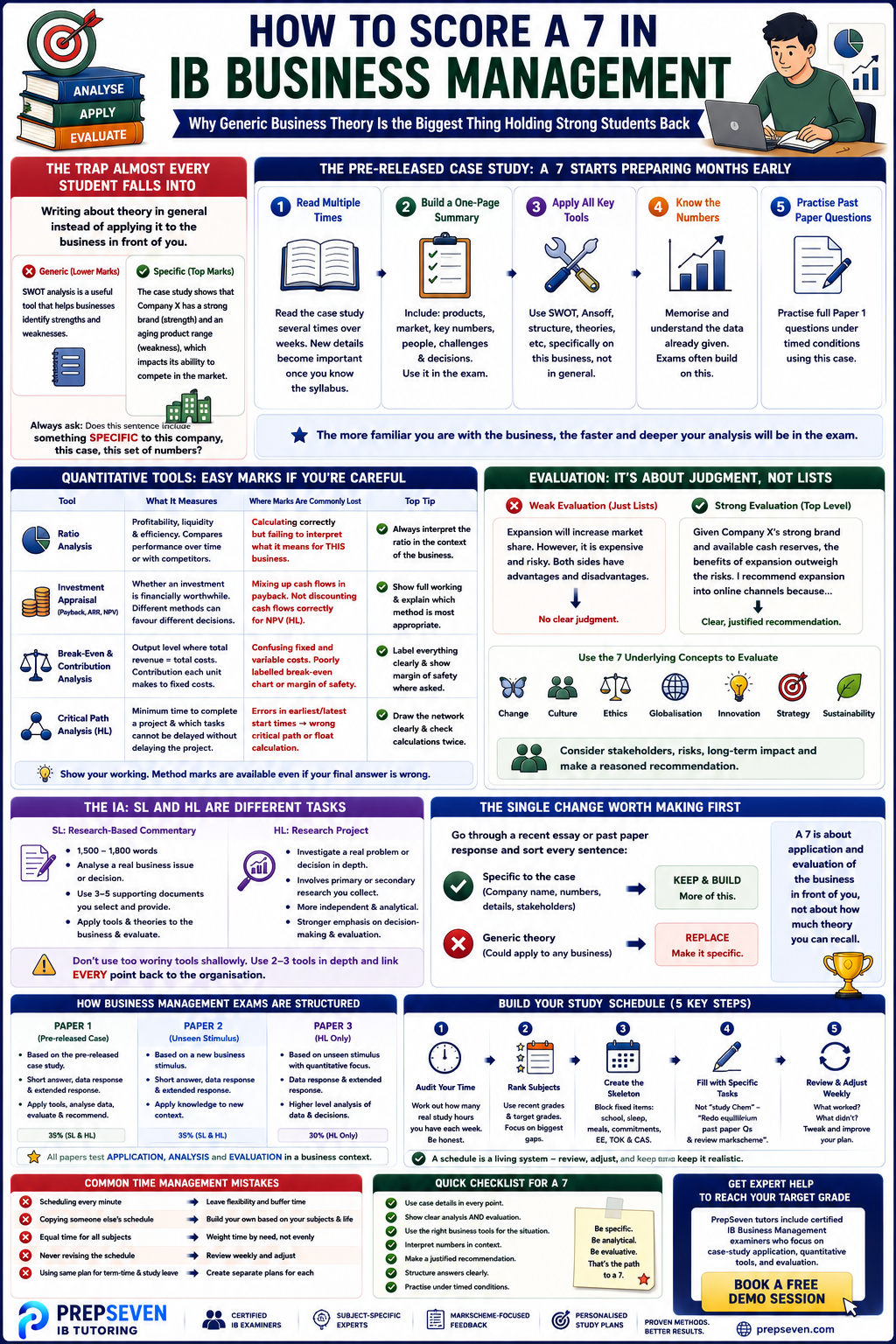
There’s a specific habit that quietly caps more Business Management grades than weak content ever does: writing about the theory correctly, but writing about it in general terms rather than tying it explicitly to the actual organisation in front of you. A student who explains what a SWOT analysis is, accurately, in the abstract, has demonstrated knowledge. A student who identifies the case study company’s specific strengths, names them using details from the text, and uses that analysis to justify a specific strategic recommendation for that company, has demonstrated the application and evaluation the top grade band actually rewards.
This distinction matters more in Business Management than in almost any other IB subject, because the entire course is built around case studies. Every paper, the pre-released Paper 1 case, the unseen Paper 2 stimulus, the HL-only Paper 3 material, and the IA itself, is asking the same underlying question: can you take a specific, messy, real or realistic business situation and apply the right tools to it with judgment, rather than reciting what you’ve memorised. Students who treat the case study as a backdrop for a pre-written essay about Ansoff matrices or motivation theory consistently underperform their actual content knowledge.
Before writing a single sentence in any Business Management answer, ask: does this sentence include something specific to this company, this case, this set of numbers? If a sentence could be dropped into any other business’s case study unchanged, it’s not yet doing the work a 7 requires.
The Pre-Released Case Study: A 7 Starts Preparing Months Early
Business Management has a feature most other IB subjects don’t: Paper 1 is based on a case study released to schools several months before the exam, usually with a real or realistic company profile covering its history, products, market, financial position, and current challenges. This is a genuine advantage if it’s used properly, and a wasted one if it isn’t. Students who only skim the case study a week or two before the exam are giving up months of preparation time that the strongest candidates use deliberately.
A useful way to spend that lead time:
- Read the case study multiple times across several weeks rather than once closely, since details that seem irrelevant on a first read often turn out to connect to a likely exam question once the rest of the syllabus has been covered.
- Build a one-page summary of the company: its products, its market position, key financial figures already given, named individuals, and the specific challenges or decisions it appears to be facing. This becomes the reference sheet used throughout the exam itself.
- Practise applying every major course tool, SWOT, Ansoff, the appropriate organisational structure, relevant HR theories, to this specific company, not as a generic exercise but asking what each tool would actually reveal about this business.
- Pay close attention to numbers already given in the case, since Paper 1 frequently asks students to extend or interpret financial information that was provided months in advance, and a student who already knows this data well moves faster and more confidently under exam pressure.
Quantitative Tools: Where Careless Errors Quietly Cap a Grade
Business Management is, in places, a genuinely quantitative subject, ratio analysis, investment appraisal, break-even and contribution calculations, cash flow forecasting, and at HL, critical path analysis. These questions tend to be more procedural than the extended written responses, which means they should be the most reliable marks on the paper, but careless errors, wrong formula, missing units, an unrounded or misread figure, cost marks that are, in principle, entirely avoidable with practice.
The fix for all four of these is the same: practise enough repetitions of each calculation type that the method becomes automatic, and always show full working, since method marks are available even when a final figure is wrong, but only if the working is visible.
Evaluation in Business Management Is Strategic Judgment, Not a List
As in several other IB subjects, evaluation is where the top grade band is actually won, and as in those other subjects, most students evaluate by listing advantages and disadvantages rather than reaching a genuine, reasoned recommendation. The strongest Business Management answers go further: they weigh the options against the specific circumstances of the case, consider the perspective of different stakeholders, and arrive at a justified recommendation rather than leaving the reader to decide.
The syllabus’s seven underlying concepts, change, culture, ethics, globalisation, innovation, strategy, and sustainability, are useful evaluative anchors precisely because they push an answer beyond a simple financial calculation toward genuine judgment. Asking whether a recommended course of action is consistent with the company’s stated culture, whether it raises ethical concerns given what the case study reveals about its stakeholders, or whether it’s sustainable as the business scales, are exactly the kinds of questions that move an answer from competent analysis into the evaluative territory a 7 requires.
A practical test for evaluative writing in Business Management: does the final sentence of a paragraph commit to a specific judgment, this option is better because, this risk outweighs that benefit in this case, or does it just present both sides and stop? If it’s the latter, the analysis is there but the evaluation hasn’t actually happened yet.
The IA: A Genuinely Different Task at SL and HL
Unlike many subjects where the IA differs only in scale between levels, Business Management’s IA is structurally different at SL and HL, and conflating the two is a common source of confusion. SL students write a research-based commentary, typically 1,500 to 1,800 words, analysing a real business issue or decision using three to five supporting documents that the student selects and provides. HL students undertake a research project investigating a genuinely identified problem or decision facing a real organisation, typically involving the student gathering primary or secondary research directly, a meaningfully more independent and demanding piece of work.
In both cases, the most common reason a strong student underperforms on the IA isn’t weak business understanding, it’s choosing a topic too broad to analyse properly within the word limit, or applying too many tools shallowly instead of two or three tools applied with real depth and direct connection to the chosen organisation’s actual situation. A tightly scoped issue, a small number of well-chosen tools, and consistent, explicit reference back to the real organisation throughout, tends to outperform a broader, more ambitious-sounding topic handled superficially.
The Single Change Worth Making First
If a Business Management grade has been stuck for a while despite genuinely solid content knowledge, the highest-leverage fix is almost always the same one: go back through a recent essay or past paper response and circle every sentence that’s specific to the case, a number, a named stakeholder, a detail from the text, versus every sentence that’s generic theory that could apply to any business. Students who do this exercise honestly are often surprised by how much of their writing falls into the second category. Rebuilding the habit of anchoring every paragraph to something specific in the case is, more often than any other single change, what moves the grade.
Want feedback on your Business Management case study technique?
PrepSeven tutors include certified IB Business Management examiners who review practice papers and IA drafts against the real grade descriptors, with a specific focus on case-study application and evaluation.
Book a Free Demo Session at prepseven.com