

How to Score a 7 in IB Biology
The Complete Guide for IB DP Students and Parents
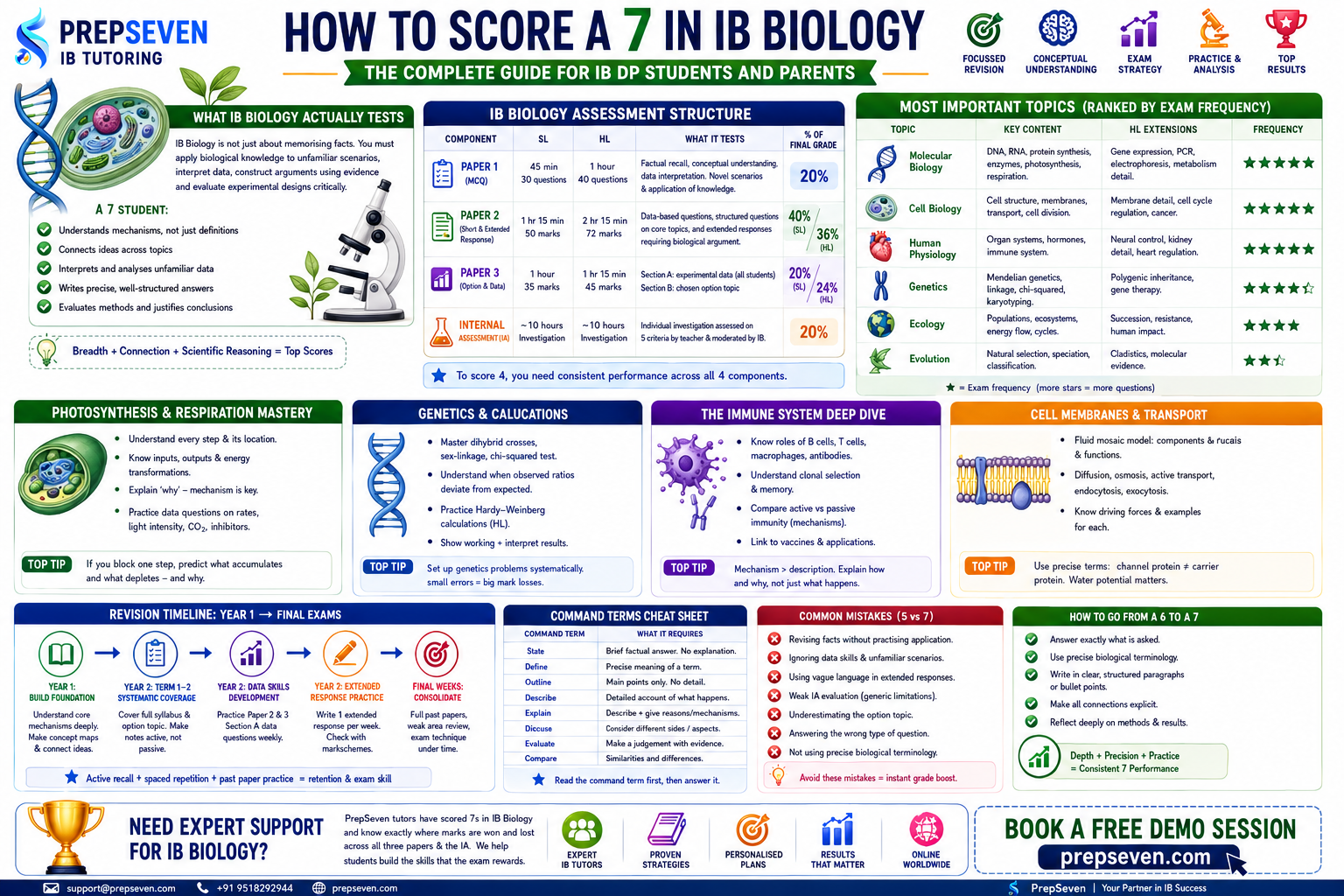
What IB Biology Actually Tests
IB Biology is the most content-heavy of the Group 4 sciences, and that single fact explains more about why students underperform than anything else. The syllabus spans eleven core topics at SL, with five additional HL topics and four option topics that schools choose from, covering everything from cell ultrastructure to population ecology to nucleotide sequencing techniques. The sheer volume of material is what most students underestimate when they begin Year 12, and it is what makes the difference between a 5 and a 7 almost entirely a question of how intelligently you manage that volume rather than how hard you work in the final weeks before exams.
But content recall alone does not get you to a 7. The questions in Papers 2 and 3 that determine whether a student sits in the 5 band or the 7 band are not asking you to recite facts. They are asking you to apply biological understanding to unfamiliar scenarios, interpret data from experiments you have never seen, construct arguments using evidence, and evaluate experimental designs critically. A student who has memorised every diagram in the textbook but has never practised applying the underlying concepts to novel situations will consistently score in the mid-band on extended response questions regardless of how complete their content knowledge is.
The 2025 first-assessment syllabus, which restructured IB Biology into a conceptual framework built around seven unifying concepts, has made this even more explicit. The new curriculum is organised around understandings that connect across topic areas rather than isolated facts within topics. Students who revise by topic in isolation and never practise making connections across the syllabus are misaligned with how the course is now designed and examined.
IB Biology rewards breadth and connection more than almost any other DP subject. The students who score 7s are not necessarily those who know the most biology. They are those who can use what they know flexibly: applying photosynthesis concepts to an unfamiliar plant experiment, connecting the mechanism of enzyme action to a data set about pH they have never seen, or explaining the evolutionary implications of a genetic variation they are encountering for the first time in the exam room. Build this flexibility deliberately, not as an afterthought.
The Assessment Structure: What Each Component Demands
IB Biology has three external exam papers and one internal assessment. The specific structure differs between SL and HL, but the principles of what each paper rewards are consistent across both levels.
Paper 1 is where students most consistently underperform relative to their content knowledge. The MCQ format creates a false sense that correct recall equals correct answer, but IB Biology Paper 1 questions regularly require you to apply a concept to a scenario or interpret data correctly to identify the right option. The four choices are often designed so that students who have surface understanding of a concept will select a plausible but incorrect answer. The distinction between the correct answer and the most tempting wrong answer is almost always a conceptual one, not a factual one.
Paper 2 is the highest-stakes paper and the one where preparation strategy matters most. Section A always includes a data-based question, sometimes several pages of data from a real or fictionalised study, with questions that ask you to describe trends, calculate values, suggest explanations, and evaluate methodology. These questions are worth significant marks and are entirely approachable with the right preparation, but students who have only revised content and have never practised interpreting unfamiliar data sets consistently leave marks on the table in Section A. The extended response questions in Paper 2 are where biological writing quality matters: the ability to construct a clear, evidence-based argument using precise biological terminology.
Paper 3 has two distinct sections. Section A presents experimental data that all students encounter regardless of which option their school has chosen. These questions test experimental design, data analysis, and critical evaluation of methodology, and they are entirely about scientific thinking rather than content recall. Section B tests the specific option topic the school studied. Option students who have genuinely engaged with the option content at depth, not just surface familiarity, consistently outperform those who treated it as lower-priority material.
The data-based questions in Paper 2 Section A and Paper 3 Section A are among the most reliably scoreable marks in IB Biology for a well-prepared student, yet they are where unprepared students most frequently struggle. The skill being tested is not content knowledge but scientific reasoning: reading a graph accurately, identifying a trend without overstating it, suggesting a biologically plausible explanation for an unexpected result, identifying a specific methodological limitation and explaining its effect on the results. These are learnable skills that improve dramatically with deliberate practice on past paper data sets.
The Syllabus: What You Study and What Gets Examined Most
The current IB Biology syllabus is built around a set of core topics that all students study, HL-only extensions within each topic, and four option topics from which the school selects one. Understanding which areas of the syllabus generate the most examination questions, and where the conceptual depth required is greatest, is essential for intelligent revision planning.
Molecular biology is the single most examined area of IB Biology and the one where genuine conceptual understanding matters most. The relationship between DNA structure and function, the mechanism of transcription and translation, the role of enzymes in metabolic pathways, and the processes of photosynthesis and respiration are not just content to be memorised. They are interconnected mechanisms that examiners probe from multiple angles across every exam session. A student who understands why the antiparallel structure of DNA is essential for replication, not just that it is antiparallel, is equipped for questions that approach this from any direction.
Human physiology is the other high-frequency area and the one where students most commonly sacrifice depth for breadth. There is an enormous amount of human physiology in the IB Biology syllabus, and the temptation is to aim for surface familiarity across all of it rather than genuine understanding of the mechanisms. This is a mistake. Examiners consistently target the mechanisms of hormonal regulation, the specificity of the immune response, the precise control of kidney function, and the neural pathways involved in coordination because these require genuine mechanistic understanding rather than descriptive recall.
Topic Deep Dives: Where Marks Are Won and Lost
Photosynthesis and Respiration: The Most Examined and Most Misunderstood Topics
Photosynthesis and cellular respiration together generate more exam questions than any other area of IB Biology, and they are the topics where the gap between surface knowledge and genuine understanding is most consequential. Most students can label the light-dependent and light-independent reactions of photosynthesis and describe the inputs and outputs of each stage. Far fewer can explain why the light-dependent reactions are located in the thylakoid membrane rather than the stroma, what happens to the proton gradient generated by the electron transport chain, and how the products of the light-dependent reactions are used in the Calvin cycle in a way that would be disrupted by a specific inhibitor.
The questions that separate 6s from 7s in this area are almost always mechanistic. They present a scenario, perhaps an inhibitor of a specific enzyme, a change in light intensity, or an unusual experimental result, and ask you to predict what would happen to downstream products and explain why. Getting these questions right requires understanding the sequence of events and their dependencies, not just the names and locations of each stage.
For respiration, the same principle applies. The distinction between substrate-level and oxidative phosphorylation, the role of NAD and FAD as electron carriers, the significance of the proton gradient across the inner mitochondrial membrane, and the calculation of ATP yield per glucose molecule are all examined regularly and all require mechanistic understanding. A student who knows that aerobic respiration produces approximately 36-38 ATP per glucose but cannot explain where each stage of that yield comes from will not be able to answer the questions that probe this.
A reliable way to test whether your understanding of photosynthesis and respiration is at the level the exam requires is to ask yourself: if I blocked this specific step, what would accumulate and what would be depleted, and why? If you can answer this for every major step in both processes without hesitation, you are prepared for the mechanism-based questions. If you find yourself uncertain at any step, that uncertainty is exactly what the Paper 2 extended response questions will expose.
Genetics: The Calculation and Reasoning Topic
Genetics is one of the few areas in IB Biology where marks are available through correct calculation as much as through biological explanation. Dihybrid crosses, sex-linked inheritance problems, chi-squared analysis, and Hardy-Weinberg calculations are all predictable question types that appear in Paper 2 almost every exam session. Students who have practised these problem types to fluency earn reliable marks here regardless of what else appears on the paper.
The conceptual difficulty in genetics increases significantly at HL with the introduction of polygenic inheritance, gene linkage, and the more detailed treatment of chromosomal behaviour during meiosis. The chi-squared test for genetics data is a specific skill that requires understanding not just the calculation but what the result means: whether the observed ratio is consistent with the expected Mendelian ratio, and what a significant chi-squared value implies about the hypothesis being tested.
The most common genetics error in Paper 2 is incomplete Punnett squares. Students who draw the correct gametes but make a transcription error in filling in the grid, or who forget to account for both sexes in sex-linked problems, lose marks that their understanding would have entitled them to. Develop a systematic method for genetics problems and apply it consistently under exam conditions.
The Immune System: Depth Over Breadth
The immune system is one of the most heavily examined human physiology topics and one where the IB regularly catches students who have revised broadly but not deeply. The distinction between the non-specific and specific immune responses, the roles of different cell types including B lymphocytes, T lymphocytes, macrophages, and memory cells, the mechanism of antibody production, and the basis of immunological memory are all examined in detail and at depth.
The questions that trip up students most consistently are those that require explaining the mechanism of clonal selection and expansion, the difference between active and passive immunity in terms of the underlying immunological process rather than just whether antibodies are produced by the host, and the molecular basis of antigen-antibody specificity. These are not obscure details. They are the core mechanistic content of the immune system topic, and they appear in some form in nearly every exam session.
Vaccines and monoclonal antibodies are also heavily examined, particularly in the context of their applications and ethical implications. The IB Biology exam consistently includes questions that require students to connect the basic immunology to specific medical applications, and students who understand the mechanism of vaccine-induced immunity at the level of clonal selection and memory cell formation are much better positioned for these questions than those who know only that vaccines work by introducing antigens.
Cell Membrane and Transport: Precision Matters
Cell membrane structure and transport mechanisms are examined in every session across all three papers and are an area where terminological precision consistently separates high scorers from mid-range scorers. The fluid mosaic model requires specific understanding of the roles of phospholipids, integral and peripheral proteins, glycoproteins, and cholesterol. Each component has a specific function, and questions that ask you to explain the structure in relation to function require connecting each component to what it does, not just listing what is present.
Transport mechanisms require precise language. Diffusion, facilitated diffusion, osmosis, active transport, endocytosis, and exocytosis each have specific definitions and specific conditions under which they operate. Students who use these terms interchangeably or imprecisely lose marks on questions that are testing whether they know the distinctions. The difference between facilitated diffusion and active transport, the correct use of water potential terminology in osmosis questions, and the distinction between channel proteins and carrier proteins are all tested regularly and require precision.
Paper-by-Paper Strategy
Paper 1: Multiple Choice Tactics
Paper 1 in IB Biology is 30 questions at SL and 40 at HL, completed in 45 minutes and 1 hour respectively. The pace is uncomfortable for students who approach each question with uncertainty, which is why content depth matters more than exam technique for Paper 1. Students who genuinely understand the biology will move through most questions confidently and spend their remaining time on the genuinely difficult ones.
The questions most likely to cause difficulty in Paper 1 fall into two categories: those that require distinguishing between very similar options using precise conceptual understanding, and those that present a novel experimental scenario or data set and ask you to identify the correct biological interpretation. The first type is answered by depth of knowledge. The second type is answered by the habit of reading what is actually there rather than what you expect to see.
Paper 2: Data Questions and Extended Responses
Paper 2 is the most important paper for your final grade and the one where preparation strategy has the most impact. The data-based questions in Section A are available to every student regardless of which option they studied, and they test scientific reasoning rather than content recall. Students who have practised interpreting unfamiliar data sets from past papers consistently outperform those who have not, even when their content knowledge is similar.
For data questions, the single most important discipline is answering what is asked rather than what you know. A question that asks you to describe the trend in the data wants a description of the data, not an explanation of why it occurs biologically. A question that asks you to suggest an explanation wants a biologically plausible mechanism, not a restatement of the data. Misreading what type of answer is required is the most common source of lost marks in data questions, and it is entirely avoidable.
Extended response questions in Paper 2 are marked using detailed markschemes that list specific biological points. Understanding how these markschemes work changes how you approach extended response answers. Each mark corresponds to a specific biological statement, and the way to maximise marks is to make sure each correct statement is clearly and distinctly present in your answer rather than implied or embedded in vague language. A student who writes a paragraph of accurate biology but uses imprecise language that does not clearly match the markscheme points will lose marks that a student with the same knowledge but more precise language will earn.
The best preparation for Paper 2 extended response questions is to write practice answers and then compare them against the markscheme, not to look at the markscheme and decide you would have written that. The gap between what you think you would write and what you actually produce under time pressure is significant, and it only closes through repeated practice of writing full answers and checking them systematically. One extended response per week from September of Year 2 is more valuable than ten the week before the exam.
Paper 3: Options and Section A
Paper 3 Section A is the same for all students and consists of data-based and short answer questions on experimental biology. The content is not tied to any specific topic, which means it cannot be revised through content review. It can only be prepared for by developing the habits of scientific reasoning that the questions test: describing data without over-interpreting it, identifying specific methodological limitations and explaining their effect, suggesting biologically plausible explanations for unexpected results, and evaluating whether a conclusion is justified by the data presented.
Paper 3 Section B tests your school’s option topic. The option topics are examined with the same depth and rigour as the core, and students who have engaged with the option content genuinely across both years are in a substantially stronger position than those who crammed it in the final weeks. If your school’s option is Neurobiology, for example, then understanding the mechanism of synaptic transmission at the level of specific neurotransmitters and receptor types, the basis of neural plasticity, and the experimental methods used to study the nervous system are all fair game. The option is not a lighter version of the core. It is additional content examined at the same standard.
The Internal Assessment: Designing an Investigation That Scores Well
The IB Biology IA is an individual investigation worth 20% of the final grade, assessed against five criteria that are consistent across all Group 4 sciences. The criteria are Personal Engagement, Exploration, Analysis, Evaluation, and Communication. Students have approximately 10 hours of class time allocated to the IA, though the writing and revision typically extends beyond this.
The choice of research question is the most important decision in the IA process and the one that most shapes the marks available to you. A strong Biology IA research question manipulates a single independent variable, measures a clear biological dependent variable, has a genuine connection to IB Biology syllabus content, and is specific enough that you can design a controlled experiment to answer it. The question how does temperature affect enzyme activity is not specific enough. The question how does temperature between 20 and 60 degrees Celsius affect the rate of amylase-catalysed starch hydrolysis, as measured by the time for iodine solution to stop turning blue, is an investigable question with a clear dependent variable and a defined range.
The Evaluation criterion is where IB Biology IAs most consistently lose marks, and it is also the most directly improvable criterion if students understand what it requires. A strong evaluation identifies specific weaknesses in the methodology, explains the direction and likely magnitude of their effect on the results, and proposes concrete modifications that would address each weakness. The student who writes that a limitation of the investigation was that only three repeats were performed should instead write that three repeats per temperature point meant that individual biological variation between enzyme samples could not be fully accounted for, potentially increasing the standard deviation of the rate measurements and reducing confidence in the mean, and that increasing to five repeats per condition would reduce this effect while remaining feasible within the available equipment time.
Biology IAs that involve living organisms or human subjects introduce ethical considerations that many students address superficially or not at all. If your investigation involves collecting data from human participants, germinating seeds, or using microorganisms, the Exploration criterion expects you to address the ethical considerations specifically: informed consent for human subjects, minimising harm to living organisms, appropriate disposal of biological material. A student who investigates the effect of a substance on plant growth and does not address whether the substance poses any risk to the organisms or the environment has left marks on the table in Exploration.
Revision Strategy: How to Handle This Much Content
IB Biology has more content than any other Group 4 science, and the revision strategy that works for Physics or Chemistry does not work for Biology without modification. The challenge is not memorising isolated facts but building a connected map of biological knowledge that allows you to apply what you know to scenarios you have not encountered before.
The most effective revision approach for IB Biology combines three things: systematic content coverage, active recall practice, and regular application to past paper questions. Each of these serves a different purpose. Content coverage ensures you have the knowledge. Active recall builds the retrieval pathways that allow you to access that knowledge under exam pressure. Past paper practice develops the application skills and scientific reasoning habits that the exam specifically tests.
Active recall is the revision technique that most consistently produces better exam performance than passive review, and it is consistently underused by IB Biology students who spend revision time re-reading notes and highlighting rather than testing themselves. The principle is simple: instead of reading your notes on the immune system, close your notes and write down everything you know about the immune system. The struggle of retrieval is the mechanism by which knowledge is consolidated into long-term memory. Passive review creates a feeling of familiarity that does not translate into exam performance because recognising something is much easier than retrieving it independently.
Flashcards, retrieval practice sets, and teaching the content to someone else are all forms of active recall that work. The specific method matters less than the principle: you need to regularly attempt to retrieve biological knowledge from memory, identify what you cannot retrieve, and focus your subsequent review on the gaps rather than the areas you already know well.
Command Terms: The Difference Between the Right and Wrong Answer Type
IB Biology exam questions use specific command terms that define what type of response is required. Producing the wrong type of response is one of the most common and most preventable sources of lost marks in IB Biology, particularly in Paper 2.
The Mistakes That Separate a 5 from a 7
Getting from a 6 to a 7: The Final Adjustments
Students who are consistently scoring in the high 6 range are usually in good shape on content but are losing marks in one or two specific patterns. Identifying and correcting these patterns in the months before the exam is a more efficient route to a 7 than attempting to learn additional content.
The most common pattern is losing marks on data interpretation through over-interpretation. Students who are strong in biology sometimes describe data trends in terms of the biological mechanism they know is happening rather than what the data actually shows. A graph that shows enzyme activity decreasing above 40 degrees shows a decrease in activity, not the denaturation of the enzyme. The denaturation is an explanation that may or may not be asked for. A student who jumps to explanation when the question asked for description has answered a different question than the one on the paper.
The second common pattern is writing extended responses that are biologically correct but insufficiently structured. A high-quality extended response in IB Biology presents a series of distinct, precise biological statements in a logical sequence, each of which corresponds to a mark on the scheme. A response that contains the same information but expresses it in continuous prose where individual statements are embedded in longer sentences is harder to mark and more likely to miss mark points that the student intended to include. Short, precise, complete sentences are more reliable than flowing paragraphs for extended response biology answers.
The third pattern is a weak Internal Assessment, specifically in the Evaluation criterion. Students who have engaged seriously with their IA in Year 1 and Year 2 and received teacher feedback have usually addressed the obvious weaknesses. The students who are still leaving Evaluation marks on the table in the final submission are typically those whose evaluation is correct in structure but insufficiently specific in substance. Every limitation should name the variable it affected, describe the direction of the effect, and propose a modification that is specific enough to be implemented.
A 7 in IB Biology requires consistent performance across all four components, not a perfect score on any one of them. Students who neglect the IA in favour of exam preparation, or who treat Paper 3 as less important than Papers 1 and 2, are sacrificing 20% of their grade in the first case and weakening a third of their external exam marks in the second. The path to a 7 runs through all four components, and the most efficient revision strategy is one that maintains strength across all of them rather than maximising any single one at the expense of the others.
Need expert support for IB Biology?
PrepSeven tutors have scored 7s in IB Biology and know exactly where marks are won and lost across all three papers. We help students build the application skills and scientific reasoning habits that the exam rewards.
Book a Free Demo Session at prepseven.com