The Specific Mechanisms Behind Grade Improvement, and Where They Matter Most
Why Tutoring Changes Outcomes in Ways Self-Study Often Cannot
Most IB students are not short of effort. They revise, they complete past papers, they sit through long evenings of content review. What separates a student who improves from one who plateaus is usually not how much they study but whether they are studying the right thing, in the right way, with feedback precise enough to correct what is actually going wrong. This is the gap tutoring is built to close, and it is a different gap from the one more revision time fills.
Self-study has a structural limitation that has nothing to do with discipline. A student marking their own past paper against a markscheme can usually tell whether an answer is right or wrong, but rarely why it lost partial credit, whether the structure matched what the command term demanded, or whether a recurring error pattern is conceptual or procedural. A tutor with direct experience of how IB papers are actually marked closes exactly that gap, and does so consistently across every piece of work a student produces, not just occasionally.
This guide sets out the specific mechanisms through which effective IB tutoring improves grades, where in the assessment system those mechanisms matter most, how the impact of tutoring typically compounds across the two years of the Diploma, and which students tend to see the largest gains.
Grade improvement from tutoring rarely comes from being taught new content a student could not have learned alone. It comes from faster, more accurate diagnosis of exactly what is costing marks, combined with the kind of structured, accountable practice that self-directed revision struggles to sustain over two years. The content is usually available somewhere already. The diagnosis and the consistency are what tutoring actually adds.
The Mechanisms: How Tutoring Actually Moves a Grade
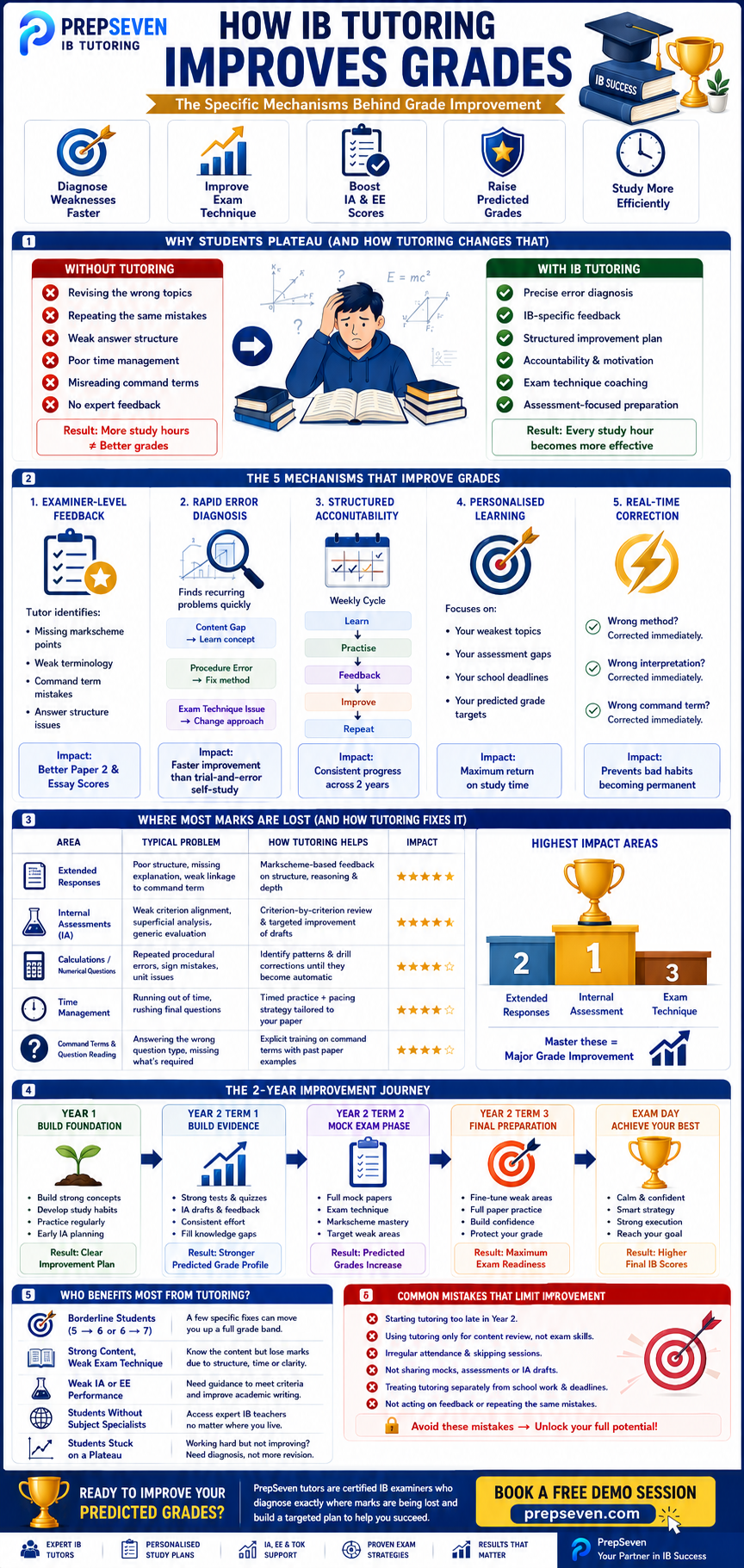
Improvement from tutoring is not a single effect. It comes from several distinct mechanisms operating together, and understanding each one explains why tutoring tends to outperform additional unstructured study time, even when the total hours are similar.
Mechanism
How It Works
Why Self-Study Often Misses This
Where the Effect Shows Up
Examiner-Level Markscheme Literacy
A tutor with direct marking or examining experience can identify exactly which sentence, step, or piece of working earned or lost a mark, not just whether the final answer was correct
Students marking their own work tend to focus on the final answer rather than the specific phrasing or structure a markscheme actually rewards
Extended response questions, IA criteria, and any assessment where method and structure carry significant marks
Rapid, Targeted Error Diagnosis
A tutor can usually identify within one or two sessions whether a recurring error is a content gap, a procedural habit, or a misreading of command terms, and adjust teaching accordingly
Self-study tends to treat every lost mark the same way, repeating general revision rather than correcting the specific, recurring cause
Calculation-heavy subjects, data-based questions, and any topic where the same mistake appears across multiple past papers
Structured Accountability
Regular scheduled sessions create a consistent cadence of practice, feedback, and review that is difficult to sustain through self-motivation alone across two full years
Self-directed study is vulnerable to motivation dips, particularly during long stretches between major assessments when the urgency is lower
Sustained performance across both years rather than a spike limited to the weeks before a mock or final exam
Individualised Pacing
A tutor can spend disproportionate time on a student’s specific weak areas rather than working through the syllabus at a fixed classroom pace that may move too fast or too slowly for that student
Self-study often follows the same linear path as classroom teaching, even when a student’s actual needs are concentrated in two or three specific topics
Borderline grade bands, where a small number of specific topic gaps are often the difference between two adjacent final grades
Real-Time Correction
Misunderstandings can be caught and corrected the moment they happen in a live session, rather than being reinforced through repeated independent practice before anyone notices the error
A student practising alone can repeat the same conceptual mistake across dozens of problems before a test result reveals it
Foundational topics, like vector resolution or equilibrium calculations, where an early misunderstanding compounds across later, related content
Where Grades Are Most Commonly Lost, and How Tutoring Targets Each One
IB grades are not lost uniformly across an exam. Certain components consistently account for a disproportionate share of lost marks, and well-targeted tutoring concentrates effort exactly there rather than spreading attention evenly across content a student may already know well.
Where Marks Are Lost
Why It Happens
How Tutoring Targets It
Typical Impact
Extended Response and Essay-Style Questions
Students often know the content but structure their answer in a way that does not match what the command term and markscheme actually require
Direct markscheme-based feedback on practice responses, with explicit modelling of how to structure an answer that captures every available mark
Often the single largest source of quick improvement, since the underlying knowledge is usually already present
Internal Assessment Criteria
Students misunderstand or only partially address criteria like Exploration, Analysis, or Evaluation, producing work that is competent but not aligned with what is actually being graded
Criterion-by-criterion review of drafts against the official IB descriptors, with specific guidance on what separates the current draft from the next mark band
A meaningful, often substantial shift in IA grade, since this is graded against explicit written criteria a tutor can directly reference
Calculation and Data-Based Questions
Recurring procedural errors, sign mistakes, unit conversions, misapplied formulas, are repeated across many questions without the student noticing the pattern
Reviewing several pieces of practice work together to identify the specific recurring error, then drilling that exact procedural fix until it becomes automatic
Consistent, compounding improvement across every future question of that type, not just the ones directly reviewed
Time Management Under Exam Conditions
Students who perform well on untimed practice lose marks in real exams by spending too long on early questions and rushing the later ones
Structured timed practice with explicit pacing targets per question, reviewed and adjusted session by session
Improved overall paper completion and reduced marks lost purely to running out of time, independent of content knowledge
Command Term Misreading
Answering describe when the question asked for explain, or evaluate when the question asked for discuss, producing an answer that is accurate but does not earn full marks for the demand of the question
Explicit, repeated practice distinguishing command terms in context, reviewed against real past paper wording rather than studied as an abstract list
Reduces a specific, recurring, and easily corrected source of lost marks across every subject
Internal Assessment is consistently one of the highest-leverage areas for tutoring impact, because it is graded against explicit, published criteria rather than judged informally, and because there is usually time for genuine revision between drafts. A tutor who reviews an early IA draft against the actual criteria, rather than just checking whether the writing reads well, frequently produces a larger grade shift here than the same hours spent on additional exam content review.
The Two-Year Pattern: How Tutoring Impact Compounds Over Time
Year 1: Establishing the Diagnostic Baseline
The earliest sessions of a tutoring relationship are rarely where the largest grade jumps happen. They matter because this is where a tutor builds an accurate picture of a student’s specific strengths, weaknesses, and recurring error patterns, the foundation that makes every later intervention more precise. Students who start tutoring in Year 1 typically see steadier, more compounding improvement than those who start later, simply because there is more time for this diagnostic picture to inform a full two-year plan.
Year 2 Term 1: Converting Diagnosis Into Documented Evidence
This is usually where the impact of tutoring becomes visible in school grades, because Year 2 Term 1 assessments and the finalisation of IA work are exactly where tutoring’s targeted approach to markscheme alignment and procedural error correction shows up as improved, evidenced results. A student whose recurring errors were identified and corrected in Year 1 enters this period with cleaner habits already in place.
Year 2 Term 2: Mock Performance and Predicted Grade Impact
Mock examinations in this period are frequently the most influential evidence behind a student’s predicted grade, and this is where the accumulated effect of consistent, targeted tutoring tends to be most visible. A student who has been correcting specific, recurring errors for a year and a half typically performs more consistently under exam conditions than one encountering structured feedback for the first time under mock pressure.
Year 2 Term 3: Protecting and Extending the Gains
In the final term, tutoring’s role shifts from building new skills to maintaining consistency and closing the last specific gaps revealed by mock results. The compounding effect of two years of targeted correction means the final stretch of preparation is usually about reinforcement and confidence rather than addressing fundamentally new weaknesses.
Three Things Tutoring Does That Self-Study Cannot Easily Replicate
Feedback That Reflects How the Exam Is Actually Marked
A markscheme on its own is difficult for a student to apply accurately to their own work, because recognising why a particular phrase earns a mark and a similar-sounding one does not requires familiarity most students simply have not built yet. A tutor with direct experience of how marks are actually awarded can show, concretely, what separates a response that earns full credit from one that looks similar but does not.
An External, Accurate View of Progress
Students are generally poor judges of their own weaknesses, often overestimating confidence in topics they have reviewed recently and underestimating quiet, persistent gaps in topics they have not revisited in months. A tutor who tracks performance across sessions provides an external, evidence-based view of where a student actually stands, which is frequently more accurate than the student’s own sense of their readiness.
Sustained Structure Across a Genuinely Long Course
The Diploma runs for two years, long enough that almost every student experiences periods of lower motivation, particularly between major assessment windows. Scheduled tutoring sessions provide a structural commitment that keeps targeted practice happening even during those lower-motivation stretches, which is precisely when self-directed study is most likely to lapse.
Which Students See the Biggest Gains From Tutoring
Student Profile
Why Tutoring Helps Particularly
What to Look For
Students on the border of two grade bands
A small number of specific, identifiable issues are often the entire gap between two adjacent grades, and targeted diagnosis closes that gap faster than broad additional revision
A tutor who can name the specific criteria or error patterns standing between the current grade and the next one, not just general encouragement to work harder
Students strong in content but weak in exam technique
These students often see little benefit from more content review, since their gap is structural, time management, command term reading, answer formatting, not knowledge-based
A tutor who prioritises timed practice and markscheme-based feedback over additional content teaching
Students without access to subject specialists at their school
When a school lacks a strong HL specialist in a given subject, tutoring can directly substitute for that missing expertise rather than just supplementing it
A tutor with specific, demonstrable expertise in the exact subject and level, ideally with examining experience
Students with strong content knowledge but weak IA or EE grades
IA and EE are graded against explicit written criteria, and targeted feedback against those criteria tends to produce faster, more defensible improvement than general writing support
A tutor who reviews drafts criterion by criterion against the official IB descriptors, not just general feedback on clarity or writing quality
Students who study consistently but plateau despite effort
A plateau frequently signals that the same recurring error is being repeated without correction, something an external, evidence-based view is well placed to identify
A tutor who reviews several pieces of past work together specifically looking for repeated patterns, rather than treating each session as an isolated topic review
Common Mistakes That Limit How Much Tutoring Improves a Grade
Mistake
Why It Limits Impact
What to Do Instead
Starting tutoring only in the final weeks before exams
Most of tutoring’s compounding benefit comes from sustained correction over time, and a few weeks is rarely enough for that pattern to take hold
Start early enough, ideally well before mock exams and predicted grade checkpoints, for diagnosis and correction to compound properly
Using tutoring only for content review rather than markscheme-based feedback
Content a student can usually find or relearn independently; the markscheme literacy a tutor provides is much harder to replicate alone
Prioritise sessions focused on reviewing actual practice work against real markschemes, not just re-explaining topics
Inconsistent attendance and irregular scheduling
Tutoring’s structural accountability benefit depends on a consistent cadence; irregular sessions weaken both the diagnostic picture and the habit-building effect
Commit to a regular weekly schedule and treat it with the same priority as a fixed school commitment
Not bringing recent school assessments or mock results to sessions
A tutor working without visibility into a student’s actual graded work is diagnosing blind, relying on practice problems alone rather than real evidence
Share recent tests, mock results, and IA drafts with the tutor so feedback is grounded in the student’s real, evidenced performance
Treating tutoring as separate from school-set work rather than integrated with it
Tutoring delivers the most value when it directly supports upcoming school assessments and predicted grade checkpoints, not when it runs on an unrelated parallel track
Align tutoring priorities with the student’s actual school calendar, mocks, IA deadlines, and topic tests, so the two reinforce each other
See how targeted IB tutoring could move your grade
PrepSeven tutors are certified IB examiners who diagnose exactly where marks are being lost, whether that’s exam technique, IA criteria, or a recurring content gap, and build a plan around closing it.


 Why Tutoring Changes Outcomes in Ways Self-Study Often Cannot