

Creating the Perfect IB Study Schedule
A Step-by-Step Process for Building a Schedule You’ll Actually Follow
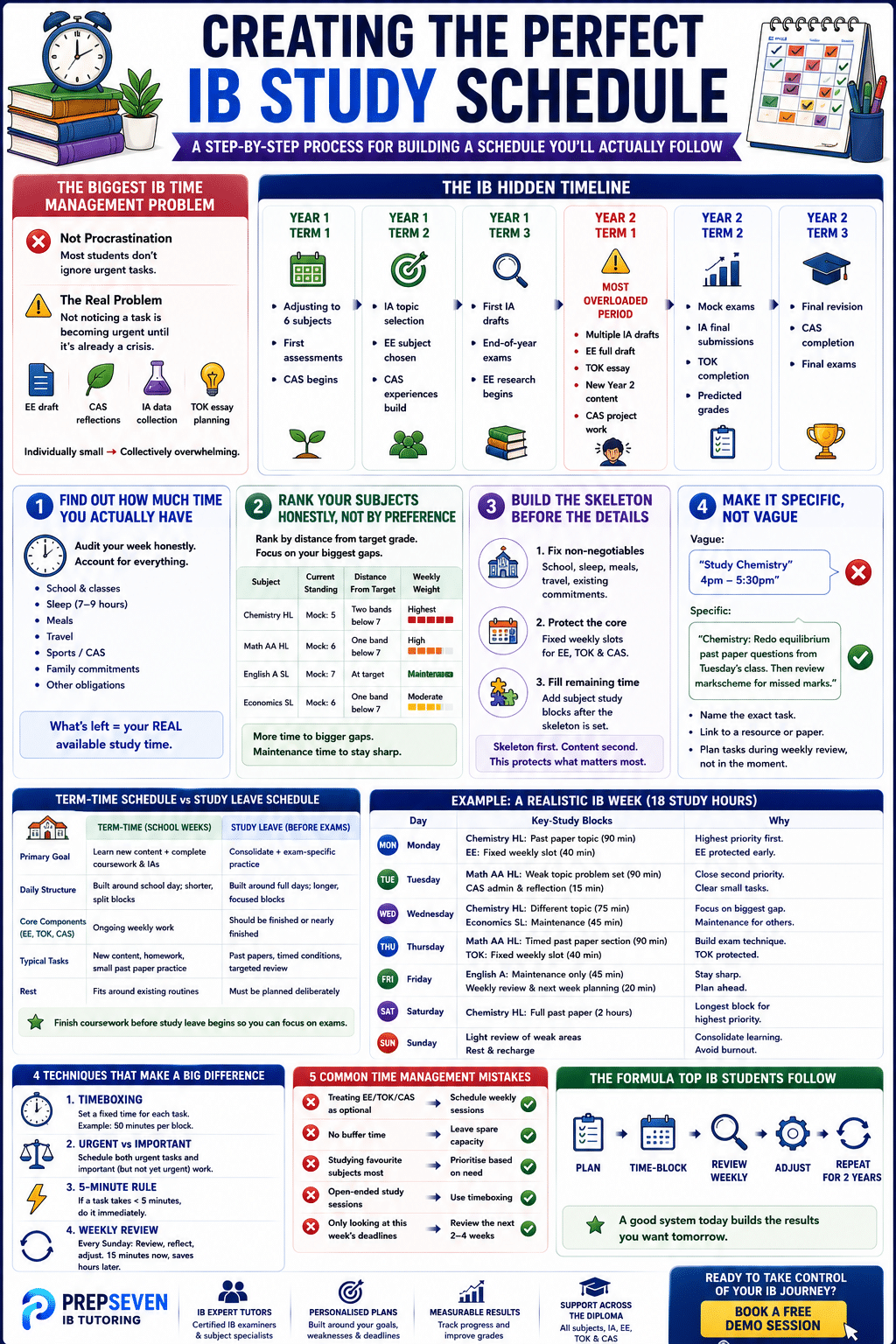
A Study Schedule Is a Series of Decisions, Not a Template
Search for an IB study schedule online and you’ll find dozens of colour-coded templates, all promising to be the system that worked for some other student’s six subjects, predicted grades, and personal circumstances. Most of them don’t survive contact with a real week, not because the template is badly designed, but because a study schedule isn’t really a document you copy. It’s a series of specific decisions, how much time do I actually have, which subjects genuinely need the most of it, what does a realistic week actually look like for me, that have to be made honestly and individually before any template becomes useful.
This guide walks through that decision-making process step by step, building a schedule from first principles rather than handing over a template to fill in. A schedule built this way takes a little longer to put together the first time, but it’s the version that’s actually built around your subjects, your weaknesses, and your real week, which is the only version that consistently survives more than two weeks of use.
Step One: Find Out How Much Time You Actually Have
Almost every student overestimates their genuinely available study time, often by a significant margin, because the calculation usually only accounts for the hours not already claimed by school and sleep, while ignoring everything else that legitimately uses up a week: travel time, meals, sport and CAS commitments, family obligations, and the basic downtime a person needs to function without burning out. A schedule built on an inflated sense of available time fails almost immediately, because it’s been set up to demand more hours than actually exist.
The fix is a genuine audit, done honestly rather than aspirationally. Take a single representative week and account for every major block of time: school hours, sleep, meals, travel, regular commitments like CAS activities or sports training, and any other fixed obligations. What’s left over is your real, available study time, and it’s almost always considerably less than the number a student would guess if asked directly. Building a schedule around this honest number, rather than an optimistic one, is what makes the resulting plan survivable.
A useful sanity check: if your planned schedule has you studying more hours per week than you slept the week before, the schedule is built on an unrealistic number, not genuine extra time you’ve found. Sleep debt doesn’t show up as a line item in most study plans, but it shows up everywhere else, including in how much of the studying you actually manage to absorb.
Step Two: Rank Your Subjects Honestly, Not by Preference
Once you know how much time exists, the next decision is how to divide it, and this is where preference quietly distorts most student-built schedules. It’s natural to want to spend more time on subjects you enjoy, but a schedule that allocates time by enjoyment rather than by need consistently under-serves the subjects most likely to be holding the overall result back. Ranking subjects honestly means looking at recent grades, mock results, and how far each subject currently sits from its target grade, then weighting study time toward the subjects with the largest gap to close, not the ones that feel best to work on.
This doesn’t mean abandoning subjects you’re already strong in entirely, some maintenance time is still necessary to avoid slipping, but it does mean a genuinely honest schedule looks uneven across subjects, weighted toward where the real gap actually is, rather than evenly divided as if every subject needed the same amount of attention.
Step Three: Build the Skeleton Before Filling In the Details
A common mistake is starting schedule-building with subject content, deciding what to study, before deciding when anything happens at all. This produces a schedule that looks thorough on paper but has no actual structure underneath it, no fixed anchors, which makes it easy to drift away from the moment real life intervenes. A more durable approach builds the skeleton first: fixed, non-negotiable blocks for school, sleep, meals, and existing commitments, then fixed, recurring slots for EE, TOK, and CAS work, and only after that skeleton is in place, the specific subject content gets filled into whatever blocks remain.
Building in this order matters because it protects the things most likely to get silently squeezed out otherwise. A schedule built content-first tends to treat sleep and core component time as flexible, the first things sacrificed when a week gets busy. A schedule built skeleton-first treats them as fixed, with subject content fitting around them instead of the other way around.
Step Four: Make the Schedule Specific, Not Vague
“Study Chemistry, 4pm to 5:30pm” looks like a plan, but it isn’t really one, because it doesn’t specify what’s actually going to happen in that ninety minutes, and a vague block is far easier to spend on whatever feels easiest in the moment rather than what’s actually needed. A genuinely useful schedule names the specific task: “Chemistry: redo the equilibrium past paper questions from Tuesday’s class, then review the markscheme for any missed marks.” This level of specificity takes slightly longer to plan, but it removes the moment of hesitation, deciding what to actually do, that’s often where a study session quietly derails before it’s even started.
- Name the specific topic or task, not just the subject, for every study block on the schedule.
- Where possible, tie the task to something concrete, a particular past paper, a specific set of flashcards, a named section of the EE, rather than an open-ended instruction to revise.
- Plan the coming week’s specific tasks during the weekly review, not in the moment a study block actually begins, since deciding under time pressure tends to default to whatever feels easiest rather than what’s most needed.
Term-Time Schedules and Study-Leave Schedules Are Different Documents
A schedule built for a normal teaching term and a schedule built for the concentrated study leave period before final exams are solving different problems, and treating them as the same document, just compressed, tends to produce a study leave schedule that’s either unrealistically intense or not focused enough on exam-specific practice.
Building these as two separate documents, rather than assuming the term-time version simply gets busier closer to exams, makes the transition into study leave far smoother. By the time study leave begins, the core components should already be finished, which frees the entire schedule to focus on exam-specific practice rather than competing with coursework deadlines at the worst possible moment.
Putting It Together: One Worked Example
The steps above are easier to apply once they’re seen working together. Here’s how they might combine for a student whose honest audit found roughly eighteen genuine study hours in an average week, and whose subject ranking, following the same process outlined in Step Two, identified Chemistry HL and Math AA HL as the largest priorities, with English A and a strong Economics result needing only maintenance.
Notice what this example does and doesn’t do. It doesn’t divide time equally across four subjects. It doesn’t leave EE and TOK to chance. It names specific tasks rather than vague subject blocks. And it includes a genuinely lighter day, because a week with no lighter day at all tends to produce burnout well before it produces better grades. None of this is a template to copy directly, since the specific subjects and weak topics will be different for every student, but the underlying logic, weighted by need, anchored by fixed commitments, specific rather than vague, transfers directly.
A schedule that looks reasonable on paper doesn’t always survive a real week, and the only way to find out is to actually run it for several days and watch what happens. Some blocks will consistently run long, some tasks will turn out to need less time than expected, and some fixed commitment will turn out to clash with something the schedule didn’t account for. None of this means the schedule failed. It means the first draft, like any first draft, needs revision based on real evidence rather than guesswork.
A short weekly check-in, comparing what the schedule planned against what actually happened, is what turns a one-off plan into a living system that improves over time. Students who treat their first schedule as fixed and final tend to abandon it within a couple of weeks when reality stops matching the plan. Students who treat it as a draft to be adjusted weekly end up, after a month or so, with a schedule that’s genuinely accurate to how they work, which is far more valuable than a perfectly designed plan that was never tested against a real week.
Knowing When to Tweak Versus When to Rebuild
A weekly check-in usually calls for small adjustments: shifting a block by half an hour, swapping which subject gets the longer Saturday slot, trimming a task that consistently runs short. But every few months, usually around a major shift like mock results coming back, a new term beginning, or predicted grades being set, the schedule needs something more substantial than a tweak. A subject that was the top priority in September might no longer be the biggest gap by January, and a schedule that’s never fully rebuilt around updated priorities slowly drifts out of sync with what actually matters most.
A useful rule of thumb: treat small, weekly adjustments as routine maintenance, but set a recurring reminder, roughly once a term, to redo Steps One and Two properly, a fresh time audit and an honest subject re-ranking based on the most recent evidence. This keeps the schedule responsive to real progress rather than quietly running on assumptions that were accurate months ago but aren’t anymore.
The Schedule That Works Is the One You Actually Follow
There’s no single perfect study schedule that works identically for every IB student, because the inputs, available time, subject strengths and weaknesses, energy patterns, are genuinely different for everyone. What makes a schedule good isn’t how impressive it looks colour-coded on a page. It’s whether it’s built from an honest accounting of real time and real priorities, specific enough to remove hesitation in the moment, and flexible enough to survive contact with an actual week. A schedule with all three of those qualities, even a relatively simple one, will consistently outperform a beautifully designed template borrowed from somewhere else.
Want help building a study schedule around your actual subjects and grades?
PrepSeven tutors work with students to audit their real available time, rank subjects honestly against target grades, and build a weekly schedule that’s specific enough to actually follow.
Book a Free Demo Session at prepseven.com