

Common Reasons Students Miss a 7
Most Near Misses Aren’t About Knowing Less Than They Think
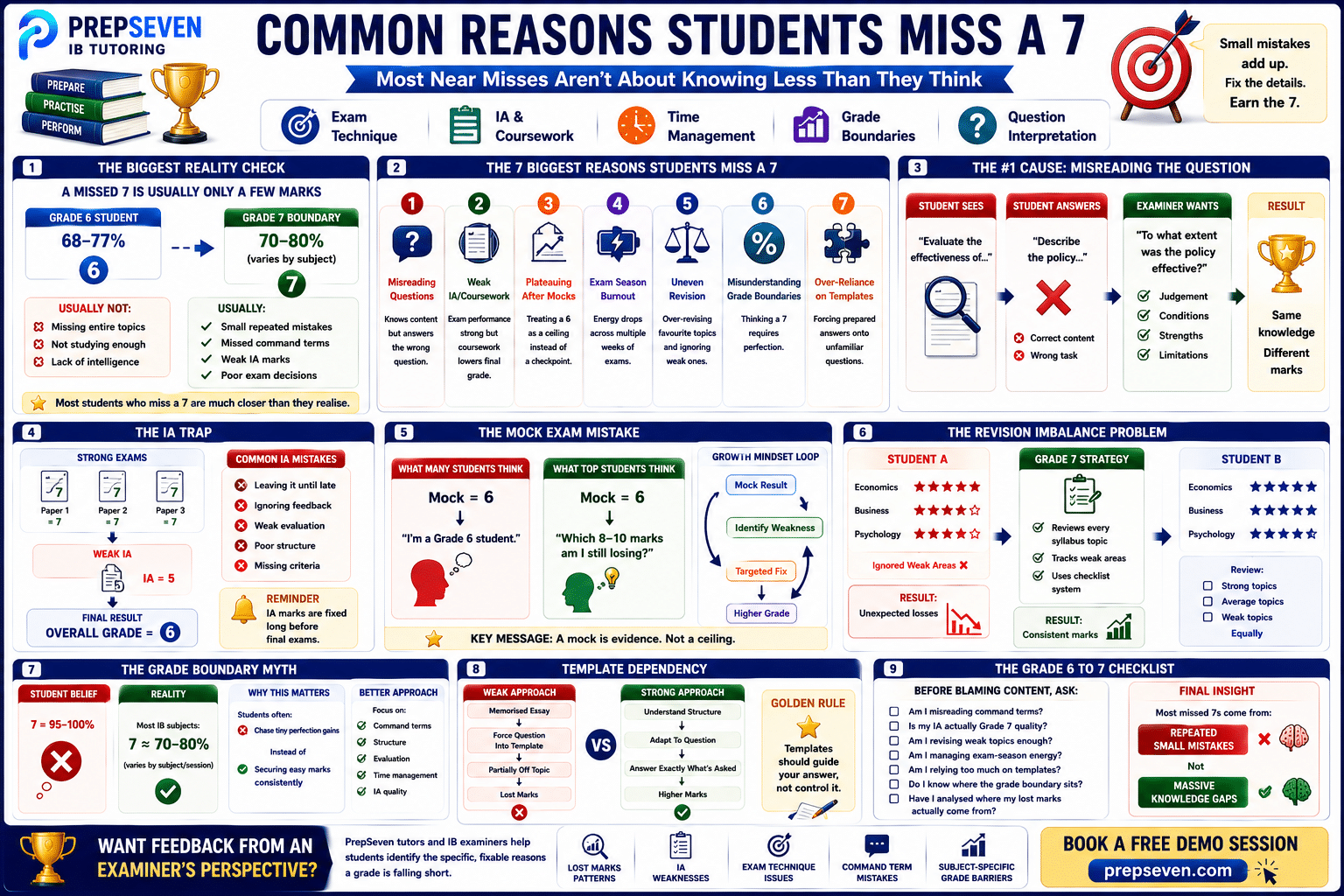
A Missed 7 Is Usually a Few Marks, Not a Few Topics
Students who narrowly miss a 7 almost never miss it because they didn’t understand the subject. Most of the time, the gap between the grade they got and the grade they were capable of is a handful of marks, sometimes a single mark, spread across small, specific, fixable problems rather than a genuine knowledge shortfall. This is actually good news, because it means the fix is rarely “learn more content.” It’s usually something narrower and more correctable, once it’s actually identified.
Here are the reasons that come up again and again when a strong student’s result doesn’t match their understanding of the subject.
They Misread What the Question Is Actually Asking For
This is, by a wide margin, the most common reason a student who clearly knows the material still doesn’t earn full marks. A question asking students to evaluate gets answered as if it asked to describe. A question asking for the effect of a specific change gets answered with general background instead. The content in the answer might be entirely accurate, and still earn well below full marks, because it isn’t actually responding to the specific demand of the question as written. This happens most often under time pressure, when a student recognises a familiar topic and starts writing the answer they’ve prepared rather than reading the question closely enough to notice it’s asking for something slightly different.
Their IA or Coursework Quietly Drags Down an Otherwise Strong Grade
Final subject grades are a blend, exam performance plus internal assessment, and it’s entirely possible to perform at a 7 standard across every exam paper and still miss the grade because IA marks were finalised many months earlier, at a point when the work genuinely wasn’t at that standard yet. Students sometimes treat the IA as a box to tick early in the course and then move on, without recognising that it carries real, fixed weight in the final calculation, weight that can’t be made up for later no matter how well the exams go.
They Plateau at a Mock Result and Quietly Stop Pushing
A student who sits a mock exam, gets a 6, and unconsciously decides that’s roughly where they sit, often stops pushing for the specific, identifiable improvements that would close the remaining gap. Mock results are a snapshot of performance at one point in time under one specific set of conditions, not a ceiling. Students who treat a 6 as confirmation of their level, rather than as evidence pointing toward specific correctable weaknesses, tend to coast through the remaining preparation time instead of using it deliberately.
They Run Out of Steam Across the Exam Season, Not Just Within One Paper
Most exam technique advice focuses on pacing within a single paper, and that matters, but a less discussed problem is pacing across an entire exam season that can run for several weeks with papers in multiple subjects overlapping. Students who push hardest in the first week and arrive at their final papers genuinely depleted, having under-slept and under-rested through the middle stretch, frequently underperform on those later papers relative to their actual ability, not because the content was harder but because they had less left to give by that point. The strongest performers tend to plan rest as deliberately as they plan revision across the whole exam period, not just around any single paper.
They Over-Prepare Favourite Topics and Under-Prepare the Syllabus Edges
Almost every student has topics they enjoy and topics they avoid, and left unchecked, this naturally produces uneven revision: real depth on the topics that feel interesting or come easily, and thin, surface-level familiarity with the topics that don’t. Exams don’t reliably favour a student’s strongest topics, and a paper that happens to lean toward the syllabus areas a student quietly deprioritised can cost more marks than a much larger number of small errors elsewhere ever would. A genuinely useful late-stage check is going through the syllabus topic by topic and being honest about which ones have actually been revised properly versus which ones have just been read once and assumed to be fine.
They Misjudge Where the Grade Boundary Actually Sits
A surprising number of students assume a 7 requires something close to a perfect score, and that assumption quietly shapes how they approach revision and exam technique, sometimes leading them to either give up on a 7 as unrealistic or to spend disproportionate effort chasing marginal, low-value marks instead of securing the more reliable ones. In most subjects, grade boundaries for the top grade sit meaningfully below full marks, often in the region of seventy to eighty percent depending on the subject and the specific exam session. Understanding roughly where that boundary actually sits, rather than assuming it requires near-perfection, changes how realistic a 7 feels and how revision time gets prioritised in the final stretch.
They Rely on Memorised Structures That Don’t Bend to the Actual Question
A prepared essay structure, a model paragraph, a rehearsed way of answering a particular question type, can be a genuinely useful scaffold, but it becomes a liability the moment a student forces a question into that structure rather than adapting the structure to fit what’s actually being asked. This shows up as essays that feel slightly off-topic despite being well written, or answers that include strong content in the wrong place because that’s where the memorised template put it. The fix isn’t abandoning preparation and structure altogether, it’s treating any pre-prepared approach as a flexible starting point that gets adjusted to the specific question in front of you, rather than a fixed shape the question has to fit into.
If a result has consistently come in just below a 7 across several pieces of work, it’s worth going through each one and asking, specifically, which of these reasons applies. “I need to know more” is rarely the honest answer. Usually it’s one or two of the patterns above, repeated quietly across multiple assessments without ever being named.
Want help identifying exactly what’s standing between you and a 7?
PrepSeven tutors include certified IB examiners who review past papers and IA work to pinpoint the specific, fixable reasons a grade is falling short, rather than assuming the answer is always more content.
Book a Free Demo Session at prepseven.com