

Best IB Subject Combinations for Medicine
What to Actually Take, What’s Optional, and Where Students Get the Choice Wrong
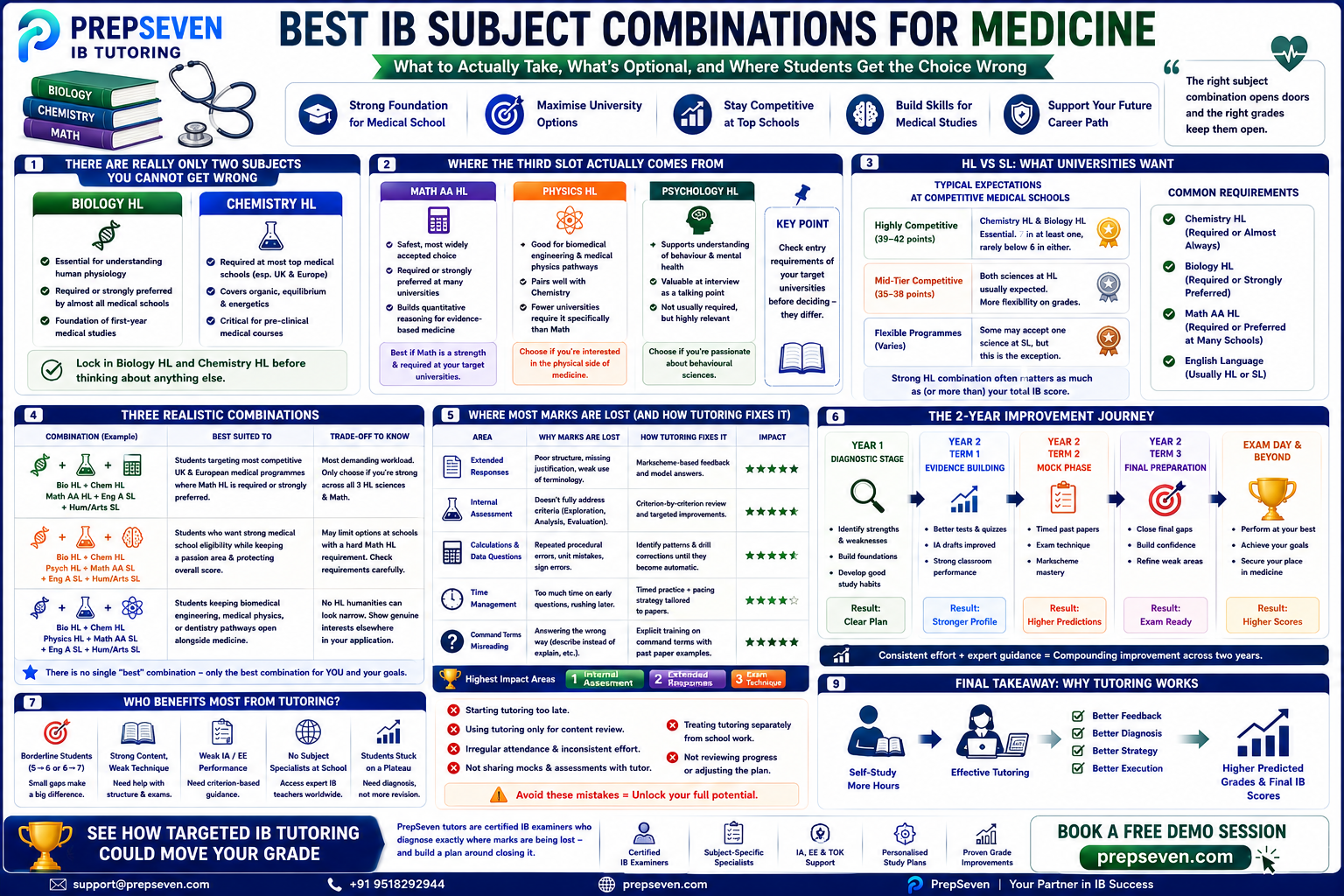
There Are Really Only Two Subjects You Cannot Get Wrong
Ask ten IB students aiming for medicine what subjects they’re taking and you’ll get ten different answers about their third or fourth choice. Ask about the first two and the answer is almost always the same: Biology and Chemistry, usually both at Higher Level. This isn’t really a choice so much as a baseline. Most medical schools, particularly in the UK and across Europe, treat Chemistry HL as close to mandatory and Biology HL as either required or so strongly preferred that taking it at SL puts you at a real disadvantage against other applicants.
It’s worth being honest about why this is the case rather than just accepting it as a rule. Medical degrees are taught at a pace and depth that assumes you arrive already fluent in molecular biology, physiology, and the chemistry of biological systems, organic chemistry, equilibrium, energetics, the kind of content that shows up again almost immediately in first-year pre-clinical courses. A university admissions tutor looking at your application isn’t just checking a box. They’re using your HL Biology and Chemistry grades as the single best predictor they have of whether you’ll cope with the academic intensity of year one.
If you’re choosing IB subjects with medicine as a genuine, serious goal rather than a vague possibility, Biology HL and Chemistry HL should be locked in before you think about anything else. Almost every other subject choice in your six is more flexible than these two.
Where the Third Slot Actually Comes From
Once Biology and Chemistry HL are settled, the real decision is what fills the remaining science or mathematics slot, because this is where applicants to the most competitive programmes start to separate from everyone else. The IB only requires one subject from Group 4, so technically you could pair Biology and Chemistry with no other science at all. In practice, the strongest applicants to competitive medical programmes, particularly in the UK, Ireland, and much of Europe, take a third subject from this group or from Mathematics, because a number of universities either require it outright or weight it heavily when comparing similarly qualified candidates.
The three realistic options here each send a slightly different signal:
- Mathematics: Analysis and Approaches HL is the safest, most broadly accepted choice, since a meaningful number of medical schools either require Math explicitly or strongly prefer it, and the statistical and quantitative reasoning it builds shows up directly in evidence-based medicine modules later in the degree.
- Physics HL: A strong choice if you’re also keeping a biomedical engineering or medical physics pathway open, and it pairs naturally with Chemistry for understanding mechanisms at a physical level, but fewer medical schools require it specifically compared to Math.
- Psychology: Often underrated. It’s not typically required, but it builds genuine fluency with the behavioural science content that appears throughout modern medical curricula, and it can be a strong, authentic talking point at interview if you can speak to it with real understanding rather than as a strategic add-on.
The honest answer to which of these is best is that it depends entirely on where you’re applying. If you have specific universities in mind already, check their published entry requirements directly rather than guessing, because some Russell Group medical schools in the UK list Mathematics as a hard requirement while others list it as preferred but not essential. A subject that’s optional everywhere you’re applying is a much lower-stakes choice than one that’s a strict requirement at your first-choice university.
HL Versus SL: Where the Line Actually Gets Drawn
Most students assume the IB total score is what matters most for medicine, and while it does matter, the specific combination of Higher Level grades is often scrutinised just as closely, sometimes more closely, by admissions teams. A 40-point applicant with 766 at HL in Chemistry, Biology, and Math reads very differently to an admissions tutor than a 40-point applicant with the same total built from a stronger Group 1 or Group 6 subject propping up weaker science grades. The total score gets you past an initial filter. The HL combination is frequently what the actual comparison between candidates is based on.
As a rough but genuinely useful guide to how competitive UK and European medical programmes typically read HL combinations:
- Highly competitive programmes (the kind requiring 39 to 42 points overall) generally expect Chemistry and Biology both at HL, with grades of 7 in at least one and rarely below 6 in either.
- Mid-tier competitive programmes typically still want both sciences at HL but show more flexibility on the exact grade profile, sometimes accepting 6,6 if the overall score and other evidence, like UCAT or BMAT performance, are strong.
- A small number of programmes will accept one of Biology or Chemistry at HL and the other at SL, but this is increasingly the exception rather than a safe assumption, and it’s worth verifying directly rather than relying on this as a backup plan.
If you’re an HL Chemistry and Biology candidate sitting on predicted 6s rather than 7s, the conversation worth having with your school isn’t whether to switch subjects this late, it’s almost never the right move, but how to close the specific gap between a 6 and a 7 before predicted grades are finalised. That’s a different problem with a different solution, and switching subjects under pressure rarely fixes it.
The Group 1 and Group 6 Choices Nobody Thinks Hard Enough About
Most of the strategic conversation around IB subjects for medicine focuses on the sciences, which makes sense, but it leaves two slots, your Group 1 language and literature subject and whatever fills your sixth slot, treated almost as afterthoughts. They’re not as decisive as Biology and Chemistry, but they’re not irrelevant either, and getting them right removes friction elsewhere in your application.
Your Group 1 subject rarely needs to be anything other than whatever you’re strongest in, since medical schools are not generally scrutinising English Literature grades the way they scrutinise science grades. Where it does matter is indirectly: strong performance in English A, particularly at HL, builds exactly the kind of close reading and argument construction that helps with the verbal reasoning sections of admissions tests like the UCAT, and with writing a personal statement that doesn’t read like everyone else’s.
The sixth slot is where the real strategic decision sits, and it usually comes down to a straightforward trade-off: take a fourth science or Math HL to maximise eligibility across the widest possible range of universities, or take something you’re genuinely strong in from Individuals and Societies or the Arts to protect your overall point total. Neither is wrong. A student who takes four HL subjects including a second Math or Science to keep every door open, but who is stretched thin and ends up with a lower overall score as a result, has not necessarily made the stronger choice. The right answer depends on how confident you genuinely are across your subjects, not on what looks most impressive on paper.
A Quick Reference: Three Realistic Combinations
Rather than one single best answer, here’s how three different, equally legitimate combinations tend to position a student, depending on what else you’re keeping open.
The Mistake That Costs Students the Most
The single most common error isn’t a wrong subject choice at all. It’s choosing a combination that maximises eligibility on paper while underestimating how demanding three HL sciences plus a genuinely strong Math grade actually is to sustain across two years. A student who takes the most ambitious possible combination and ends up with 6,6,5 at HL has almost always closed off more doors than the student who took a slightly more conservative combination and finished with 7,7,6. Admissions teams are reading grades, not subject lists. Ambition that doesn’t convert into results doesn’t help an application; it just adds risk.
The second most common mistake is leaving the decision until applications are imminent, after subject choices were already locked in two years earlier without medicine specifically in mind. If medicine is even a possibility you’re taking seriously, it’s worth having this conversation before Year 1 subject selection, not during Year 2 when the only options left are managing the consequences of an earlier choice rather than making a better one from the start.
Not sure which combination fits your target universities?
PrepSeven tutors include certified IB examiners who work with students on both subject strategy and the HL grades that actually get them there, across Biology, Chemistry, Math, and beyond.
Book a Free Demo Session at prepseven.com