

Best IB Subject Combinations for Engineering
Why Math and Physics Are Non-Negotiable, and How the Rest Depends on Which Engineering You Mean
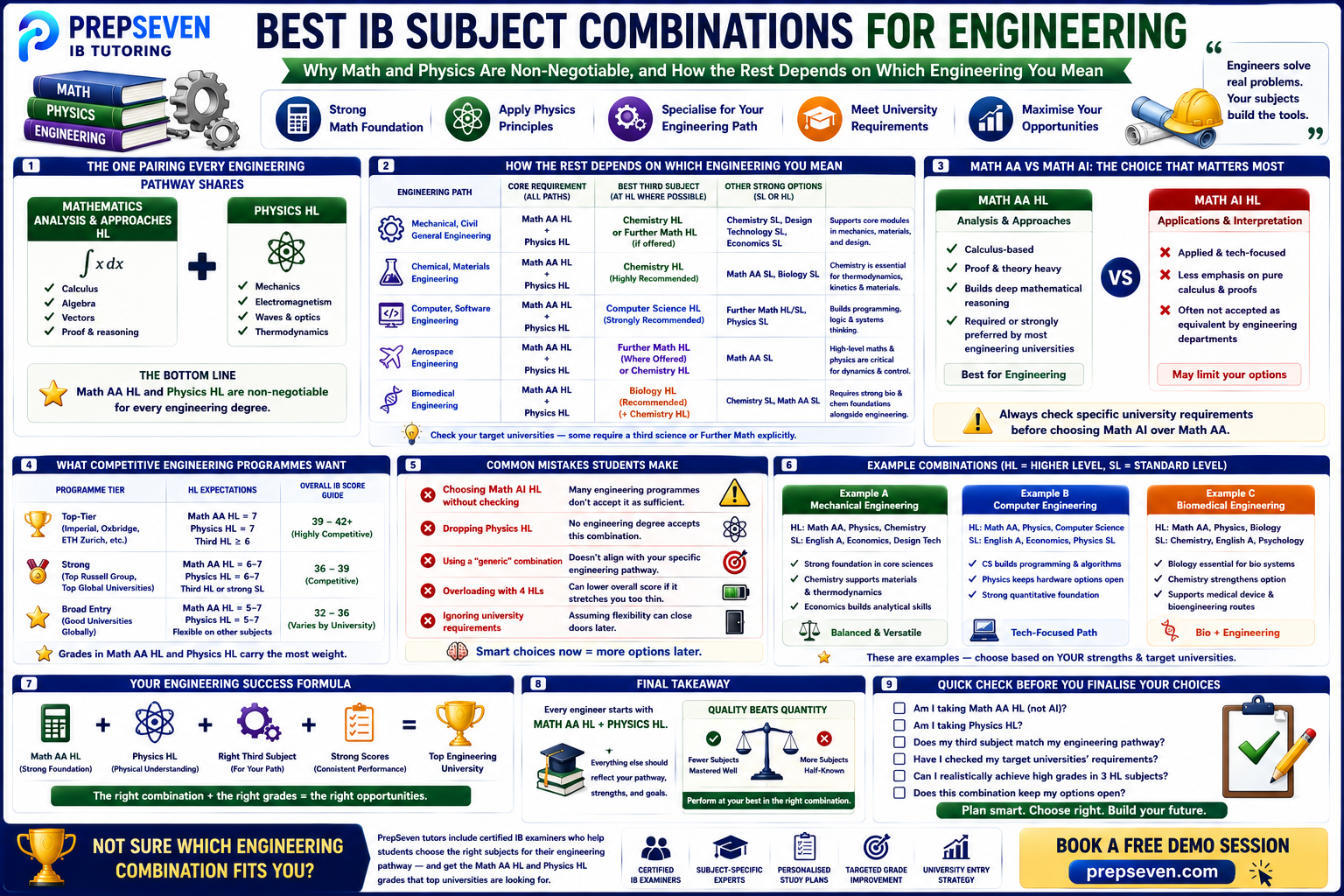
The One Pairing Every Engineering Pathway Shares
Unlike medicine, where almost every applicant is heading toward roughly the same degree, engineering splits into genuinely different disciplines with different academic demands, mechanical, civil, electrical, chemical, computer, aerospace, biomedical, and the right IB subjects depend partly on which of these you actually mean. But before any of that branching matters, there’s one pairing that every single one of these pathways shares without exception: Mathematics Analysis and Approaches at Higher Level, and Physics at Higher Level.
This isn’t a soft recommendation. Engineering degrees, wherever you study them, are built on the assumption that you arrive with serious mathematical fluency, calculus, vectors, differential equations in their early form, and the physical intuition that Physics HL is specifically designed to build. A student applying to any engineering programme without both of these at Higher Level is applying with a real, structural gap that a strong personal statement cannot fully compensate for. Admissions tutors are not being arbitrary when they list these as requirements. First-year engineering modules move quickly, and they assume this foundation is already solid.
If you take nothing else from this guide, take this: Math AA HL and Physics HL are the two subjects engineering applicants cannot trade away, regardless of which branch of engineering they end up in. Everything else in your combination is genuinely more flexible than these two.
What Changes Depending on Which Engineering You’re Aiming For
Once Math AA HL and Physics HL are settled, the rest of your combination should start to reflect the specific kind of engineer you’re aiming to become, since different branches lean on different supporting subjects.
Mechanical, Civil, and General Engineering
This is the broadest category and the one with the most flexibility beyond the core pairing. A third HL subject from either Chemistry or a second Math (Further Mathematics, where your school offers it) strengthens an application, but it isn’t always required the way it is for more specialised branches. Many students heading into mechanical or civil engineering pair Math AA HL and Physics HL with a strong SL science and use their remaining slots for subjects they’re genuinely confident in, since overall point total carries real weight for these broader programmes and a stretched third HL science that drags the average down rarely helps.
Chemical and Materials Engineering
Here, Chemistry HL stops being optional and becomes close to essential alongside Math AA HL and Physics HL, since chemical and materials engineering degrees lean heavily on thermodynamics, reaction kinetics, and material properties from the very first term. Applicants who arrive with all three sciences at HL, Chemistry, Physics, and ideally Biology or a fourth subject at SL, tend to have the most flexibility across different universities’ specific entry requirements, since some chemical engineering departments are more particular about a third science than mechanical or civil departments tend to be.
Computer and Software Engineering
This is the one branch where Computer Science genuinely competes with Physics for relevance, though it rarely replaces it outright. Math AA HL remains essential, since the discrete mathematics, logic, and algorithmic thinking computer engineering depends on are built directly on the same foundation as the rest of engineering mathematics. Computer Science HL is a strong, increasingly common third subject for this pathway, particularly for programmes with a heavier software or systems focus, though Physics HL is still worth keeping if you’re not entirely certain you’ll stay on the software side, since it keeps hardware-adjacent and electrical engineering options open.
Aerospace Engineering
Aerospace is, in practice, the most mathematically and physically demanding of the common branches, and it shows in what competitive programmes expect. Math AA HL and Physics HL are taken as an absolute given here, and a meaningful number of the strongest applicants add Further Mathematics where it’s offered, specifically because aerospace dynamics and control theory lean on mathematical content that goes beyond the standard Math AA HL syllabus. Where Further Math isn’t available, a third HL science, typically Chemistry, is the more common substitute.
Biomedical Engineering
This is the branch that breaks the usual pattern, because it sits genuinely between engineering and the life sciences. Math AA HL and Physics HL remain the foundation, but Biology HL, and often Chemistry as well, carries real weight here in a way it doesn’t for mechanical or electrical engineering, since biomedical engineering programmes assume familiarity with physiology and biochemistry alongside the standard engineering mathematics. Students aiming specifically at biomedical engineering are often the ones taking three HL sciences plus Math, which is a genuinely heavier load than most other engineering pathways require.
Math AA Versus Math AI: The Choice That Actually Matters Most
Of all the subject decisions an aspiring engineer makes, this is the one most likely to quietly close doors without the student realising it until it’s too late to fix. The IB does not formally state that engineering programmes require Analysis and Approaches over Applications and Interpretation, but in practice, the overwhelming majority of competitive engineering departments either state Math AA explicitly or describe a requirement, calculus-based, proof-based reasoning, that Math AI simply isn’t designed to build to the same depth.
Math AI HL is a genuinely rigorous course, and it is the right choice for many strong students. It is not, however, generally accepted as equivalent to Math AA HL by engineering admissions teams, because it deliberately emphasises applied, technology-assisted problem solving over the pure calculus and algebraic manipulation that early engineering modules assume. A student who takes Math AI HL because it feels more comfortable, without checking their target universities’ specific wording, can find out during the application process that a programme they assumed was open to them effectively isn’t.
If engineering is a serious goal and you are currently leaning toward Math AI over Math AA because it feels more manageable, have that conversation with a tutor or teacher honestly before committing. It’s far better to get the right support to succeed in Math AA HL than to discover in Year 2 that your safer-feeling choice has narrowed your options more than expected.
What Competitive Engineering Programmes Are Actually Looking For
Point totals matter less in isolation for engineering than the specific HL science and maths grades behind them, in much the same way they do for medicine. A useful, if rough, way to read how different tiers of programme tend to respond to an HL profile:
- The most competitive programmes (Imperial, Oxford and Cambridge engineering, ETH Zurich, and similarly ranked departments) generally expect Math AA HL and Physics HL at 7, with a third HL subject at 6 or above, alongside an overall score in the high 30s to low 40s.
- Strong, well-regarded but slightly less selective programmes typically still want Math AA HL and Physics HL, but show more flexibility on whether the third subject is at HL or a strong SL, provided the overall point total is competitive.
- Programmes with a broader entry profile often care most about Math AA HL and Physics HL being present at all, at a solid grade, treating the rest of the combination with considerably more flexibility than the subjects themselves might suggest.
Where Students Get This Wrong
The most common mistake isn’t choosing the wrong subjects outright, it’s choosing Math AI HL or dropping Physics in favour of a more comfortable subject without checking what a specific target university actually requires, and only discovering the mismatch once applications are already underway. The second most common mistake is treating every branch of engineering as identical and defaulting to a generic Math, Physics, Chemistry combination regardless of whether the student is actually aiming at software engineering, where Computer Science would serve them far better, or biomedical engineering, where Biology genuinely belongs in the mix.
The third, quieter mistake is academic overreach: stacking four HL subjects, often Math AA, Physics, Chemistry, and a second Math or Computer Science, in pursuit of maximum eligibility, and ending up with a lower overall score than a more focused three-HL combination would have produced. Engineering admissions teams are, in the end, reading grades. A combination that signals ambition but delivers 6,6,5 rarely outperforms a slightly more conservative combination delivering 7,7,6 in the way students often expect it to.
Not sure which engineering combination fits your target universities?
PrepSeven tutors include certified IB examiners who help students choose the right subject combination for their specific engineering pathway, and build the Math AA HL and Physics HL grades that competitive programmes are actually looking for.
Book a Free Demo Session at prepseven.com