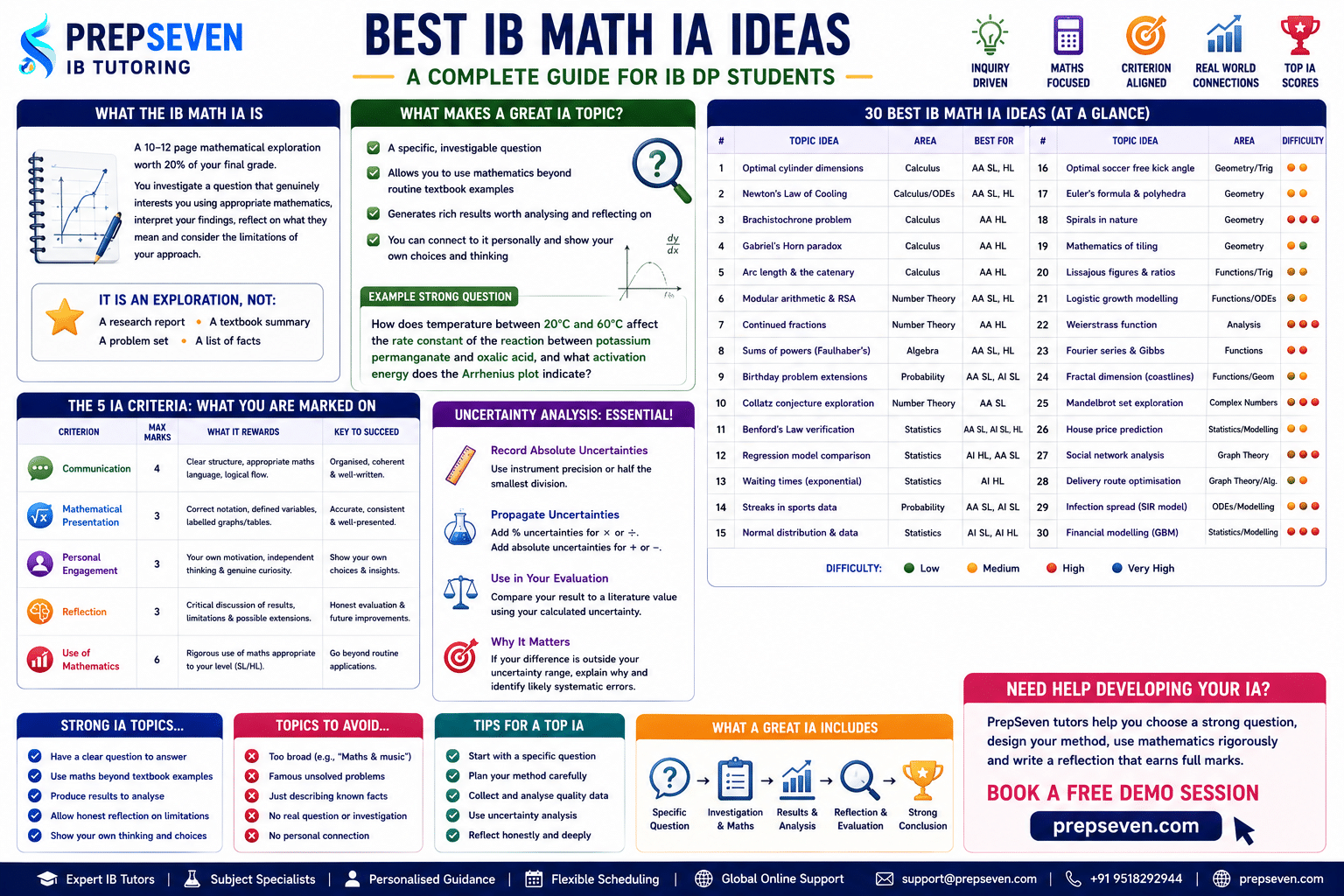
The IB Mathematics Internal Assessment is a 10 to 12 page mathematical exploration worth 20% of your final grade. It is not a research report, a textbook summary, or a problem set. It is a piece of mathematical writing that demonstrates your ability to explore a question that genuinely interests you using mathematics that is appropriate for your course level.
The word exploration is doing a lot of work in that description. The IB is not asking you to explain a mathematical concept. It is asking you to investigate something: to pose a question, apply mathematics to it, interpret what you find, reflect on what your results mean, and consider the limitations of your approach. The students who score 18, 19, or 20 out of 20 are those who have done this genuinely, not those who have picked the most impressive-sounding topic.
The topic you choose shapes everything that follows: the mathematics you can use, the depth you can reach, how easy the Personal Engagement criterion is to satisfy, and how naturally reflection emerges from your findings. This guide covers how to evaluate a potential topic, ideas across all main areas of the mathematics syllabus for both AA and AI, and what separates the ideas that produce strong explorations from those that consistently disappoint.
The most common IA mistake is choosing a topic based on what sounds impressive rather than what you can genuinely investigate. A student who picks the Riemann Hypothesis because it sounds mathematically serious but cannot engage with it beyond a Wikipedia summary will produce a weaker exploration than a student who investigates why a penalty kick in football has an optimal angle of approach using basic trigonometry and personal data they collected themselves. Depth on a genuine question always outperforms breadth on a borrowed one.
The Criteria You Are Being Marked On
Every IA idea should be evaluated against the five assessment criteria before you commit to it. Understanding what each criterion rewards will help you see, before you begin, whether a given topic has the properties it needs.
Criterion
What It Rewards
Max Marks
The Question to Ask About Your Topic
Communication
Clear structure, appropriate mathematical language, coherent flow from introduction through to conclusion
4
Can I write this up with a clear question, structured investigation, and logical conclusion?
Mathematical Presentation
Correct notation, properly defined variables, labelled graphs and tables, consistent formatting throughout
3
Will this topic require me to use and present mathematics formally rather than just describe it?
Personal Engagement
Evidence of independent thinking, original observations, genuine curiosity visible in the choices made throughout the exploration
3
Is there something genuinely personal about why I chose this, and will my individual thinking show in the investigation?
Reflection
Critical engagement with findings, acknowledgment of limitations, consideration of what results mean and how the investigation could be extended
3
Does this topic naturally generate interesting findings to reflect on, and are there limitations or extensions worth exploring?
Use of Mathematics
Mathematical rigour and sophistication appropriate to the course level; correct application of relevant techniques; mathematics that goes beyond routine application
6
Does this topic allow me to use mathematics at the right level, derive something, prove something, or extend beyond standard examples?
The Use of Mathematics criterion is worth 6 of the 20 available marks and is the one most explorations fall short on. For AA HL, the mathematics needs to reflect Higher Level content: proof, calculus beyond standard differentiation and integration, complex numbers, Maclaurin series, differential equations, or similarly demanding material. For AA SL and AI, the requirement is still that the mathematics goes beyond routine textbook application. Showing that you can apply a technique correctly is not enough; you need to show that you understand what you are doing and why.
A topic earns marks on Use of Mathematics not by being complicated, but by being rigorous. A student who investigates a simple question about exponential growth in compound interest, derives the continuous compounding formula from first principles, proves the relationship between discrete and continuous models, and reflects on where the approximation breaks down, demonstrates more mathematical sophistication than a student who applies ten different techniques superficially across a sprawling topic.
What Makes a Topic Worth Choosing
Before getting to specific ideas, it helps to understand the properties that make a topic generate a strong exploration. Not every interesting-sounding mathematical subject has these properties, and recognising them saves you from investing weeks in a topic that will not deliver the marks.
A strong IA topic has a specific, investigable question at its centre. Not mathematics of music or the golden ratio in nature, which are themes, not questions. A question is something like: does the golden ratio appear in Fibonacci-indexed terms of other recursive sequences, and if so under what conditions? or how well does a logistic growth model fit the population data for a specific city compared to an exponential model? The question tells you exactly when you have finished investigating and what your conclusion needs to address.
A strong IA topic allows you to introduce mathematics beyond standard textbook examples. This is where many students misunderstand what the criterion requires. It does not mean using a technique your teacher has not taught you. It means applying, deriving, or extending techniques in a way that demonstrates genuine mathematical thinking. Deriving a formula rather than stating it, proving a result rather than assuming it, or connecting two areas of mathematics that are usually treated separately, all satisfy this requirement.
A strong IA topic generates natural personal engagement. This does not mean you have to write about something from your personal life. It means that your individual thinking, your choices about how to approach the question, which cases to investigate, which extensions to pursue, should be visible in the work. An exploration that could have been written by any student who read the same sources has no personal engagement, regardless of how well it is written.
Topic Type
Likely Outcome
Why
Broad theme: ‘Mathematics and music’
Weak on Use of Mathematics and Personal Engagement
Too wide to investigate rigorously; ends up as a descriptive essay with some formulae inserted
Famous unsolved problem: ‘The Riemann Hypothesis’
Weak on Use of Mathematics and Reflection
The mathematics required to engage rigorously is beyond DP level; exploration becomes a summary of others’ work
Specific question with real data: ‘Which function best models the spread of a viral video on social media, and what does the model predict?’
Strong on all five criteria
Specific question, real personal data, room for model comparison and critical reflection on limitations
Proof-based investigation: ‘Under what conditions do the sums of an arithmetic and geometric series converge to the same value?’
Strong on Use of Mathematics and Reflection
Requires algebraic manipulation, proof techniques, and generates genuine mathematical findings worth reflecting on
Application to personal interest: ‘Modelling the optimal release angle for a basketball free throw using projectile motion and calculus’
Strong on Personal Engagement and Communication
Genuine personal context, accessible to set up, can go deep with optimisation calculus, naturally generates reflection on model assumptions
IB Math IA Ideas by Topic Area
The ideas below are organised by mathematical topic area. Each includes the core question, why it works as an IA, what mathematics it naturally generates, and which course level it is most appropriate for. None of these are ready-made explorations: they are starting points that you need to make your own through the specific choices you make in how you investigate them.
Calculus
Calculus generates some of the most naturally rigorous IAs because it lends itself to derivation, proof, and the exploration of rates of change in real-world contexts. The key is finding a question where calculus is not just applied but genuinely illuminating.
Topic Idea
The Core Question
Mathematics It Generates
Level
Optimal container design
What dimensions minimise the material used to construct a cylindrical can with a fixed volume, and how does the optimal ratio change with different volume constraints?
Optimisation using calculus, AM-GM inequality as an alternative approach, comparison of both methods, sensitivity analysis of the solution
AA SL / AA HL
The brachistochrone problem
What is the curve of fastest descent between two points under gravity, and how does calculus of variations approach this problem?
Parametric equations, cycloid derivation, comparison with straight-line and circular arc descent times using numerical integration, HL extension into variational calculus
AA HL
Gabriel’s Horn paradox
How can a shape have finite volume but infinite surface area, and what does this reveal about the limits of intuition in calculus?
Improper integrals, convergence and divergence, comparison tests, reflection on what the paradox implies about mathematical models
AA HL
Modelling cooling with Newton’s Law
How accurately does Newton’s Law of Cooling predict the temperature of a specific object over time, and what does the model fail to capture?
First-order differential equations, separation of variables, fitting exponential models to real collected data, critical reflection on model assumptions
AA SL / AA HL
Arc length and the catenary
Why does a hanging chain form a catenary rather than a parabola, and how large is the error if you model it as a parabola?
Cosh and sinh functions, arc length integration, calculus of the catenary derivation, quantitative comparison of catenary and parabola
AA HL
The Newton’s Law of Cooling IA is one of the most reliably strong calculus topics at AA SL and HL because it combines a genuine differential equation, real data collection, and natural reflection on model limitations. The student who collects their own temperature data, solves the ODE, fits the model to their data, and then critically evaluates where and why the model diverges from their measurements produces an exploration with strong marks on every criterion. The mathematics is not exotic, but it is handled rigorously and personally.
Number and Algebra
Number theory and algebra topics are particularly well-suited to proof-based explorations. They often require fewer computational tools, which means the quality of the mathematical argument is the primary vehicle for marks on Use of Mathematics.
Topic Idea
The Core Question
Mathematics It Generates
Level
Continued fractions and irrational numbers
How do continued fraction representations of irrational numbers compare in their convergence properties, and why does the golden ratio have the slowest-converging continued fraction of any irrational number?
Continued fraction algorithm, convergents and their properties, proof of convergence rate, connection to Fibonacci sequence and Diophantine approximation
AA HL
Modular arithmetic and cryptography
How does the RSA algorithm use modular arithmetic to encrypt and decrypt messages, and what mathematical properties make it secure?
Modular arithmetic, Fermat’s Little Theorem, proof of why large prime factorisation is computationally hard, worked encryption example with reflection on number-theoretic foundations
AA SL / AA HL
Exploring the Collatz conjecture numerically
Is there a pattern in the number of steps different starting values take to reach 1 under the Collatz process, and what does statistical analysis reveal?
Sequences, modular arithmetic, statistical analysis of step counts, visualisation of stopping times, honest reflection on why a proof remains elusive
AA SL
Sums of powers and Faulhaber’s formulas
Is there a pattern in the formulas for sums of consecutive integer powers, and can these be derived algebraically for general n?
Algebraic manipulation, proof by induction, polynomial fitting, connection to Bernoulli numbers at HL extension
AA SL / AA HL
The birthday problem and its extensions
At what group size does the probability of a shared birthday first exceed 50%, and how does this change if birthdays are not uniformly distributed?
Combinatorics, probability theory, exponential approximation, comparison of uniform and non-uniform birthday distribution models using real birth data
AA SL / AI HL
Statistics and Probability
Statistics IAs are among the most flexible because they allow students to work with data from almost any domain. The risk is that they become data description exercises rather than mathematical investigations. The difference between a strong statistics IA and a weak one is whether the student is using statistics to answer a genuine mathematical question or simply reporting what the data shows.
Topic Idea
The Core Question
Mathematics It Generates
Level
Benford’s Law verification
Does the distribution of leading digits in real-world datasets follow Benford’s Law, and does the fit vary across different types of data?
Probability distributions, chi-squared goodness of fit test, logarithmic derivation of Benford’s distribution, comparison across multiple datasets with reflection on why some datasets conform and others do not
AA SL / AI SL / AI HL
Modelling waiting times
How well does an exponential distribution model the waiting times between events in a real queuing system, and what determines whether the fit is strong or weak?
Exponential distribution, parameter estimation using MLE, chi-squared or KS test for goodness of fit, reflection on the memoryless property and where it breaks down
AI HL / AA SL
Streaks in sports data
How does the observed distribution of winning streaks in a sport compare to what probability theory predicts if outcomes were independent, and what does any deviation suggest?
Geometric distribution, probability of streak lengths, chi-squared test, honest statistical reasoning about what the test can and cannot tell us about whether outcomes are truly independent
AA SL / AI SL
Normal distribution and anthropometric data
How well does the normal distribution model a biometric variable in a real population, and where does the model break down?
Normal distribution, parameter estimation, probability calculations, QQ plots or formal normality tests, reflection on why the tails often diverge from theoretical predictions
AI SL / AI HL
Regression model comparison
Which regression model, linear, polynomial, or exponential, best fits a real dataset with a genuine underlying trend, and how should ‘best fit’ be defined mathematically?
Multiple regression types, R-squared and RMSE as fit metrics, overfitting as a mathematical concept, cross-validation reasoning, reflection on the difference between fit and predictive power
AI HL / AA SL
The Benford’s Law IA works particularly well because it combines a surprising mathematical result with genuine data collection and a formal statistical test. Almost no student has encountered Benford’s Law in class, which makes it easy to demonstrate genuine personal engagement. The derivation of why logarithmic spacing produces the Benford distribution is the kind of mathematical result that earns marks on Use of Mathematics without requiring HL-level techniques, making it accessible to AA SL and AI students who need to demonstrate mathematical understanding rather than complexity.
Geometry and Trigonometry
Geometry topics often produce visually elegant explorations, and the combination of geometric reasoning and algebraic proof makes them well-suited to demonstrating mathematical rigour. The challenge is going beyond results that are well-known and finding a genuine investigative question.
Topic Idea
The Core Question
Mathematics It Generates
Level
Optimal angle for a soccer free kick
What angle of approach and what initial speed minimises the probability of a goalkeeper saving a free kick, modelled geometrically?
Trigonometry, optimisation, angle subtended at a point, comparison of trajectories, critical reflection on model assumptions about goalkeeper reach and reaction time
AA SL / AI SL
Euler’s formula and polyhedra
Does Euler’s formula V minus E plus F equals 2 hold for all convex polyhedra, and what happens when you relax the convexity assumption?
Graph theory basics, proof of Euler’s formula using induction or planar graph arguments, investigation of non-convex cases, connection to the Euler characteristic
AA HL
Spirals in nature: Archimedean vs logarithmic
What is the mathematical difference between an Archimedean and a logarithmic spiral, and which better describes the spiral in a specific natural object?
Polar coordinates, parametric equations, measurement from a physical object, fitting and comparison of the two models, reflection on why self-similar spirals appear in growth processes
AA SL / AA HL
The mathematics of tiling
Which regular polygons can tile the plane alone, and what conditions are required for a combination of regular polygons to tile the plane?
Interior angle sums, algebraic conditions for tiling, proof of which tessellations are possible, investigation of semi-regular tilings, connection to symmetry groups at HL
AA SL
Lissajous figures and frequency ratios
How does the shape of a Lissajous figure change with the ratio of its two component frequencies, and can the ratio be recovered from the shape?
Parametric equations, period and frequency relationships, investigation of rational versus irrational frequency ratios, connection to harmonic analysis
AA SL / AA HL
Functions
Functions explorations work well when they involve comparing models, investigating transformations with real data, or exploring limiting behaviour. They are also a natural home for explorations that connect to other subjects, including physics, economics, and biology.
Topic Idea
The Core Question
Mathematics It Generates
Level
Logistic growth modelling
How well does a logistic growth function model a real population, and at what point does the model diverge most significantly from the data?
Logistic differential equation, solution by separation of variables, parameter estimation from data, comparison with exponential model, reflection on carrying capacity as a mathematical and ecological concept
AA SL / AA HL
The Weierstrass function
How can a function be continuous everywhere but differentiable nowhere, and what does this reveal about the assumptions built into standard calculus?
Infinite series of functions, uniform convergence, intuition about differentiability, graphical investigation of partial sums, reflection on mathematical pathology
AA HL
Fourier series approximation
How many terms of a Fourier series are needed to approximate a square wave to a given accuracy, and what causes the Gibbs phenomenon?
Trigonometric series, integration to find coefficients, partial sum plotting, quantitative analysis of convergence rate and overshoot at discontinuities
AA HL
Fractal dimension of coastlines
Does the measured length of a coastline depend on the ruler length, and what does this reveal about the concept of fractal dimension?
Power law relationships, log-log regression, box-counting dimension, reflection on the mathematical meaning of non-integer dimension
AA SL / AI HL
Investigating the Mandelbrot set
What determines whether a point belongs to the Mandelbrot set, and how does the boundary between member and non-member points behave?
Complex number iteration, convergence and divergence of sequences, connection to Julia sets, investigation of escape time algorithm, reflection on infinite complexity from a simple rule
AA HL
Ideas Specifically Well-Suited to Math AI
Mathematics Applications and Interpretation is built around modelling real-world situations, and the strongest AI IAs lean into this fully. An AI exploration should have a clear real-world context, genuine data, and mathematics that illuminates something non-obvious about that context.
Topic Idea
The Core Question
Mathematics It Generates
Level
Predicting house prices with multiple regression
Which combination of variables most accurately predicts house prices in a specific area, and how much does adding more variables improve the model?
Multiple linear regression, residual analysis, adjusted R-squared, multicollinearity, reflection on what the model cannot capture and why correlation is not causation
AI HL
Network analysis of a social graph
What does the degree distribution of a real social network reveal about its structure, and does it follow a power law?
Graph theory, degree distribution, power law fitting using log-log regression, comparison with random graph models, reflection on preferential attachment as a generative mechanism
AI HL
Optimising a delivery route
What is the mathematically optimal route for delivering to a set of locations, and how close can a heuristic algorithm get to the true optimum?
Graph theory, the Travelling Salesman Problem, nearest-neighbour and 2-opt heuristics, comparison of routes, honest reflection on computational complexity and why exact optimisation becomes infeasible
AI SL / AI HL
Financial modelling with geometric Brownian motion
How well does geometric Brownian motion model the price movements of a specific stock, and what assumptions does this model require?
Stochastic processes at an introductory level, log-normal distribution, parameter estimation from historical data, Monte Carlo simulation of future prices, reflection on model risk
AI HL
Modelling infection spread with SIR
How accurately does a basic SIR model reproduce the trajectory of a real disease outbreak, and which parameters have the most influence on outcomes?
System of differential equations, numerical solution using Euler’s method, parameter fitting to real data, sensitivity analysis, reflection on what a model with this structure can and cannot predict
AI SL / AI HL
Topics to Avoid and Why
Some topics appear frequently in IB Math IAs and consistently underperform. This is not because the underlying mathematics is uninteresting, but because the way students typically approach these topics does not generate the mathematical depth or personal engagement the criteria reward.
Topic
Why It Tends to Underperform
What to Do Instead
The golden ratio in art and architecture
Quickly becomes a descriptive essay. The measurements rarely confirm the golden ratio precisely, and students often lack the mathematical framework to analyse why. Use of Mathematics is typically weak.
Investigate the golden ratio through the Fibonacci sequence: prove the ratio of consecutive terms converges to phi, derive the closed-form expression using the characteristic equation, and investigate whether this convergence property holds for other recursive sequences.
Pi through Monte Carlo simulation
The mathematics is well-known, the result is predetermined, and there is nothing for the student to discover. Personal Engagement is almost impossible to demonstrate genuinely.
If you want to explore pi, investigate its irrationality proof, or compare the convergence rates of different infinite series representations of pi such as the Leibniz formula versus the Ramanujan series.
Investigating a cryptographic algorithm
Students typically end up explaining the algorithm rather than investigating it mathematically. Without genuine engagement with the number theory, Use of Mathematics is shallow.
Pick one specific number-theoretic result that the algorithm depends on, such as Fermat’s Little Theorem or the difficulty of discrete logarithms, and prove it from first principles as the mathematical core of the exploration.
SIR modelling without real data
A SIR model exploration that fits parameters to hypothetical data or uses published parameters without verifying them misses the personal engagement and reflection that make this topic work.
Collect or source real outbreak data, fit the model yourself, and dedicate the Reflection section to an honest analysis of where the model fails and what additional compartments or mechanisms would be needed to improve it.
Fibonacci numbers and nature
Almost always becomes a descriptive tour of examples. Without a specific question and genuine mathematical investigation, this topic produces weak marks on every criterion.
Pick one specific claim about Fibonacci numbers, such as that the ratio of consecutive terms converges faster than other recursive sequences, and investigate it rigorously with proof and comparison.
How to Make Any Topic Genuinely Your Own
The single most useful thing you can do after choosing a topic is to find the specific question within it that nobody has written exactly before. Not a completely original mathematical result, which is too high a bar, but a specific version of the question that reflects your context, your data, your choices about which cases to investigate.
If you are investigating logistic growth, choose a population that is personally meaningful to you and collect or source the data yourself rather than using the textbook example. If you are investigating the catenary, measure an actual hanging chain or power line rather than working with idealised parameters. If you are investigating Benford’s Law, choose a dataset from a domain you care about rather than the standard financial data example.
The Personal Engagement criterion is not asking for a paragraph at the start explaining why you like mathematics. It is asking for evidence throughout the exploration that you made choices, not just followed a procedure. The student who investigates three different recursive sequences and notices an unexpected pattern, then pursues it for two additional pages beyond the original plan, demonstrates personal engagement through the work itself.
Reflection is the other criterion where the topic choice matters less than the mindset. Every topic, even a simple one, generates opportunities for genuine reflection if the student engages honestly with what they found. What did your model fail to predict? What assumption turned out to be more consequential than expected? What would you do differently if you ran the investigation again, and specifically why? These questions have real answers that demonstrate mathematical maturity, and they are available on every IA topic regardless of how straightforward the mathematics is.
The best time to think about reflection is not at the end when you are writing the conclusion. It is throughout the investigation, every time something unexpected happens. Keep a note of the moments when your results surprised you, when a technique did not work as expected, when a model fitted better or worse than anticipated. These are the raw material of genuine reflection, and they emerge from active engagement with the mathematics rather than from sitting down to write a conclusion section after the fact.
Quick Reference: 30 IB Math IA Ideas at a Glance
Topic
Area
Best For
Difficulty
Optimal cylinder dimensions
Calculus
AA SL, AA HL
Medium
Newton’s Law of Cooling with real data
Calculus / ODEs
AA SL, AA HL
Medium
The brachistochrone problem
Calculus
AA HL
High
Gabriel’s Horn paradox
Calculus
AA HL
High
Arc length and the catenary
Calculus
AA HL
High
Modular arithmetic and RSA cryptography
Number Theory
AA SL, AA HL
Medium
Continued fractions and irrational numbers
Number Theory
AA HL
High
Sums of powers and Faulhaber’s formulas
Algebra
AA SL, AA HL
Medium
The birthday problem extensions
Probability
AA SL, AI SL
Medium
Collatz conjecture numerical exploration
Number Theory
AA SL
Low-Medium
Benford’s Law verification
Statistics
AA SL, AI SL, AI HL
Medium
Regression model comparison
Statistics
AI HL, AA SL
Medium
Modelling waiting times with exponential distribution
Statistics
AI HL
Medium
Streaks in sports data
Probability
AA SL, AI SL
Low-Medium
Normal distribution and biometric data
Statistics
AI SL, AI HL
Low-Medium
Optimal soccer free kick angle
Geometry / Trigonometry
AA SL, AI SL
Low-Medium
Euler’s formula and polyhedra
Geometry
AA HL
Medium-High
Spirals in nature: Archimedean vs logarithmic
Geometry
AA SL, AA HL
Medium
The mathematics of tiling
Geometry
AA SL
Low-Medium
Lissajous figures and frequency ratios
Functions / Trigonometry
AA SL, AA HL
Medium
Logistic growth modelling with real data
Functions / ODEs
AA SL, AA HL
Medium
The Weierstrass function
Functions / Analysis
AA HL
Very High
Fourier series approximation and Gibbs phenomenon
Functions
AA HL
High
Fractal dimension of coastlines
Functions / Geometry
AA SL, AI HL
Medium
Investigating the Mandelbrot set
Complex Numbers
AA HL
High
Predicting house prices with multiple regression
Statistics / Modelling
AI HL
Medium
Network analysis of a social graph
Graph Theory
AI HL
Medium-High
Optimising a delivery route
Graph Theory / Algorithms
AI SL, AI HL
Medium
Modelling infection spread with SIR
ODEs / Modelling
AI SL, AI HL
Medium-High
Financial modelling with geometric Brownian motion
Statistics / Modelling
AI HL
High
Need help developing your IB Math IA?
PrepSeven tutors have guided students to top IA scores across AA and AI at both SL and HL. We help you develop a strong research question, structure your exploration, and reach the depth of mathematics the criteria require.