
PrepSeven | IB Content Guide authored by Shankar Mutneja (Founder of Prepseven)
IB Visual Arts
What Is IB Visual Arts?
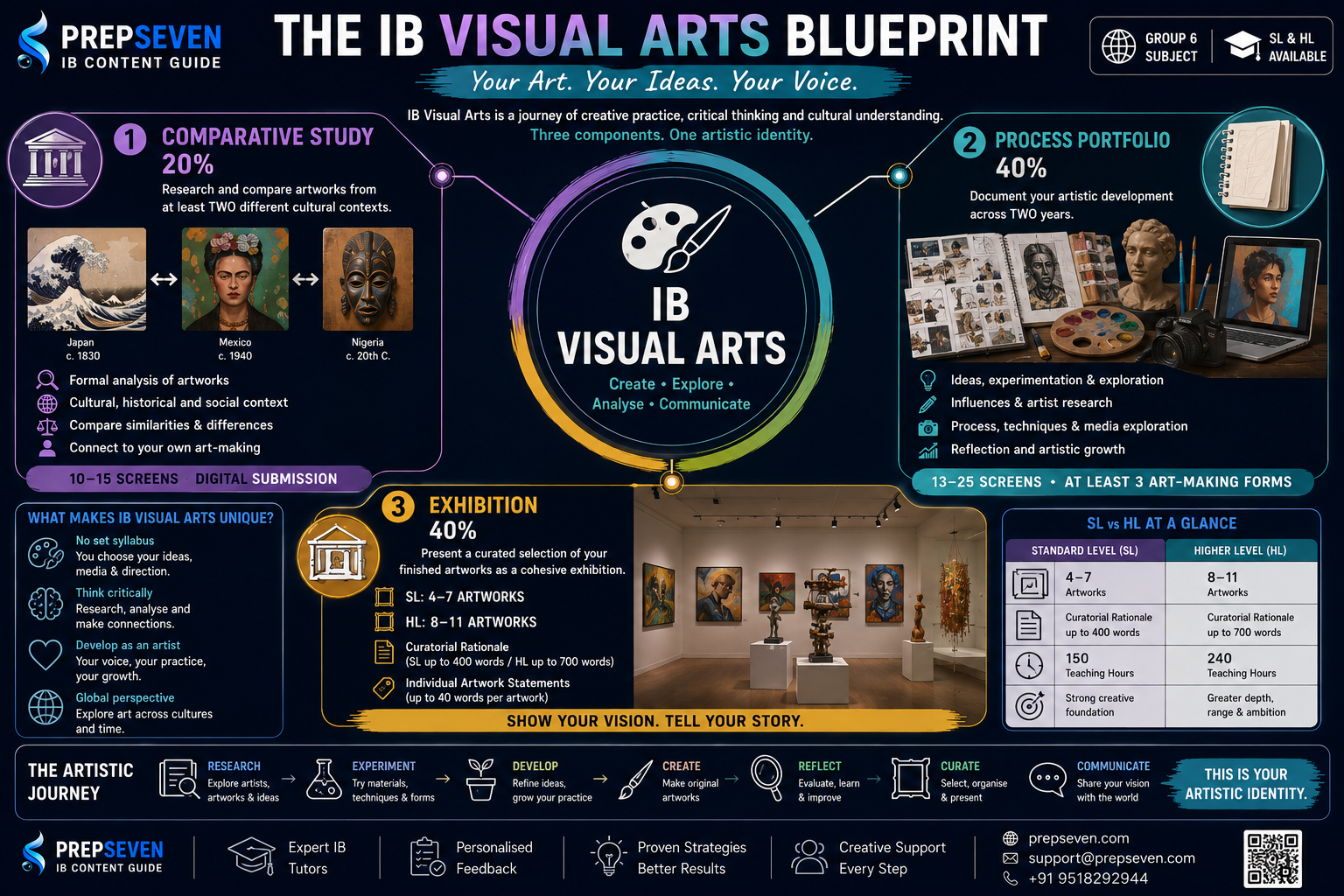
IB Visual Arts is the only Group 6 course in the IB Diploma Programme that is built almost entirely around your own creative practice. Unlike most IB subjects where the curriculum is defined by what you study, Visual Arts is defined by what you make, why you make it, and how deeply you can think about it. The course sits in Group 6 of the diploma and is available at both Standard Level and Higher Level.
The course has three assessed components, all of which are submitted as portfolios of work rather than written under exam conditions. The Comparative Study is a researched analysis of artworks from different cultural contexts. The Process Portfolio documents your artistic development across two years of studio practice. And the Exhibition is a curated selection of your finished artworks presented with written curatorial rationale. Together, these three components ask you to be simultaneously a practising artist, a critical thinker, and a cultural researcher.
What makes IB Visual Arts genuinely distinctive is that it does not prescribe what kind of art you make or which medium you work in. Painting, sculpture, photography, digital art, printmaking, ceramics, installation, video, textile art, and mixed media are all valid. The freedom is real and it is one of the most appealing aspects of the course. It is also demanding, because the absence of prescription means you carry the creative and intellectual responsibility for the direction of your own practice.
IB Visual Arts is not a free studio session. The three components are assessed against specific criteria that require both artistic quality and intellectual depth. Students who produce technically skilled artwork but engage superficially with the research and written dimensions of the course consistently underperform. Students who engage with genuine intellectual curiosity about art, artists, and cultural contexts, and who allow that curiosity to inform and deepen their own studio practice, produce work that scores at the top across all three components.
SL vs HL: What Changes and What Stays the Same
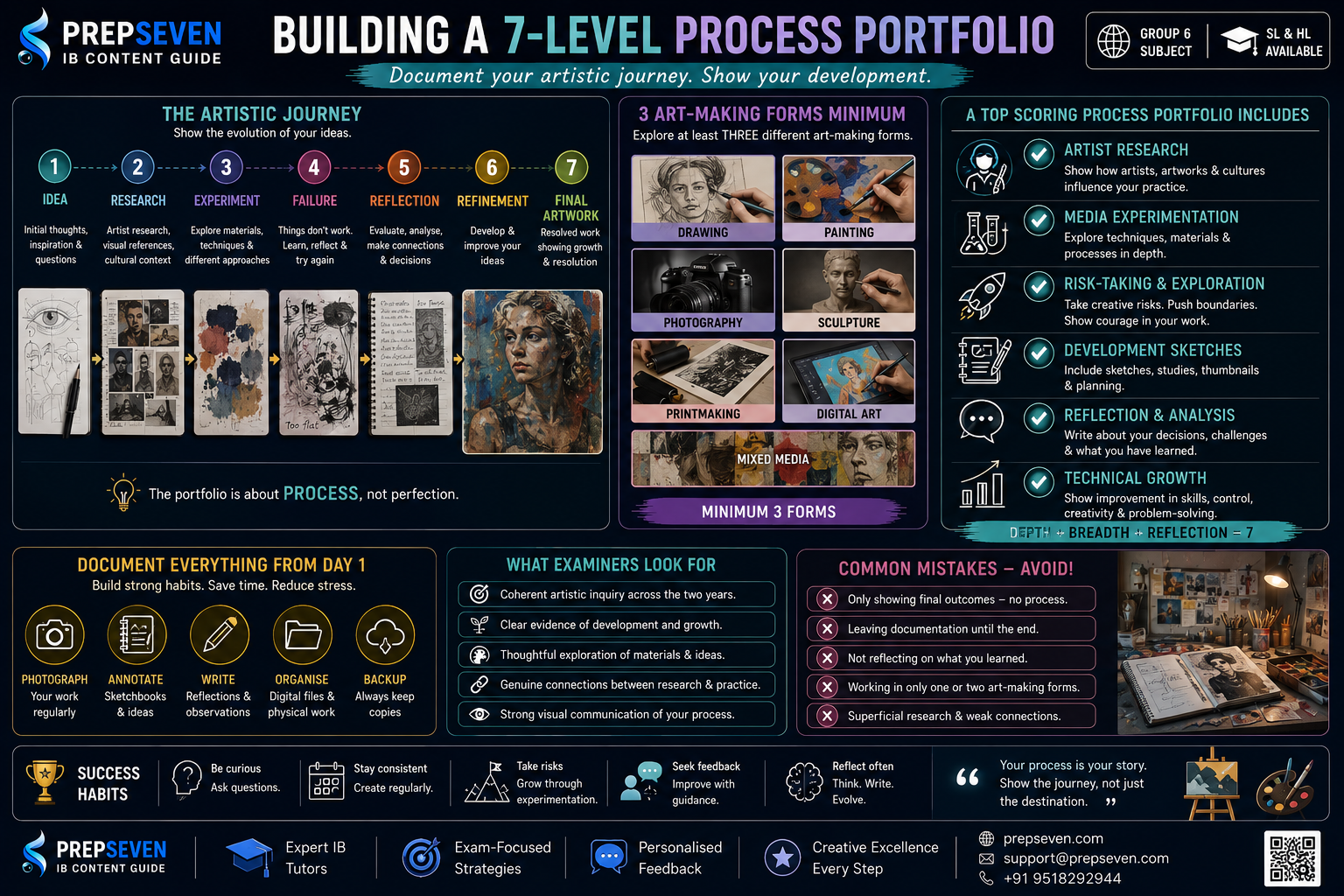
The difference between Visual Arts SL and HL is significant in terms of the scope and quantity of work required, but the underlying intellectual and artistic expectations are the same at both levels. HL students are simply expected to demonstrate greater range, depth, and ambition across all three components.
The Exhibition difference is the most practically significant: HL students exhibit eight to eleven artworks compared to SL students exhibiting four to seven. This is not just a quantity difference. More artworks means a more developed and coherent body of work is required, which means the conceptual thread running through your exhibition needs to be richer, and the range of technical and formal exploration needs to be broader. Students who choose HL should be genuinely committed to developing a substantial studio practice over two years.
If you are planning to study fine art, illustration, graphic design, architecture, film, photography, or any creative discipline at university, Visual Arts HL is a meaningful choice. Many creative programmes at university level expect or prefer a portfolio of work from applicants, and the IB Visual Arts HL exhibition and process portfolio effectively constitute that portfolio. Students who complete HL Visual Arts arrive at university art foundation or degree programmes with two years of documented, critically engaged studio practice behind them.
The Three Assessed Components: What They Are and What They Require
The Comparative Study
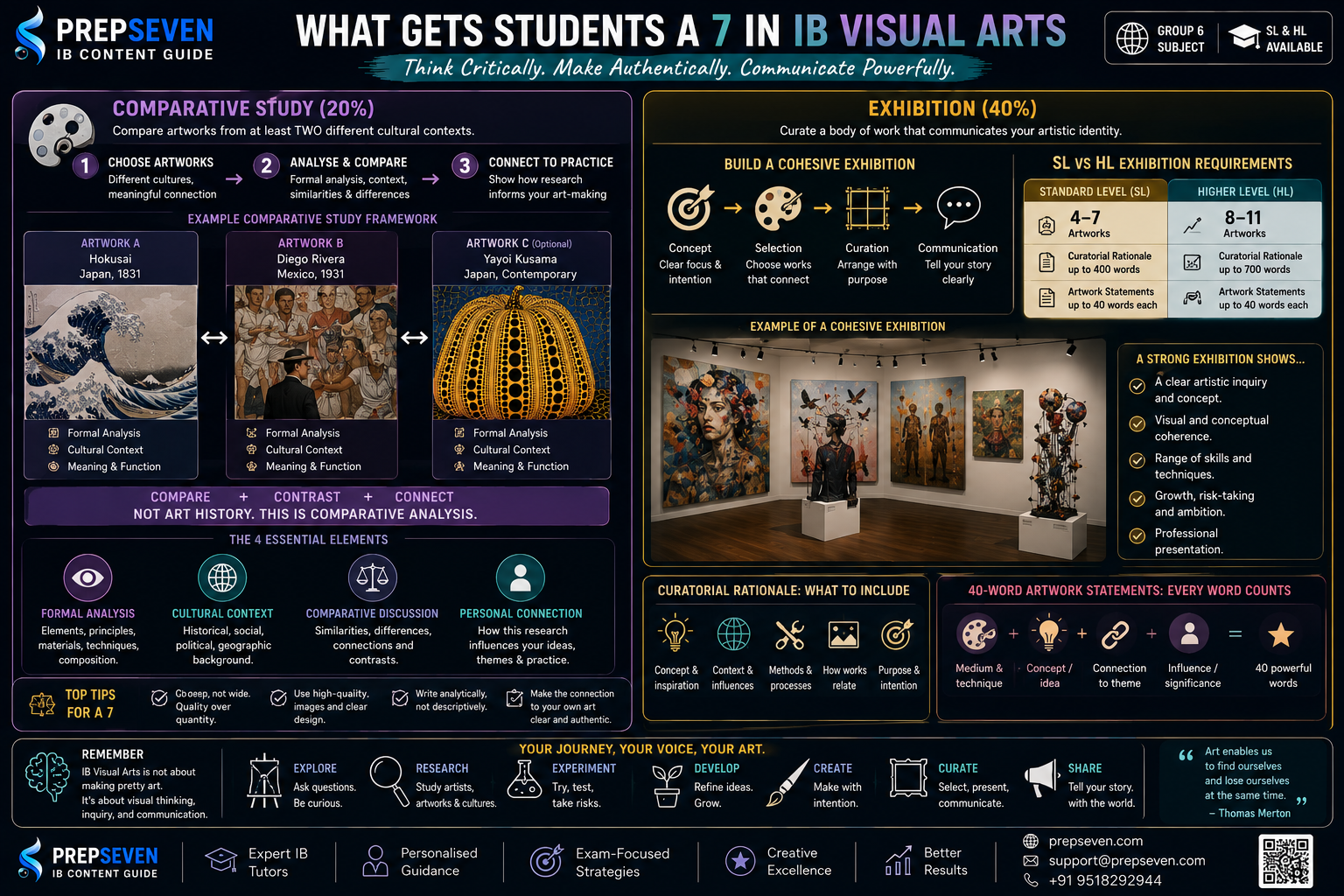
The Comparative Study is a researched visual analysis of artworks from at least two different cultural contexts. It is presented as 10 to 15 screens of images and text, submitted digitally. It counts for 20% of the final grade at SL and HL.
The word comparative is doing a lot of work in this component title. The Comparative Study is not an art history essay about two artists. It is a structured visual and contextual analysis that examines how artworks from different cultural backgrounds create meaning, reflect their contexts, and connect to or contrast with each other. The artworks you choose should be genuinely comparable in some substantive way, whether through theme, medium, formal qualities, cultural function, or historical relationship. Artworks chosen simply because they are both famous or both paintings, without a deeper comparative rationale, produce superficial studies.
The Comparative Study has a specific structure. It must include formal analysis of the artworks, analysis of the cultural and contextual significance of the artworks, a clear and sustained comparison between them, and a connection to your own art-making practice. That last requirement is one that many students include as an afterthought, a brief paragraph at the end noting that one of the artists influenced them. The most compelling Comparative Studies are those where the connection to the student’s own practice is genuinely evident throughout the analysis, where the research is actually informing what the student makes.
The Comparative Study is submitted as screens, not pages. Each screen is a visual composition of images and text that you design. The quality of the visual presentation matters: a Comparative Study where the images are poorly reproduced, the layout is cluttered, and the text is hard to read will score lower on the Communication criterion than one where the visual presentation is clear, well-organised, and itself demonstrates visual sensibility. Treat each screen as a designed object, not a document.
The Process Portfolio
The Process Portfolio is a documentation of your artistic development across the two years of the course. It is presented as 13 to 25 screens and must document work in at least three different art-making forms. It counts for 40% of the final grade at SL and HL, which makes it the single most heavily weighted component.
The Process Portfolio is not a collection of your best work. It is a record of your artistic thinking and development. It should include initial ideas and experiments, influences from artists and artworks you have researched, failed attempts and what you learned from them, technical skill development, and the evolution of ideas from early sketches to more resolved works. The key word is process, and the documentation should make that process genuinely visible.
Students sometimes make the mistake of including only successful outcomes in their Process Portfolio, presenting it as a highlight reel of finished work. This misunderstands what the component is assessing. The criteria for the Process Portfolio include Artistic Development, which specifically rewards evidence of ongoing inquiry, experimentation, and risk-taking. A portfolio that only shows successful work suggests a student who has not been genuinely experimenting. A portfolio that honestly documents the full arc of development, including the moments where an approach did not work and what that led to next, demonstrates the kind of authentic artistic practice the criterion rewards.
Documentation habits built throughout the course are the foundation of a strong Process Portfolio. Students who photograph their work regularly, annotate their sketchbooks, write brief reflective notes on experiments as they happen, and build a digital archive of their process materials from Year 1 arrive at submission with an abundance of material to select from. Students who try to reconstruct their two years of practice from memory in the weeks before the submission deadline consistently produce thinner, less convincing portfolios. Build the documentation habit from your first studio session.
The Exhibition
The Exhibition is a curated selection of your finished artworks, presented as a physical or digital exhibition. At SL you present four to seven artworks, at HL eight to eleven. The Exhibition is submitted with a curatorial rationale of up to 400 words at SL and up to 700 words at HL, and individual artwork statements of up to 40 words per artwork. It counts for 40% of the final grade at SL and HL.
The Exhibition is not simply a display of your best individual artworks. It is a curated body of work that has a coherent conceptual identity. The artworks should speak to each other, should demonstrate a developed and sustained artistic inquiry, and should collectively tell a story about your practice as an artist. This is what curation means: making deliberate decisions about what to include and how to present it so that the whole is more meaningful than the sum of its parts.
The curatorial rationale is a critical piece of writing, not a description of what the artworks look like. It should explain the conceptual focus of the exhibition, the cultural and artistic influences that have shaped your practice, the techniques and processes you have explored, and how the selected works relate to each other and to the broader themes of your inquiry. A curatorial rationale that reads as a descriptive summary of the artworks earns minimal marks on the Communication criterion. One that articulates a genuine artistic vision and explains the thinking behind the curation earns marks in the top band.
The 40-word individual artwork statements are where many students lose marks without realising it. Forty words is very short. It is not enough to describe what the artwork looks like. It should name the medium and technique, reference the conceptual concern the artwork addresses, and make a specific connection to either the curatorial theme or the artistic influence it draws on. Every word matters.
The Art-Making Forms: Understanding the Requirement
IB Visual Arts requires students to work in at least three different art-making forms across the course. The IB identifies seven broad art-making forms: drawing, painting, printmaking, sculpture, photography, film and video, and digital art. Within these broad categories, there is enormous range: drawing includes everything from pencil sketching to charcoal, ink, and gestural mark-making; sculpture includes ceramics, installation, assemblage, and three-dimensional construction; digital art includes graphic design, digital painting, and generative art.
The requirement to work across at least three forms is not a box-ticking exercise. It exists because working in different media requires different ways of thinking about material, process, and representation, and because genuine artistic development often comes from the productive friction between different approaches. A student who primarily paints but who also explores printmaking and sculpture will find that each medium informs the others in ways that enrich their practice beyond what any single medium can offer.
The most common mistake students make with the art-making forms requirement is treating each form as a separate project rather than as interconnected threads of a single inquiry. A student who makes three paintings for their painting unit, three prints for their printmaking unit, and three photographs for their photography unit has satisfied the requirement technically but has not demonstrated the kind of integrated artistic development the Process Portfolio rewards. A student whose painting practice is informed by their exploration of printmaking techniques, and whose photography documents the process of making sculpture, is showing the interconnected development that produces the highest scores.
Talk to your teacher early about which art-making forms your school has the facilities and equipment to support. Not all schools have professional darkrooms, printmaking presses, or ceramics kilns. Knowing what is available from the start allows you to plan your exploration of different forms realistically rather than discovering mid-course that the medium you wanted to explore is not accessible. Digital art and photography are almost universally available, and drawing is always accessible regardless of school resources.
Research and Artistic Influence: The Intellectual Dimension
IB Visual Arts is unusual among studio art courses because it explicitly requires students to develop their practice through research into artists, artworks, and cultural contexts. This research dimension is not separate from the studio work. It is supposed to be genuinely integrated with it: the artists you research should be influencing what you make and how you make it, and the artworks you analyse should be raising questions that your own studio practice explores.
The Comparative Study makes this research requirement most visible, but it runs through the Process Portfolio and the Exhibition as well. The Process Portfolio should include evidence of artistic influences: annotations that show you engaging with an artist’s work, experiments that were prompted by a specific artwork or technique you encountered, and reflections on how your practice is developing in relation to the art world you have been researching.
The most compelling artistic practices in IB Visual Arts are those where the student has developed a genuine relationship with a specific area of art history, art practice, or cultural context. A student who has spent two years deeply engaged with Japanese printmaking traditions, and whose own practice explores how those traditions can be reinterpreted through contemporary digital methods, will produce work that has an intellectual coherence and depth that a student who has referenced dozens of artists superficially cannot match. Depth of engagement with fewer influences almost always produces stronger work than breadth of reference with shallow engagement.
Keep a research journal throughout both years. Every time you encounter an artwork, an artist, or a cultural practice that genuinely interests you, spend ten minutes writing about why it interests you, what questions it raises, and how it might connect to what you are making. Over two years this journal becomes an invaluable resource for the Comparative Study, for the written dimensions of the Process Portfolio, and for the curatorial rationale of the Exhibition. It also documents your authentic intellectual journey as an artist, which is what the criteria are rewarding.
What Actually Gets Students to a 7
They develop a coherent artistic inquiry across both years
The students who score highest in IB Visual Arts are almost always those who have developed a genuine artistic inquiry that runs through their entire practice: a set of questions, themes, or concerns that give their work a coherent identity across different media and different stages of development. This inquiry does not need to be fixed from the start. It can evolve and deepen as the course progresses. But by the time of the Exhibition, there should be a clear sense of what the student’s artistic practice is about, and the Process Portfolio should document how that understanding developed.
They document their process as they go, not retrospectively
The Process Portfolio is the single most heavily weighted component and it is the one most commonly approached too late. Students who photograph their work, annotate their sketchbooks, and write brief reflective notes throughout both years arrive at submission with rich, authentic documentation of genuine artistic development. Students who try to reconstruct their process in the final weeks before the deadline produce documentation that looks exactly like what it is: retrospective reconstruction. The difference is visible to external moderators and it affects the Artistic Development criterion directly.
They treat the written components with the same seriousness as the studio work
The curatorial rationale, the individual artwork statements, the Comparative Study annotations, and the reflective writing throughout the Process Portfolio collectively constitute a significant portion of what is being assessed. Students who are strong studio practitioners but who write carelessly or superficially in the written dimensions consistently score below their potential. The writing in IB Visual Arts should be precise, specific, and genuinely analytical: it should explain the thinking behind the work, not describe what the work looks like.
They select artworks for the Exhibition curatorially, not sentimentally
Exhibition selection is one of the most important decisions of the entire course and it should be made curatorially rather than sentimentally. The question is not which of your artworks are your personal favourites or which took the most effort. The question is which combination of artworks most effectively communicates your artistic inquiry, demonstrates the range of your practice, and functions together as a coherent body of work. Sometimes a technically simpler artwork is the right choice because of how it connects to the other works in the exhibition. Sometimes a more ambitious piece needs to be excluded because it does not fit the curatorial logic. Making these decisions requires genuine curatorial thinking, which your teacher or tutor can help you develop.
They engage with art from genuinely diverse cultural contexts
The Comparative Study requirement to engage with at least two different cultural contexts is an invitation to broaden your artistic frame of reference beyond the Western European tradition that dominates most school art history curricula. Students who choose to compare a Picasso painting with a Klimt painting have technically satisfied the cultural context requirement but have not meaningfully broadened their artistic perspective. Students who engage seriously with art from non-Western traditions, whether that is Japanese Zen painting, West African textile art, pre-Columbian sculpture, contemporary Indigenous Australian art, or any of the extraordinarily rich traditions from outside the Western canon, produce Comparative Studies that are more intellectually interesting, more genuinely comparative, and consistently score higher.
Common Mistakes That Cost Marks
A Realistic Year-by-Year Approach
Year 1 (Grade 11): Explore, Research, and Build Habits
- Build your documentation habit from the very first studio session. Photograph every piece of work, annotate your sketchbook, and write brief reflective notes on experiments as they happen. Do not leave documentation to the end.
- Start a research journal from week one. Every time an artwork, artist, or cultural practice genuinely interests you, spend ten minutes writing about why. This journal will feed your Comparative Study, your Process Portfolio annotations, and your curatorial rationale.
- Experiment broadly in Year 1. Try different media, different scales, different approaches. The Process Portfolio rewards genuine exploration, and Year 1 is the time to discover which directions are most productive for your practice before you commit more deeply in Year 2.
- Begin thinking about your Comparative Study subject by the end of Term 1. The research component takes time to develop properly, and starting early allows you to build genuine depth of engagement with your chosen artworks and cultural contexts.
- Discuss your developing artistic inquiry with your teacher regularly. Early conversations about the conceptual direction of your practice help you develop a more coherent body of work over two years rather than a collection of disconnected experiments.
Year 2 (Grade 12): Deepen Practice and Prepare for Submission
- By the start of Year 2, you should have a clear sense of the artistic inquiry that will shape your Exhibition. Use Year 2 studio time to deepen and resolve that inquiry rather than starting in new directions.
- Complete your Comparative Study in the first term of Year 2 and submit it for teacher feedback. The research and writing take longer than students expect and leaving it to the second term creates pressure that affects quality.
- Select your Exhibition artworks by the middle of Year 2 so that you have time to create additional works if needed to fill gaps in the curatorial logic of the exhibition.
- Write and revise your curatorial rationale with your teacher before finalising the Exhibition submission. The rationale is the intellectual centrepiece of the Exhibition and it deserves multiple drafts.
- In the final preparation period, review your Process Portfolio screens for completeness and coherence. Every screen should serve a clear purpose in documenting your development. Remove anything that is redundant and fill any gaps where the documentation does not clearly show the process behind the outcomes.
How PrepSeven Helps You Score Higher in IB Visual Arts
IB Visual Arts rewards two things that benefit enormously from expert guidance: the development of a coherent artistic practice with genuine intellectual depth, and the ability to articulate that practice in the written components in ways that match what the IB criteria are actually rewarding. Our Visual Arts tutors are experienced IB teachers and examiners who have assessed student work across all three components and understand exactly what distinguishes a 6 from a 7 in this course.
- Process Portfolio review sessions where your tutor assesses your current documentation against the IB criteria and helps you identify gaps in the evidence of artistic development, technical exploration, and critical reflection.
- Comparative Study mentorship covering artwork selection, research strategy, analytical writing development, and screen design, with feedback at each stage against the criteria for the component.
- Exhibition curation sessions where your tutor helps you think through artwork selection from a curatorial perspective, develop a curatorial rationale that articulates your artistic vision clearly, and refine your individual artwork statements to make every word count.
- Written component coaching for students who are strong studio practitioners but find the analytical writing dimensions of the course more challenging, including the specific language and analytical approaches that the written criteria reward.
Book your free demo lesson at prepseven.com. Bring your sketchbook or portfolio to show where your practice currently is, and your tutor will help you see how your work maps against the IB criteria and what the clearest path to improvement looks like.