
PrepSeven | IB Content Guideauthored by Shankar Mutneja (Founder of Prepseven)
IB Theatre
The Complete Guide for IB DP Students and Parents
What Is IB Theatre?
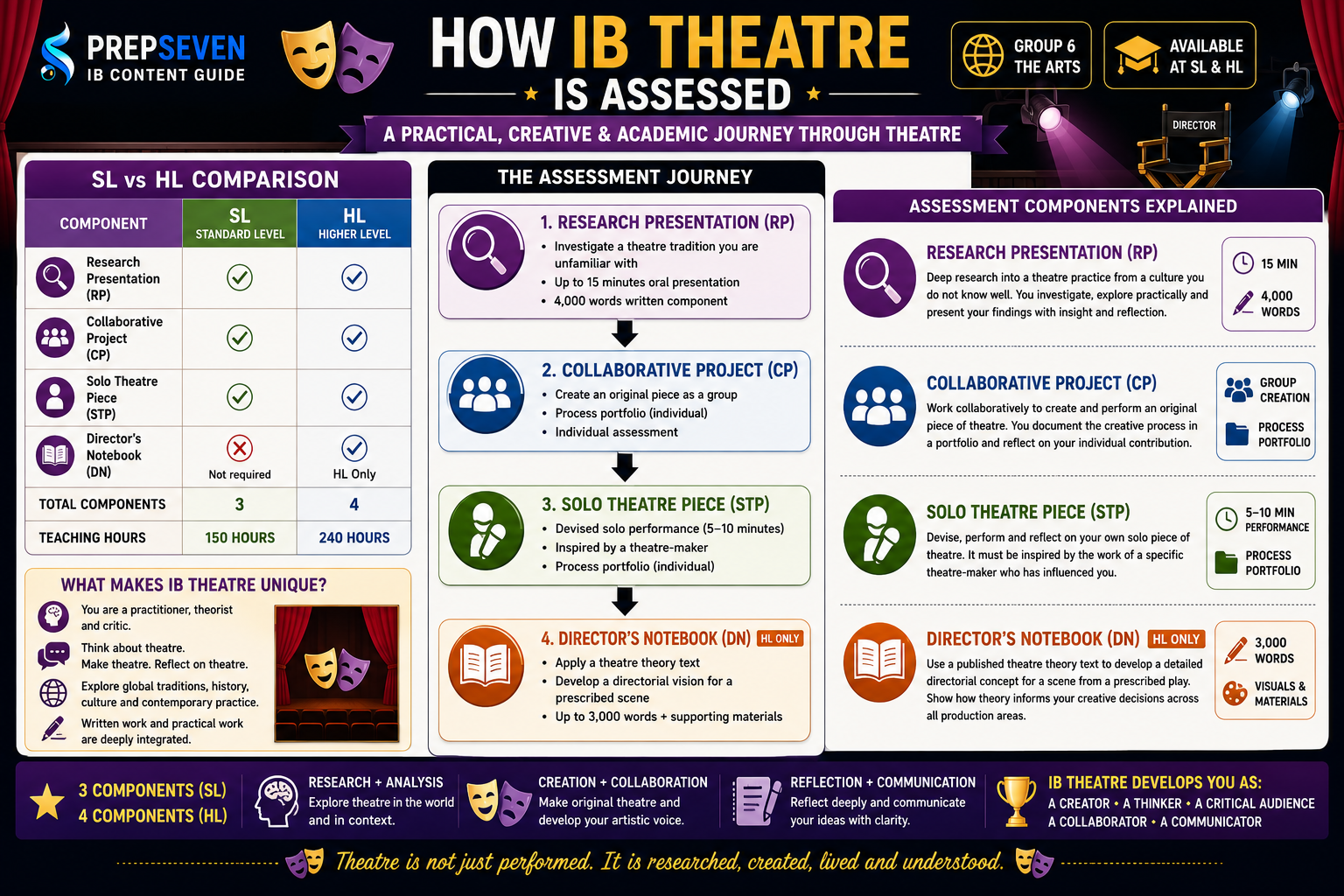
IB Theatre is the Diploma Programme’s Group 6 arts course for students who want to engage with theatre as a creative, analytical, and practical discipline. It is available at Standard Level and Higher Level and is one of the most distinctive courses in the IB because it asks students to be practitioners, theorists, and critics simultaneously. Unlike school drama programmes that focus primarily on performance, IB Theatre requires students to investigate theatre from multiple angles: as makers, as performers, as researchers, and as audience members who can articulate what a theatrical experience means and how it creates meaning.
The course is built around a core principle that theatre is a living art form rooted in culture and human experience, and that engaging with it seriously means engaging with both its present practice and its global history. Students in IB Theatre do not just perform plays. They research theatrical traditions from outside their own cultural experience, they create original work, they direct, they design, they collaborate, and they reflect on all of this in writing that is itself assessed. The written and practical components are not separate. They are deliberately integrated so that thinking about theatre and making theatre inform each other throughout the two years.
What makes IB Theatre genuinely challenging is the volume and variety of the assessment. There are four assessed components in total at HL and three at SL, and each requires a different kind of output: extended written research, a practical group creation, a solo devised performance, and at HL, a director’s notebook for a theatre theory text. Managing these across two years while maintaining quality in each requires sustained organisation and consistent engagement with the course material that occasional effort cannot replace.
Students sometimes choose IB Theatre because they enjoy performing and assume the course will be enjoyable. It usually is, but the written components are substantial and require analytical rigour that surprises students who expected primarily practical work. The Research Presentation alone requires months of genuine research into an unfamiliar theatrical tradition. Students who bring both genuine enthusiasm for theatre and willingness to engage with the written and analytical dimensions of the course are the ones who achieve strong results.
SL vs HL: What the Difference Really Involves
IB Theatre is available at SL and HL and the difference between the two levels is significant in terms of both volume and the type of additional demand HL places on students. Both levels complete the Research Presentation, the Collaborative Project, and the Solo Theatre Piece. HL students complete one additional component: the Director’s Notebook, which requires sustained engagement with a published theatre theory text and the creation of a detailed directorial vision for a scene from a prescribed play.
The Director’s Notebook at HL is a genuinely demanding component that requires students to read and apply a published theatre theory text, develop an original directorial vision for a specific scene from a prescribed play, and demonstrate how the theory informs their directorial choices across every dimension of a production: staging, space, movement, design, sound, light, and the work with performers. Students who choose HL should be genuinely interested in the intellectual and directorial dimensions of theatre, not just performance. The HL student who thrives is one who finds the challenge of translating theory into concrete directorial decisions exciting rather than burdensome.
HL Theatre requires strong time management more than anything else. Four major assessed components across two years means that each component needs to be started early and developed progressively rather than produced under deadline pressure. Students who leave any of the four components until the final months of Year 2 consistently produce weaker work than those who begin each component with genuine lead time. The Director’s Notebook in particular benefits enormously from sustained reading and rereading of the theory text over months rather than a compressed engagement with it close to the deadline.
The Three Strands: How the Course Is Structured
IB Theatre is organised around three strands that run throughout the course and that each assessed component connects to. Understanding the strands helps students see why the course asks for what it asks for and what kind of thinking is being developed at each stage.
The three strands are not separate units studied sequentially. They are simultaneous and interwoven. A student working on the Collaborative Project is engaging with Theatre in the Making. The research they bring to that collaboration, if the piece draws on a theatrical tradition from another culture, is Theatre in the World. The theoretical framework informing their directorial choices in the piece is Theatre in Context. The IB explicitly wants students to see these as dimensions of the same thing, not as separate subjects. Students who make the connections between strands produce richer work across all components.
Assessment Breakdown: Every Component Explained
Research Presentation (RP)
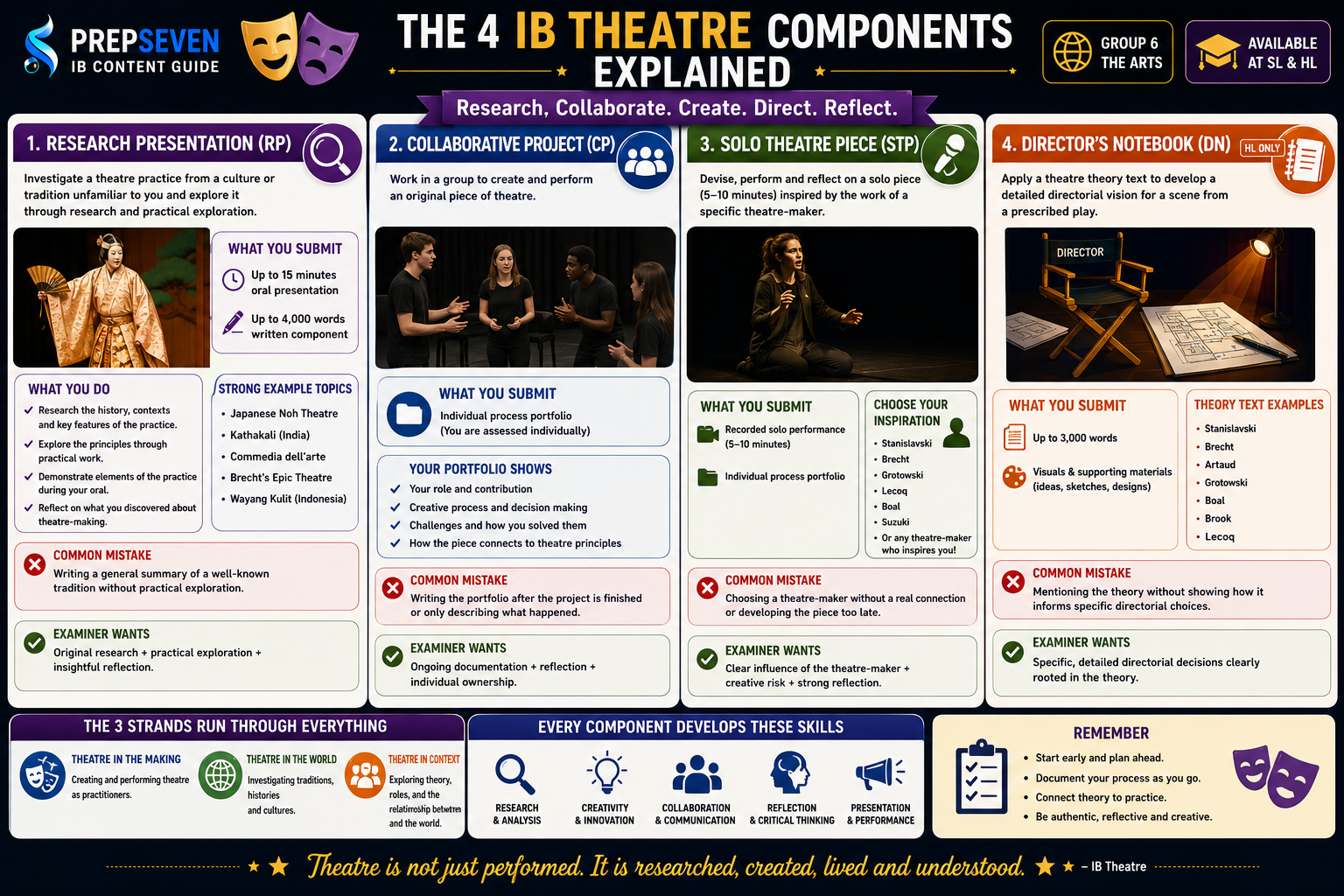
The Research Presentation is the most academically demanding component of IB Theatre and the one that most consistently surprises students who expected the course to be primarily practical. Students investigate a theatre practice from a culture or tradition unfamiliar to them. The research must be genuinely investigative: students are not reviewing what is already known about a tradition but exploring it through primary and secondary sources, connecting it to the IB’s theatre-making principles, and culminating in a practical exploration of the practice that they can demonstrate.
The RP has two parts: a written component of up to 4,000 words and an oral presentation of up to 15 minutes. The written component documents the research process, the theatrical practice investigated, and the student’s own reflection on what the practice revealed about theatre-making. The oral presentation demonstrates the practice practically and explains how the research connects to the student’s understanding of theatre. Both parts are submitted together and assessed holistically.
The choice of theatrical practice is the most consequential decision in the RP. Students need to choose a tradition that is genuinely unfamiliar to them, that has sufficient depth and complexity to sustain months of research, and that connects to meaningful questions about how theatre creates meaning. Practices that have been investigated so many times that generic information is easy to find, and that students engage with superficially, produce weak RPs. Practices that are less commonly researched, that students approach with genuine curiosity, and that reveal something unexpected about theatrical form, produce strong ones.
The most common RP failure mode is choosing a well-known practice and producing a research essay rather than a genuine investigation that culminates in practical demonstration. An RP about Greek tragedy that summarises what everyone already knows about the chorus and the unities, without practically exploring what it means to embody those conventions, earns low marks regardless of how well-written the text is. The practical demonstration component is not an afterthought. It is the proof that the research has genuinely informed the student’s understanding of how theatre is made.
Collaborative Project (CP)
The Collaborative Project is the course’s group assessment component. Students work in groups to create and present an original piece of theatre, and each student submits an individual process portfolio documenting their contribution to and experience of the collaborative process. The assessment is individual even though the project is collective: what is marked is each student’s process portfolio, not the group’s performance.
The CP asks students to make theatre from a starting point that connects to a theatrical convention, a social issue, a theme, or a text, and to document the making process honestly and reflectively. This means the process portfolio needs to capture the genuine messiness and development of a creative process, not a sanitised version of it. Portfolios that document setbacks, disagreements, shifts in direction, and the solutions found to creative problems are more convincing evidence of genuine engagement than those that present a smoothly linear progression from idea to performance.
The role each student takes in the CP is important and needs to be documented clearly. A student who directs needs to document their directorial decisions and how they shaped the work. A student who designs the lighting needs to document their design choices and the reasoning behind them. A student who performs needs to document their character development and rehearsal process. The IB expects each student to demonstrate meaningful artistic ownership of their specific contribution, not just a description of what the group did collectively.
The most significant CP mistake is producing a process portfolio retrospectively, assembled from memory after the project is finished rather than documented throughout the process. The portfolio is supposed to be a genuine record of how the work developed over time. A portfolio written at the end looks like what it is: a reconstruction rather than a record. Start documenting from the first session. Take photographs, write short reflections after each rehearsal, save drafts of scripts and design sketches, and record the decisions that shaped the work as they happen. This documentation is both better evidence of process and significantly easier to produce.
Solo Theatre Piece (STP)
The Solo Theatre Piece is perhaps the most creative and personal component of IB Theatre. Each student devises, performs, and reflects on a solo piece of theatre of five to ten minutes that must be developed from a theatre-maker who has influenced or inspired them in some way. The choice of theatre-maker is the student’s own and can be a director, a performer, a designer, a theorist, or anyone whose practice with theatre offers a source of inspiration for original solo work.
The STP requires two things: a solo performance and a process portfolio that documents how the student developed the piece from their engagement with the theatre-maker’s work through to the final performance. The performance itself is filmed and submitted along with the portfolio. The assessment is holistic across both the performance and the portfolio, and both need to be strong. A technically accomplished performance with a thin portfolio, or a rich portfolio paired with a weak performance, will not achieve the highest marks.
The choice of theatre-maker is consequential. A student who chooses a theatre-maker whose work genuinely excites them, whose practice offers specific and concrete techniques to explore, and whose influence can be traced visibly in the devised piece, will produce a more convincing STP than one who chooses a famous name without genuine personal connection to the work. The portfolio needs to document how the theatre-maker’s specific practices shaped the devised piece, not just that the student finds them interesting.
The STP is the component where students most often underestimate the time required for genuine development. A five to ten minute solo piece that emerges from serious engagement with a theatre-maker’s practice requires significantly more rehearsal and development time than students expect. Begin developing the STP concept at least six months before the performance deadline. Allow time to explore approaches that do not work, discard them, and develop what does work. Portfolios documenting this genuine exploratory process, including the directions abandoned, are far more compelling than those documenting a piece that was conceived fully formed and performed after a few weeks of rehearsal.
Director’s Notebook (HL Only)
The Director’s Notebook is the component that distinguishes HL from SL in IB Theatre and is the one that most clearly requires the integration of theoretical knowledge with practical vision. HL students study one published theatre theory text from the IB’s prescribed list and use it as the foundation for developing a directorial vision for a scene from one play on a separate prescribed play list. The Notebook is up to 3,000 words plus visual, design, and supporting materials.
The theatre theory texts on the IB prescribed list include works by major theatrical practitioners and theorists including Stanislavski, Brecht, Artaud, Grotowski, Brook, Boal, Lecoq, and others. Each text presents a systematic vision of what theatre is, what it should do, and how it should be made. The Director’s Notebook requires the student to demonstrate genuine understanding of the text’s ideas and to show how those ideas translate into specific, concrete directorial decisions for the prescribed scene.
The most common failure in the Director’s Notebook is surface-level application of the theory: a student who has read Brecht and produces a notebook that says the production will use alienation effects and then describes conventional staging without demonstrating how alienation effects would actually be achieved in specific moments of the scene. Strong Director’s Notebooks show how the theoretical principles manifest in precise, specific choices: how a character’s entrance would be staged, what the lighting state in a particular moment would achieve, how the set design embodies the text’s ideas about the relationship between performer and audience, and why each of these choices follows from the theory rather than from conventional theatrical instinct.
Process Portfolios: What Makes the Difference
Process portfolios appear in both the Collaborative Project and the Solo Theatre Piece, and they are the written record through which examiners assess the depth of a student’s creative engagement. The quality of a process portfolio is the single biggest differentiator between mid-band and top-band marks in both components, and it is entirely within a student’s control because the portfolio is produced throughout the creative process rather than under exam conditions.
A strong process portfolio does several things that weak ones do not. It documents development rather than just outcome. It shows the decisions made and why, including decisions that were later reversed. It connects the practical work to theatrical principles and, where relevant, to the theories and practitioners studied in the course. It reflects honestly on challenges and how they were addressed rather than presenting only what worked. And it demonstrates that the student is thinking about theatre as an art form with history, theory, and cultural context, not just as a thing they are doing in a room.
The most consistent process portfolio mistake is waiting too long to start documenting. Students who document as they go produce richer and more authentic records than those who reconstruct the process from memory at the end. The other consistent mistake is describing rather than reflecting. A portfolio entry that says today we rehearsed the opening scene and tried different staging options is a description. A portfolio entry that says we explored three different configurations for the opening, and the traverse staging revealed a tension between the characters that end-on staging had obscured, which connects to the Boal principle of spatial dynamics as political expression, is a reflection. The difference between these two entries is the difference between mid-band and top-band marks.
Structure your process portfolio entries around three questions: What did we do or decide? Why did we make that choice? What does it reveal about the work or about theatre-making more broadly? Even a short entry structured around these three questions demonstrates the kind of reflective thinking that the portfolio is designed to capture. Entries that only answer the first question are descriptions, not reflections, and the IB assessment criteria reward reflection, not description.
What the Research Presentation Actually Demands
The Research Presentation is the component where students most often underestimate what genuine research into an unfamiliar theatrical tradition involves and overestimate what a general overview of a well-known practice will achieve. The IB is specific about what research in this context means: it is an active investigation that moves beyond secondary sources and that culminates in a practical understanding of how the tradition creates meaning in performance.
Most students begin with secondary sources, which is reasonable and necessary. Books, academic articles, documentaries, and online resources about the theatrical tradition establish the factual and historical foundation. But the RP is distinguished from a standard research essay by its practical dimension. The student needs to actually explore the practice, to try applying its conventions, to understand from the inside what it feels like to perform in the tradition and what performance choices the tradition makes available and forecloses. This practical exploration is documented in the RP and demonstrated in the oral presentation.
The oral presentation element of the RP is not a lecture about the tradition. It is a demonstration with explanation. The student shows something from the practice, explains the choices being made and the principles they embody, and connects those principles to the broader understanding of how theatre creates meaning. A student presenting on Kathakali does not talk about Kathakali for fifteen minutes. They demonstrate specific mudras and facial expressions from the tradition, explain what they communicate and how, connect them to the broader aesthetic principles of Kathakali, and reflect on what exploring the practice has revealed about the relationship between physical vocabulary and theatrical meaning.
Begin your Research Presentation research in the first term of Year 1 if possible. The traditions that produce the strongest RPs are those that have been lived with for months, explored practically in small ways throughout the course, and returned to repeatedly as understanding deepens. A student who has been thinking about Noh theatre for six months before writing the RP has a fundamentally different relationship to the material than one who begins research three months before the deadline. The depth of that relationship shows in the writing and in the oral demonstration.
What Actually Gets Students to a 7
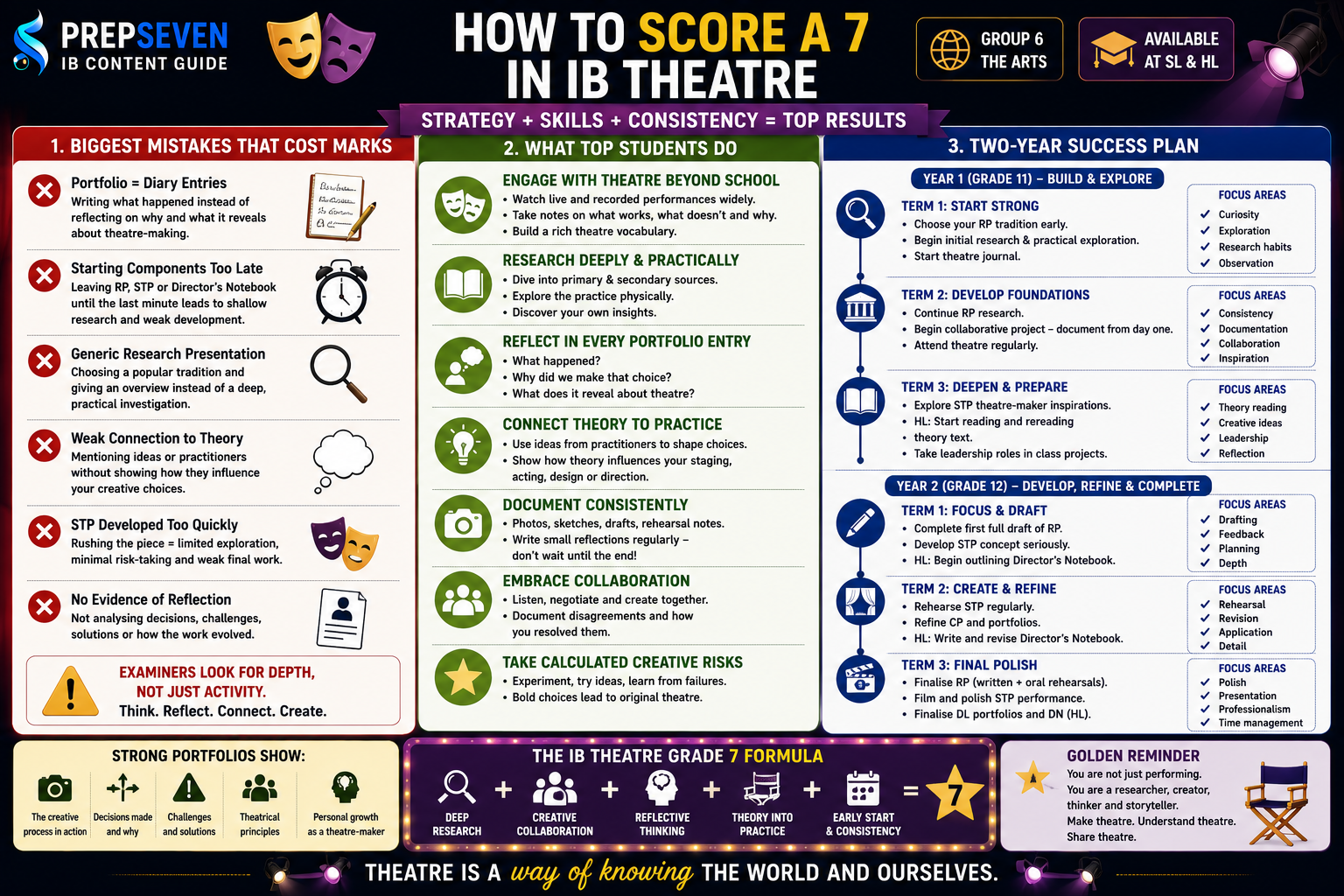
They start each component early and develop it progressively
Every top-band IB Theatre student has one thing in common: they did not leave any component until the deadline was imminent. The Research Presentation needs months of genuine research. The Collaborative Project benefits from starting the creative process long before the performance date. The Solo Theatre Piece requires extended development time to move through exploratory work to a piece that is genuinely performance-ready. The Director’s Notebook at HL needs sustained reading of the theory text over time. Students who compress any of these into the final weeks consistently produce work that is shallower than their ability would allow.
They write process portfolios that reflect rather than describe
In both the CP and the STP, the process portfolio is where marks are predominantly earned or lost. Students who write entries that document not just what happened but why choices were made, what those choices reveal about theatre-making, and how the work connects to the theatrical principles and practitioners studied in the course, produce portfolios that demonstrate exactly the kind of thinking the IB is assessing. Students who write summaries of rehearsal activities produce adequate but not excellent portfolios regardless of how strong their practical work is.
They connect theory to practice throughout
The students who perform best in IB Theatre are those who genuinely see theory and practice as informing each other rather than as parallel activities. When they make a staging choice in the CP, they can articulate why it serves the work in terms drawn from the theatrical principles they have studied. When they develop a character approach in the STP, they can connect it to specific techniques from their chosen theatre-maker. When they write the Director’s Notebook, the theory text is not an external requirement but a genuine lens through which they see the scene. This integration of thinking and making is what IB Theatre is designed to develop, and it is visible in the work of students who have genuinely engaged with the course.
They see theatre widely outside of school
Students who attend theatre regularly across both years bring something to the course that cannot be simulated in the classroom: the experience of sitting in an audience and being affected by theatrical choices. They know what it feels like when a lighting state produces an emotional response. They have seen how different actors approach the same scene differently and what that reveals about character. They understand from experience how staging geometry affects the audience’s relationship to the action. This experiential knowledge, accumulated through regular theatre attendance, informs the quality of their written and practical work in ways that are genuinely hard to replicate without it.
They treat the RP as genuine research, not a report
The Research Presentations that earn the highest marks are those where the student has discovered something through the research process that they did not expect when they began. They have been genuinely changed by the investigation. Their practical exploration of the tradition has revealed something about theatre-making that surprised them and that they can articulate with specificity. This kind of genuine discovery comes from approaching the RP with intellectual curiosity rather than as a task to be completed, and it produces writing and demonstration that is qualitatively different from a well-organised summary of existing knowledge.
Common Mistakes That Cost Marks
A Realistic Year-by-Year Approach
Year 1 (Grade 11): Research, Explore, and Begin
- Begin your Research Presentation investigation in Term 1. Choose your theatrical tradition early, begin reading and watching primary and secondary sources, and start making small practical explorations of the tradition in your own time. The depth of an RP is directly proportional to how long it has been lived with. Six months of genuine engagement produces fundamentally different work than three months.
- Attend theatre whenever possible from the beginning of Year 1. See live performances if available in your city. Watch filmed theatre productions online: the National Theatre Live archive, Globe on Screen productions, and documentary films about theatre companies and practitioners are all accessible. Build the habit of watching theatre analytically, asking what choices were made, why, and what effect they produced.
- For HL students, begin reading your chosen theory text in Term 1 or Term 2 of Year 1. The Director’s Notebook benefits from a long and deepening relationship with the theory. Students who have read their text multiple times across two years have a fundamentally different understanding of it than those who read it once close to the deadline.
- Keep a theatre journal throughout Year 1. Record responses to performances seen, ideas sparked by research, connections between the traditions studied in class and your own creative impulses. This journal is not formally assessed but it feeds every assessed component by building the habit of reflective thinking about theatre that the portfolios require.
- In the Collaborative Project, document from the very first session. Do not wait until the work is developed before beginning to write about it. The early stages of a creative process, the confusion, the false starts, the moments of unexpected discovery, are valuable portfolio material that cannot be reconstructed after the fact.
Year 2 (Grade 12): Develop, Complete, and Refine
- Complete a full draft of the Research Presentation written component in Term 1 of Year 2 and get teacher feedback before revising. The RP is submitted in Year 2 and students who begin drafting early have time to revise significantly. The oral presentation should be rehearsed multiple times before the actual assessment, with feedback from your teacher on both the quality of the demonstration and the clarity of the explanation.
- Begin developing your Solo Theatre Piece concept seriously in Year 2 Term 1 at the latest. Book regular sessions with your teacher for feedback on the development process. The STP requires genuine iterative development, not a single period of intense rehearsal. A piece that has been shaped by feedback across several months is significantly stronger than one produced in a concentrated final push.
- For HL students, complete a first draft of the Director’s Notebook in Term 2 and revise it based on teacher feedback before the final submission. The Notebook needs to demonstrate both theoretical understanding and practical vision. Feedback on whether the theoretical application is specific enough, and whether the directorial choices are concrete and theatrically imaginable, is essential before finalising the work.
- In the final term before submissions, focus on the quality of your process portfolio entries for both the CP and STP. Read back through what you have written and identify where entries are purely descriptive and need to be expanded with reflection. The portfolio entries written closest to the deadline are often the most reflective because the student has developed analytical language through the course. Use that developed analytical capacity to revisit and deepen earlier entries where needed.
- Do not neglect the filming of the Solo Theatre Piece. The performance is submitted on film, and the quality of the filming matters. Arrange good lighting, stable camera placement, and a clean audio environment. A technically accomplished performance filmed badly loses marks that careful filming preparation would have secured. Test the filming setup before the actual performance recording.
How PrepSeven Helps You Score Higher in IB Theatre
IB Theatre is one of the most intellectually and creatively demanding courses in the Diploma Programme, and it is also one of the most rewarding for students who engage with it fully. The challenge is that the breadth of what is required, from research to performance to directorial vision to process documentation, means that students without experienced guidance often invest effort in the wrong places or miss what the assessment criteria are specifically rewarding. Our IB Theatre tutors are certified IB examiners and experienced theatre educators who know exactly what distinguishes a 5 from a 7 in every component.
- Research Presentation sessions where your tutor evaluates the depth and specificity of your research, assesses the quality of your practical exploration of the tradition, and gives you precise feedback on whether your written component and oral presentation demonstrate the level of investigative engagement that the top band requires.
- Process portfolio review sessions for the Collaborative Project and Solo Theatre Piece where your tutor assesses each entry against the IB criteria and shows you specifically where reflection is insufficient, where theoretical connections are missing, and what additions would move individual entries from description to genuine analysis.
- Solo Theatre Piece development sessions where your tutor works with you on the connection between your chosen theatre-maker’s practice and your devised piece, helps you articulate the specific influences and translate them into concrete performance choices, and gives you feedback on the piece itself as it develops.
- Director’s Notebook sessions for HL students where your tutor works through the theory text with you, checks the depth of your theoretical understanding, and assesses whether your directorial vision for the prescribed scene demonstrates specific and convincing translation of the theory into practice.
- Mock oral presentation rehearsals for the Research Presentation where your tutor evaluates both the quality of the practical demonstration and the clarity and depth of your explanation, and identifies the specific adjustments that will move your oral from adequate to compelling.
Book your free demo lesson at prepseven.com. Bring a process portfolio entry from the CP or STP, a section of your RP draft, or describe your current Director’s Notebook approach if you are an HL student. Your tutor will show you precisely where the assessment criteria are being met and where they are not, and what the work looks like that earns marks in the top band for each component.