
PrepSeven | IB Content Guide authored by Shankar Mutneja (Founder of Prepseven)
IB Music
The Complete Guide for IB DP Students and Parents
What Is IB Music?
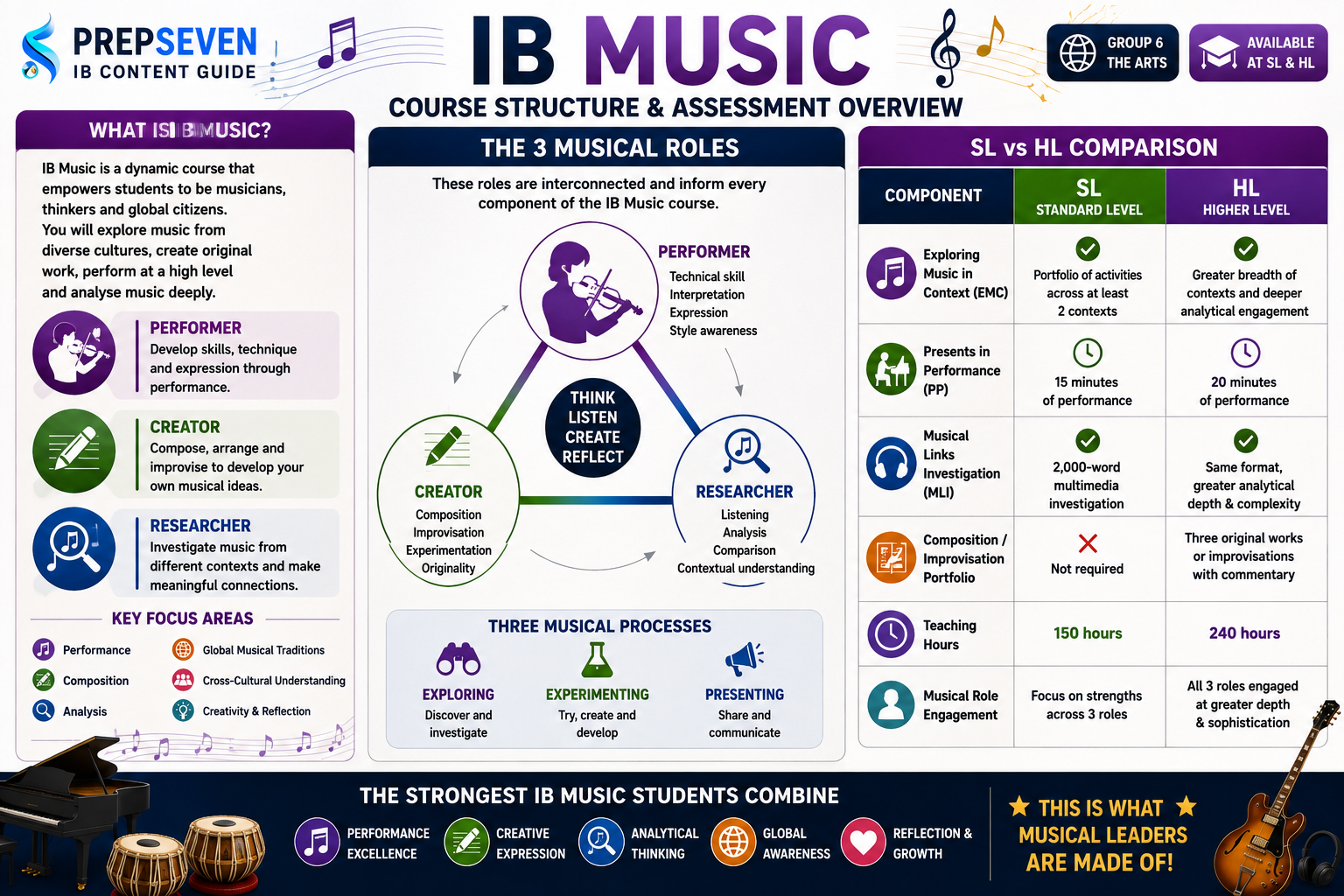
IB Music is the Diploma Programme’s Group 6 arts course for students who want to engage seriously with music as a creative, analytical, and performative discipline. It is available at Standard Level and Higher Level and, like IB Theatre, asks students to operate simultaneously as practitioners and thinkers. The course does not separate musical making from musical understanding. Playing, composing, listening, and analysing are treated as dimensions of the same activity, and the assessment reflects that integration throughout.
The current IB Music course, first assessed in 2020, is built around three musical processes: exploring, experimenting, and presenting. Students explore music from a range of cultural and historical contexts, they experiment with musical materials and ideas in their own creative and performative work, and they present their musical thinking in performances, compositions, and written analyses. The course is explicitly designed to develop musicians who can think across traditions and genres rather than musicians who are expert only in the Western classical canon.
What makes IB Music distinctive among school music courses is its global scope. Students are required to engage with music from outside their own musical background and to make genuine connections between different musical traditions. A student who grew up playing Western classical piano and who takes IB Music will encounter and engage analytically with Indian classical music, Brazilian popular music, Japanese Gagaku, or West African drumming traditions alongside the repertoire they are more familiar with. This breadth is not just an enrichment add-on. It is central to what the IB believes music education should do, and it is built into the assessment at every level.
Students sometimes choose IB Music because they play an instrument well and assume the course will reward performance ability above everything else. Performance matters, but it is one component among several, and the students who achieve the highest results are those who bring genuine intellectual curiosity about how music works across cultures and traditions as well as strong practical musicianship. A technically accomplished performer who engages shallowly with the analytical and creative components of the course will not reach the top grade band.
SL vs HL: What the Difference Really Involves
IB Music is available at SL and HL, and the differences between the two levels are significant in terms of both volume and depth. Both levels complete a Exploring Music in Context assessment, a Presents in Performance assessment, and the Musical Links Investigation. HL students complete an additional component: the Hlisting task component called Higher Level component adds the HL Composition/Improvisation portfolio. Additionally HL requires greater depth, breadth, and analytical complexity across all shared components.
The choice between SL and HL should be driven by honest assessment of your musical strengths and what you want to develop across two years. Students who are strong performers but have limited compositional experience should consider whether HL’s composition requirement is something they want to invest in developing. Students who are strong theorists and analysts but whose performance is less developed need to be realistic about whether a 20-minute performance requirement is achievable at the standard they want to reach. The most successful HL students are those who bring genuine strength and interest across all three musical roles.
IB Music HL is a genuinely challenging course for students who are strong in one musical area but underdeveloped in others. A student who is an accomplished performer but has never composed will find the HL composition portfolio demanding. A student who composes prolifically but has not developed analytical skills will find the Musical Links Investigation harder than expected. Assess your strengths honestly before choosing HL, and if you choose it, identify your weaker areas in Year 1 and invest in developing them before those assessments arrive.
The Three Musical Roles: How the Course Is Structured
IB Music is organised around three musical roles that students are expected to develop throughout the course. These roles are not sequential units. They run simultaneously and inform each other, and every assessed component draws on more than one of them.
The three roles are not equally weighted in every student’s experience. A student who primarily identifies as a performer will naturally find that the performer role dominates their engagement. But the IB is explicit that all three roles need to be developed across the course, and the assessment is designed to ensure that students who are strong in only one or two roles cannot compensate fully across all components. The most significant implication of this is that students who have never seriously composed or who have never engaged analytically with non-Western musical traditions cannot rely on their strongest role to carry all their marks. They need to develop genuine competence in the roles where they are weaker.
Assessment Breakdown: Every Component Explained
Exploring Music in Context (EMC)
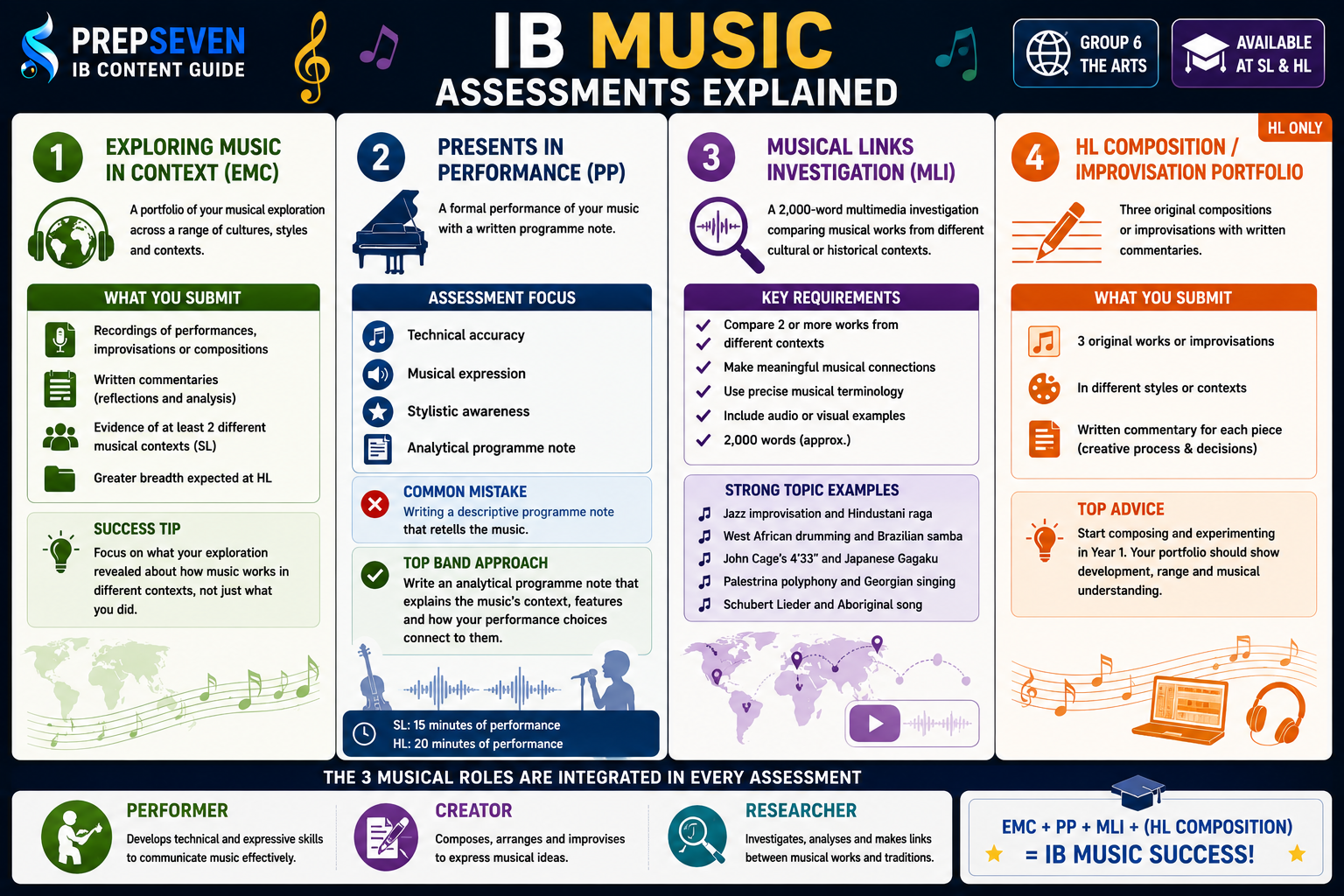
The Exploring Music in Context component is the course’s portfolio assessment and is submitted as a collection of recorded and written evidence documenting the student’s musical exploration across a range of contexts throughout the two years. The EMC is not a single task. It is an ongoing record of the musical investigation, experimentation, and reflection that the course requires, assembled into a coherent portfolio for submission.
The EMC requires students to engage with music from at least two of the IB’s prescribed musical contexts: popular and traditional music in the local or global context, art music in the Western tradition, and music in a traditional or indigenous context outside the Western art music tradition. Students at SL are required to engage with at least two contexts; HL students with greater breadth. The portfolio must include recorded evidence of musical activities, such as performances, improvisations, or compositional experiments, alongside written commentary that reflects on what the exploration revealed.
The written commentary in the EMC is not a report on what was done. It is a reflection on what the musical exploration revealed about how music creates meaning in different contexts. A commentary that says I played a piece in the Indian classical style and it was interesting is a description. A commentary that examines what specific features of the raga system constrain and enable melodic expression, how those constraints differ from the harmonic constraints of Western tonal music, and what that difference reveals about how each tradition relates improvisation to structure, is the kind of analytical reflection the EMC rewards.
The EMC is the component that most benefits from being built throughout the two years rather than assembled at the end. Students who genuinely explore diverse musical traditions across the course, who keep records of their experiments and reflections as they go, and who allow one exploration to inform the next, produce portfolios that have an organic coherence that assembled-at-the-end portfolios cannot replicate. Treat the EMC as a living document rather than a submission deadline.
Presents in Performance (PP)
The Presents in Performance component is the course’s formal performance assessment. SL students present 15 minutes of performed music; HL students present 20 minutes. The performance can be a recital of pre-existing repertoire, an improvisation, or a combination, and it can be solo or include ensemble elements, though solo performance ability must be clearly demonstrated. The performance is recorded and submitted alongside a written programme note that contextualises the repertoire and explains the performance choices made.
The PP is assessed on musical and technical skills in performance, which includes technical accuracy, musical expression, and stylistic understanding; and on the written programme note, which is assessed for analytical quality and contextual depth. A student who performs brilliantly but writes a thin programme note, or who writes a richly analytical note but delivers a technically inconsistent performance, will not reach the top band. Both dimensions need to be strong.
The programme note is where many students lose marks they could easily have secured with more careful preparation. A programme note is not a description of the pieces performed. It is an analytical and contextual account that explains what the music is, where it comes from, what its significant musical features are, and how the performer’s specific interpretative choices relate to those features and to the musical tradition the piece belongs to. A strong programme note for a Bach Partita would discuss the dance forms involved, the harmonic language Bach uses, the ornamentation conventions of the Baroque period, and the specific interpretative decisions the performer has made in relation to these features. A weak programme note summarises the piece and describes it as beautiful or technically demanding.
The recording of the Presents in Performance is not an afterthought. Examiners assess what they can hear and see on the recording, and a technically accomplished performance recorded badly is assessed on what the recording conveys, not on what the performance actually was. Plan the recording setup well in advance of the actual recording session. Test microphone placement for your specific instrument or voice type. Ensure the room acoustics do not introduce reverb or noise that obscures musical detail. A single dedicated recording session with proper setup is worth far more than a quickly-arranged recording made under time pressure.
Musical Links Investigation (MLI)
The Musical Links Investigation is the course’s extended analytical component and is the assessment that most directly tests the researcher role. Students produce a multimedia presentation of approximately 2,000 words that investigates musical links between two or more musical works from different cultural or historical contexts. The MLI is submitted digitally and must include audio or visual examples that support the analysis.
The MLI is assessed on the quality of the musical analysis, the depth of the connections made between the works investigated, the accuracy and specificity of musical terminology used, and the effectiveness of the multimedia presentation in supporting and illustrating the argument. This is fundamentally an analytical exercise that requires genuine musical knowledge: students who try to make connections at a surface level, noting that two pieces from different traditions both use rhythm, without engaging with how each tradition thinks about rhythm and what those different approaches reveal, will not achieve top marks.
The choice of works to investigate is one of the most consequential decisions in the MLI. The connections between the chosen works need to be genuinely productive: they need to be specific enough that the analysis can go deep rather than staying at generalities, and they need to span genuinely different musical contexts so that the investigation illuminates something about music across traditions. Connections that are too obvious, such as comparing two Western classical symphonies on the grounds that they both develop themes, do not generate the analytical depth the MLI requires. Connections that are too superficial, such as comparing pieces that happen to be in similar tempos, do not generate meaningful musical insight.
HL Composition/Improvisation Portfolio (HL Only)
The HL Composition/Improvisation portfolio requires HL students to submit three original works or improvisations, each accompanied by a written commentary explaining the compositional or improvisational process and decisions made. The works must demonstrate engagement with different musical contexts or styles, and together they should show development and range across the two years.
The portfolio is assessed on the compositional or improvisational craft demonstrated in the works themselves, the depth and accuracy of the written commentary, and the range of musical contexts engaged with across the three pieces. A portfolio of three works that are all in the same Western classical idiom, however well-crafted, demonstrates less range than one that moves between musical traditions or compositional approaches. The commentary is not a description of the piece but an analytical account of the compositional decisions made and why, connecting those decisions to the musical traditions and techniques that informed them.
Students who have not composed formally before taking IB Music often find the HL portfolio the most daunting component of the course, and it is worth being honest about this when choosing between SL and HL. Composition is a skill that develops over time with practice and feedback, and students who begin developing compositional work from the beginning of Year 1, however simple the initial pieces are, arrive at the portfolio submission with significantly more craft and confidence than those who approach composition for the first time in Year 2.
The written commentary for each HL composition portfolio piece is as important as the piece itself. An interesting, well-crafted piece with a thin commentary that simply describes what happens in the music will not achieve top marks. A commentary that engages analytically with the specific compositional decisions made, explains how the piece engages with or departs from the conventions of its musical tradition, and reflects on what the compositional process revealed about music-making, demonstrates exactly the integrated musical thinking that HL is designed to develop. Write the commentary in depth.
Musical Contexts: Engaging Beyond Your Background
One of the most distinctive requirements of IB Music, and one that genuinely sets it apart from most school music programmes, is the expectation that students engage seriously with musical traditions outside their own background. This is not optional enrichment. It is built into the EMC requirement, the MLI requirement, and for HL students into the composition portfolio requirement of demonstrating range across contexts. Students who resist engaging with unfamiliar musical traditions and try to complete the course within their own comfortable repertoire will not achieve the marks that genuine cross-cultural engagement produces.
The practical challenge of engaging with unfamiliar musical traditions is that it requires different things from different students. A student trained in Western classical music needs to develop analytical vocabulary for music that does not organise pitch harmonically or structure time metrically in familiar ways. A student trained in jazz needs to engage with music in which improvisation is not central or in which the relationship between performer and composer is structured differently. A student from an Indian classical background needs to engage with music in which the oral transmission traditions and the guru-shishya relationship that underpin their training are replaced by notation, scores, and different authority structures.
The most effective way to develop genuine understanding of an unfamiliar musical tradition is sustained listening over time, not a concentrated research session. Choose two or three traditions that you want to engage with beyond your own background at the beginning of Year 1, find accessible recordings and listening guides for each, and listen to them regularly throughout the course. Understanding of how a raga works, or what a West African polyrhythmic structure sounds like from the inside, builds through repeated exposure over months, not through reading about it. Let your listening inform your writing and your creative work, and the connections between traditions will emerge naturally.
The Programme Note: Why It Matters More Than Students Expect
The programme note for the Presents in Performance component is the piece of writing that most consistently separates top-band from mid-band performance results in IB Music. It is also the piece of writing that is most consistently underestimated and under-prepared. Many students who have invested months in preparing their performance repertoire write the programme note in the days before submission and produce something that is readable but analytically thin. This is a significant and preventable loss of marks.
A programme note is a specialised piece of writing with conventions that are worth studying. Real concert programme notes, from professional orchestras, chamber ensembles, and solo recitalists, demonstrate what the form looks like at its best. They balance historical and biographical context with specific musical analysis. They make the music’s structural and expressive features accessible to an informed listener without being condescending or reductive. They connect the specific work to the broader tradition it belongs to and explain what makes this particular piece significant within that tradition. And they often conclude with something about the performer’s specific relationship to the work and the interpretative choices they have made.
For IB Music, the programme note needs to demonstrate analytical depth that goes beyond what a general audience programme note might require. The examiner is looking for evidence that the student understands the music they are performing at a level deeper than being able to play it. This means engaging with specific musical features: the harmonic language, the formal structure, the rhythmic organisation, the relationship between different sections or movements, the conventions of the style and genre, and how the specific performance choices being made relate to these features.
Begin drafting the programme note at least six weeks before the performance submission. Read concert programme notes for similar repertoire. Study how professional performers and scholars write about music analytically. Then draft your own note, get teacher feedback, and revise it. A programme note written under deadline pressure in a few days is invariably less analytical and less convincing than one developed with time for reflection and revision. The time invested in a strong programme note returns marks that the performance itself cannot fully compensate for if the note is weak.
What Actually Gets Students to a 7
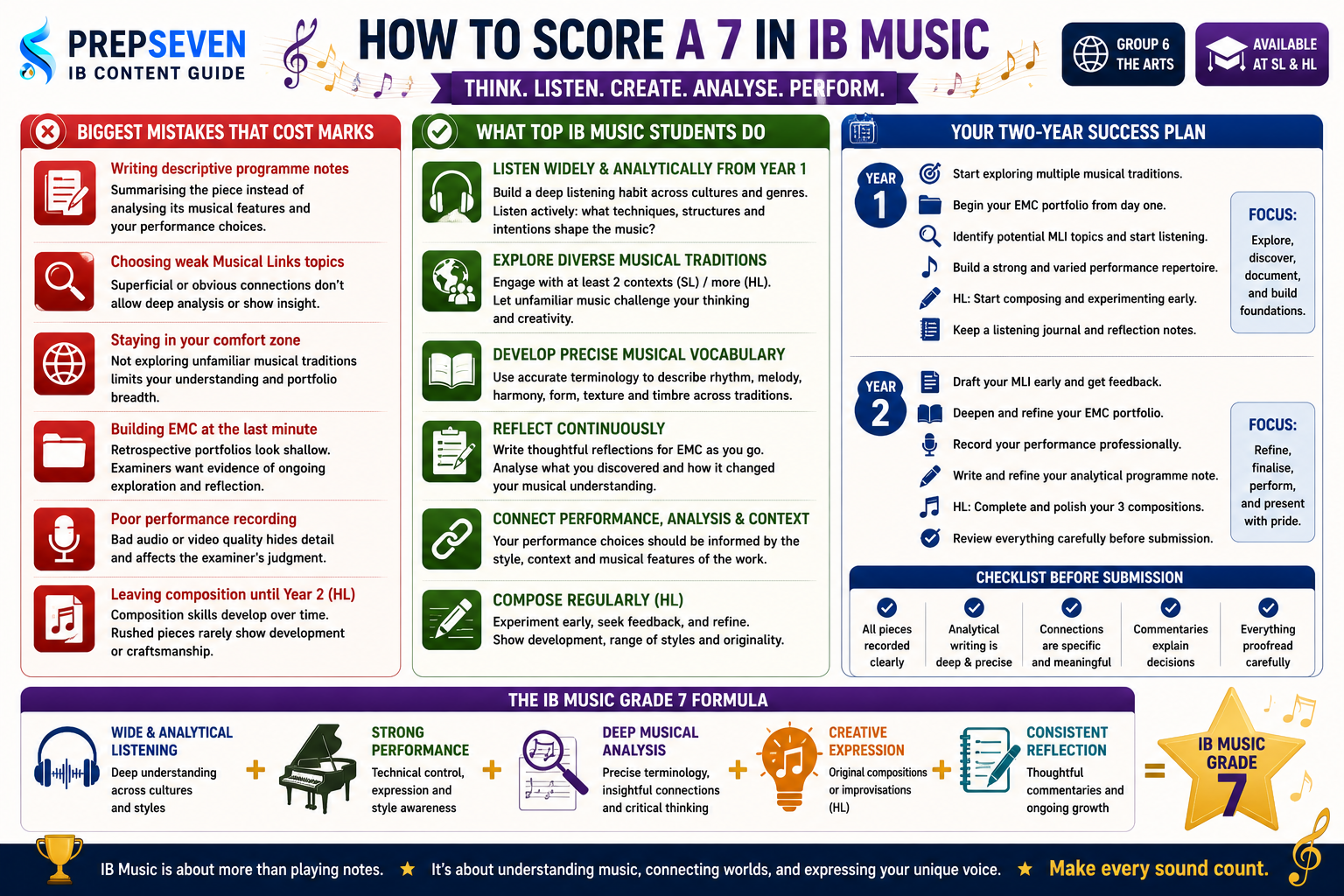
They listen widely and analytically from Year 1
The students who perform best in IB Music are those who have built a genuinely wide listening practice throughout the course, extending well beyond the traditions they perform in. They listen with analytical attention, asking what choices the composer or performer is making and what effect those choices produce. They have encountered multiple musical cultures through sustained listening rather than one-off exposure, and they have developed the vocabulary to describe and compare what they hear. This listening practice feeds every component: it builds the contextual knowledge that the EMC requires, the analytical vocabulary that the MLI and programme note demand, and the stylistic understanding that the PP assesses.
They treat every component as a thinking exercise, not just a task
Top-band IB Music students understand that the course is assessing musical thinking as much as musical skill. They approach the EMC commentary as an opportunity to articulate what they have genuinely discovered through exploration. They write the programme note as an analytical argument, not a summary. They choose MLI topics that genuinely interest them and that they want to understand more deeply. They build the HL composition portfolio as a record of genuine creative development rather than a set of pieces produced to a specification. This orientation toward genuine intellectual engagement produces work that is qualitatively different from work produced to satisfy requirements.
They develop musical vocabulary deliberately and use it precisely
Musical analysis requires precise vocabulary: terms that describe specific features of music accurately and that mean the same thing to the examiner reading them as they do to the student writing them. Students who develop a strong analytical vocabulary across multiple musical traditions, and who use that vocabulary precisely rather than approximately, produce stronger MLIs, stronger programme notes, and stronger EMC commentaries. Students who describe music in impressionistic or vague terms, even when those descriptions are evocative, are not demonstrating the analytical precision that the assessment criteria reward. Build your musical vocabulary deliberately and test it by applying it accurately to specific musical examples.
They start the HL composition portfolio in Year 1
For HL students, the composition portfolio is the component that most rewards early and sustained engagement. Compositional craft develops through practice and feedback over time, not through concentrated effort close to a deadline. Students who begin developing original work from the beginning of Year 1, who seek teacher feedback regularly, who experiment with different styles and approaches, and who allow their compositional voice to develop naturally across the course, produce portfolios that demonstrate genuine musical development. Students who approach composition seriously for the first time in Year 2 produce technically limited work regardless of how talented they are in other musical roles.
They choose performance repertoire that connects to the course’s analytical demands
The most successful Presents in Performance submissions are those where the student has chosen repertoire that they can perform with genuine musical understanding, not just technical proficiency, and that they have something genuinely analytical to say about in the programme note. A student who performs a technically demanding piece in a tradition they understand deeply can write a programme note that demonstrates real analytical insight. A student who performs technically accomplished music in a tradition they have not studied analytically will struggle to write a programme note that goes beyond surface description. Choose repertoire you can both play and think about.
Common Mistakes That Cost Marks
A Realistic Year-by-Year Approach
Year 1 (Grade 11): Build Breadth and Begin Everything
- Begin your listening practice across multiple musical traditions from the first week of Year 1. Identify two or three traditions beyond your own background that you want to engage with seriously, find accessible recordings and listening resources for each, and listen to them regularly throughout both years. Understanding of unfamiliar musical traditions builds through sustained exposure, not concentrated pre-assessment sessions.
- Start documenting your Exploring Music in Context activities from the first musical exploration you undertake in the course. Keep a record of what you explored, recordings of experiments or improvisations, and written reflections on what the exploration revealed. Building this record as you go produces an authentic and coherent portfolio. Trying to reconstruct it at the end produces a less convincing one.
- For HL students, begin compositional work from Term 1 of Year 1. The first pieces do not need to be portfolio-quality. They need to be genuine creative experiments that develop your compositional thinking. Work with your teacher regularly on compositional feedback. The development across two years of consistent compositional work is visible in a strong portfolio in a way that compressed development is not.
- Begin thinking about your Musical Links Investigation topic in Term 2 of Year 1. The strongest MLIs are those where the student has been thinking about the connection between the works for months before writing the investigation. Start listening to your chosen works analytically, building notes on their musical features and the connections you are beginning to observe.
- Assess your performance repertoire early and plan the Presents in Performance programme with your teacher. Choose repertoire that you have something analytical to say about, not just music you can technically execute. Begin thinking about the programme note from the moment you choose the repertoire, not as a separate writing task at the end.
Year 2 (Grade 12): Deepen, Complete, and Refine
- Complete a full draft of the Musical Links Investigation in Term 1 of Year 2 and get detailed teacher feedback before revising. The MLI needs genuine analytical depth, precise musical terminology, and effective use of audio-visual examples to support the analysis. A first draft is rarely analytically deep enough, and feedback from an experienced teacher on where the analysis needs to go further is essential before finalising.
- Record your Presents in Performance recital with proper preparation of the recording setup. Test the recording environment, microphone or camera placement, and acoustics in advance. Complete the programme note with the same level of investment as the performance itself. Get teacher feedback on both the analytical depth of the note and the accuracy of the musical claims you are making.
- Finalise your Exploring Music in Context portfolio with a coherent editorial vision. Review the entries across two years and ensure they demonstrate the breadth of musical contexts required and the analytical depth of the written commentaries. Strengthen any entries that are primarily descriptive by adding specific analytical reflection.
- For HL students, complete the final compositions or improvisations in the portfolio in Term 2 of Year 2, ensuring the three pieces demonstrate range across contexts. Write each commentary with genuine analytical depth, explaining compositional decisions in terms of the musical traditions and techniques that informed them. Get teacher feedback on the commentaries specifically, not just the pieces.
- In the final weeks before submission, focus on the written components of each assessment: the programme note, the EMC commentaries, the MLI, and the HL composition commentaries. These are the elements where marks are most often left on the table by students who have invested heavily in the practical work but underinvested in the analytical writing that accompanies it.
How PrepSeven Helps You Score Higher in IB Music
IB Music is a course where the difference between a 5 and a 7 is almost always in the quality of the analytical writing rather than in the practical musical skill. Students who are accomplished musicians but who write thin programme notes, superficial EMC commentaries, or an MLI that makes general connections rather than specific analytical ones, consistently score below their musical ability would suggest they should. Our IB Music tutors are certified IB examiners and experienced music educators who know exactly what each written and practical component requires and where students systematically leave marks on the table.
- Programme note development sessions where your tutor works with you on the analytical depth, musical accuracy, and structural quality of your Presents in Performance programme note, showing you specifically where the analysis is thin, where terminology is imprecise, and what a top-band programme note for your specific repertoire would look like.
- Musical Links Investigation sessions where your tutor evaluates your choice of works and the analytical framework you are developing, checks the precision and accuracy of your musical analysis, and identifies where the investigation needs to go deeper or make more specific connections to achieve top-band marks.
- Exploring Music in Context portfolio review sessions where your tutor assesses your EMC commentaries against the IB criteria, identifies where reflection is insufficient or where musical analysis needs more depth, and helps you strengthen the portfolio’s analytical coherence across all the documented explorations.
- HL Composition portfolio sessions where your tutor gives detailed feedback on the musical craft of each piece, the analytical depth of the written commentary, and the range of musical contexts demonstrated across the three works, with targeted guidance on what development would strengthen the portfolio before submission.
- Listening and analytical vocabulary sessions where your tutor works with you on developing precise analytical vocabulary for the musical traditions you are engaging with, building the descriptive and analytical language that the MLI, programme note, and EMC commentaries all require.
Book your free demo lesson at prepseven.com. Bring a draft programme note, an EMC commentary entry, or the initial framework for your Musical Links Investigation. Your tutor will show you precisely where the analytical depth is sufficient and where it needs development, and what the work looks like that earns marks in the top band for each component.