
PrepSeven | IB Content Guide authored by Shankar Mutneja (Founder of Prepseven)
IB Mathematics: Analysis and Approaches (AA)
What Is IB Mathematics: Analysis and Approaches?
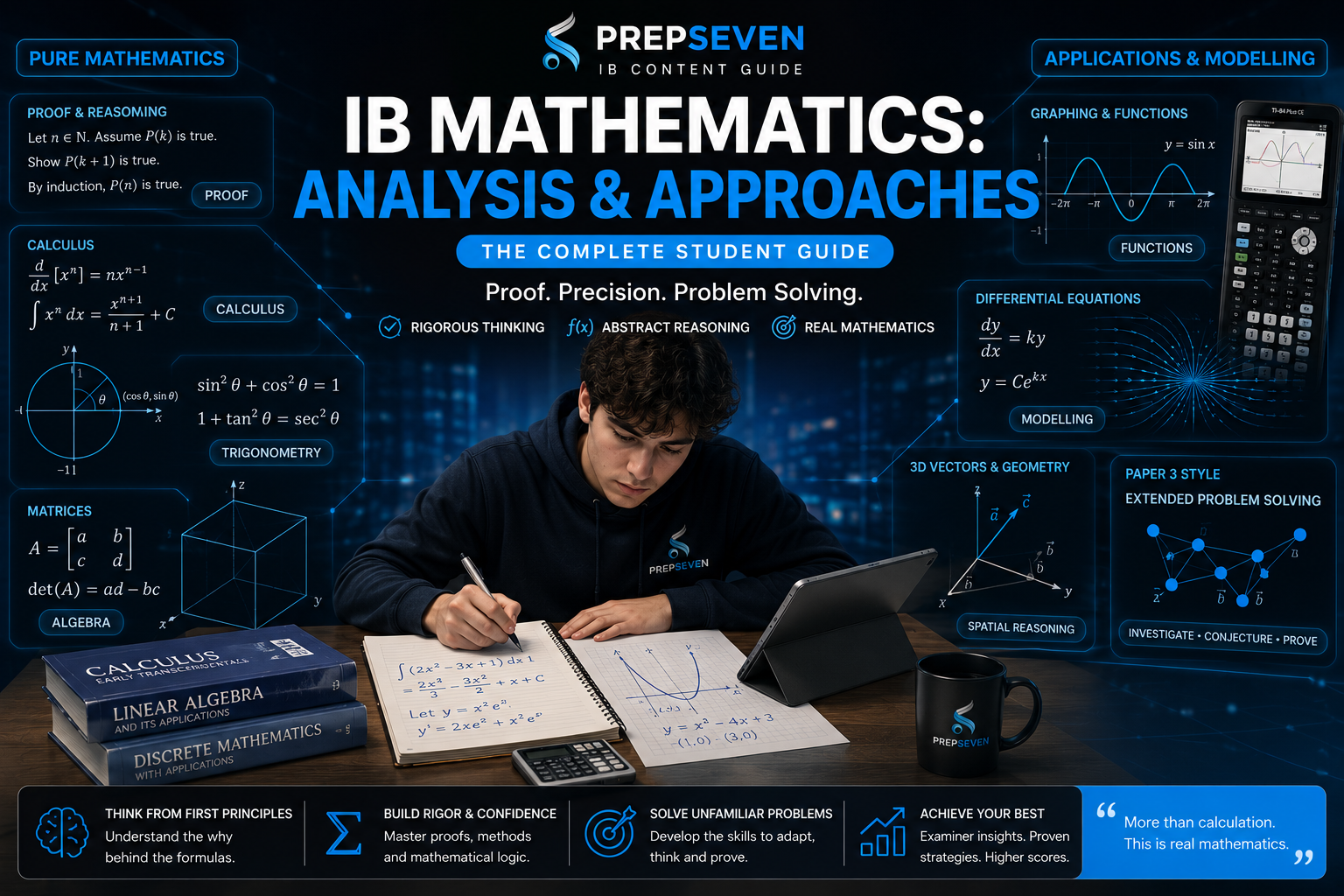
IB Mathematics: Analysis and Approaches, almost universally called IB Math AA, is one of two mathematics courses in the Diploma Programme. The other is Applications and Interpretation (AI). The choice between them is one of the most consequential decisions an IB student makes, and it is also one of the most misunderstood.
Math AA is built around mathematical rigour and formal reasoning. It is the course for students who enjoy working with abstract ideas, constructing proofs, and understanding why mathematical results are true rather than simply how to apply them. If you have ever found yourself curious about where a formula actually comes from, this is the course that answers that question.
The course covers algebra, functions, trigonometry, calculus, statistics and probability, and at Higher Level, additional topics in differential equations, complex numbers, graph theory, and further proof. The jump from SL to HL is genuinely significant, and not just in terms of content volume.
Math AA HL is widely regarded as the most demanding subject in the IB Diploma Programme. Universities, particularly for engineering, mathematics, economics, and physical sciences, treat an HL grade of 6 or 7 as a meaningful signal of quantitative aptitude. The difficulty is real, but so is the reward.
Math AA vs Math AI: Getting the Choice Right
Before going any further into the specifics of Math AA, it is worth spending time on the comparison with Math AI, because a significant number of students end up in the wrong course and find out too late.
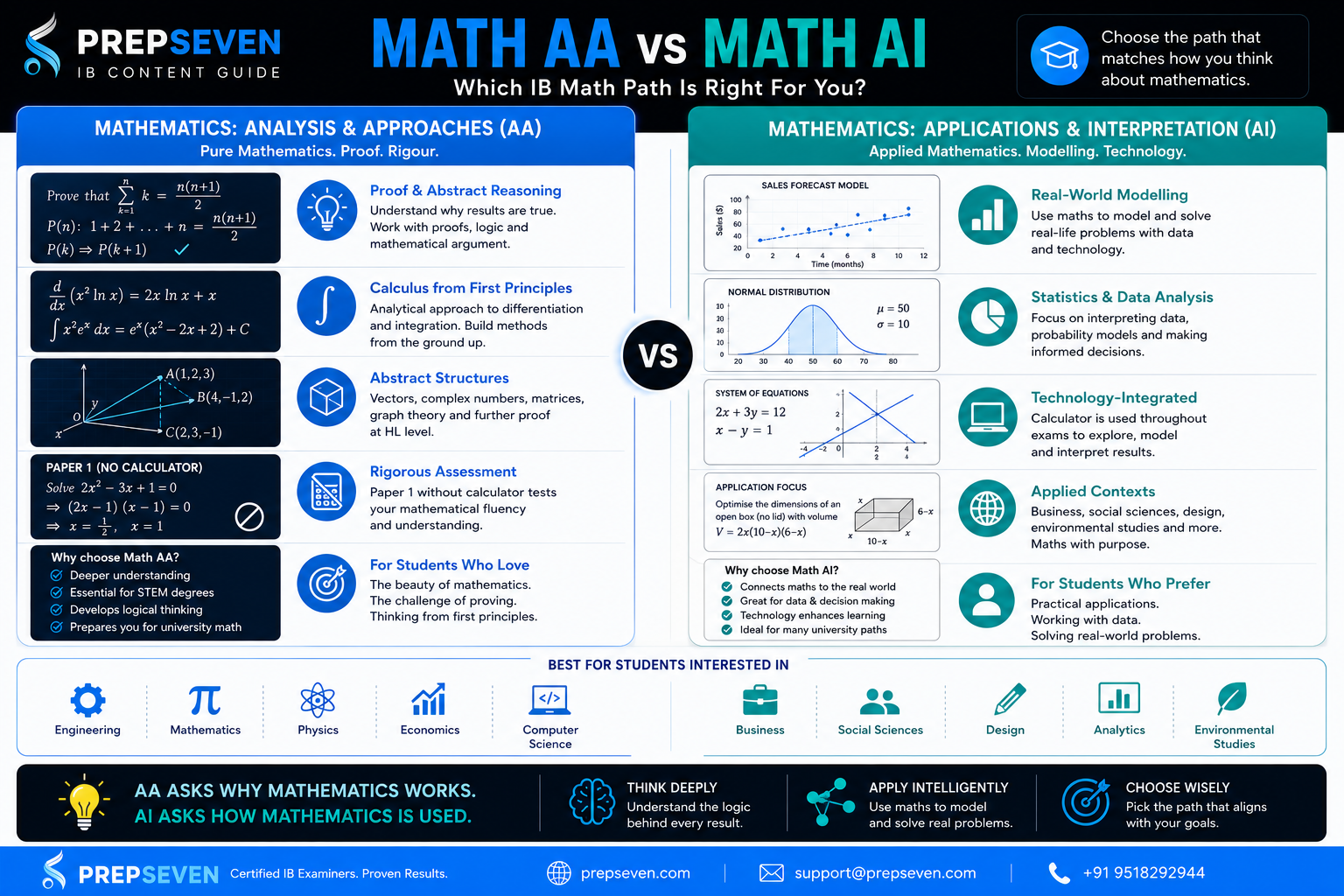
Math AI is not an easier version of Math AA. It is a different subject with a different philosophy. AI focuses on real-world applications of mathematics, modelling, and the use of technology to solve problems. AA focuses on rigorous proof, abstract reasoning, and working from first principles. A student who is comfortable with computation but finds abstract reasoning difficult may genuinely perform better in AI. A student who finds pure mathematics engaging will likely perform better in AA.
If you are planning to study engineering, economics, mathematics, physics, or computer science at university, research the specific entry requirements for the programmes you are targeting. Many will state Math AA HL explicitly. Do this research before the end of Year 11.
SL vs HL: What the Jump Actually Involves
The difference between Math AA SL and Math AA HL is not simply more topics. The questions at HL demand a qualitatively different level of mathematical thinking. SL tests whether you can apply methods correctly. HL tests whether you understand the mathematical structures well enough to adapt, prove, and extend them in unfamiliar situations.
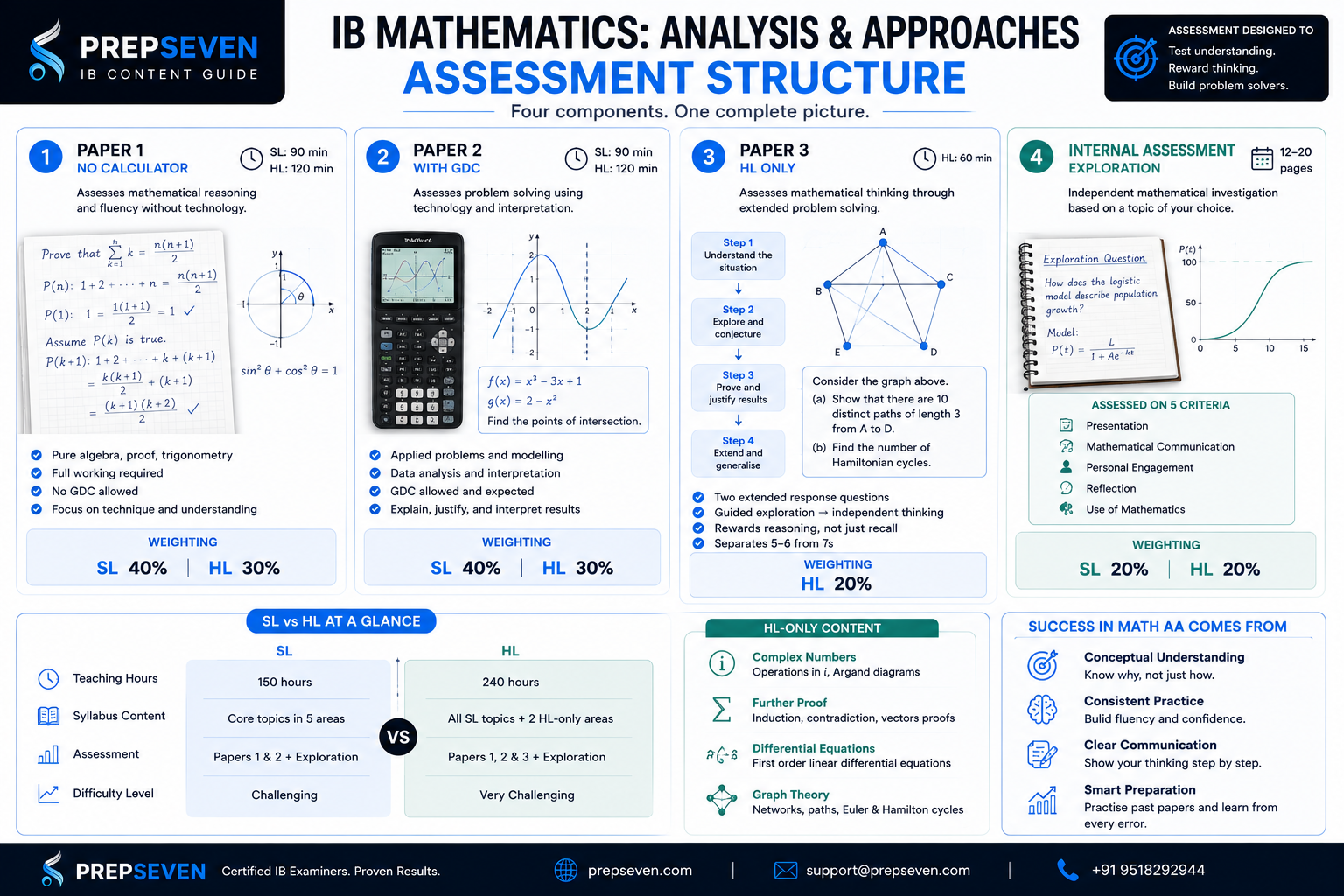
Paper 3 at HL deserves particular attention because it is genuinely unlike anything students have encountered before. It presents two extended problems, each structured as a guided investigation. You are given a mathematical scenario you have never seen, and you work through it step by step, building a solution as you go. The steps scaffold, but the later parts of each problem require you to conjecture and prove results independently. It rewards students who think mathematically, not just students who have memorised methods.
What the Syllabus Actually Covers
The IB Math AA syllabus is organised into five topic areas. At SL, these form the complete course. At HL, each topic is extended and two additional areas are added.
Calculus carries the most weight in the final exams at both SL and HL. Students who are still shaky on differentiation and integration rules by the start of Year 2 are at a serious disadvantage. Build that foundation early.
Assessment Breakdown: How You Are Actually Graded
Paper 1: No Calculator
Paper 1 is taken without a graphical display calculator (GDC). This is where many students struggle, because modern mathematics education often relies heavily on technology. The IB wants to see whether you understand the mathematics itself, not just whether you can operate a calculator.
Questions on Paper 1 tend to focus on algebraic manipulation, proof, trigonometric identities, and anything where the process of working is the point. You will be expected to present full working. A correct answer with no working earns no credit. An incorrect answer with clear, logical working can earn most of the marks.
Something many students discover too late: on Paper 1, simplifying expressions elegantly is often faster than brute-force calculation. Students who have developed algebraic fluency, the ability to see the cleanest path through a problem, consistently outperform students who rely on lengthy computation.
Paper 2: With GDC
Paper 2 is taken with a graphical display calculator. The questions here are typically more applied, involving modelling, data interpretation, and longer multi-part problems. Having a GDC does not make this paper easier in any simple sense. The problems are designed assuming you have one. What a GDC gives you is speed and the ability to verify your analytical work.
A common mistake is using the GDC as a substitute for understanding. If you cannot explain why your calculator gave you a particular result, you will lose marks on the ‘reason’ or ‘justify’ parts of a question. Use the GDC to check and extend your thinking, not to replace it.
Paper 3: HL Extended Problem Solving
Paper 3 is 60 minutes and contains two extended response questions. Each begins with accessible, structured steps and gradually requires more independent mathematical thinking. The final parts of these questions are intentionally designed so that not all students will complete them. They separate the students scoring in the 5 to 6 range from those scoring 7.
The best preparation for Paper 3 is not more topic revision. It is practice with unfamiliar problems. Students who have only ever practised methods they recognise tend to freeze when Paper 3 presents something that looks different from anything they have seen. Students who have practised mathematical exploration, including the Internal Assessment process, are much better placed.
Internal Assessment: The Exploration
The Internal Assessment for Math AA is called the Exploration. It is a 12 to 20 page mathematical investigation on a topic of your own choice, internally assessed and externally moderated. It carries 20% of your final grade at both SL and HL.
The Exploration is assessed on five criteria: Presentation, Mathematical Communication, Personal Engagement, Reflection, and Use of Mathematics. That last criterion is the most heavily weighted, and it means something specific. At SL, the mathematics should be commensurate with the SL syllabus. At HL, it should go beyond the syllabus in some way.
The most common reason good mathematics students get disappointing marks on the Exploration is Personal Engagement and Reflection. These criteria reward students who show genuine curiosity, who ask their own questions, and who reflect honestly on what they found surprising, what did not work, and what their results actually mean. A technically proficient exploration that reads like a textbook chapter typically scores around 12 to 14 out of 20. An exploration with rich personal voice and genuine mathematical curiosity can score 18 to 20.
Topic selection matters enormously. A student who investigates a topic they genuinely care about, even if the mathematics is not the most impressive, will almost always outscore a student who picks a showy topic they do not understand deeply. The Exploration rewards authenticity.
What Actually Gets Students to a 7: The Habits That Separate Top Scorers
Working with IB mathematics students over many years, the patterns at the very top of the grade distribution are consistent. They are habits of mathematical thinking, not study routines.
They practise Paper 1 without any calculator, ever
Many students use their GDC habitually throughout Year 1 and Year 2, including for topics that Paper 1 will test by hand. When the exam arrives, they are slow and uncertain because they have never built the fluency. Top scorers practise Paper 1 topics with no technology from the beginning. Algebraic manipulation, logarithm laws, trigonometric identities, and integration by inspection are skills that need regular, unassisted practice to become fast.
They treat working as communication
In IB mathematics, working is not just a route to the answer. It is itself assessed. Examiners award marks for correct method even when the final answer is wrong. Students who present their working as a clear logical argument, with each step following from the last, earn significantly more method marks than students who show fragments of working or skip steps.
They understand the Exploration criteria before they start writing
Students who read the marking criteria after finishing their Exploration draft are at a disadvantage. The criteria shape what the Exploration should contain from the very first page. Personal Engagement cannot be added as a paragraph at the end. It has to be present throughout, in the questions you ask, the choices you make, and the way you reflect on your findings. Start with the criteria, not the topic.
They build a topic summary document, not just notes
Passive notes are rarely useful for mathematics revision. Top scorers tend to build active summary documents: every key formula with a worked example showing when and why to use it, common errors they have made and corrected, and a list of ‘interesting questions’ that connect topics unexpectedly. This kind of document forces synthesis across the syllabus rather than topic-by-topic revision.
They read errors as information, not failures
In practice papers, students who review their errors and identify exactly why they went wrong, not just what the right answer was, improve faster than those who simply redo problems correctly. If you got a differential equations question wrong, the useful question is not ‘what is the right method?’ It is ‘at what step did my reasoning break down, and why?’ That kind of diagnosis is what makes a tutor’s feedback genuinely valuable.
Common Mistakes That Cost Marks
A Realistic Year-by-Year Approach
Year 1 (Grade 11): Build Foundations and Start Early on the Exploration
- Work through algebra, functions, and trigonometry with rigour. These topics form the scaffolding for everything that comes later.
- Practise Paper 1 style questions without a calculator at least once a week, even informally.
- Start thinking about your Exploration topic by the end of Term 2. You want enough time to change direction if your first idea does not yield enough interesting mathematics.
- For HL students: do not let the HL-only content sit untouched until Year 2. Complex numbers and proof by induction are easier to absorb when you first encounter them without exam pressure.
Year 2 (Grade 12): Consolidate, Practise, and Finish the Exploration
- Complete at least 6 timed past papers across Papers 1 and 2 before your mock exams.
- For HL students: do at least 4 Paper 3 practice questions from past papers. There is no substitute for exposure to the format.
- Submit your Exploration first draft to your teacher no later than the end of Term 1. The feedback cycle is where marks are made or lost.
- In the final 8 weeks before exams, work through your personal error log and target the specific topic areas where your marks are lowest. Generic revision is far less efficient than targeted practice.
How PrepSeven Helps You Score Higher in IB Math AA
Our Math AA tutors have worked as IB examiners and know the mark scheme from the inside. They understand not just what the right answer is, but why certain types of working earn full marks and why others, even when technically correct, lose marks for poor mathematical communication.
Here is what working with a PrepSeven Math AA tutor typically looks like in practice:
- Paper 1 and 2 sessions where your tutor marks your practice paper exactly as an IB examiner would, then walks through every method mark, accuracy mark, and follow-through mark in detail.
- Exploration mentorship from topic selection through to final draft, covering all five criteria and ensuring your Personal Engagement and Reflection sections are as strong as your mathematics.
- Paper 3 sessions built around novel problem-solving, where your tutor walks you through the mathematical thinking process on unfamiliar questions rather than simply showing you the solution.
- HL-only intensive sessions on differential equations, complex numbers, and further proof for students who need to build confidence in the most demanding parts of the syllabus.
Book a free demo lesson at prepseven.com and work through a Paper 1 question with one of our examiners. You will see the difference immediately.