
PrepSeven | IB Content Guide authored by Shankar Mutneja (Founder of Prepseven)
IB Mandarin Chinese B
The Complete Guide for IB DP Students and Parents
What Is IB Mandarin Chinese B?
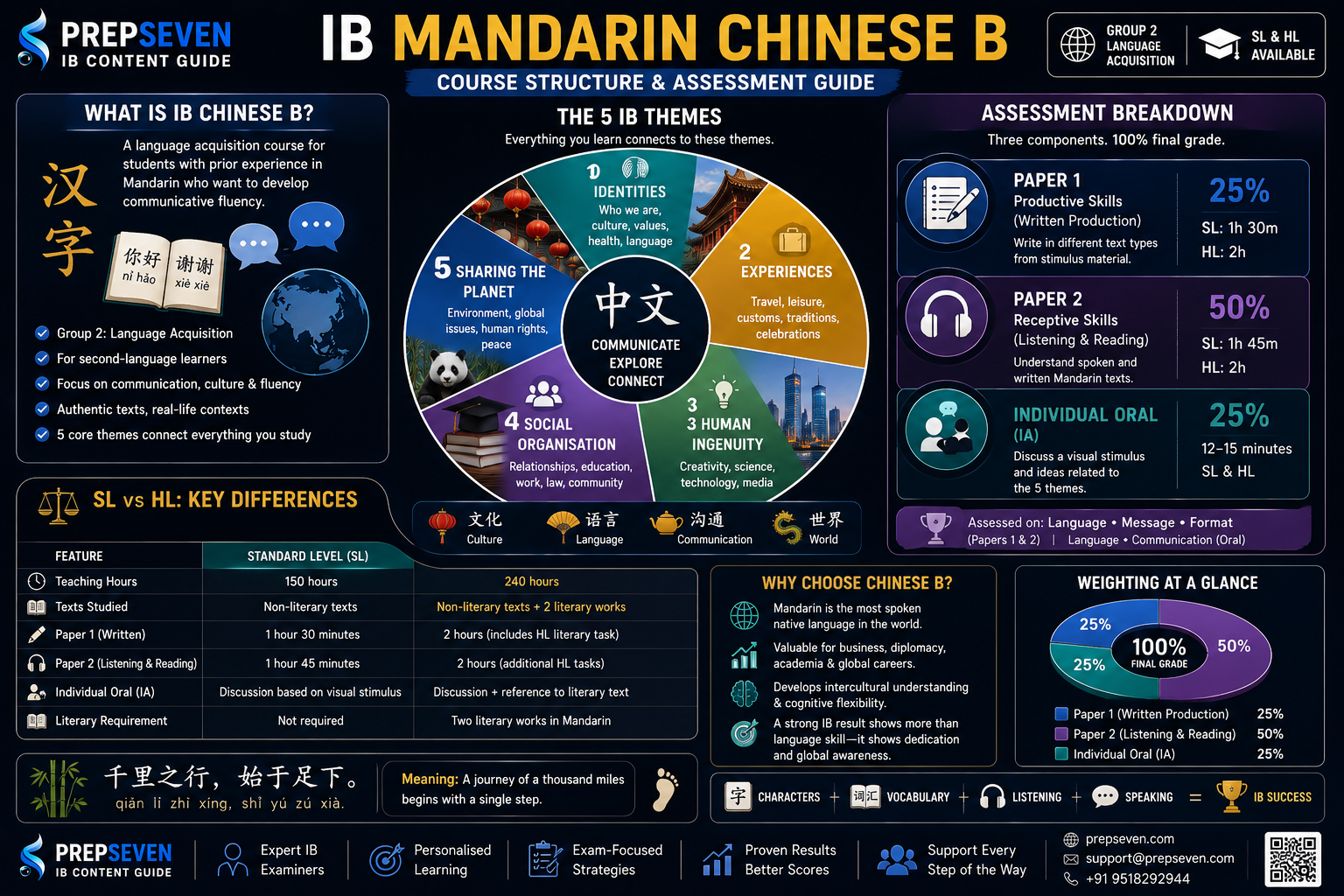
IB Mandarin Chinese B is the Diploma Programme’s course for students who already have some prior experience with Mandarin and want to develop genuine communicative fluency in the language. It sits in Group 2 of the Diploma Programme alongside other language acquisition courses and is available at Standard Level and Higher Level. For students who have grown up in Mandarin-medium environments, this is the wrong course. For students who have studied Mandarin at school, perhaps as a second language from a young age, or who have a moderate working knowledge of the language and want to develop it further, Chinese B is exactly what it is designed for.
The course is built around five themes that recur at both SL and HL: identities, experiences, human ingenuity, social organisation, and sharing the planet. Everything in the course, the texts you study, the conversations you have, the writing tasks you complete, connects back to these themes. Mandarin is not taught as a grammar course or a vocabulary memorisation exercise. It is taught as a language for communicating about the things that actually matter in the world, which is the approach that produces durable fluency rather than exam performance that evaporates after the test.
What makes IB Mandarin Chinese B particularly demanding is the combination of scale and specificity that Mandarin requires. The writing system alone, which uses logographic characters rather than an alphabet, means that literacy in Mandarin requires hundreds of hours of dedicated character practice that students in other language B courses simply do not face. Students who arrive in the DP with a strong oral foundation but limited reading and writing ability find that the written components of the course demand serious investment. Students who can read and write reasonably well but are not comfortable in spoken production find the oral components genuinely challenging. A well-balanced Mandarin B student is one who has developed both dimensions, and most students have to actively work on whichever dimension is weaker.
Mandarin Chinese B is one of the most valuable courses in the IB Diploma for students who complete it well. Mandarin is the most spoken language in the world by number of native speakers, and communicative competence in Mandarin is increasingly valued in business, diplomacy, academia, and international careers. A strong result in IB Chinese B signals something beyond language skill. It signals the sustained effort and cognitive flexibility required to operate in a genuinely different linguistic and cultural system.
SL vs HL: What the Difference Really Involves
Chinese B is available at Standard Level and Higher Level, and the difference between them is significant enough to affect how you approach the course from the beginning. Both levels use the same five themes and the same communicative framework, but HL requires engagement with literary texts and the additional written tasks those texts generate, and HL students face more demanding receptive and productive tasks across all components.
The HL literary requirement is the most significant structural difference between the two levels and the one that most affects how students should approach the course. HL students study two literary works in Mandarin, which means reading novels, short story collections, or plays in the target language and engaging with them analytically. For students who have a strong Mandarin foundation and enjoy reading, this is one of the most intellectually rewarding aspects of the course. For students who find Chinese character reading slow and effortful, the literary requirement adds a layer of preparation that requires sustained work across both years.
If you are choosing between SL and HL in Chinese B, consider your reading speed and comfort in Mandarin as much as your speaking and listening ability. HL students who read Mandarin slowly find the literary texts genuinely time-consuming to process, and the oral discussion of those texts in the Individual Oral requires you to quote and discuss specific moments from the work. Students who arrive with strong literacy skills tend to find HL manageable and intellectually engaging. Students who struggle with Chinese characters will likely find the HL workload harder to sustain over two years.
The Five Themes: What You Actually Study
Everything in IB Chinese B is organised around five recurring themes. These are not just administrative labels. They shape the texts you read, the writing tasks you are given, the conversations you have in class, and the questions that appear in the exam. Understanding what each theme covers, and how Mandarin-language culture intersects with each theme, is the foundation of good preparation.
The reason it matters to understand these themes before you sit the exam is that Paper 1 asks you to produce written texts in Mandarin based on stimulus material, and that stimulus material is always thematically grounded. A student who has engaged meaningfully with the themes throughout the course, who has read authentic Mandarin texts about education pressure or environmental policy or cultural identity, arrives at Paper 1 with vocabulary and ideas already organised around those topics. A student who has only practised language structures without building thematic knowledge finds the writing tasks harder because they have to generate both language and content simultaneously under timed conditions.
Assessment Breakdown: How You Are Graded
IB Chinese B is assessed through three components: Paper 1, Paper 2, and the Individual Oral. Understanding the weight and purpose of each component is essential for building a preparation strategy that allocates effort proportionately.
Paper 1: Productive Skills (Written)
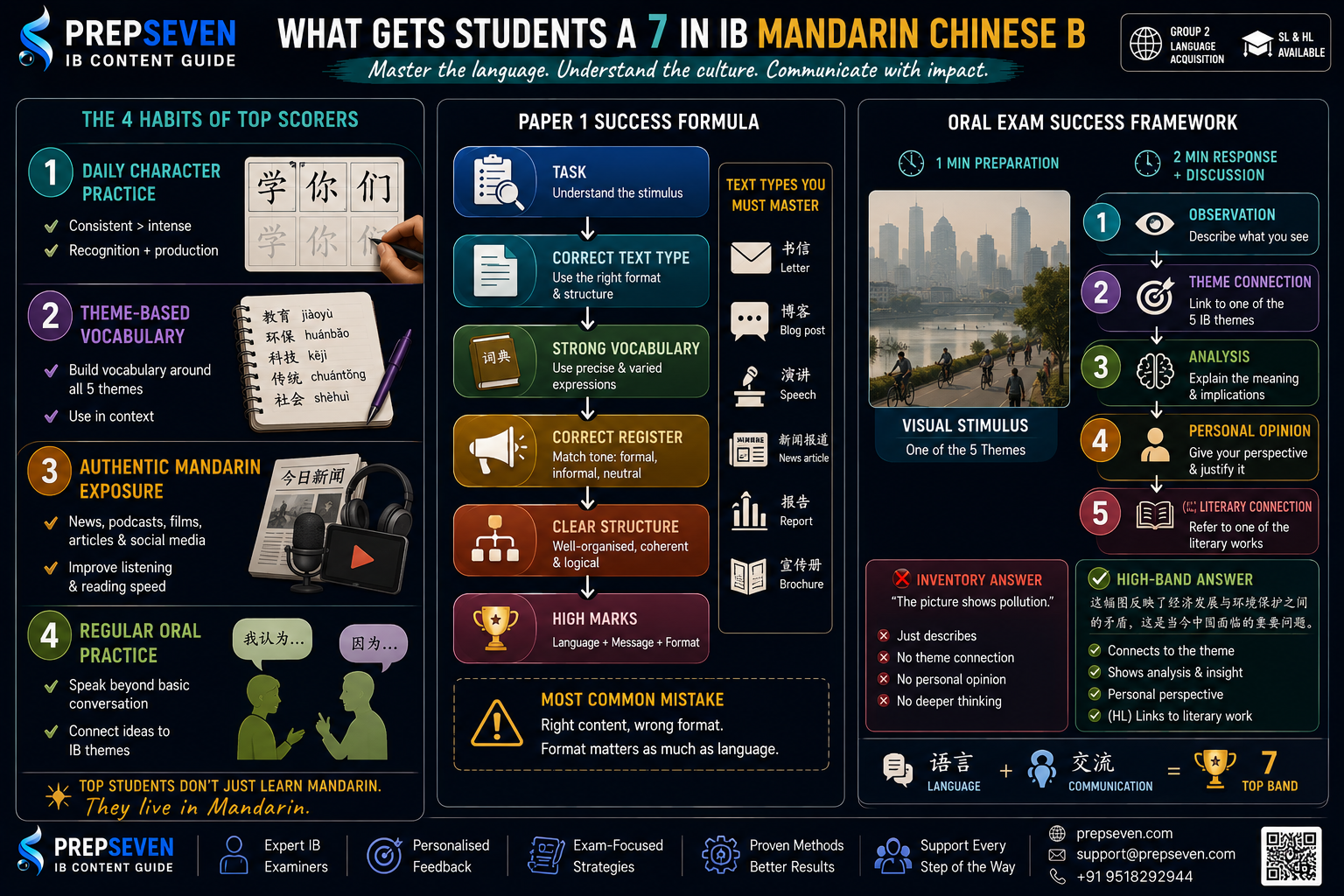
Paper 1 tests your ability to produce written texts in Mandarin. You are given stimulus material, which might be an image, a short text extract, or a visual prompt, and asked to produce one or more written responses in specific text types. The text types you need to know include essays, letters, blog posts, social media posts, speeches, reports, brochures, and news articles. The text type is specified in the task and students lose marks when they produce the correct content in the wrong format.
At SL, Paper 1 is one hour and thirty minutes. At HL, it is two hours and includes an additional task connected to the literary works. Both levels test your ability to use appropriate register for the specified text type, organise your writing coherently, deploy a range of vocabulary and grammatical structures accurately, and respond meaningfully to the stimulus.
The marking criteria for Paper 1 assess language, message, and format. Language looks at vocabulary range and accuracy, grammatical accuracy and complexity, and the variety of sentence structures you use. Message looks at whether you have responded directly to the task, developed ideas with sufficient depth, and whether your writing makes sense as a piece of communication. Format looks at whether you have correctly applied the conventions of the specified text type. A letter that reads well but has no salutation and no sign-off loses marks on format regardless of how good the language is.
The text type conventions in Chinese B matter as much as the language quality. Students who consistently practise producing different text types in Mandarin, not just freewriting or essay practice, develop the automatic awareness of format that Paper 1 requires. A student who has never practised writing a Chinese formal letter or a Chinese news report before sitting the exam will waste time in the exam figuring out the appropriate structure rather than focusing on the quality of language.
Paper 2: Receptive Skills (Listening and Reading)
Paper 2 tests your ability to understand spoken and written Mandarin through listening and reading comprehension tasks. The texts used in Paper 2 come from authentic or near-authentic Mandarin language sources and cover the five themes. Task types include multiple choice, short answer questions, gap fill, matching, and identifying whether statements are true, false, or not given.
The listening section uses recordings of native or near-native Mandarin speakers. These recordings include different accents, speeds, and contexts, from formal news broadcasts to informal conversations, and students need to extract specific information, identify attitudes, infer meaning from context, and understand the overall message. Students who have only studied formal classroom Mandarin often find authentic spoken Mandarin significantly faster and less clearly articulated than what they are used to.
The reading section presents multiple authentic texts and asks comprehension questions that test literal understanding, inferential understanding, and the ability to identify the writer’s purpose and attitude. The vocabulary in reading texts is often more complex than what appears in listening scripts, and students who have not built their reading vocabulary through regular exposure to authentic Mandarin texts find certain passages genuinely difficult.
For Paper 2, the single most important preparation habit is regular exposure to authentic Mandarin listening and reading material outside of class. Students who watch Chinese news programmes, listen to Mandarin podcasts, or read Chinese newspapers consistently throughout both years develop listening comprehension and reading speed that cannot be replicated through last-minute preparation. The auditory processing required for listening comprehension builds slowly over repeated exposure. There is no shortcut.
Individual Oral (IA)
The Individual Oral is worth 25% of the final grade and is the component that most directly tests communicative fluency. Students are shown a visual stimulus connected to one of the five themes and engage in a structured conversation with the teacher. At SL, the conversation focuses on the themes and the stimulus. At HL, students must also connect the discussion to one of the two literary works they have studied, discussing how the stimulus relates to a theme explored in the literary text.
The oral is assessed on language and communication. Language looks at vocabulary range and accuracy, grammatical accuracy, pronunciation and intonation, and the variety of structures used. Communication looks at whether the student can maintain a coherent conversation, respond directly to questions, develop ideas beyond surface level, and express personal perspectives on the themes discussed.
The Individual Oral is internally assessed by the teacher and externally moderated by the IB. This means your teacher marks it and the IB adjusts if their marks differ significantly from a sample. Students whose teachers are experienced IB Chinese B teachers tend to receive well-calibrated marks. Students whose teachers are less familiar with IB standards may find their marks adjusted. Working to a level that would satisfy an IB moderator, rather than just your own teacher, is always the right standard.
The Character Question: Reading, Writing, and the Writing System
Every student in IB Mandarin Chinese B faces a challenge that students in other language B courses simply do not encounter to the same degree: the Chinese writing system. Mandarin uses logographic characters, each of which represents a syllable and carries meaning, and reading and writing ability in Mandarin is directly proportional to the number of characters a student knows and can produce fluently.
There is no reliable estimate of exactly how many characters are needed for IB Chinese B, but students aiming for the top bands in Paper 1 and Paper 2 typically need functional literacy across several hundred to low thousands of characters. More important than the raw number is the ability to use characters fluently in context, recognising them quickly in reading and producing them correctly in writing, including under timed exam conditions.
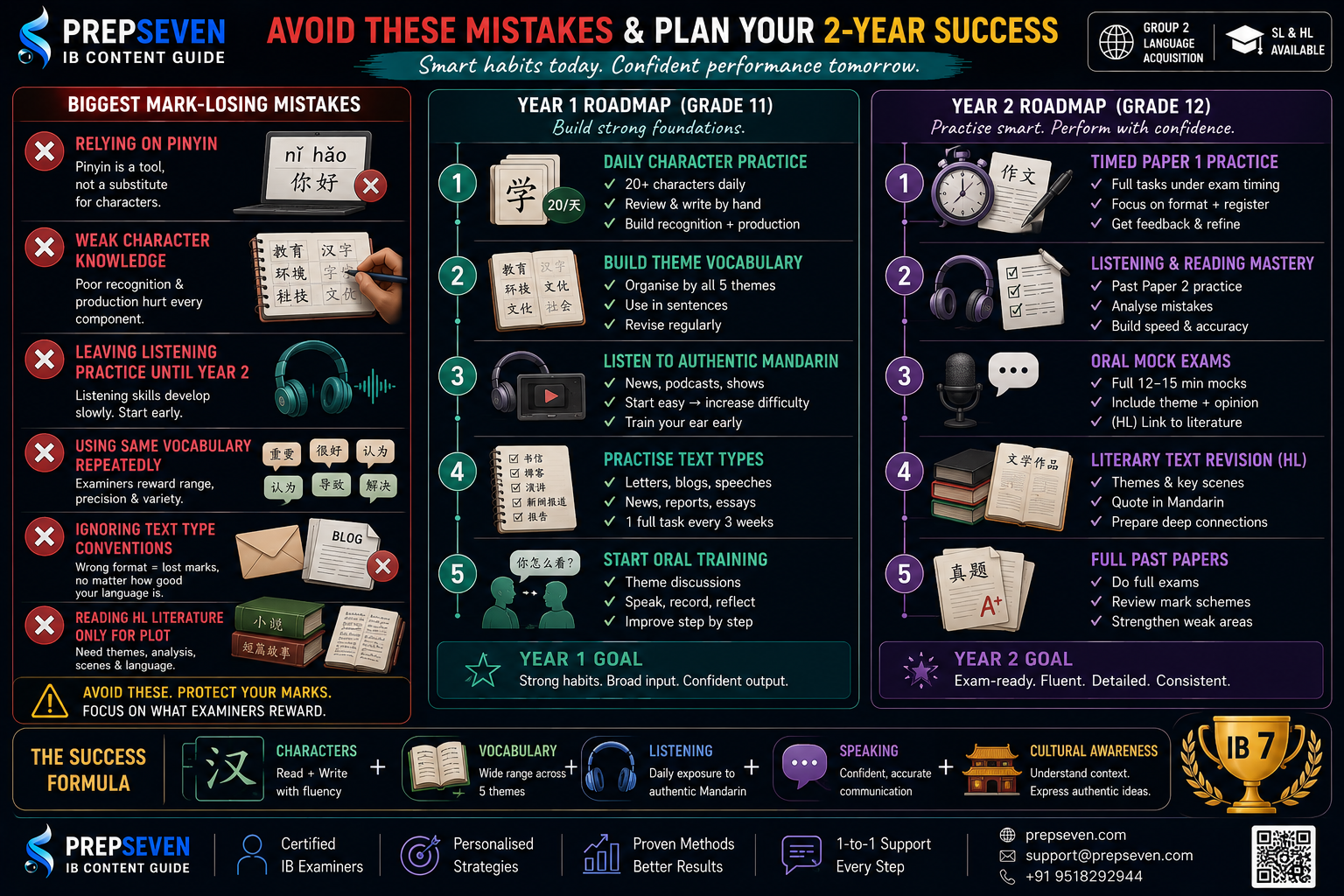
Students who were taught Mandarin using pinyin romanisation and have not invested in character literacy face a particular challenge in this course. Pinyin is a useful tool for learning pronunciation and for input methods on digital devices, but it is not a substitute for character knowledge in IB Chinese B. The exams require you to read and write characters, and students who cannot do so fluently will lose marks on every component.
The most effective approach to character literacy is daily practice, sustained across both years. Flashcard systems like Anki or physical character practice books, where you write characters by hand repeatedly while associating them with their meaning and pronunciation, build the kind of deep encoding that allows character recognition and production to become automatic. Students who practise characters intensively for a few weeks before the exam and have not built consistent practice over time will find that characters they learned in review do not stay accessible under exam pressure.
Typed versus handwritten production is a practical consideration worth flagging. IB Paper 1 may be completed using a keyboard in some centres, using pinyin input methods to produce characters. In other centres, handwriting is required. Check your school’s policy well in advance. If your exam will require handwritten character production, practise handwriting your written tasks throughout both years. If you are only ever practising on a keyboard, your handwriting will not be at the standard required.
What the Oral Actually Demands: Beyond Basic Conversation
Many students underestimate the Individual Oral until they are practicing for it and discover that conversational fluency in everyday Mandarin is not the same as the level of articulate, theme-connected discussion that the oral requires. The IB Individual Oral is not a casual conversation. It is an assessed performance that requires you to describe and analyse a visual stimulus, express and justify personal opinions on the themes it raises, develop ideas beyond surface observation, and at HL connect the discussion to thematic content in a literary work.
The common failure mode is what oral preparation teachers call the inventory answer: a student who, when shown a stimulus depicting environmental pollution in a Chinese city, lists what they can see in the image and then stops. The image shows a city with grey skies and factory chimneys. The image also shows people wearing masks. That is an inventory. An oral answer that earns marks in the upper band says something about what the image communicates about the tension between economic development and environmental cost in contemporary China, connects it to a specific aspect of the Sharing the Planet theme, offers a personal perspective on how this tension might be resolved, and in HL draws a connection to how a character in the literary work confronts a similar conflict between individual interest and collective responsibility.
The difference between these two responses is not language proficiency alone. It is the habit of thinking analytically about the themes throughout the course, so that when a visual prompt appears, the student has a framework of ideas already available rather than having to construct one from scratch under time pressure.
Practice your oral with the actual exam format from at least Year 1 Term 3. Sit with a visual stimulus, give yourself one minute of preparation, and then speak for two minutes about the image before entering a conversation. Record yourself. Listen back. Identify where you use the same vocabulary repeatedly, where your grammar becomes less accurate under pressure, and where your ideas remain at the surface level. The act of listening critically to your own oral performance is one of the most efficient development tools available, and most students avoid it because it is uncomfortable.
HL Literary Texts: What Engagement Actually Looks Like
HL students study two literary works in Mandarin. These are usually a novel or a collection of short stories and a play, though schools have some flexibility in their choices within the IB’s approved list. The literary requirement is not peripheral to the HL course. It connects directly to Paper 1 (which at HL includes a written task connected to the literature), to the Individual Oral (which at HL must include discussion of one of the two works), and to the cultural depth that distinguishes an HL response from an SL one.
The most effective approach to the literary texts is to read them actively rather than passively. Active reading means identifying the themes from the five IB themes that appear in the text, noting specific scenes or moments that illustrate those themes, building a vocabulary list of key language that appears in the text, and forming personal responses to characters, events, and ideas that you can articulate in Mandarin. A student who has read a text but only knows its plot summary is not prepared for HL literary discussion. A student who can say in Mandarin what a specific scene reveals about social organisation in contemporary China, and why that matters to the themes of the course, is prepared.
Schools often assign the literary texts at the beginning of Year 1 or Year 2. Regardless of when your teacher introduces them, it is worth starting to read them as early as possible. Reading a literary work in Mandarin slowly, over an extended period, with a dictionary available and regular re-reading of difficult passages, produces significantly deeper textual understanding than trying to get through the whole work quickly in the weeks before the exam.
Keep a literary text journal as you read. After each chapter or section, write three or four sentences in Mandarin summarising what happened, identifying one thematic connection to the IB themes, and noting one piece of vocabulary you want to add to your active vocabulary. This journal serves as revision material before the oral and Paper 1, and the act of writing in Mandarin regularly about what you are reading reinforces both your language production and your textual familiarity.
What Actually Gets Students to a 7
They have a wide and accurate vocabulary across all five themes
The single most consistent differentiator in IB Chinese B is vocabulary range. Students who score in the top bands have a thematically organised vocabulary that allows them to produce precise, varied language about each of the five themes. They do not reach for the same ten high-frequency words in every context. They can discuss environmental policy, cultural tradition, education systems, and technological change using appropriate and varied Mandarin vocabulary. This vocabulary is built over two years of deliberate study, not assembled in the final weeks of revision.
They engage authentically with Mandarin-language culture
The students who produce the most compelling oral performances and the most interesting written texts are those who have genuinely engaged with Chinese-language media, culture, and society beyond the classroom. They watch Chinese films or television with Mandarin subtitles. They read Chinese news articles or blogs, however slowly. They are curious about how the five themes play out in real Chinese-speaking communities rather than just studying them as exam categories. This cultural engagement produces the specific detail and the personal authenticity that examiners recognise and reward.
They practise each text type repeatedly before the exam
Paper 1 requires you to produce a specific text type. Students who have practised writing letters, essays, blog posts, speeches, and news articles in Mandarin throughout both years arrive at Paper 1 knowing exactly what the format and register of each type requires. Students who have only practised freewriting or essay writing find that text type variety in Paper 1 is harder than expected and lose marks on format that have nothing to do with their language quality.
They treat listening practice as a daily habit, not a pre-exam activity
Listening comprehension in Mandarin requires a kind of auditory processing that develops only through extended exposure. Students who listen to Mandarin regularly across both years develop the ability to parse speech at natural speed and process multiple speakers, accents, and registers. Students who begin listening practice in the final months before the exam consistently find that their listening comprehension is the weakest component in Paper 2.
Common Mistakes That Cost Marks
A Realistic Year-by-Year Approach
Year 1 (Grade 11): Build the Foundations
- Start daily character practice from Week 1. Whether you use a digital flashcard system or physical practice books, the goal is consistent, manageable daily exposure rather than occasional intense sessions. Twenty characters reviewed or practised each day compounds into serious literacy over two years.
- Build thematic vocabulary lists for each of the five IB themes from the beginning of Year 1. Organise vocabulary by theme rather than by lesson, so that when you need to discuss social organisation or human ingenuity, you have a mental vocabulary cluster to draw on.
- Begin listening to authentic Mandarin material outside of class. Start with material that is slightly easier than you find uncomfortable, such as slow-paced news programmes or intermediate podcasts designed for Mandarin learners, and gradually increase the difficulty and speed as your processing improves.
- For HL students: read the first literary text slowly and actively from the beginning of Year 1 if your teacher assigns it then. Do not wait until the formal literary work period. Early familiarity with the text means the oral preparation in Year 2 builds on real engagement rather than last-minute reading.
- Practise at least one full written task in a specific text type every three weeks throughout Year 1. Include at least one formal letter, one informal blog post, and one essay in the mix before the end of Year 1.
Year 2 (Grade 12): Consolidate and Perform
- Complete at least six full oral practices in exam conditions before your actual Individual Oral. Record each practice and listen back critically. Build an error log of the vocabulary gaps, grammatical inaccuracies, and analytical limitations that appear consistently.
- Work through past Paper 2 listening and reading tasks under timed conditions, starting from the beginning of Year 2 Term 1. Mark your own work against the mark scheme and identify whether your errors are vocabulary errors, comprehension errors, or attention errors. Each type requires a different response.
- Complete at least three full Paper 1 practice tasks under timed conditions before your mock exam. Write in the actual text types that are most likely to appear, and get feedback from your teacher on language accuracy, format correctness, and message development.
- For HL students: revise both literary works thoroughly in Term 2 of Year 2. Prepare five or six themes from each text that you can discuss fluently in the oral, with specific scenes or moments from the text that you can reference. Do not rely on general impressions of the literary work.
- In the final four to six weeks before the exam, focus your Paper 2 preparation on the listening section if it has been your weaker area throughout practice. Increase your daily authentic listening exposure significantly. For Paper 1, focus on the text types where your format accuracy has been least consistent.
How PrepSeven Helps You Score Higher in IB Mandarin Chinese B
IB Mandarin Chinese B requires a level of linguistic precision, cultural knowledge, and exam technique that most students struggle to develop without expert support. The difference between a 5 and a 7 in Chinese B is not just language proficiency. It is thematic fluency, oral analytical skill, text type mastery, and listening comprehension built over two years of targeted practice. Our Mandarin Chinese B tutors are certified IB examiners and experienced language teachers who know exactly what each component demands and what distinguishes a top-band response from a mid-range one.
- Individual Oral preparation sessions where your tutor evaluates your oral performance exactly as an IB examiner would, identifying where your analysis stays at the surface level, where vocabulary repetition limits your language band, and how to connect your discussion to the five themes and HL literary texts with the specificity examiners reward.
- Paper 1 written task sessions where your tutor marks your texts against the IB criteria and shows you precisely where your format, language, and message lose marks, and what a full-band response to the same task looks like.
- Thematic vocabulary building sessions targeted at the five IB themes, building the organised vocabulary clusters that allow you to produce varied, precise language in both writing and speaking tasks.
- HL literary text sessions where your tutor works through the two literary works with you, identifying the key themes, scenes, and language to prepare for the Individual Oral and the HL Paper 1 task.
- Listening comprehension sessions using authentic Mandarin audio at exam speed, with targeted work on the types of inferential and attitude questions that Paper 2 consistently tests.
Book your free demo lesson at prepseven.com. Bring a recent oral practice recording or a Paper 1 written task you have completed. Your tutor will show you exactly where the marks are being left on the table and what the preparation looks like that closes that gap.