
PrepSeven | IB Content Guide authored by Shankar Mutneja (Founder of Prepseven)
IB Hindi B
The Complete Guide for IB DP Students and Parents
What Is IB Hindi B?
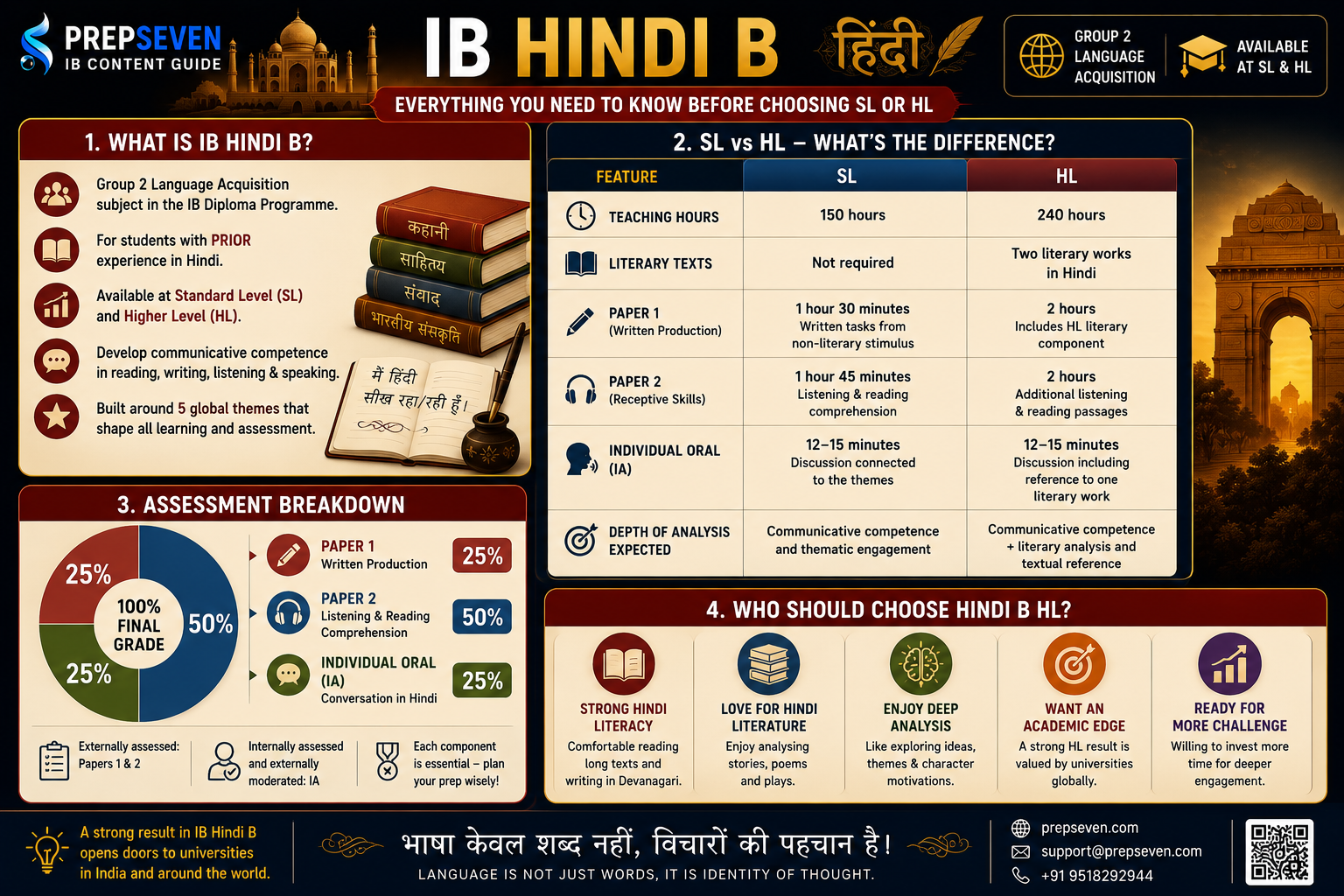
IB Hindi B is the Diploma Programme’s language acquisition course for students who already have some prior experience with Hindi and want to develop genuine communicative competence in the language. It sits in Group 2 of the DP alongside other language B courses and is available at both Standard Level and Higher Level. Hindi B is not designed for native speakers of Hindi. It is designed for students who have encountered Hindi as a school subject or in their environment, have developed a working foundation in the language, and are ready to engage with it at an analytical and communicative level across a structured curriculum.
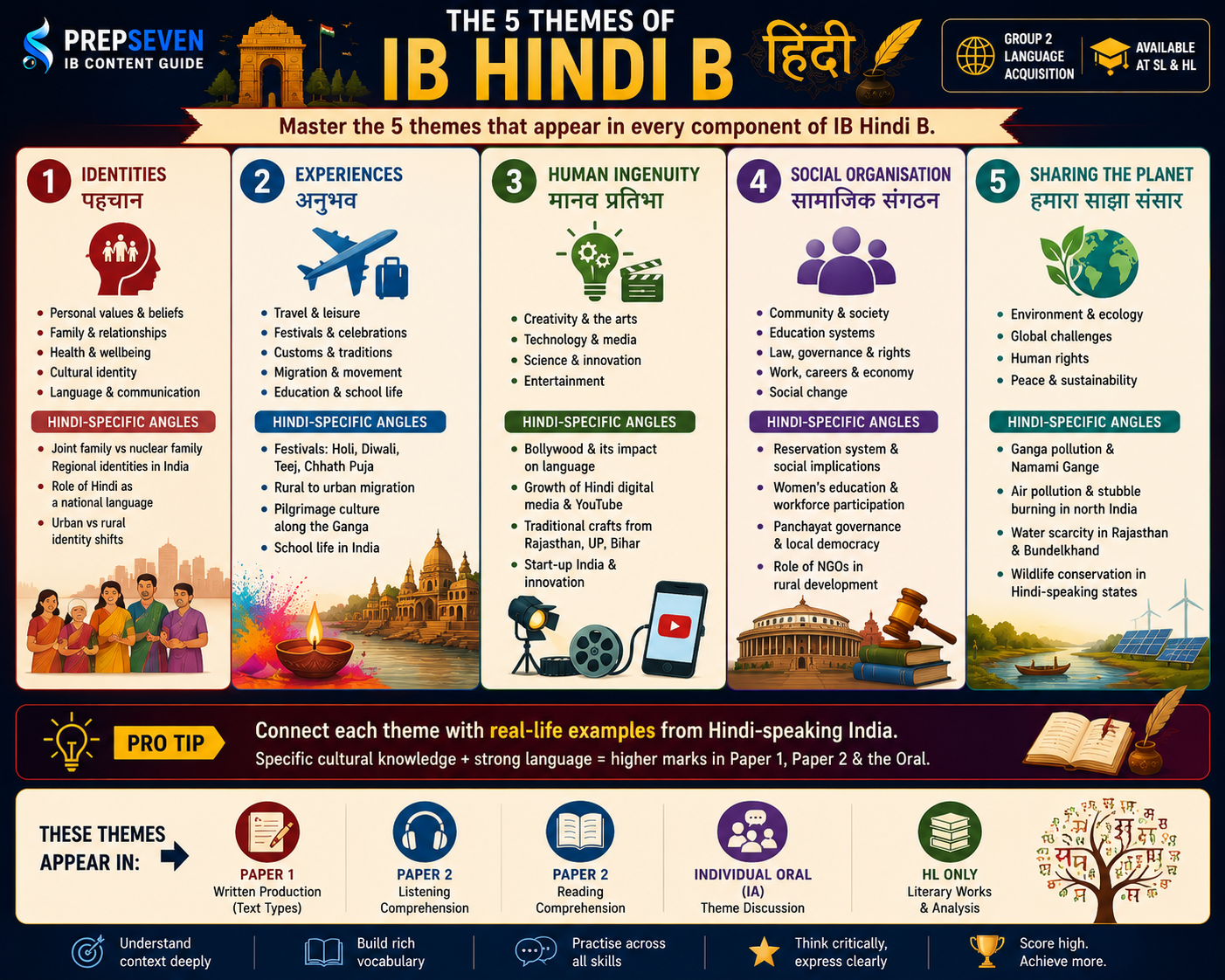
The course is built around five recurring themes: identities, experiences, human ingenuity, social organisation, and sharing the planet. These themes provide the content framework through which language is developed and tested. Everything you read, write, listen to, and speak about in Hindi B connects to one or more of these themes, which is why understanding them deeply, not just as labels but as genuine intellectual territory, is the foundation of good preparation.
What makes IB Hindi B distinctive among language B courses is the specific cultural and social context it operates in. Hindi is the most widely spoken language in India and one of the most spoken languages in the world. Students taking Hindi B are not just learning a language. They are engaging with one of the world’s great literary and cultural traditions, with a society undergoing rapid transformation, and with a language that sits at the intersection of ancient classical heritage and contemporary popular culture. The best Hindi B students bring genuine curiosity about that context to the course, and that curiosity shows up in the quality of their written and oral work.
IB Hindi B is one of the most strategically valuable courses available to Indian international school students who have a functional foundation in Hindi but have not developed it formally. A strong result in Hindi B signals cultural fluency and linguistic range that universities and employers in India, the UK, and internationally recognise as meaningful. Students who treat the course as a guaranteed grade rather than an intellectual opportunity consistently underperform their potential.
Who This Course Is For and Who It Is Not For
Hindi B is intended for students who have previous experience with Hindi, typically from school instruction or from growing up in a Hindi-speaking or Hindi-influenced environment, but who are not native or near-native speakers of the language. The IB’s guidance is that students should not have received their primary or significant secondary education in Hindi-medium schools and should not have Hindi as their dominant home language.
In practice, the students who take Hindi B in Indian international schools often fall into one of a few categories. Some have studied Hindi as a compulsory subject through their junior school years and have a reasonable reading and writing foundation but limited practice with formal written expression or analytical engagement with texts. Some grew up in Hindi-speaking households but attended English-medium schools and have strong oral fluency but underdeveloped literacy. Some attended CBSE or ICSE schools before switching to the IB and have formal Hindi language skills but limited experience with the kind of communicative and thematic analysis the IB requires.
Each of these backgrounds produces a different set of strengths and gaps. Students with strong oral fluency but weak formal writing need to invest in written text type practice and grammatical accuracy. Students with solid literacy but limited oral fluency need to invest in speaking practice and oral technique. Students with formal language skills but limited analytical experience need to build the habit of engaging with texts thematically rather than just comprehending them. Identifying which category you are in is the first step toward a realistic preparation plan.
Students who are genuinely dominant Hindi speakers, who think in Hindi, dream in Hindi, and communicate at home primarily in Hindi, are expected to take Hindi A rather than Hindi B. Placing a near-native speaker in Hindi B is a breach of IB eligibility rules and can result in disqualification of results. If there is genuine ambiguity about which course is appropriate for your level, discuss it honestly with your IB coordinator before your course choices are finalised.
SL vs HL: What the Difference Really Involves
Hindi B is available at Standard Level and Higher Level, and choosing between them has implications for how you approach the course from the beginning. Both levels cover the same five themes and use the same communicative framework, but HL requires the study of two literary works in Hindi and includes additional demands in the Individual Oral and in Paper 1.
The decision between SL and HL should be driven by two questions. First, how confident is your Hindi literacy? HL students need to read two complete literary works in Hindi, understand them analytically, and discuss and write about them in the language. If you read Hindi slowly or find extended reading in the script effortful, HL will require significantly more time investment. Second, how much do you genuinely want to engage with Hindi literature? The literary component of HL Hindi B is one of its most intellectually rewarding elements for students who approach it with genuine interest. For students who see it as an additional burden, it adds workload without adding engagement.
For students at Indian international schools who have solid Hindi foundations and are considering which Group 2 course to take, Hindi B HL is a genuinely strong option. It is a course in a language you have cultural familiarity with, which means the content is often more accessible than a second foreign language at HL would be, and a strong result in Hindi B HL is recognised and valued by Indian universities and employers in ways that a result in a less familiar language may not be.
The Five Themes: What You Actually Study
Every element of IB Hindi B is organised around five themes. These are not just chapter headings. They determine the vocabulary you build, the texts you read, the tasks you are given in Paper 1, and the conversations you have in the oral. Building deep thematic knowledge, including how each theme plays out specifically in Hindi-speaking Indian society and culture, is what separates students who perform at the top of the grade range from those who plateau in the mid-bands.
The cultural specificity in the right column above is not decorative. Examiners notice when students produce generic, context-free responses about identity or the environment versus responses that demonstrate actual knowledge of how these themes play out in Hindi-speaking society. A student who can discuss the Ganga pollution crisis with specific reference to causes, the government response, and community perspectives is producing a more compelling written or oral response than a student who produces generic statements about water pollution. Build the cultural knowledge alongside the language, and your responses will be more persuasive at every level.
Assessment Breakdown: How You Are Graded
Hindi B is assessed through three components: Paper 1, Paper 2, and the Individual Oral. Understanding the weight of each component and what specifically is being tested in each is the foundation of a preparation strategy that allocates effort where it matters most.
Paper 1: Productive Skills (Written)
Paper 1 tests your ability to produce written texts in Hindi. At SL it is one hour and thirty minutes; at HL it is two hours, with the additional time accommodating the literary component. You are given stimulus material and asked to produce one or more written responses in a specified text type. The text types in Hindi B that students need to know and be able to write include formal and informal letters, essays, blog posts, speeches, news articles, diary entries, brochures, and social media posts.
Each text type in Hindi has its own conventions. A formal letter in Hindi uses specific salutation forms, closing phrases, and a register distinct from both spoken Hindi and informal writing. A news article in Hindi follows conventions of Hindi journalism that differ from English news writing in structure and tone. A blog post in Hindi may blend colloquial and formal registers in ways that are specific to contemporary digital Hindi. Students who have only practised freewriting or essay composition in Hindi and have not specifically practised individual text types will lose format marks that have nothing to do with the quality of their language.
Paper 1 is assessed on three criteria: language, message, and format. Language looks at vocabulary range and accuracy, grammatical accuracy, and the variety and sophistication of sentence structures. Message looks at whether your response addresses the task directly, develops ideas with sufficient depth, and communicates clearly. Format looks at whether you have correctly applied the conventions of the text type specified in the task.
The format criterion in Paper 1 is where marks are most consistently lost unnecessarily. A student who writes an excellent essay when the task asks for a speech loses marks not because their Hindi is weak but because they have not applied the conventions of the requested text type. Learn the specific opening phrases, structural expectations, and register of each text type in Hindi. This is entirely learnable before the exam and produces marks that require no additional language improvement to earn.
Paper 2: Receptive Skills (Listening and Reading)
Paper 2 is one hour forty-five minutes at SL and two hours at HL. It tests your ability to understand spoken and written Hindi through listening comprehension and reading comprehension tasks. The texts in Paper 2 come from authentic or near-authentic Hindi sources across the five themes.
The listening section presents recordings of spoken Hindi and asks you to identify specific information, understand the general message, infer meaning from context, and identify the speaker’s attitude or purpose. The recordings include a range of registers, from formal news broadcasts and public speeches to informal conversations and interviews. Students who have only encountered formal classroom Hindi often find authentic spoken Hindi significantly faster and more colloquial than expected.
The reading section presents multiple written texts and asks comprehension questions testing literal understanding, inferential understanding, and the ability to identify the writer’s purpose and attitude. Hindi-language texts use a range of vocabulary that includes Sanskrit-derived formal vocabulary, Urdu-influenced vocabulary in certain registers, English borrowings in contemporary writing, and regional variations in more informal texts. Students who have read broadly in Hindi throughout the course are better equipped to handle this vocabulary range than those who have only read their textbook.
Individual Oral (IA)
The Individual Oral is worth 25% of the final grade and is the component that most directly tests whether a student can actually communicate in Hindi under real-time conversational pressure. Students are shown a visual stimulus connected to one of the five themes and engage in a structured conversation with their teacher. At HL, students must connect the discussion to one of their two literary works. The oral is twelve to fifteen minutes long and is internally assessed by the teacher, with a sample moderated externally by the IB.
The oral is assessed on two criteria: language and communication. Language looks at the range and accuracy of vocabulary, grammatical accuracy and complexity, the variety of sentence structures used, and the naturalness of pronunciation and intonation in Hindi. Communication looks at whether the student can maintain a genuine conversation, respond directly and specifically to questions, develop ideas beyond surface observation, and express and justify personal perspectives on the themes.
The most significant performance problem in the Hindi B oral is what experienced examiners describe as prepared monologue disorder: a student who has memorised several long paragraphs about each theme and tries to deliver them regardless of what the teacher actually asks. This approach earns low marks on communication because it demonstrates the inability to respond flexibly and authentically rather than the ability to converse. The oral is a conversation, not a presentation, and the students who perform best are those who can listen, respond, develop, and disagree in Hindi in real time.
For HL students, the literary text reference in the oral must be specific rather than general. Saying that the image reminds me of the themes in the book is not sufficient. The response that earns marks in the upper band says something like this image of urban poverty reminds me of the character of X in the novel Y, who faces a similar tension between economic necessity and personal dignity, and the author shows us this through a specific scene where… The specificity of the textual reference is what distinguishes a well-prepared HL oral from a generic one.
The Script Question: Devanagari Literacy in Hindi B
Hindi is written in the Devanagari script, and reading and writing ability in Hindi is inseparable from Devanagari literacy. Unlike some language courses where romanisation can serve as a partial substitute, Hindi B exams require students to read and produce text in Devanagari. There is no pinyin equivalent in Hindi B. You write in Devanagari in Paper 1, you read Devanagari in Paper 2, and you are expected to have functional literacy in the script throughout.
Most students taking Hindi B at Indian international schools have some Devanagari literacy from prior Hindi study. The variation is in the depth and fluency of that literacy. A student who can read Devanagari slowly by sounding out each character is in a different position from a student who reads Hindi fluently and can process a paragraph of written Hindi at near-English reading speed. The gap between these two positions matters enormously in Paper 2, where the time available for reading comprehension is not generous, and in Paper 1, where writing fluency under timed conditions depends on Devanagari production being automatic rather than laboured.
Students whose Devanagari reading and writing speed is slow should invest deliberately in building script fluency from the beginning of Year 1. The most effective approach is daily reading of short authentic Hindi texts, starting at a comfortable level and gradually increasing complexity. Hindi news websites, Hindi-language children’s books, or simple blog posts in Hindi are all viable starting points. The goal is to build the automatic character recognition that makes reading feel like reading rather than decoding.
Writing speed in Devanagari matters more than most students realise until they sit their first timed Paper 1 practice. A student who writes Devanagari slowly finds that the time available in Paper 1 is not sufficient to produce a response of the required length at the required quality. If your Devanagari writing is slow, practise handwriting in the script daily, not just typing. Handwriting builds the motor fluency that timed exam writing demands, and typing in Hindi, while useful for class work, does not translate to exam handwriting speed.
Hindi B and the Heritage Speaker Context
A significant proportion of students taking Hindi B at Indian international schools are what linguists call heritage speakers of Hindi: students who grew up hearing or speaking Hindi at home or in their community but received their formal education primarily in English. Heritage speakers often have strong oral comprehension and conversational fluency in Hindi but underdeveloped formal literacy, limited exposure to written Hindi registers, and significant gaps in formal grammar knowledge.
The heritage speaker experience in Hindi B is one of the most common and most misunderstood student profiles in the course. Heritage speakers often assume their oral fluency will carry them through the whole course, and they are right that it gives them a head start in the oral component. But Paper 1 and Paper 2 test written production and comprehension of written and formal spoken Hindi at a level of formal register and grammatical precision that oral fluency alone does not prepare students for.
A heritage speaker who has invested in formal Hindi grammar, in the conventions of written text types, in the vocabulary of formal written Hindi including Sanskrit-derived vocabulary not commonly used in conversation, and in Devanagari reading and writing speed, will find Hindi B significantly more manageable than one who relies on oral fluency and conversational vocabulary throughout. The formal written register of Hindi is genuinely different from conversational Hindi, and students who have not developed familiarity with it will find Paper 1 harder than expected.
HL Literary Texts: What Genuine Engagement Looks Like
HL students study two literary works in Hindi. These are chosen from the IB’s approved list and typically include a novel or short story collection and a play or poetry collection, though schools have some flexibility. The literary requirement is not supplementary to the HL course. It directly affects Paper 1, the Individual Oral, and the cultural depth that is expected of HL responses throughout.
The most effective approach to the literary texts is to read them actively and to build explicit thematic connections as you read. Active reading means noting which of the five IB themes each text explores and where, identifying specific scenes, characters, or passages that illustrate those themes, and forming genuine personal responses to the literary work that you can articulate in Hindi. A student who can say in Hindi that the author of X uses the character of Y to explore the tension between traditional family expectations and individual aspiration, and can cite a specific moment in the text that illustrates this, is prepared for the HL oral. A student who knows the plot and has a general impression of the themes is not.
Hindi literature offers extraordinary material for the five IB themes. The great novelists of the Hindi canon, Premchand, Nirala, Jaishankar Prasad, Harivansh Rai Bachchan, Mahadevi Verma, Mannu Bhandari, and their contemporaries, engage deeply with social organisation, identity, human experience, and the relationship between individuals and their communities. Students who engage genuinely with the literary texts, rather than treating them as an additional burden, often find that the literary works become the most memorable intellectual experience of the Hindi B course.
Keep a literary journal as you read each HL text. After each chapter or section, write three or four sentences in Hindi summarising what happened, identifying one connection to the IB themes, and noting a piece of specific language or imagery that struck you. This journal is revision material before the oral and Paper 1, and the act of writing in Hindi regularly about what you are reading reinforces both your language production and your textual engagement simultaneously.
What Actually Gets Students to a 7
They know Hindi beyond the classroom
The students who perform at the top of the grade range in Hindi B are those who have built a genuine relationship with Hindi outside of lessons. They watch Hindi-language films, news programmes, or documentaries. They read Hindi newspapers or online articles, however briefly. They listen to Hindi music and pay attention to the lyrics. They have conversations in Hindi with family or community members. This continuous exposure builds the vocabulary range, the register flexibility, and the cultural knowledge that the exam rewards, and none of it can be replicated through classroom instruction alone.
They have a wide and precisely differentiated vocabulary
Vocabulary in Hindi B needs to be organised by register as much as by theme. The vocabulary appropriate for a formal speech or a newspaper article is different from the vocabulary appropriate for a blog post or an informal letter, and both are different from conversational Hindi. Students who score in the top bands have a vocabulary that spans these registers and can select appropriate words for the context of each task rather than defaulting to the same vocabulary regardless of what is being asked.
They practise each text type specifically and repeatedly
Paper 1 asks you to produce a specific text type under time pressure. Students who have written formal Hindi letters, speeches, essays, blog posts, and news articles repeatedly throughout both years know exactly what each type requires and can produce a correctly formatted response automatically. Students who have only practised general writing in Hindi find that the format criterion in Paper 1 costs them marks that better preparation would have secured.
They treat the oral as a conversation, not a performance
The Individual Oral is assessed on communication as well as language, and communication means genuine responsiveness to the conversation, not the delivery of prepared material. Students who practise the oral by rehearsing prepared speeches about each theme arrive at the exam unable to respond flexibly when the teacher’s questions go in an unexpected direction. Students who practise responding to unprepared questions, in actual conversations with teachers, tutors, or Hindi-speaking peers, build the conversational flexibility that communication criterion rewards.
They engage seriously with Paper 2 listening throughout both years
Listening comprehension in Hindi B requires auditory processing skills that develop slowly through exposure to authentic spoken Hindi. Students who listen to Hindi audio consistently throughout both years, progressively increasing the difficulty and speed of what they listen to, develop the ability to parse fast natural speech that Paper 2 demands. Students who begin listening preparation in the months before the exam consistently find that their listening comprehension lags behind their reading and writing ability because it cannot be crammed.
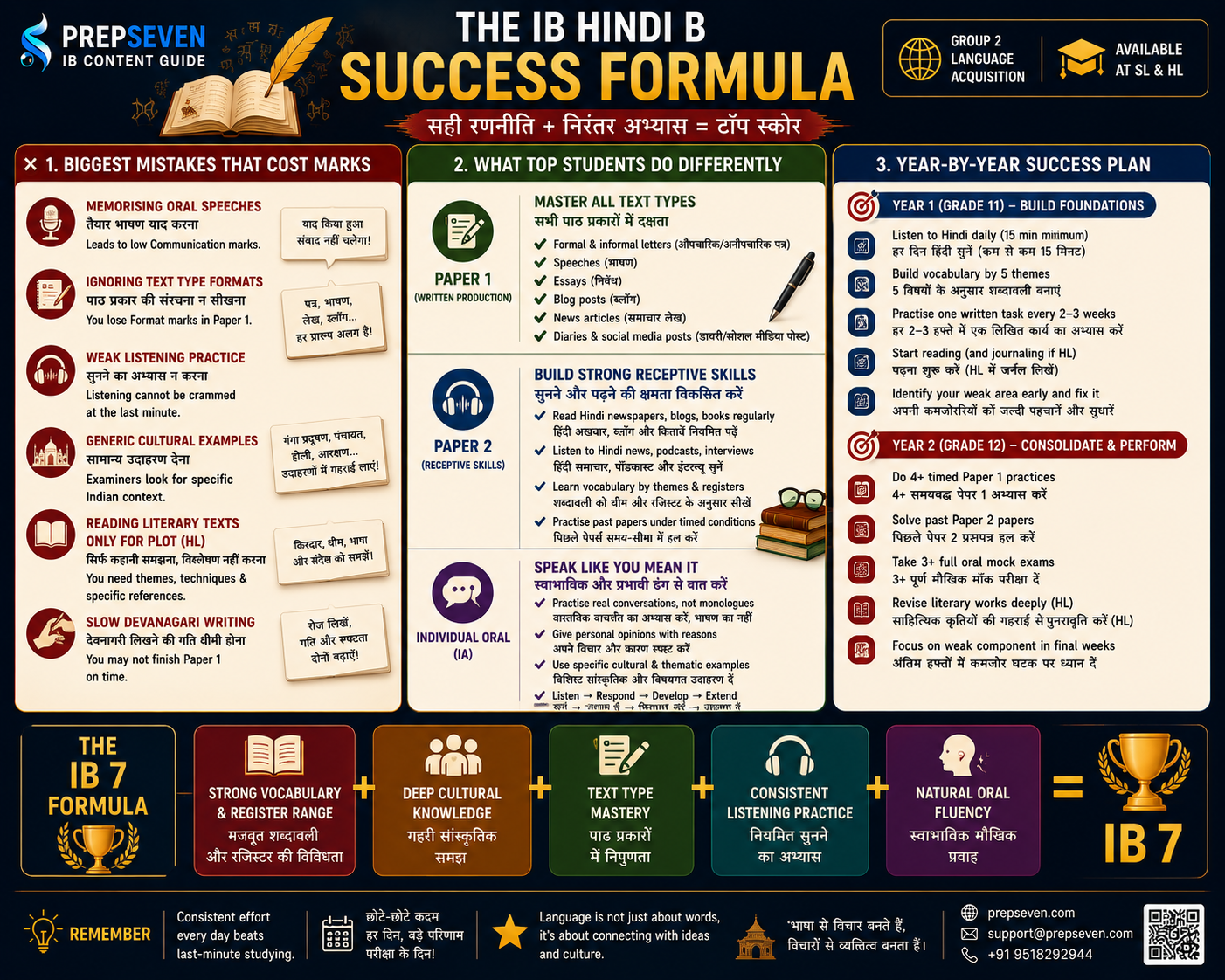
Common Mistakes That Cost Marks
A Realistic Year-by-Year Approach
Year 1 (Grade 11): Build Foundations and Habits
- Start listening to authentic Hindi audio from the beginning of Year 1. Choose material that is slightly above your current comfort level, Hindi news broadcasts, Hindi documentary content on YouTube, or intermediate Hindi podcasts, and listen for at least fifteen minutes every day outside of class. The auditory processing required for Paper 2 listening builds through cumulative exposure, not through concentrated pre-exam effort.
- Build thematic vocabulary lists for each of the five IB themes as they are introduced in class. Organise vocabulary by theme and by register, noting whether each word belongs to formal written Hindi, journalistic Hindi, or conversational Hindi. This thematic and register organisation makes pre-exam vocabulary revision significantly more efficient.
- Practise at least one complete Paper 1 written task in a specific text type every two to three weeks throughout Year 1. Rotate through the main text types: formal letter, informal letter, speech, essay, blog post, diary entry, and news article. Get teacher feedback on format accuracy as well as language quality. Build the habit of checking the text type requirements before writing a single sentence.
- For HL students, begin reading the first literary text as early in Year 1 as your teacher assigns it, and start the literary journal immediately. Do not wait for the formal literary study period. Familiarity with the text built over months produces much deeper engagement than reading it in compressed time before the exam.
- Identify early whether your weaker component is oral fluency, formal written production, listening comprehension, or reading speed, and begin targeted work in that area from Term 1 of Year 1. The students who arrive at Year 2 with balanced skills across all components are in the strongest position. Imbalanced preparation catches up with students in the exam.
Year 2 (Grade 12): Consolidate and Perform
- Complete at least four timed Paper 1 practice tasks under exam conditions before your mock exam, writing by hand if your exam requires handwritten production. Mark your responses against the three criteria and build an error log that distinguishes language errors, message gaps, and format mistakes. Each type of error requires a different correction strategy.
- Work through past Paper 2 listening and reading tasks from the beginning of Year 2. Use the IB’s past papers and mark schemes to identify whether your errors in listening are attention errors, vocabulary errors, or comprehension errors. Each has a different cause and a different solution.
- Complete at least three full oral practices in exam format before your actual Individual Oral, with at least one conducted by someone who can give you genuine feedback rather than just confirmation that you did well. Record each practice. Listen back and identify where your language reverts to simpler structures under conversational pressure and where your analytical development of ideas stops short of what the communication criterion rewards.
- For HL students, revise both literary works thoroughly in Term 2 of Year 2. Prepare five or six thematic angles for each text, with specific scenes, passages, or characters that illustrate each angle, and practise introducing these references naturally in conversation rather than as a prepared speech insert.
- In the final four to six weeks before the exam, focus your Paper 2 preparation on whichever component, listening or reading, has shown the weakest performance in your practice sessions. For Paper 1, focus on the text type where your format accuracy has been least consistent. These targeted adjustments in the final weeks produce significantly better results than undifferentiated general revision.
How PrepSeven Helps You Score Higher in IB Hindi B
IB Hindi B sits at an unusual intersection: it is a language that many Indian international school students have some relationship with, but the specific demands of the IB assessment, the formal written registers, the text type conventions, the literary analysis at HL, and the oral technique required for the top band, are not things that prior Hindi exposure automatically prepares students for. The students who reach 6s and 7s are those who have had expert guidance on exactly what the assessment rewards and how to produce it. Our Hindi B tutors are certified IB examiners and experienced language teachers who know this course from the inside.
- Paper 1 written task sessions where your tutor marks your responses exactly as an IB examiner would, showing you precisely where your format, language accuracy, and message development are losing marks, and what a full-band response to the same task looks like across every text type you will encounter in the exam.
- Individual Oral preparation sessions where your tutor conducts a simulated oral and assesses your performance against both criteria, identifies where your responses stay at surface level or revert to memorised material, and coaches you on the specific conversational moves that push communication scores into the upper band.
- Listening comprehension sessions using authentic Hindi audio at the level and speed of Paper 2, with targeted work on the inference and attitude questions that students without regular listening exposure find consistently hardest.
- HL literary text sessions where your tutor works through both texts with you, building the thematic frameworks, specific textual references, and Hindi language to discuss the works analytically in the oral and in Paper 1’s HL component.
- Vocabulary building sessions organised around the five themes and the register distinctions between formal written Hindi, journalistic Hindi, and conversational Hindi, building the vocabulary range that the language criterion’s top band requires.
Book your free demo lesson at prepseven.com. Bring a recent Paper 1 written task or describe your current oral preparation approach. Your tutor will give you a clear assessment of where your preparation stands against the IB criteria and what the most efficient path to your target grade looks like from where you are now.