
PrepSeven | IB Content Guide authored by Shankar Mutneja (Founder of Prepseven)
IB German B
What Is IB German B?
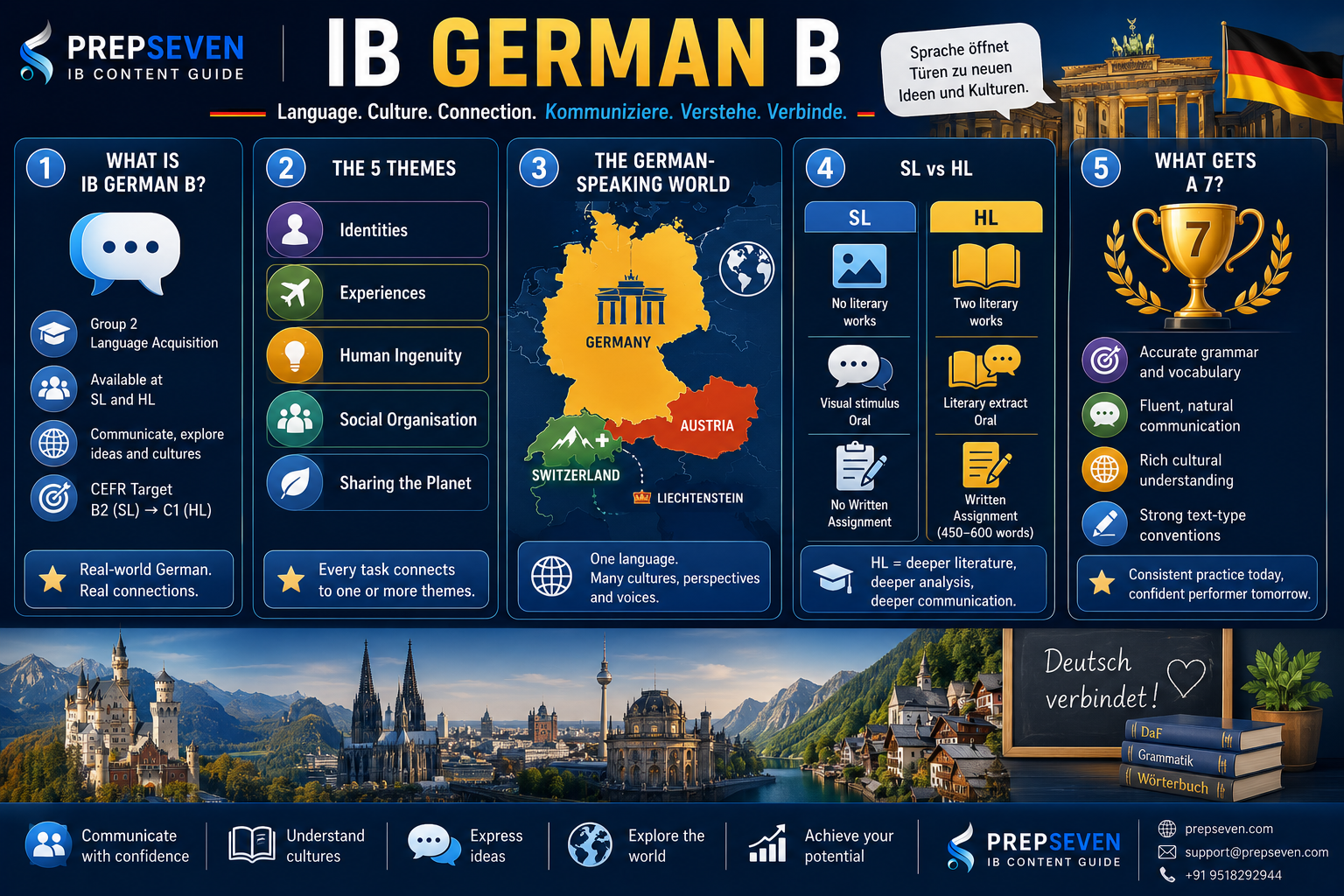
IB German B is the language acquisition course for students who already have a meaningful foundation in German and want to develop that into genuine communicative and cultural fluency through the IB Diploma Programme. It sits in Group 2 of the diploma and is available at both Standard Level and Higher Level.
German B is built around the same five themes that run through all IB language acquisition courses: identities, experiences, human ingenuity, social organisation, and sharing the planet. Every text you read, every listening task you complete, every piece of writing you produce, and every oral interaction you practise connects to one or more of these themes. The course is not just about language accuracy. It is about using German to engage with ideas, cultures, and real-world issues across the German-speaking world.
What makes German B genuinely rewarding at the IB level is that it goes well beyond grammar and vocabulary. The German-speaking world, which includes Germany, Austria, Switzerland, Liechtenstein, and significant German-speaking communities across the globe, has a rich and complex cultural, historical, and political identity. The course rewards students who engage with that breadth rather than treating German as a monolithic language from a single country.
German has a reputation among language learners for being grammatically demanding, and that reputation is not entirely undeserved. The four-case system, grammatical gender, adjective declension, and word order rules all require sustained attention and consistent practice to master at the B2 to C1 level that German B targets. Students who expect grammar to take care of itself through exposure alone often find their accuracy plateauing well short of the level needed for the top grade bands.
Are You in the Right Course?
Placement between German Ab Initio, German B, and German A matters more than students often realise before the two years begin. Getting it wrong has consequences that are difficult to reverse.
German B SL is designed for students who have studied German for three to five years and can already hold a basic conversation, read simple texts, and write short paragraphs with manageable accuracy. German B HL assumes a stronger foundation and targets C1, which requires the ability to express nuanced ideas fluently, read literary texts critically, and sustain extended conversation on complex themes.
If German is spoken at home, or you grew up in a German-speaking country, speak honestly with your coordinator about whether German B or German A is the more appropriate course. Students whose natural German proficiency significantly exceeds the B level will not develop their language meaningfully in German B, and the IB may raise concerns about inappropriate course placement in either direction.
SL vs HL: What the Difference Really Means
The gap between German B SL and HL is substantial in practice. HL students study two literary works in German, which changes the character of the course fundamentally. The Individual Oral at HL is built around literary text analysis rather than a visual stimulus, and Paper 2 includes a literary comprehension question that SL students do not face.
The HL Individual Oral is where the literary dimension becomes most directly assessed. At SL, you describe an unseen visual stimulus and then enter a broader conversation about the theme it represents. At HL, you choose an extract from one of your two literary works, speak about how it connects to a course theme, and then enter a conversation that moves between the work and the broader thematic framework of the course. The ability to analyse a German literary text with genuine depth, in German, under exam conditions, is a high-level skill that requires sustained engagement with the works throughout both years.
Students choosing HL German B should genuinely want to engage with German literature and culture at depth rather than choosing HL purely for the perceived university signal. The two literary works are not supplementary reading. They shape the HL Individual Oral and contribute to Paper 2 directly. Students who disengage from the literary component consistently underperform relative to their general German ability.
The Five Themes: Content and Exam Relevance
Germany’s Energiewende, the ambitious transition from fossil fuels and nuclear power toward renewable energy, is one of the richest real-world sources of content for the Sharing the Planet theme in IB German B. It connects environmental science, political decision-making, economic trade-offs, and German national identity in a way that is directly relevant to the IB’s thematic framework. Students who understand it well have a natural advantage when this theme appears in Paper 2 comprehension or Paper 1 writing tasks.
Assessment Breakdown: How You Are Graded
Paper 1: Productive Writing
Paper 1 is one hour fifteen minutes at SL and one hour thirty minutes at HL. It presents stimulus material and asks you to produce one or two pieces of writing in specified text types. The text types that may appear include formal and informal letters, emails, blog posts, opinion articles, speeches, reports, social media posts, and interviews.
The three criteria are Language, Message, and Conceptual Understanding of the text type. Language covers grammatical accuracy, vocabulary range, and clarity of expression. Message covers whether you have communicated the required content fully. Conceptual Understanding covers whether your writing correctly reflects the conventions of the text type you were asked to produce.
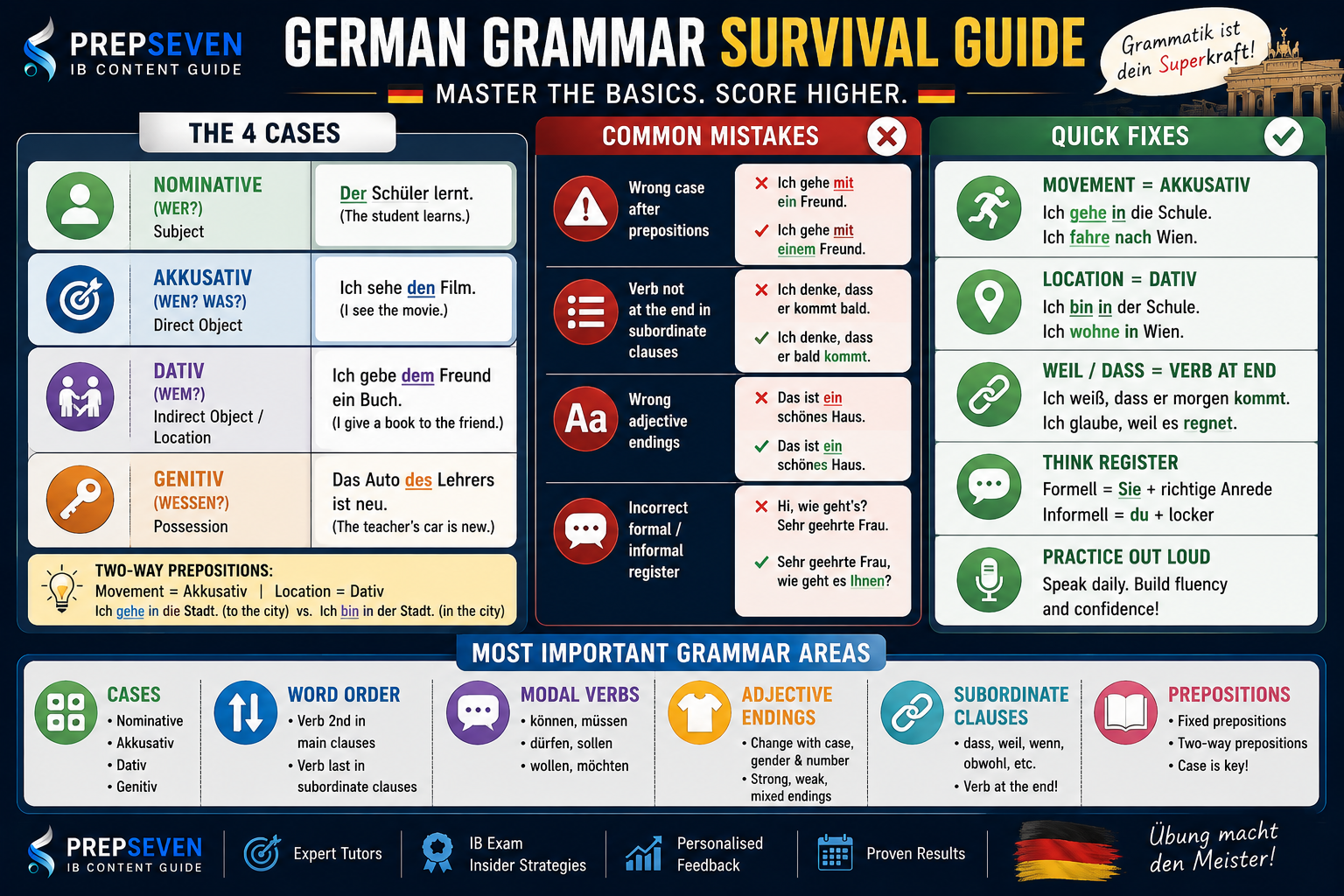
German grammar is where the Language criterion is most visibly tested in Paper 1. Case endings, verb placement in subordinate clauses, adjective declension, and the correct use of modal verbs are all features that examiners notice immediately. A student who writes grammatically complex German with consistent case errors is signalling a gap in formal grammatical control. A student who writes slightly simpler German that is consistently accurate signals genuine command of the language. The Language criterion rewards accuracy and appropriate range, not complexity for its own sake.
German word order is one of the most consistent sources of mark loss in Paper 1. The verb-second rule in main clauses, the verb-final rule in subordinate clauses, and the specific placement of separable verb prefixes are features of German grammar that English speakers consistently get wrong because they have no equivalent in English. These are rules that can be learned and practised until they become automatic, and doing so from the start of Year 1 pays dividends across every piece of writing you produce in the course.
Paper 2: Reading Comprehension
Paper 2 is one hour at SL and one hour thirty minutes at HL. The reading section presents three texts in German at SL and four texts at HL, with comprehension questions answered in English. At HL, the fourth text is a literary or literary non-fiction passage with questions that go beyond comprehension to analyse how language creates meaning.
Reading comprehension in German at this level tests the ability to understand not just explicit content but implied meaning, attitude, and tone. German journalism and literary non-fiction in particular frequently uses irony, understatement, and complex subordinate clause structures that require careful reading rather than surface scanning. Students who have read authentic German texts regularly throughout both years find the reading comprehension significantly more manageable than those whose only exposure to written German has been through course textbooks.
The HL literary text question is where students who have genuinely engaged with their literary works at depth have a clear advantage. The question asks you to identify not just what the writer says but how the language creates specific effects: the connotations of a word choice, the tone established by sentence rhythm, the implied meaning of a passage whose surface content appears straightforward. This requires a level of literary reading competence in German that only develops through close, attentive engagement with literary texts throughout the course.
Individual Oral
The Individual Oral contributes 30% of the SL grade and 20% of the HL grade. It is conducted by your teacher, recorded, and externally moderated by the IB. It lasts approximately twelve to fifteen minutes in total.
At SL, you are shown an unseen visual stimulus connected to one of the five themes and given preparation time. You speak about the image for approximately two minutes before entering a broader conversation about the relevant theme. At HL, you choose an extract from one of your literary works before the exam, speak for two minutes about how it connects to a course theme, and then enter a conversation that moves between the literary text and the broader themes.
The oral is assessed on Language and Communication, and Cultural Awareness. Language and Communication covers accuracy, fluency, and conversational ability in German. Cultural Awareness covers whether you demonstrate genuine knowledge of and engagement with German-speaking cultures in your responses.
The Cultural Awareness criterion in German B has a specific dimension that sets it apart from many other IB language courses: the weight of twentieth-century German history in contemporary German cultural identity. How contemporary Germany engages with its Nazi past, the significance of reunification in 1990 for German national identity, the Erinnerungskultur or culture of remembrance that shapes German public life, and the ongoing debates about integration and belonging in a diverse modern Germany, these are all thematically relevant to multiple of the five IB themes and are exactly the kind of culturally specific knowledge that the criterion rewards.
Students who engage with contemporary German media, German politics, and German cultural life throughout both years of the course arrive at the Individual Oral with a depth of cultural reference that cannot be manufactured in the weeks before the exam. Thirty minutes per week of authentic German content, whether news, documentary, podcast, or social media, builds this cultural fluency over time in a way that is both linguistically and culturally enriching.
HL Written Assignment
The HL Written Assignment is 450 to 600 words and connects one of the two literary works to one of the five course themes. It is externally marked and carries 15% of the final HL grade. The format is flexible: it can be an analytical response, a piece of creative writing inspired by the work, or a reflective engagement with how the work illuminates a theme.
The criteria are Language, Content, and Format and Register. The Content criterion rewards students who demonstrate genuine intellectual engagement with both the literary work and the broader course theme, connecting them specifically and meaningfully rather than superficially. A student who writes with real insight about how a specific aspect of a literary work speaks to a contemporary German cultural or social issue will score significantly higher than one who produces technically correct German about a vague thematic connection.
Grammar Spotlight: The Four Cases and Why They Define Your Grade
German grammar is more systematically case-inflected than English, French, or Spanish, and the four-case system is where the Language criterion in Paper 1 and the spoken fluency in the Individual Oral are most clearly tested. The four cases are nominative, accusative, dative, and genitive. Each changes the form of articles, adjectives, and some pronouns depending on the grammatical role of the noun in the sentence.
Students at B2 level are expected to use all four cases with reasonable consistency. Students at C1 level are expected to use them accurately and naturally, including in subordinate clauses, after two-way prepositions, and with indirect objects in complex sentence structures. Getting to C1 accuracy in case usage requires more than understanding the rules. It requires the kind of repeated practice where correct case endings become automatic rather than the product of conscious deliberation.
Two-way prepositions are where case errors are most concentrated in IB German B student writing. Prepositions like in, an, auf, uber, unter, vor, hinter, neben, and zwischen take accusative when indicating movement or direction and dative when indicating location or state. The question to ask is always: is something moving toward a destination (accusative) or is something at a location (dative)? Ich gehe in die Schule uses accusative because going involves movement to a destination. Ich bin in der Schule uses dative because being involves location. Build this distinction as a reflex rather than a rule to look up.
What Actually Gets Students to a 7
They build grammatical accuracy through deliberate practice, not just exposure
German grammar does not improve significantly through exposure alone at the level IB German B demands. Reading and listening to German builds vocabulary, familiarity with natural phrasing, and cultural knowledge, all of which are valuable. But the case system, adjective declension, verb placement in subordinate clauses, and the correct use of modal and reflexive verbs require deliberate, targeted practice where you are consciously applying the rules and correcting yourself when you get them wrong. Students who read extensively in German but never practise grammar deliberately often find their spoken German sounds natural but their written German contains systematic errors that the Language criterion penalises consistently.
They consume authentic German content regularly from both Germany and Austria
The Cultural Awareness criterion in the Individual Oral and the thematic engagement rewarded in Paper 1 both benefit significantly from genuine cultural familiarity with the German-speaking world. The Deutsche Welle Langsam gesprochene Nachrichten podcast provides news in clearly spoken German at a pace accessible to upper-intermediate learners. ARD and ZDF both have extensive free online content including news, documentary, and cultural programming. Austrian and Swiss German content, which is less commonly encountered in language courses but specifically valued by the IB’s emphasis on the diversity of German-speaking cultures, can be found through ORF in Austria and SRF in Switzerland. Variety of cultural input builds the range of reference that distinguishes a 6 from a 7 in the oral.
They learn text type conventions before the exam
The Conceptual Understanding criterion in Paper 1 is where marks are won or lost based on preparation that has nothing to do with German proficiency. A formal letter in German opens with Sehr geehrte Damen und Herren or the named recipient in formal address, uses the Sie form consistently, and closes with Mit freundlichen Grussen. A blog post uses du, an informal and personal voice, and direct address to the reader. A speech uses rhetorical structuring, audience address, and persuasive language. These conventions are German-specific, learnable, and directly assessed. A student who has practised each text type at least once during the two years arrives at Paper 1 with an advantage that requires almost no additional German ability.
They practise speaking German out loud consistently
Oral fluency in German requires physical practice. The sounds of German, the guttural ch, the umlaut vowels, the consonant clusters, and the sentence-final verb in subordinate clauses are all features that feel unnatural to produce for non-native speakers until they have been practised enough to become automatic. Students who have spoken German regularly throughout both years, in class discussions, with a language partner, with a tutor, or even talking to themselves during revision, develop the motor fluency that makes the Individual Oral manageable. Students who have studied German silently often discover in the oral that their productive German is significantly weaker than their receptive German.
They engage seriously with the HL literary works from the start
HL students who treat the literary works as supplementary reading to be caught up with before the exam are at a significant disadvantage in both Paper 2 and the Individual Oral. The HL literary text question in Paper 2 requires close reading at the level of language choices and implied meaning in German, not just plot comprehension. The HL Individual Oral requires you to speak with intellectual depth about the work in German and defend your analysis under questioning. Both require the kind of familiarity that only comes from careful, attentive reading of the actual text, with annotation, throughout both years of the course.
Common Mistakes That Cost Marks
A Realistic Year-by-Year Approach
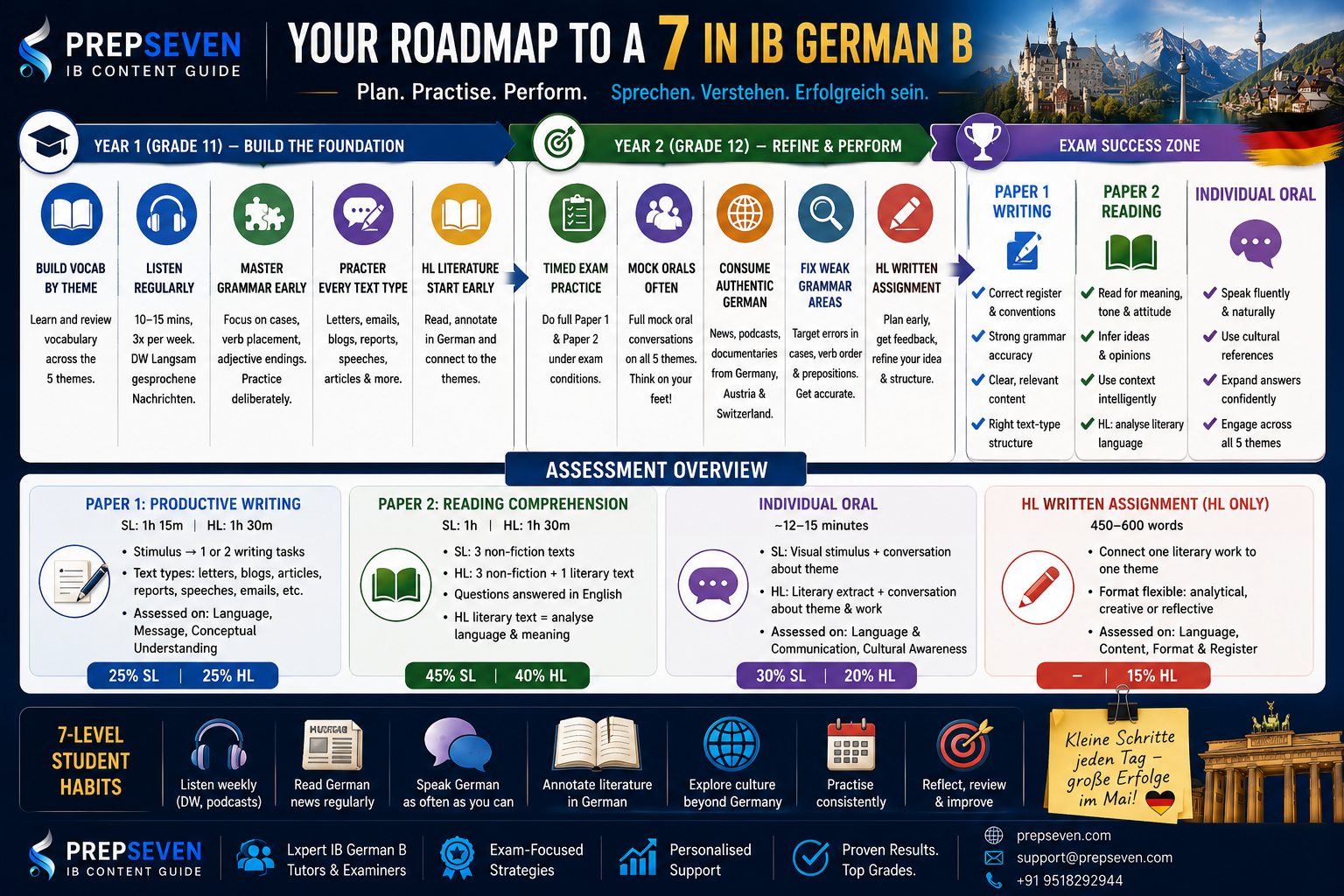
Year 1 (Grade 11): Build Accuracy and Cultural Foundation
- Organise your vocabulary learning by the five themes from week one. Every new word and phrase goes into its theme category and gets reviewed weekly.
- Establish a German listening habit from the first month. Deutsche Welle’s Langsam gesprochene Nachrichten is pitched specifically for upper-intermediate learners and covers news relevant to the IB themes. Ten to fifteen minutes three times a week builds far more than intensive pre-exam cramming.
- Practise case endings deliberately in every piece of writing and every oral exercise. Do not move past a sentence with a preposition or an article without checking you have used the correct case.
- Practise each Paper 1 text type at least once during Year 1 and ask for feedback specifically on German-specific text type conventions, not just language accuracy.
- For HL students: begin reading the first literary work as soon as your teacher assigns it. Annotate in German as you read, noting vocabulary, cultural references, and thematic connections.
Year 2 (Grade 12): Consolidate and Prepare to Perform
- Complete at least four full timed Paper 2 comprehension exercises under exam conditions before your mock exams. Focus particularly on inference and attitude questions, which require more than surface reading.
- Practise the Individual Oral at least three times in realistic conditions with someone who can conduct a full mock conversation in German, including unpredictable follow-up questions on all five themes.
- For HL students: submit your Written Assignment first draft for teacher feedback before the end of Term 1. Use the feedback cycle and give yourself time to experiment with format before committing to a final approach.
- In the final revision period, target the grammar structures where your error rate in practice writing is highest. Verb placement, case endings, and adjective declension are the three areas that most consistently separate the 6 and 7 grade boundaries in Paper 1.
How PrepSeven Helps You Score Higher in IB German B
German B requires both linguistic precision and cultural depth, and developing both simultaneously while managing a full diploma workload is demanding. Our German B tutors are experienced IB language teachers and examiners who understand the specific grammatical demands of German at this level and know exactly where students lose marks across each component.
- Paper 1 writing sessions where you produce a timed writing task and your tutor marks it against the three criteria, giving specific feedback on case accuracy, word order, text type conventions, and message completeness.
- Paper 2 comprehension sessions where your tutor builds your reading strategy for German texts, works through listening comprehension with past paper audio, and helps you develop the inference and literary analysis skills that the HL paper demands.
- Individual Oral preparation sessions where your tutor conducts a full mock oral in German, starting with the stimulus or literary extract and moving through an unpredictable themed conversation, with feedback on fluency, accuracy, and cultural awareness.
- Grammar sessions targeting the specific areas where your accuracy is weakest, built around the structures that the Language criterion most directly assesses: cases, verb placement, adjective declension, and modal verbs.
Book your free demo lesson at prepseven.com. Bring a Paper 1 writing task you have already completed or a grammar area you want to work on. Your tutor will show you exactly where your German stands against the IB criteria and what it takes to reach a 7.