PrepSeven | IB Content Guide authored by Shankar Mutneja (Founder of Prepseven)
IB French B
What Is IB French B?
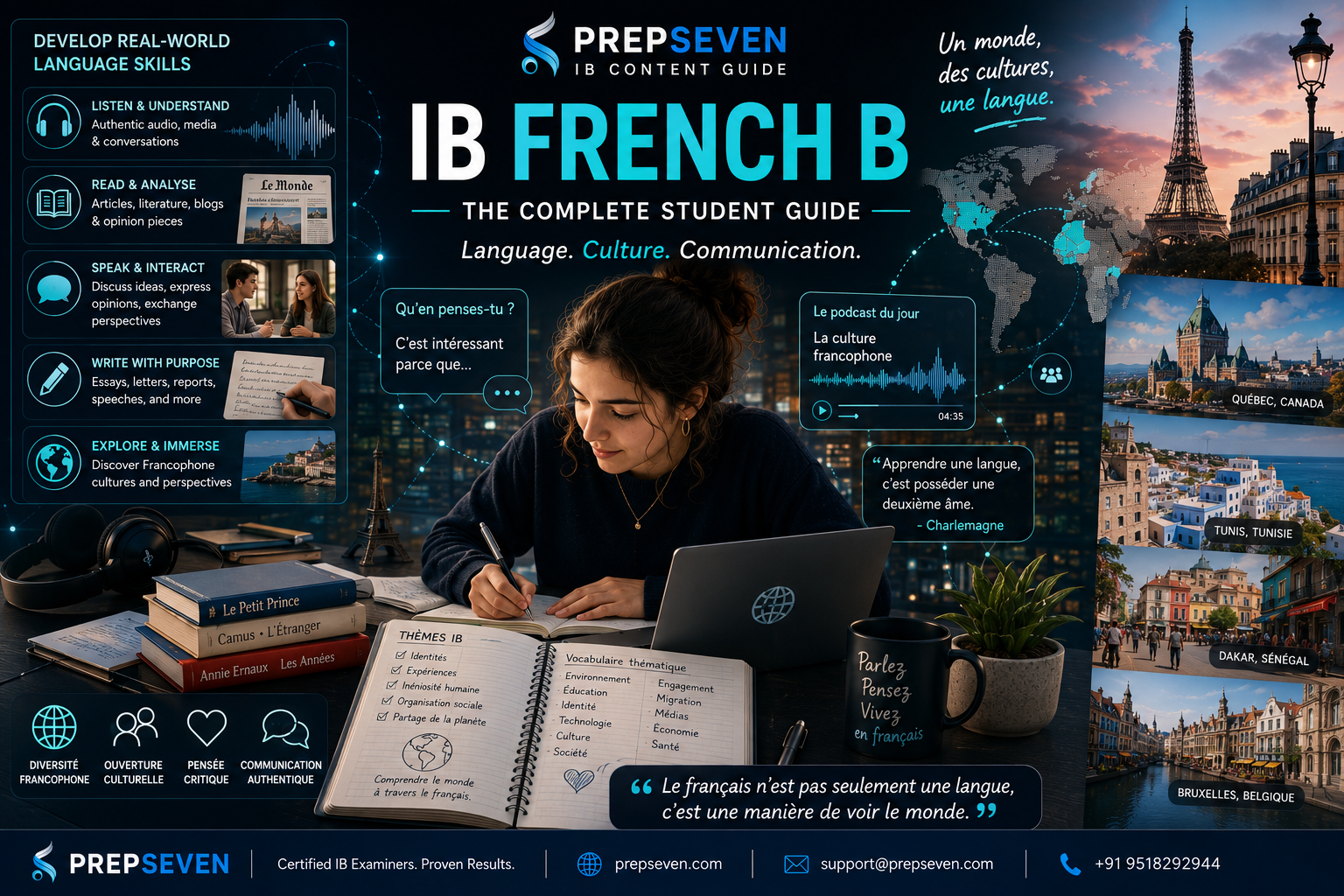
IB French B is the language acquisition course for students who already have some experience learning French and want to develop it to a high level of proficiency through the IB Diploma Programme. It sits in Group 2 of the diploma, which covers language acquisition across all languages. French B is the most commonly taken Group 2 language worldwide, and it is available at both Standard Level and Higher Level.
The course is built around five themes: identities, experiences, human ingenuity, social organisation, and sharing the planet. These themes are not just content topics to read about. They are the lenses through which you develop your ability to understand, speak, read, and write in French across a wide range of real-world contexts. By the end of the two years, the expectation is that you can engage with French language and Francophone cultures with genuine fluency and intellectual depth.
What distinguishes French B from a standard language course is that it treats language and culture as inseparable. You are not just learning grammar and vocabulary. You are learning how French is used in France, in West Africa, in Quebec, in Belgium, in the Maghreb, and across the wider Francophone world. That cultural dimension is explicitly assessed and it rewards students who are genuinely curious about the French-speaking world rather than those who are only focused on passing the exam.
A common misunderstanding about French B: it is not the course for complete beginners. Students who are starting French from scratch should be in French Ab Initio. French B is designed for students who have been learning French for three to five years and already have a solid foundation in grammar and vocabulary. Arriving in French B without that foundation puts you at a serious disadvantage from the very first lesson.
French B, Ab Initio, and French A: Understanding the Difference
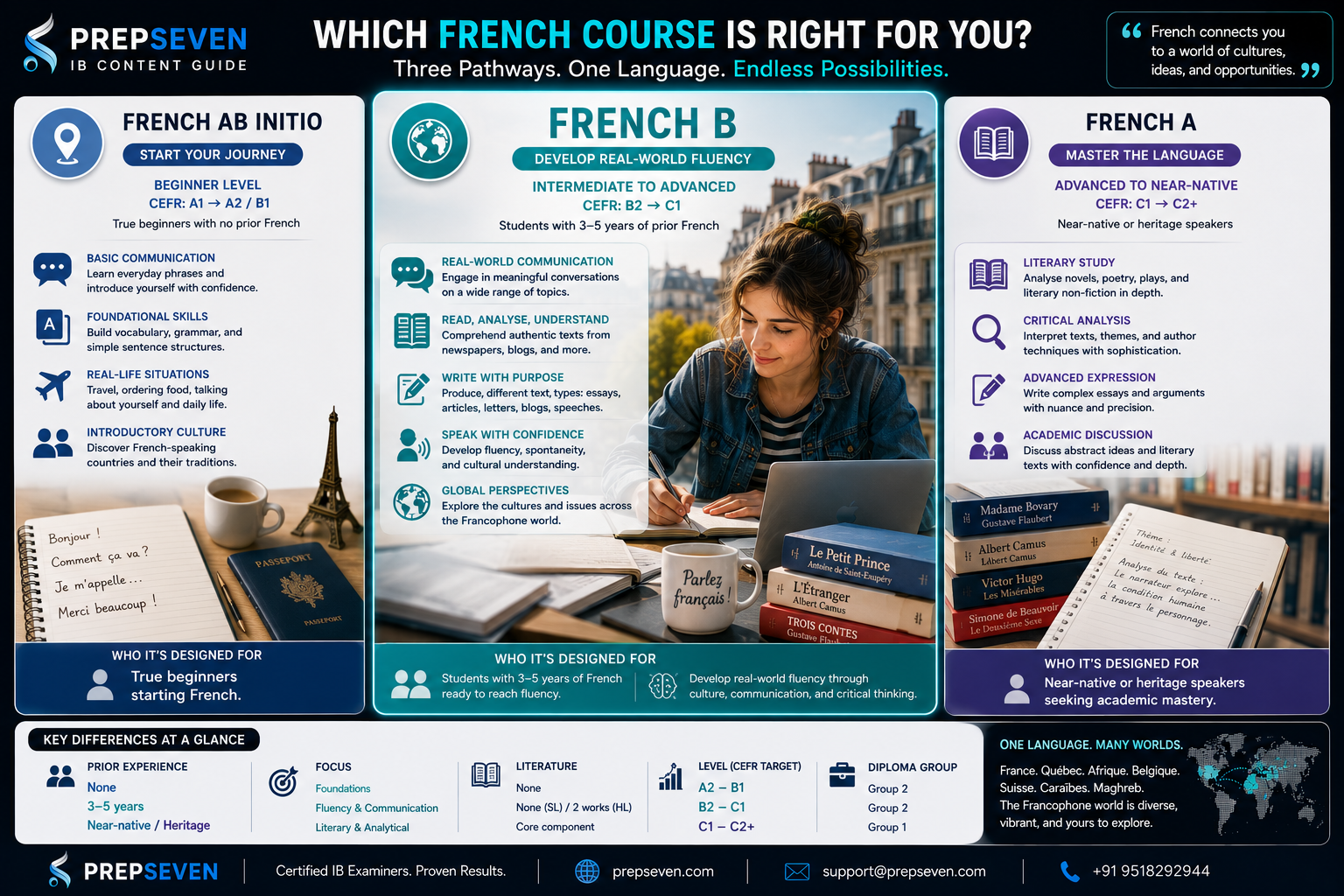
IB students studying French have three potential course options, and choosing the right one from the start matters considerably for both exam performance and diploma planning.
Feature
French Ab Initio
French B
French A
Who it is for
True beginners with no prior French
Students with 3 to 5 years of prior French
Near-native or heritage speakers
Level (CEFR)
Aims for A2 to B1
Aims for B2 to C1
C1 to C2 and beyond
Literary texts
None
Two literary works at HL
Central to the entire course
Available levels
SL only
SL and HL
SL and HL
Group 2 requirement
Satisfies Group 2
Satisfies Group 2
Satisfies Group 1 (not Group 2)
The most important distinction for diploma planning is that French A sits in Group 1, not Group 2. A student who takes French A is using their Group 1 slot for French, which means they need a different language or subject for Group 2. Students who are genuinely near-native in French should consider whether French A or French B better serves their overall diploma combination, not just their French proficiency.
If you are a heritage French speaker or you have lived in a French-speaking country for several years, speak honestly with your coordinator about whether French B HL is the right course for you. Taking a course that is significantly below your actual level of proficiency means you are not developing your language skills, and if the IB determines that a student is enrolled in an inappropriate course for their ability, it can create complications for your diploma results.
SL vs HL: The Differences That Actually Matter
The gap between French B SL and HL is significant in practice, and it goes beyond the obvious difference in teaching hours. At HL, students study two literary works in French, which are assessed in both the Individual Oral and in Paper 2. This literary dimension fundamentally changes the nature of the course at HL.
Feature
SL
HL
Teaching hours
150 hours
240 hours
Literary works
None required
Two literary works studied in French
Paper 1
Productive writing tasks based on stimulus
Productive writing tasks based on stimulus (more complex texts)
Paper 2
Reading comprehension across three texts
Reading comprehension plus literary text analysis
Individual Oral
Based on a visual stimulus, conversation on themes
Based on a literary extract, conversation on themes and works
CEFR target
B2
C1
The HL Individual Oral is substantially more demanding than the SL version. At SL, you are given an unseen visual stimulus and asked to speak about it in the context of one of the five themes before moving into a general conversation. At HL, you choose an extract from one of your two studied literary works and use it as the basis for a 10-minute prepared discussion with your teacher. You need to be able to discuss the text with genuine analytical depth and then defend your ideas in a conversation that will probe beyond your prepared points.
Students who choose HL French B should do so because they are genuinely committed to developing a high level of French proficiency and because they find the literary dimension interesting rather than burdensome. The two literary works are not supplementary reading. They are central to a significant portion of the HL assessment.
The Five Themes: What They Are and Why They Matter
The five themes of IB French B are not just a content list. They are the organising framework for everything you read, write, speak, and listen to throughout the course. Every text in the exam, every oral stimulus, every writing task, every piece of extended reading connects to one or more of these themes.
Theme
What It Covers
Exam Relevance
Identities
Personal beliefs, values, cultural identity, language and identity, health and wellbeing, subcultures
Very high. Individual oral conversations often return to identity questions.
Experiences
Leisure, travel, migration, rites of passage, life in different Francophone communities
High. Paper 1 writing tasks often involve narrative or descriptive writing rooted in experience.
Human Ingenuity
Science and technology, the arts, media, innovation, impact of the digital world
Moderate to high. Media and technology texts appear frequently in Paper 2 comprehension.
Social Organisation
Community, government, education systems, employment, urban and rural life
High. Many Paper 2 non-fiction texts address social structures and institutions.
Sharing the Planet
Environment, climate change, human rights, globalisation, conflict, peace
Very high. Environmental and social justice themes appear consistently across both papers.
Understanding the themes is important not just for content revision but for developing the vocabulary and register you need to discuss them intelligently in French. Each theme has its own vocabulary domain. A student who can discuss climate change in English but cannot explain the difference between le rechauffement climatique, la biodiversite, and les energies renouvelables in French will struggle with the Sharing the Planet theme regardless of their general language level. Build theme-specific vocabulary throughout both years, not just before the exam.
Assessment Breakdown: How You Are Graded
Paper 1: Productive Writing
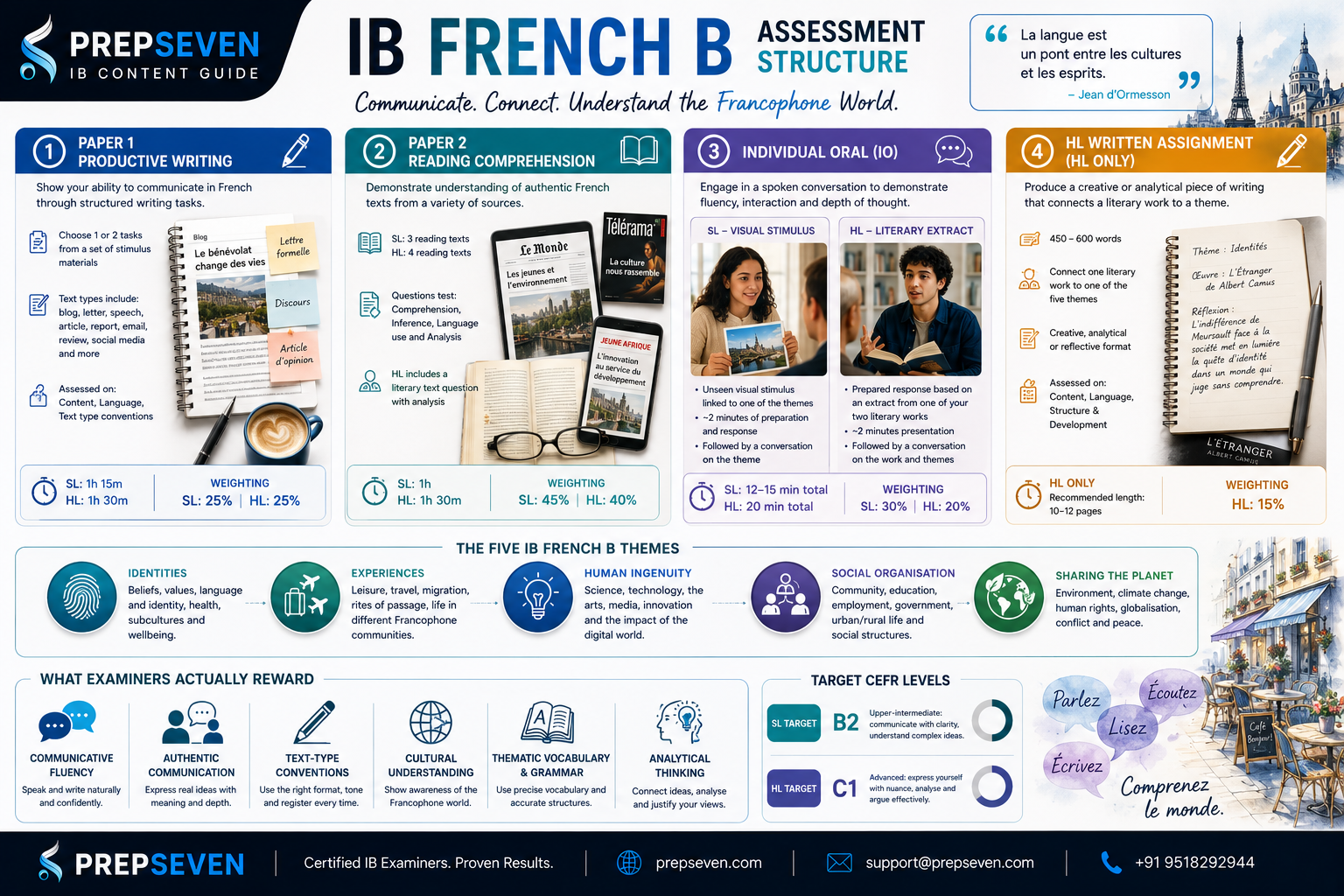
Paper 1 is one hour fifteen minutes at SL and one hour thirty minutes at HL. It presents you with a set of stimulus materials and asks you to produce one or two pieces of writing in a specified text type. The text types you may be asked to produce include blog posts, letters, essays, speeches, articles, reports, and social media posts among others.
The key skill Paper 1 tests is not vocabulary range or grammatical accuracy alone. It tests whether you can write purposefully in a specific format for a specific audience. A speech written in the same register as a private diary entry, however linguistically accurate, will not score well on the criterion for the conventions of the text type. Each text type has its own conventions: a blog post uses informal register, direct address to the reader, and a personal voice; a formal letter uses specific salutation and closing formulas, impersonal register, and a structured argument. Knowing these conventions and applying them correctly is a skill that can and should be practised throughout both years.
At HL, the stimulus materials are more complex and the writing tasks demand greater linguistic sophistication. HL students are expected to write with a wider range of vocabulary, more complex grammatical structures, and more nuanced expression of ideas than SL students.
Text type conventions are assessed as a specific criterion in Paper 1. Students who produce linguistically excellent French in the wrong format consistently score below their language level. Before your exam, make sure you have studied and practised every text type that the IB identifies for French B. One afternoon spent on this is worth more than days of vocabulary drilling.
Paper 2: Reading Comprehension
Paper 2 is one hour at SL and one hour thirty minutes at HL. It contains three reading texts at SL and four reading texts at HL, all in French, drawn from a range of sources including journalism, literary non-fiction, social commentary, and promotional or informational writing. Questions test comprehension at multiple levels: identifying specific information, inferring meaning, understanding how language is used, and, at HL, analysing a literary text.
The reading comprehension questions in Paper 2 are designed to test genuine understanding, not pattern-matching. A student who reads carelessly and guesses based on familiar vocabulary will score poorly on the inference and language use questions. A student who has developed the habit of reading French texts actively, pausing to consider what the writer is implying as well as stating, will score significantly higher.
At HL, Paper 2 includes a literary text question. This asks you to demonstrate understanding and analysis of a passage from literature or literary non-fiction, connecting it to the themes of the course and showing awareness of how the writer has used language. Students who have engaged seriously with their two literary works and developed the habit of reading literary French critically are far better prepared for this question than those who have treated the literary works as an afterthought.
Individual Oral (IO)
The Individual Oral is assessed internally by your teacher and externally moderated by the IB. It contributes 30% of your final grade at SL and 20% at HL. The format differs between SL and HL in a way that matters substantially.
At SL, you are shown an unseen visual stimulus related to one of the five themes. You speak about it for approximately two minutes, then enter a broader conversation with your teacher about the theme the image represents, drawing on your knowledge and vocabulary from across the course. The conversation lasts around 12 to 15 minutes in total.
At HL, you prepare a response based on an extract from one of your two studied literary works. You speak for approximately two minutes about how the extract connects to a theme from the course, then enter a conversation that covers both the literary work and broader thematic discussion. The literary connection is not optional at HL: it is the foundation of the entire oral.
For both SL and HL, the quality of the oral is determined not just by how accurately you speak French but by how substantively you engage with the theme or text. A student who speaks perfectly correct but intellectually empty French will score lower than a student who makes occasional grammatical errors but engages with genuine ideas. The IB is assessing your ability to communicate meaning in French, not to recite prepared phrases.
Preparation for the Individual Oral involves two distinct skills that many students conflate: linguistic preparation and intellectual preparation. Linguistic preparation means building the vocabulary and structures you need to discuss the themes fluently. Intellectual preparation means actually having something to say about them: a point of view, a specific example, a connection to your own experience or to current events. Both are necessary. Students who prepare only linguistically tend to sound rehearsed but shallow. Students who prepare only intellectually often struggle to express their ideas clearly under pressure.
Assessment Weightings
Component
SL Weight
HL Weight
Assessed By
Paper 1 (Productive writing)
25%
25%
External (IB)
Paper 2 (Reading comprehension)
45%
40%
External (IB)
Individual Oral
30%
20%
Internal + Moderated
HL Written Assignment (HL only)
Not assessed
15%
External (IB)
The HL Written Assignment: What It Is and What It Requires
The HL Written Assignment is a piece of assessed written work that connects one of the two literary works studied at HL to a theme from the course. It is 450 to 600 words and is externally marked by the IB. It carries 15% of the final HL grade.
The assignment asks students to write a piece of creative or analytical writing that responds to, reflects on, or extends from the literary work they have chosen. The format is flexible: it could be a piece of creative writing inspired by the work, an analytical essay comparing a theme in the work to a real-world context, or a reflective response to the work’s ideas.
The criterion that most students underperform on in the HL Written Assignment is the connection to the course themes. Students who write well in French but produce a response that feels disconnected from the five IB themes tend to score in the middle range. The assignment should demonstrate that you understand both the literary work and the broader thematic framework of the course, and that you can bring them into meaningful conversation with each other.
Start thinking about your HL Written Assignment topic early in Year 2. Because you have flexibility in the format, the best assignments tend to come from students who have given themselves time to experiment: writing a draft, sitting with it, deciding it is not quite right, and trying a different angle. Students who write their assignment in a single sitting the week before the deadline consistently produce work that does not reflect their actual ability.
What Actually Gets Students to a 7
They immerse themselves in French outside class
The students who score highest in French B are almost never the ones who have only studied French in the classroom. They are the ones who have watched French films, listened to French podcasts, followed French-language news, read French social media, or found some other way to encounter authentic French regularly throughout both years. Language acquisition accelerates dramatically when you encounter the language in contexts that feel meaningful rather than purely academic. Thirty minutes a week of authentic French input, whether that is a podcast, a TV series, or a French-language news source, does more for your comprehension and vocabulary than the equivalent time spent studying grammar rules.
They learn text type conventions before the exam, not during it
Paper 1 is where students who have not practised specific text types consistently lose marks they should not lose. The conventions of a formal letter, a blog post, a speech, a report, or an opinion article are specific and learnable. A student who has written at least one example of every text type the IB assesses, received feedback on it, and understood exactly what each format requires will approach Paper 1 with confidence. A student encountering an unfamiliar text type for the first time in the exam room will produce something technically inaccurate in format, regardless of how good their French is.
They build theme-specific vocabulary actively
General French vocabulary is necessary but not sufficient for a high score in French B. The five themes each have their own register and vocabulary domain that needs to be built deliberately. A student who can discuss identities and experiences fluently but has sparse vocabulary for environmental or technological topics will struggle with Paper 2 comprehension and Paper 1 writing tasks on those themes. The most effective approach is to build a vocabulary document for each theme throughout both years, adding new words and phrases as you encounter them in reading and class discussion, and reviewing them regularly.
They practise speaking French before the IO, not just thinking about what to say
The Individual Oral is an assessed spoken performance. Students who have thought carefully about what they want to say in their oral but have not actually practised saying it out loud, in French, under something approaching exam conditions, consistently underperform relative to their language level. Speaking a foreign language fluently requires physical practice: getting your mouth to produce the sounds, your memory to retrieve the words, and your mind to process meaning and formulate responses simultaneously. This cannot be developed through silent revision. It requires speaking, and the more often and the more realistically you practise before the oral, the better you will perform.
They read the French literary works at HL with genuine attention
HL students who skim the two literary works and rely on summaries or secondary sources to understand them are at a significant disadvantage in both Paper 2 and the Individual Oral. The HL literary text question in Paper 2 requires genuine reading comprehension at the level of the passage itself, including its language choices and implied meanings. The HL Individual Oral requires you to speak with genuine intellectual engagement about the work and its connection to a theme. Neither of these can be faked by someone who has not actually read and thought about the text. Read both works carefully, annotate as you go, and discuss them with your teacher and classmates as you would any serious text.
Common Mistakes That Cost Marks
The Mistake
What to Do Instead
Using the wrong register or format for the Paper 1 text type
Study and practise every text type before the exam. Format conventions are a graded criterion.
Translating from English rather than thinking in French
Build French thinking habits through regular immersive exposure. Translation produces unnatural French that examiners notice immediately.
Preparing only a script for the Individual Oral
Practise responding to unpredictable questions, not just delivering a prepared speech. The conversation section is where real language ability shows.
Neglecting the five themes in vocabulary preparation
Build a dedicated vocabulary bank for each theme. You will encounter all five across both papers and the oral.
Skimming the HL literary works at HL
Read both works carefully and annotate them. The HL oral and Paper 2 literary question require genuine engagement with the text.
Not listening to authentic French audio before the oral
Your ear for French rhythm and intonation directly affects the fluency of your spoken French. Regular listening builds this over time.
Leaving the HL Written Assignment until the last moment
Start early, experiment with format, and give yourself time to revise. The best assignments come from students who have tried more than one approach.
A Realistic Year-by-Year Approach
Year 1 (Grade 11): Build Language Habits and Theme Vocabulary
Start a vocabulary notebook or digital document organised by theme from the very first week. Add new words and phrases as you encounter them in class, in reading, and in any French you consume outside school.
Establish one regular habit of French exposure outside the classroom: a podcast, a YouTube channel, a Netflix series, or a French-language news source. Consistency over two years matters far more than intensity in the final weeks.
Practise each text type at least once during Year 1. Write a blog post, a formal letter, a speech, and an article in French and ask your teacher for feedback on the format conventions, not just the language.
For HL students: begin reading the first literary work as soon as your teacher assigns it. Do not let the literary works accumulate as a debt you will pay back in Year 2.
Year 2 (Grade 12): Consolidate Language and Prepare to Perform
Do at least four full past Paper 2 comprehension exercises under timed conditions. Reading speed and inference under time pressure are skills that need deliberate practice.
Practise the Individual Oral at least three times: once in an informal setting, once with a peer who can ask questions, and once in a formal mock session with your teacher.
For HL students: finalise your HL Written Assignment topic early in Term 1 and submit a draft to your teacher before the end of that term. Use the feedback seriously.
In the final revision period, focus especially on any themes where your vocabulary feels thin. A targeted week on Sharing the Planet or Human Ingenuity vocabulary, if those are weak areas, will pay dividends across both Paper 1 writing tasks and Paper 2 comprehension.
How PrepSeven Helps You Score Higher in IB French B
Language learning at the IB level is faster and more effective with someone who understands both the language and the specific demands of the IB assessment. Our French B tutors are experienced IB teachers and examiners who know where marks are made and lost in each component.
Here is what working with a PrepSeven French B tutor typically looks like:
Paper 1 writing sessions where you produce a timed writing task in a specific text type and your tutor marks it against the IB criteria, giving detailed feedback on language quality, text type conventions, and thematic engagement.
Paper 2 reading sessions where your tutor guides you through comprehension strategy: how to read efficiently under time pressure, how to identify inference questions, and how to approach the HL literary text question analytically.
Individual Oral preparation sessions where your tutor takes the role of the examiner, gives you the stimulus or extract, and conducts a full mock oral with detailed feedback on both linguistic fluency and intellectual engagement.
For HL students: HL Written Assignment mentorship covering topic selection, format choice, and draft revision, with feedback on both the French writing quality and the connection to the course themes.
Book your free demo lesson at prepseven.com and experience a mock oral or timed writing session with one of our French B tutors. Seeing exactly where your French stands against the IB criteria is the clearest starting point for improvement.
Frequently Asked Questions
How good does my French need to be to take French B SL?
French B SL targets a B2 level on the Common European Framework of Reference, which corresponds to upper-intermediate proficiency. In practice, this means you should be able to understand the main points of complex texts on familiar topics, communicate with enough fluency and spontaneity to have regular conversations with native speakers, and produce clear, detailed text on a range of subjects. Students who are solidly at B1 level at the start of Year 12 can reach B2 by the end of the course with consistent effort, but students who are below B1 will find French B extremely challenging and may be better placed in Ab Initio.
Can I take French B HL without having studied literary texts in French before?
Yes, and most students who take French B HL have not studied French literary texts formally before the IB. The two literary works are introduced as part of the course, and your teacher will guide you through them. What you do need is a level of French proficiency strong enough to read and discuss reasonably complex literary French, which corresponds roughly to B2 level or above. The literary component is demanding but not inaccessible to students who engage with it seriously throughout both years.
What text types might appear in Paper 1?
The IB French B guide specifies a range of text types that may be assessed in Paper 1. These include blog posts, formal and informal letters, emails, articles, essays, speeches, interviews, reports, reviews, and social media posts. Not all of these will appear in every exam session, but because you cannot predict which ones will be asked, the most sensible preparation is to practise all of them at least once during your two years. Each has distinct conventions, and the criterion for text type conventions is specifically graded in the Paper 1 mark scheme.
Does accent matter in the Individual Oral?
Accent is not directly assessed in the IB Individual Oral. What is assessed is communicative effectiveness: whether you can express yourself clearly, whether you can engage meaningfully with the themes, and whether your French is sufficiently accurate and fluent to maintain a coherent conversation. A strong regional accent or a non-native accent does not penalise you as long as your communication is clear and your ideas are substantive. Pronunciation errors that impede comprehension, or that indicate fundamental misunderstanding of French phonology, will affect how naturally you communicate, which does affect your score indirectly. But perfecting a native accent is not the goal.
What French-language resources are most useful for IB French B preparation?
For news and current events: RFI (Radio France Internationale) publishes news in simplified French at different levels, Le Monde and Le Figaro for more advanced reading. For listening practice: France Inter podcasts, Arte documentary series available on YouTube, and the Netflix series produced in French are all excellent. For vocabulary in context: reading opinion articles and opinion journalism on topics related to the five IB themes is more useful than vocabulary lists because you see words used in natural context. For speaking practice: language exchange platforms that connect you with French speakers, or any regular opportunity to speak French outside the classroom, will develop fluency faster than any other single practice.
This guide is produced by PrepSeven for educational purposes. All IB assessment information is based on publicly available IB documentation and is subject to change. Always verify current assessment details with your school’s IB coordinator.