PrepSeven | IB Content Guide authored by Shankar Mutneja (Founder of Prepseven)
IB French Ab Initio
What Is IB French Ab Initio?
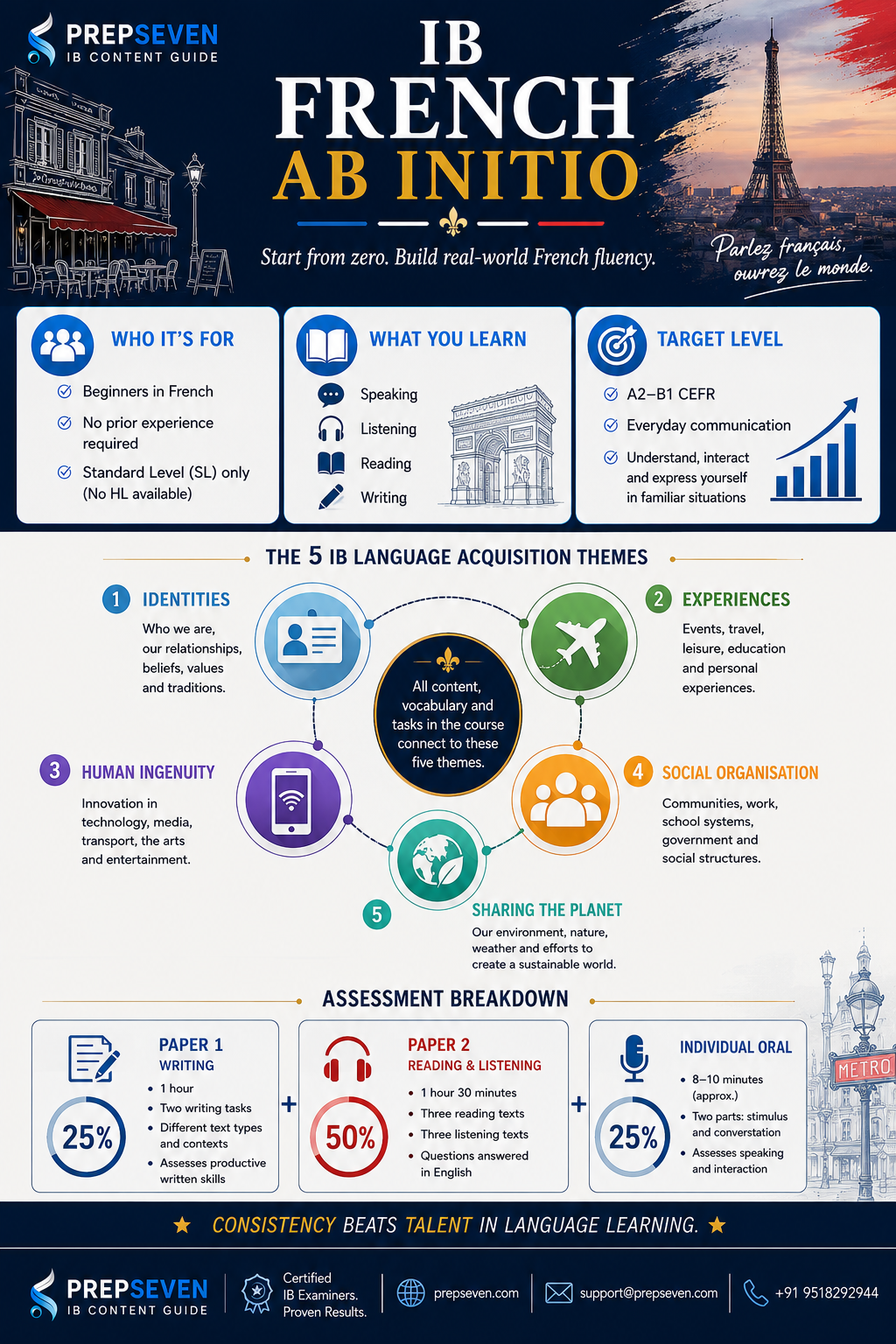
IB French Ab Initio is the entry-level French course in the IB Diploma Programme, designed specifically for students who have little to no prior experience learning French. Ab initio is a Latin phrase meaning from the beginning, and that is exactly what the course does: it starts from zero and builds genuine communicative competence in French over two years.
The course is offered at Standard Level only. There is no Higher Level version of Ab Initio in any language. It sits in Group 2 of the diploma alongside French B and other language acquisition courses, and it satisfies the Group 2 language requirement for students who are genuinely beginning a new language in the IB.
Over the two years, the course develops all four language skills: listening, speaking, reading, and writing. These are not taught in isolation. They are developed together through the course’s five themes: identities, experiences, human ingenuity, social organisation, and sharing the planet. Every vocabulary set, grammar structure, and communicative task you practise connects to one or more of these themes, which also form the basis of the exam content.
By the time students sit their final exams, the IB expects them to have reached a level that roughly corresponds to A2 to B1 on the Common European Framework of Reference for Languages. That is the level at which you can handle straightforward communication tasks, understand the main points of clear messages and texts, and express yourself on familiar topics with reasonable accuracy.
Ab Initio is sometimes dismissed as the easy language option in the IB. That framing is misleading. Going from zero to A2 or B1 in a language in two years, while managing a full Diploma Programme workload, requires genuine dedication and consistent effort outside class. Students who treat it as a low-effort subject because it starts at a lower level often plateau early and struggle to reach the higher grade bands by exam time.
Who Should Take IB French Ab Initio?
The answer to this question matters more than it might appear, because choosing the wrong French course, either one that is too advanced or not advanced enough for your actual level, has consequences that are difficult to reverse once the two years have started.
Ab Initio is the right choice if you have genuinely had little or no formal French instruction before the IB. This means no French classes in secondary school, or perhaps one year of introductory French with no sustained continuation. Students who have studied French for two or more years at school, even if they feel their French is weak, are usually better placed in French B SL rather than Ab Initio.
The reason this matters is that Ab Initio has a ceiling. It is offered at Standard Level only, and it is assessed against criteria calibrated for beginner-level learners. A student who already has meaningful French proficiency will find the course insufficiently challenging, will not develop their language further in any significant way, and may actually find that the assessment format disadvantages them compared to their true ability. The IB is also alert to students being placed in Ab Initio when their proficiency level suggests they should be in a higher course.
If you are unsure whether your French is at Ab Initio or French B level, talk to your language teacher or IB coordinator before the course begins. A brief proficiency conversation or written exercise will tell you where you actually stand. Starting in the wrong course and switching mid-year is disruptive and sometimes impossible depending on your school’s timetabling.
The Five Themes and Why They Structure Everything
The five IB language acquisition themes are the backbone of the Ab Initio course. Every text you read, every vocabulary set you learn, every writing task and oral exercise you practise connects to one of these themes. They are also the framework that the exam is built around, so understanding them from the first week of the course helps you see how everything fits together.
A practical approach that many students overlook: rather than learning vocabulary as isolated word lists, organise your vocabulary learning by theme from the start. When you encounter a new word related to travel or holidays, it goes in the Experiences section of your vocabulary notes. When you learn environmental vocabulary, it goes under Sharing the Planet. This organisation mirrors the structure of the exam and makes retrieval under pressure significantly faster.
Assessment Breakdown: How You Are Graded
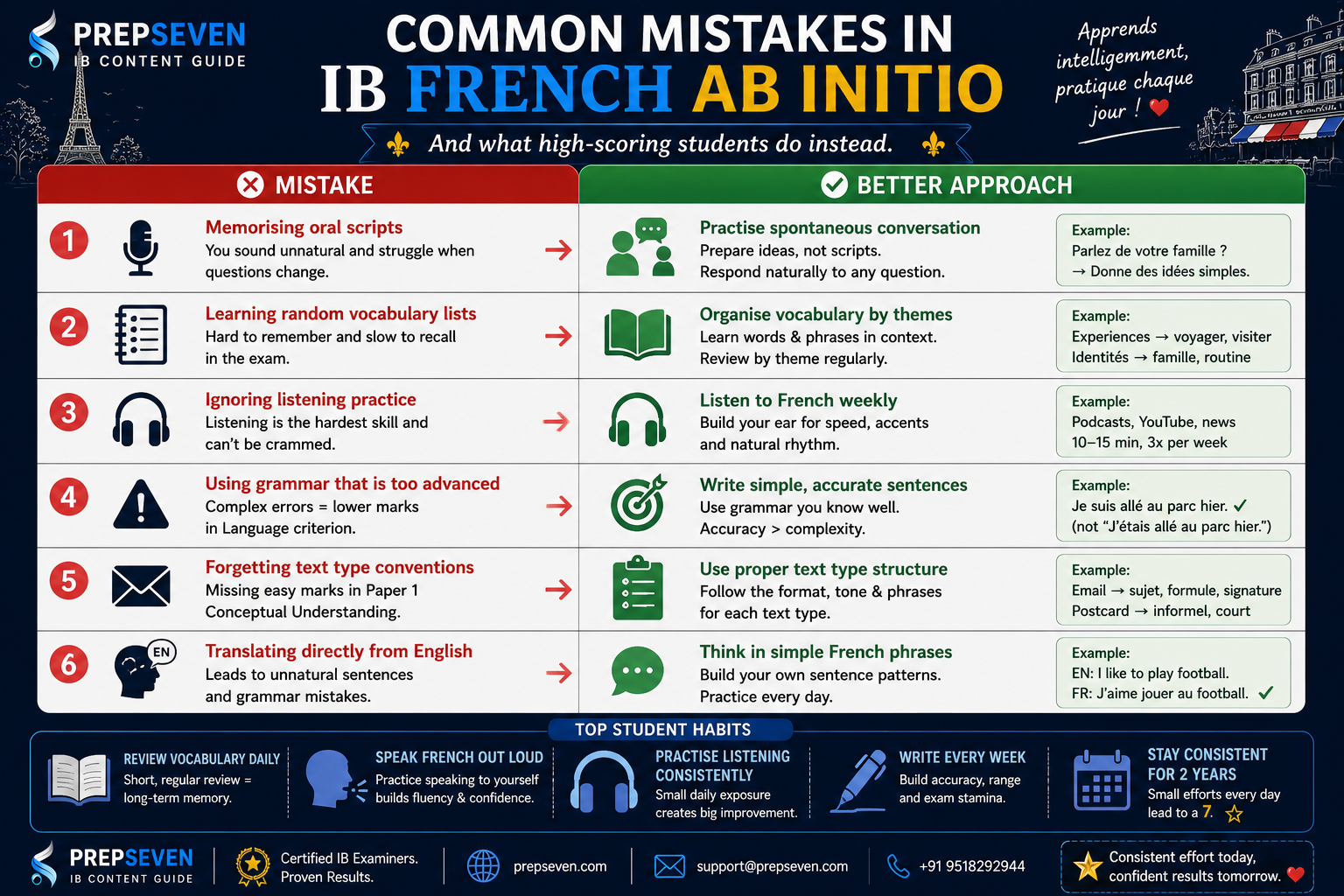
Ab Initio has three assessed components: Paper 1, Paper 2, and the Individual Oral. Together they assess all four language skills across the five themes.
Paper 1: Writing Tasks
Paper 1 is one hour long and asks you to complete two writing tasks. Each task is based on a stimulus and specifies a text type and a context. You might be asked to write a postcard to a friend describing a holiday, an email to a host family introducing yourself, a short article for a school magazine about an environmental issue, or a blog post about your weekend plans. The tasks are deliberately designed to be accessible to learners at the Ab Initio level, which means familiar contexts and manageable topics.
Each writing task is assessed on three criteria: Language, Message, and Conceptual Understanding of the text type. The Language criterion covers accuracy of grammar and vocabulary, range of structures used, and clarity of expression. The Message criterion covers whether you have communicated the required content clearly and completely. The Conceptual Understanding criterion covers whether your writing demonstrates awareness of the specific conventions of the text type you have been asked to produce.
The text type conventions criterion is one where students consistently either gain or lose easy marks. A postcard sounds informal, uses short sentences, ends with a greeting. A formal email uses vous rather than tu, includes an appropriate opening and closing formula, and maintains a more structured tone throughout. These are not subtle distinctions. They are specific, learnable features that you can practise and apply. Students who have not thought about text type conventions before the exam are leaving marks on the table that required very little effort to pick up.
A practical preparation habit: for each text type that might appear in Paper 1, write one example during the course and ask your teacher for feedback specifically on whether you have used the right conventions. Not whether your French is correct, though that matters too, but whether your postcard sounds like a postcard, your email sounds like an email, and your blog post sounds like a blog post. That feedback is worth more than most vocabulary revision.
Paper 2: Reading and Listening Comprehension
Paper 2 is one hour thirty minutes and is split into two sections. The reading section presents three written texts in French, each connected to one of the five themes, and asks comprehension questions in English. The listening section plays three audio recordings in French, also theme-connected, and asks comprehension questions in English.
The fact that comprehension questions are answered in English is important. You are being tested on how well you understand French, not on how well you can produce it under pressure. This means that students whose productive French writing is weak can still score strongly in Paper 2 if their comprehension is solid. The two skills are genuinely separate, and students who spend all their preparation time on writing sometimes discover too late that Paper 2 carries more weight in the overall grade.
The listening section is where many Ab Initio students struggle most, because audio comprehension in a new language requires a different kind of practice than reading comprehension. When you read, you can slow down, reread, and take your time with unfamiliar words. When you listen, the audio keeps moving regardless of whether you have processed what you just heard. Building listening comprehension requires sustained exposure to authentic French audio throughout both years, not just in the weeks before the exam.
The reading comprehension questions at Ab Initio level are designed to be accessible. They test whether you understood the main points of a text, specific details, and in some cases the writer’s attitude or purpose. Students who read quickly without careful attention often miss the nuance of specific detail questions. A habit of reading comprehension texts twice, once for general meaning and once for specific details, before answering questions saves marks in Paper 2.
The listening section of Paper 2 plays each recording twice. Use the first listening to understand the overall topic and main points. Use the second listening to verify your answers and pick up specific details you may have missed. Students who try to answer all questions fully during the first listening often lose track and miss content they would have caught on the second pass.
Individual Oral
The Individual Oral is conducted by your teacher and contributes 25% of your final grade. It is approximately eight to ten minutes long and has two parts. In the first part, you are shown a visual stimulus, a photograph or image related to one of the five themes, and asked to describe and respond to it for approximately two minutes. In the second part, your teacher leads a conversation based on the stimulus and the themes, asking questions and following up on what you have said.
The oral is assessed on two criteria: Language and Communication and Cultural Awareness. The Language and Communication criterion covers the accuracy and range of your French and your ability to maintain a conversation. The Cultural Awareness criterion covers whether you demonstrate awareness of French-speaking cultures and communities in your responses.
The Cultural Awareness criterion is one that students sometimes find surprising. It does not require you to have encyclopedic knowledge of French culture. It rewards students who can make relevant references to French-speaking communities, countries, or cultural practices when they arise naturally in the conversation. Knowing that French is spoken across multiple continents, that Francophone Africa has a different relationship with French than metropolitan France, or that Swiss French has distinct features from Parisian French, is the kind of awareness this criterion is looking for. It is built through genuine curiosity about the French-speaking world, not through memorisation of cultural facts.
The conversation section of the oral is where marks are most often won or lost. Students who have practised only describing the stimulus image but have not prepared for the unpredictable follow-up questions often run dry after their two-minute prepared section. The teacher can ask you about anything related to the themes, your own life, your opinions on topics connected to the image, or cultural questions. Preparation for the oral should include practising spontaneous responses to unpredictable questions, not only rehearsing a prepared description.
Grammar: What You Actually Need to Know
One of the most common anxieties Ab Initio students have is about French grammar. French grammar has a reputation for complexity, and it is not entirely undeserved. But the Ab Initio course does not require mastery of the entire grammatical system. It requires confident command of the grammar structures that are genuinely necessary for communication at A2 to B1 level.
The grammar areas that matter most for Ab Initio performance across all three components are consistent and learnable. Students who have genuinely mastered these structures have a significant advantage over those who are still uncertain about them by exam time.
A mistake many Ab Initio students make is trying to use complex grammar structures they have not fully mastered in the hope of impressing the examiner. The Language criterion in Paper 1 rewards accuracy and appropriate range, not complexity for its own sake. A sentence with a correctly formed passe compose and appropriate adjectival agreement earns more marks than an attempted subjunctive construction that is grammatically wrong throughout. Aim for confident accuracy in the structures you know rather than adventurous inaccuracy in structures you do not.
What Actually Gets Students to a 7
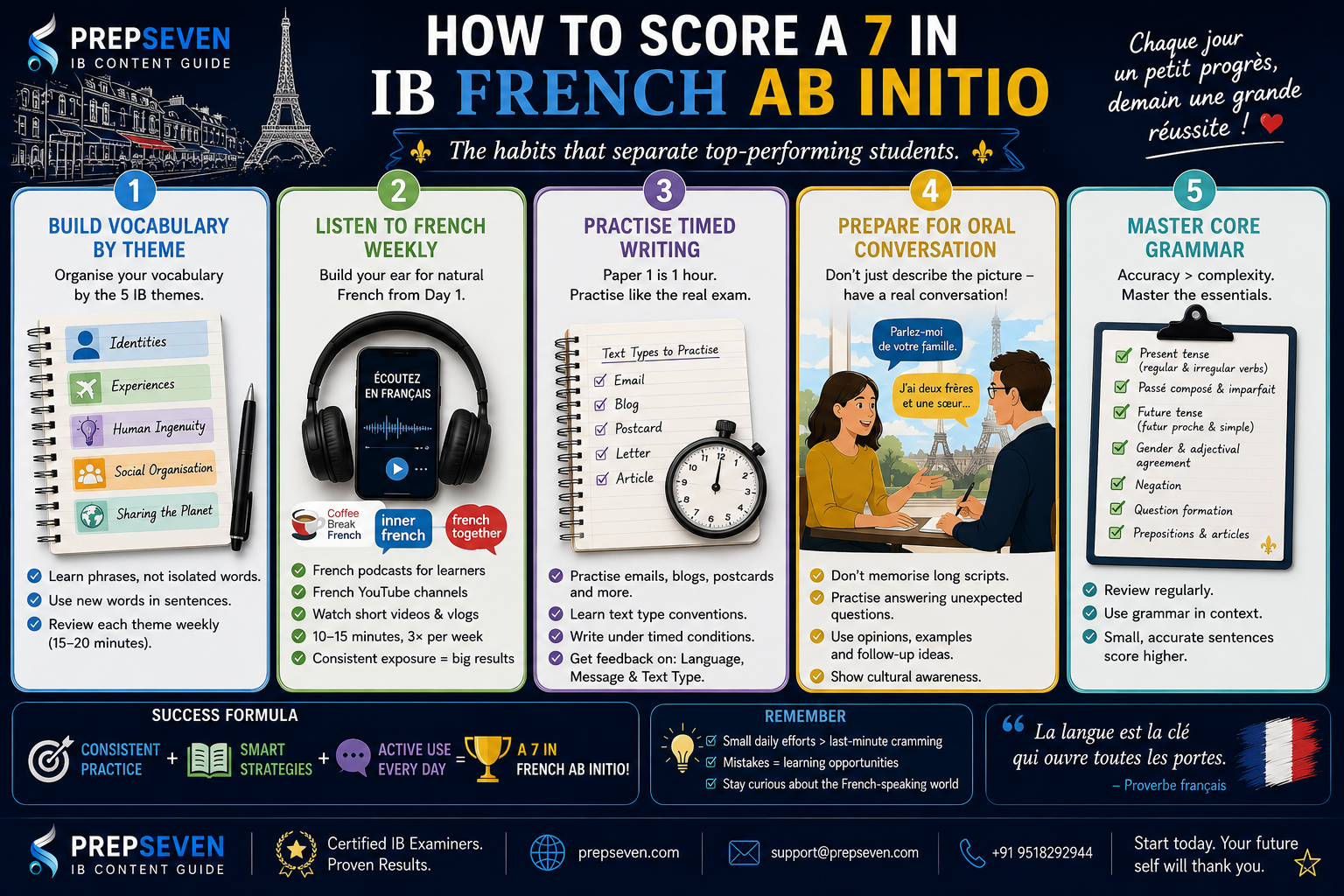
They build vocabulary by theme, not by unit number
Students who organise their vocabulary learning around the five themes from the very beginning of the course arrive at the exam with a mental filing system that matches the structure of the papers. When Paper 2 presents a reading text about environmental issues, a student whose Sharing the Planet vocabulary is well-developed retrieves relevant words quickly and confidently. A student whose vocabulary is organised by textbook chapter or by random encounter has to do more work to access the right words under pressure. Theme-based vocabulary organisation is a small habit change with a large cumulative payoff.
They listen to French audio every week throughout both years
The listening section of Paper 2 carries significant weight and it is the most neglected area of Ab Initio preparation. Reading comprehension can be improved relatively quickly with focused practice. Listening comprehension requires the ear to adjust to the rhythm, speed, and sound patterns of natural French speech, and that adjustment takes time. Students who have listened to French audio regularly throughout both years, through podcasts designed for learners, French-language YouTube channels, simple French news broadcasts, or even French children’s television, develop listening comprehension that cannot be built by a few weeks of intensive practice before the exam.
They practise writing tasks under timed conditions with feedback
Paper 1 is a timed writing exam. Students who have only written French tasks at home with unlimited time and a dictionary often discover under exam conditions that they are significantly slower, make more errors under pressure, and struggle to remember vocabulary they know well in relaxed settings. Practising at least four Paper 1 style writing tasks under timed conditions before the exam, without dictionaries or notes, is the most direct preparation for what the exam actually requires. Feedback from a teacher or tutor on each practice task, specifically against the three Paper 1 criteria, shows you where marks are being dropped and how to recover them.
They prepare for oral conversation, not just the stimulus description
The Individual Oral conversation section is where prepared students and unprepared students diverge most visibly. A student who has practised only the two-minute stimulus description often finds the subsequent conversation difficult because it goes in directions they have not anticipated. Effective oral preparation includes practising responses to a wide range of questions on all five themes: your family, your daily routine, your opinions on environmental issues, your experience of technology, your school, your future plans. These are the kinds of questions that follow naturally from stimulus images and from conversational flow. Practising them out loud, in French, with someone who can respond and follow up, is the preparation that makes the difference.
They use text type conventions deliberately in Paper 1
The Conceptual Understanding criterion in Paper 1 rewards students who demonstrate clear awareness of the text type they are writing. This is not a difficult criterion to score well on if you have prepared for it. It requires knowing that a postcard is short and informal, that a letter or email to an institution uses formal register and specific opening and closing phrases, that a blog post addresses the reader directly and uses a personal voice, and that a message to a friend is casual and brief. Spending one lesson on each text type convention during the course, and then applying that knowledge deliberately in every practice task, makes this criterion a reliable source of marks rather than an unpredictable one.
Common Mistakes That Cost Marks
A Realistic Year-by-Year Approach
Year 1 (Grade 11): Build Foundations Systematically
- Organise your vocabulary notes by theme from week one. Every new word and phrase goes into its theme category. Review each theme section weekly rather than waiting until exam revision.
- Establish a regular French listening habit within the first month. Start with content designed for French learners: podcasts such as Coffee Break French, French Together, or Innerfrench are pitched at levels from complete beginner to B1 and are excellent for Ab Initio students. Ten to fifteen minutes three times a week builds more than an hour once a week.
- Practise the present tense of the most common irregular verbs, etre, avoir, aller, faire, vouloir, pouvoir, prendre, until they are completely automatic. These verbs appear in almost every sentence you will ever write or say in French.
- Write one practice Paper 1 style task per month from the end of Term 1 onwards. Ask your teacher for feedback specifically on the three Paper 1 criteria: Language, Message, and text type conventions.
Year 2 (Grade 12): Consolidate and Prepare to Perform
- Complete at least four full timed Paper 1 practice sessions before your mock exams. Practise the text types you find hardest and ask for written feedback on each one.
- Do at least three full Paper 2 reading and listening practice sets under exam conditions. Use the listening section audio from past papers, which your teacher can provide, and practise the two-listen strategy on every recording.
- Practise the Individual Oral at least three times in conditions as close to the real thing as possible: with a teacher or tutor who can show you a stimulus image, listen to your description, and then conduct an unpredictable follow-up conversation in French.
- In the final revision period, focus vocabulary review on your weakest theme areas. Use past Paper 2 texts to identify which theme vocabulary you are slowest to access and spend targeted time filling those gaps.
How PrepSeven Helps You Score Higher in IB French Ab Initio
Learning a language from scratch while managing a full IB Diploma workload is one of the most demanding things a student can take on. Our French Ab Initio tutors are experienced IB language teachers who understand both the specific demands of the course and the particular challenges of adult language learning from zero.
Here is what working with a PrepSeven French Ab Initio tutor typically looks like:
- Paper 1 writing sessions where you complete a timed practice task, your tutor marks it against the three IB criteria, and you work through specifically how to improve your language accuracy, message clarity, and text type awareness in your next attempt.
- Paper 2 comprehension sessions where your tutor guides you through reading strategy for French texts at your level, builds your ability to identify key information quickly, and works through listening comprehension exercises with you using past paper audio.
- Individual Oral preparation sessions where your tutor presents a stimulus image, conducts a full mock oral with you in French, and gives detailed feedback on both your language use and your ability to sustain a conversation on all five themes.
- Vocabulary and grammar sessions targeted at the specific areas where your accuracy is weakest, with a focus on the structures that carry the most weight across all three assessment components.
Book your free demo lesson at prepseven.com. Whether you are just starting French from zero or approaching the exam and looking for targeted preparation, we will show you exactly where you stand and what it takes to reach a 7.