PrepSeven | IB Content Guide authored by Shankar Mutneja (Founder of Prepseven)
IB Film
What Is IB Film?
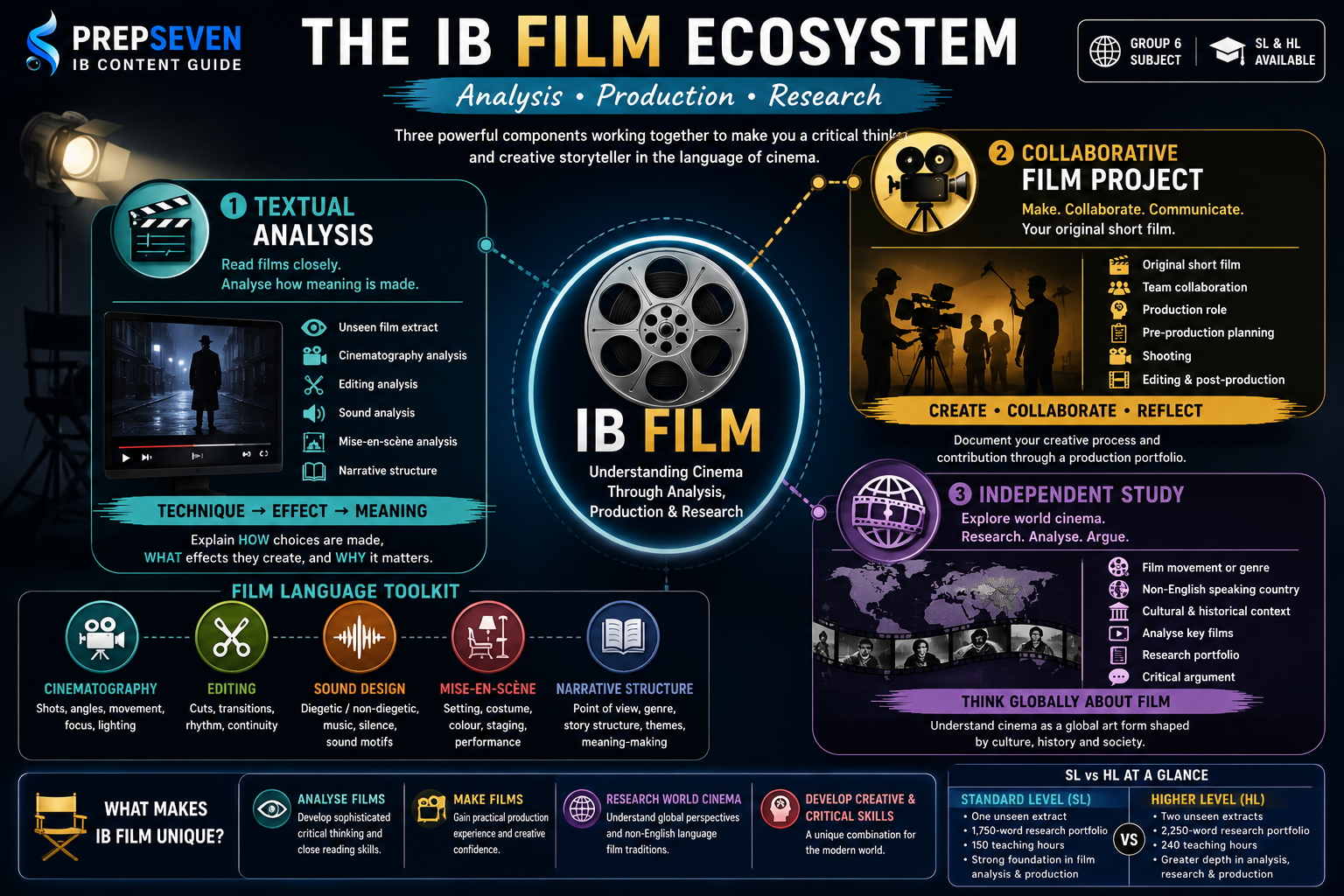
IB Film is a course about understanding cinema as one of the most powerful and complex art forms of the modern world, and about developing the practical and analytical skills to both make films and think rigorously about them. It sits in Group 6 of the Diploma Programme and is available at both Standard Level and Higher Level. It is the only IB course that asks students to simultaneously analyse films as texts, research cinema as a cultural and industrial practice, and produce original moving-image work.
The course is built on the conviction that film literacy is an essential skill in the contemporary world. We live in a culture saturated with moving images, but most people consume them passively. IB Film teaches students to watch actively: to understand how a film constructs meaning through cinematography, editing, sound design, mise-en-scene, and narrative structure, and to recognise how those choices reflect and shape the cultural contexts from which films emerge.
The course has three assessed components that span both analysis and production. The Textual Analysis requires close analytical reading of an unseen film extract. The Collaborative Film Project requires students to make and screen original short films. And the Independent Study requires research into a film movement or genre from a non-English speaking country. Together, these three components develop students as both critical thinkers and creative practitioners, which is a genuinely unusual combination in pre-university education.
IB Film is not a course for students who enjoy watching films. It is a course for students who want to understand how films work, why they work the way they do, and what they can do. Students who arrive expecting to watch and discuss movies quickly discover that the course demands rigorous analytical writing, genuine production skills, and serious research engagement. Students who thrive are those who find the relationship between form and meaning genuinely fascinating, whether their primary orientation is toward filmmaking or film criticism.
SL vs HL: What the Difference Involves
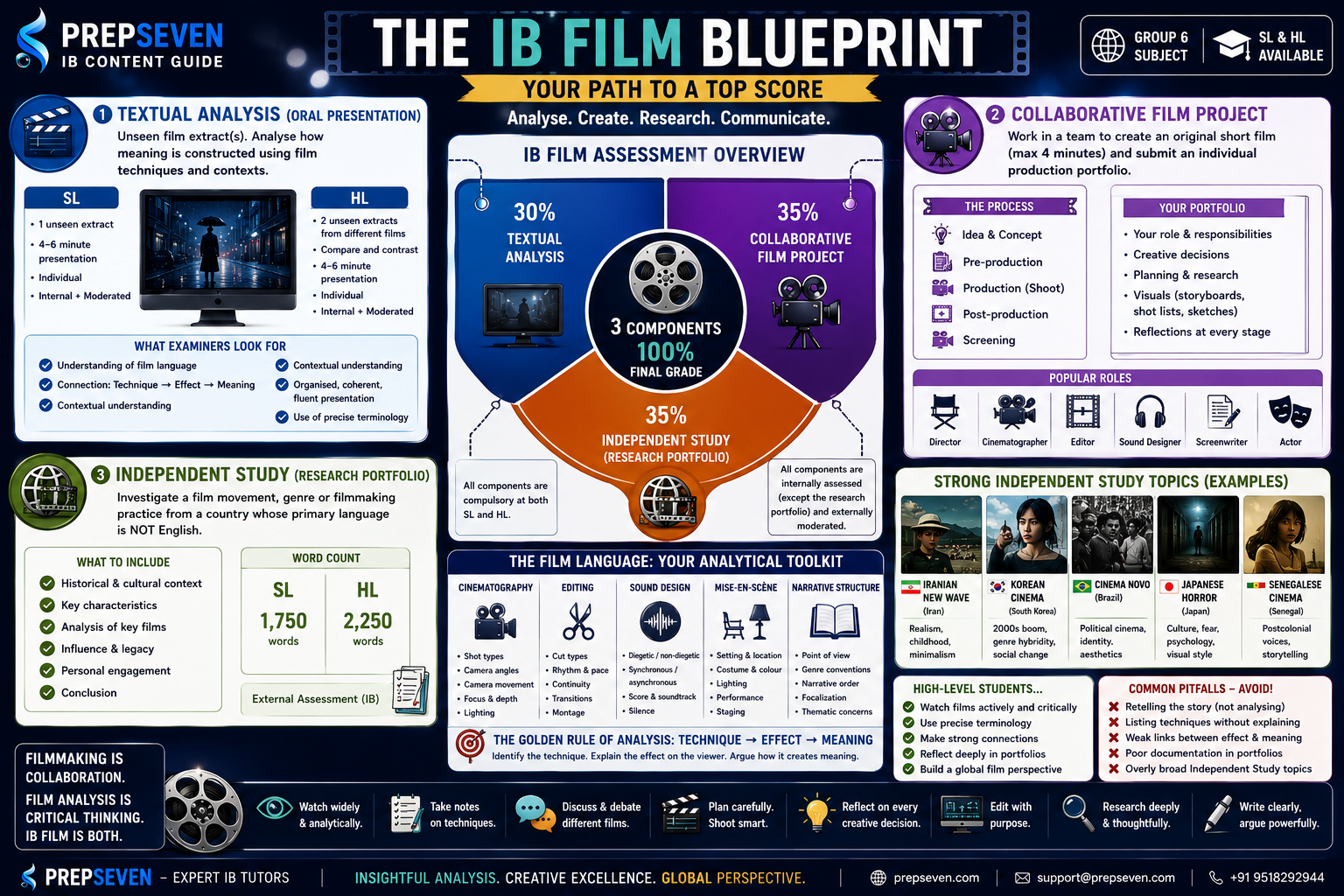
The difference between Film SL and HL is substantial in terms of the depth of analytical and production work required. HL students engage with each component at a more demanding level, and the HL Textual Analysis in particular requires analysis of a longer extract with a more sophisticated analytical framework.
The HL Textual Analysis presents a significant additional challenge: rather than analysing one unseen extract, HL students analyse two extracts from two different films and are expected to draw comparisons between them in their presentation. This comparative dimension demands not just analytical depth but the ability to think across films, identifying how different directorial approaches, cultural contexts, or genre conventions produce different cinematic experiences. It is a genuinely more demanding intellectual task than the SL version.
If you are considering applying to film school, media studies, creative writing, communications, or any programme in the creative industries, Film HL is a meaningful preparation. The production experience from the Collaborative Film Project, combined with the analytical rigour of the Textual Analysis and the cultural research of the Independent Study, provides a portfolio of skills and work that is directly relevant to applications for creative programmes. Many film schools and media departments look favourably on applicants who have produced and critically engaged with original moving-image work at this level.
The Three Assessed Components
The Textual Analysis
The Textual Analysis is the most traditional academic component of IB Film. You are given an unseen film extract, or at HL two extracts, and a preparation period of time to watch it and make notes before delivering a 4 to 6 minute oral presentation in which you analyse how the filmmaker constructs meaning through cinematic techniques.
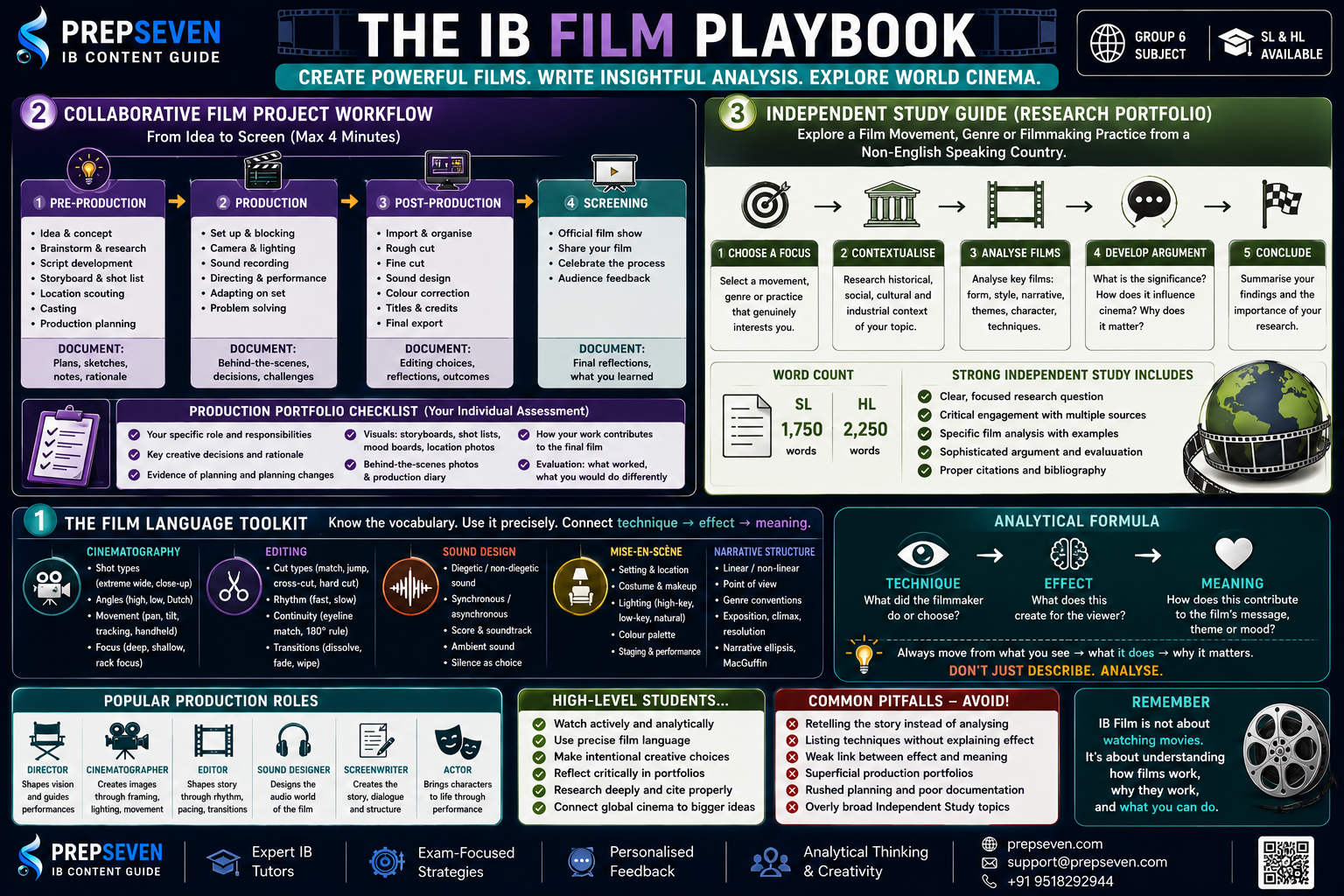
The Textual Analysis tests your ability to read a film closely and precisely. This means identifying specific cinematic techniques, explaining what effect they create, and arguing how those effects contribute to the film’s broader meaning, mood, or thematic concerns. The techniques you should be able to analyse include cinematography such as shot types, angles, movement, and depth of field; editing such as cut types, rhythm, and continuity; sound design including diegetic and non-diegetic sound, score, and silence; mise-en-scene including setting, costume, lighting, and performance; and narrative structure including how the extract positions the viewer in relation to characters and events.
The key analytical move in a strong Textual Analysis is connecting technique to effect to meaning. Writing that the director uses a low-angle shot identifies a technique. Writing that the low-angle shot positions the viewer below the character, creating a sense of imposing authority that reinforces the scene’s exploration of institutional power over the individual connects technique to effect to meaning. The second version earns marks. The first does not.
Many students make the mistake of describing what happens in the extract rather than analysing how the filmmaker constructs what we experience. A Textual Analysis that tells the story of the extract is not doing analysis. A Textual Analysis that explains how specific filmmaking choices create specific effects on a viewer is. Before your presentation, watch the extract multiple times: once for general understanding, once specifically looking at the camera, once specifically listening to the sound design, once looking at the editing, and once at the mise-en-scene. This systematic approach ensures you are genuinely analysing the filmmaking rather than summarising the narrative.
The Collaborative Film Project
The Collaborative Film Project is the production component of IB Film. You work in a group to produce an original short film of no more than four minutes, which is then screened as part of an official school film show. Each student in the group takes on a specific production role such as director, cinematographer, editor, sound designer, or screenwriter, and submits an individual production portfolio documenting their creative contribution to the project.
The word collaborative in this component title is important. The film is a group effort but the assessment is individual. Each student is assessed on the quality of their own production portfolio, which documents their specific creative role, the decisions they made in that role, and how those decisions contributed to the overall film. A student who performs their role brilliantly but documents it superficially will score lower than a student whose work was less technically accomplished but whose portfolio demonstrates genuine creative thinking, intentional decision-making, and reflective engagement with the production process.
The production portfolio is structured around the pre-production, production, and post-production phases of filmmaking. In pre-production you document your planning: script, storyboard, shot list, location scouting, casting decisions, and the creative rationale behind them. In production you document the shoot itself: what decisions were made on set, how the plan was adapted, and what you learned. In post-production you document the editing and finishing process: how the film was assembled, what choices were made in the edit, and how the final film relates to the original concept.
Role selection in the Collaborative Film Project matters more than most students realise. Choose a role that genuinely interests you and that you have time to develop real competence in before the shoot. A student who directs but has never thought seriously about how to work with actors and communicate visual ideas will produce weaker work than one who takes on cinematography and spends time learning how camera placement and movement create meaning. The role you choose shapes your production portfolio and therefore your individual mark. Choose strategically, not just by what sounds most impressive.
The Independent Study
The Independent Study is a research portfolio of 1,750 words at SL and 2,250 words at HL that investigates a film movement, film genre, or filmmaking practice from a country whose primary language is not English. The requirement to engage with non-English-language cinema is deliberate and important: it is designed to broaden students beyond the Hollywood and English-language art cinema traditions that dominate most informal film education, and to develop genuine global film literacy.
The Independent Study has a specific structure. It should include a contextual analysis of the film movement or genre, examining the historical, social, cultural, and industrial conditions that shaped it. It should analyse specific films from the movement in terms of how their formal and narrative choices reflect those conditions. And it should argue a position about the significance of the movement, what it contributed to cinema as an art form, how it has influenced subsequent filmmaking, or why it matters in the context of world cinema.
The choice of film movement or genre for the Independent Study significantly shapes the intellectual quality of the work. Students who choose movements they genuinely find interesting, whose films raise questions they actually want to investigate, produce research that has authentic intellectual energy. Students who choose movements because they seem academically respectable but whose films they find boring produce research that reads exactly like what it is. Iranian New Wave cinema, Hong Kong action cinema, Brazilian Cinema Novo, Romanian New Wave, Korean cinema of the 2000s, Japanese horror, Senegalese cinema, and Mexican fantasy realism are all genuinely rich areas with substantial critical literature and fascinating films to investigate.
The Film Language You Need to Know
IB Film has a specific technical vocabulary that is both assessed in the Textual Analysis and expected throughout the course. Students who do not know this vocabulary cannot write or speak precisely about film, which directly affects their marks across all three components. Building this vocabulary is not optional. It is a foundation skill that needs to be in place from the start of Year 1.
The single most productive habit for building film language fluency is watching films actively rather than passively. When you watch a film, pause at moments that affect you and ask: how did the filmmaker create this effect? What camera position, what edit, what sound choice produced that feeling of dread, or intimacy, or disorientation? Active watching is not the same as enjoying films. It is a deliberate analytical practice that builds the vocabulary and observational habits that the Textual Analysis requires. Make it a habit from the first week of Year 1.
World Cinema and the Independent Study: Why It Matters
The requirement to study non-English-language cinema in the Independent Study is one of the most intellectually distinctive features of IB Film, and one of the most rewarding for students who engage with it seriously. Most students arrive in the course with a film knowledge dominated by Hollywood and, at best, English-language art cinema. The Independent Study asks them to step outside that tradition and encounter cinema as a genuinely global practice with radically different aesthetic, cultural, and political dimensions.
The greatest films in cinema history are not all American or British. The work of Akira Kurosawa in Japan, Ingmar Bergman in Sweden, Federico Fellini and Michelangelo Antonioni in Italy, Wong Kar-wai in Hong Kong, Bong Joon-ho in South Korea, Abbas Kiarostami in Iran, Ousmane Sembene in Senegal, Pedro Almodovar in Spain, and Andrei Tarkovsky in the Soviet Union all represent filmmaking that is as technically sophisticated and intellectually rich as anything Hollywood has produced, and often more so. Encountering these traditions genuinely transforms how students understand what cinema can be and do.
For the Independent Study, choosing a movement whose films you have actually watched and found genuinely interesting is far more productive than choosing one that seems academically respectable. The research is richer when it comes from genuine curiosity, and the writing is more compelling when the student actually cares about the films they are discussing. Spend time in Year 1 exploring different world cinema traditions through legal streaming platforms, film societies, or your school’s film library before committing to an Independent Study subject.
A practical note on access to world cinema: many of the most significant non-English-language film movements are available legally and freely or cheaply through Mubi, the Criterion Channel, BFI Player, and various national film archive collections. YouTube also hosts a surprisingly large number of significant world cinema films in full, particularly older works whose copyright has expired or been released. Do not assume you cannot access the films you want to research. Start looking before assuming they are unavailable.
What Actually Gets Students to a 7
They watch films analytically throughout both years
The students who score highest in the Textual Analysis are almost never those who watched the most films. They are the ones who watched films the most carefully. Developing the habit of watching films analytically, pausing to notice specific choices, asking why the filmmaker made each decision, and building a vocabulary for articulating the effects of those choices, is the preparation that makes the Textual Analysis manageable. This habit cannot be developed in the weeks before the assessment. It needs to be built throughout both years through regular, deliberate analytical watching.
They choose their Collaborative Film Project role strategically
The production portfolio is where individual marks in the Collaborative Film Project are won or lost, and the quality of the portfolio depends significantly on the student choosing a role they can genuinely develop competence and creative thinking in. A student who takes on a role they are not genuinely invested in and documents it perfunctorily will score significantly lower than one who is genuinely excited about their role and documents every creative decision with genuine reflective engagement. The role also shapes what you learn: a student who directs will develop different skills from one who edits, and both are valuable but different preparations for further study in film and media.
They treat the production portfolio as concurrent documentation, not retrospective reconstruction
The Collaborative Film Project production portfolio is assessed on the evidence it provides of genuine creative thinking throughout the production process. Students who document their decisions as they happen, who photograph location scouts, annotate storyboards, write brief production diary entries during the shoot, and reflect on editing decisions as they make them, produce portfolios with an authenticity and richness that retrospective documentation cannot replicate. The evidence of creative thinking in the moment is more convincing than a tidy write-up produced after the fact.
They engage with the Independent Study subject through the actual films, not just through secondary literature
The Independent Study requires you to analyse specific films from your chosen movement or genre. Students who write about films they have not actually watched, relying entirely on descriptions and analyses from secondary sources, produce work that lacks the specificity and authenticity of genuine film engagement. The best Independent Studies engage closely with the actual films: specific scenes, specific formal choices, specific moments that illustrate the arguments being made. This requires watching the films carefully and analytically, which is exactly the same skill the Textual Analysis develops. The two components reinforce each other.
They develop a genuine intellectual position in the Independent Study
The most compelling Independent Studies are not comprehensive surveys of a film movement. They are arguments: a specific claim about what the movement represents, what distinguishes it, why it matters, or how it challenges mainstream filmmaking. A student who argues that Iranian New Wave cinema uses a deliberately slow, contemplative style to create the kind of attentive spectatorship that Hollywood actively discourages, positioning the viewer as an active meaning-maker rather than a passive consumer, has a genuine intellectual position that can be developed and defended across 1,750 or 2,250 words. A student who writes that Iranian New Wave cinema is important and has many interesting directors does not.
Common Mistakes That Cost Marks
A Realistic Year-by-Year Approach
Year 1 (Grade 11): Build Vocabulary, Watch Analytically, Explore World Cinema
- Learn the technical vocabulary of filmmaking from the first week: shot types, editing terms, sound design vocabulary, and mise-en-scene terminology. This vocabulary is the foundation of every analytical task in the course.
- Develop the habit of watching films analytically throughout Year 1. When you watch any film, practise pausing at significant moments and articulating what filmmaking choices created the effect you experienced.
- Explore world cinema traditions broadly in Year 1. Sample Iranian, Korean, Japanese, Brazilian, West African, and Eastern European cinema to identify which tradition genuinely interests you for the Independent Study. It is much easier to sustain research into a movement whose films you find genuinely compelling.
- Begin thinking about your Independent Study subject by the end of Term 2. Start reading critical literature about movements that interest you and watching the films with analytical attention.
- For the Collaborative Film Project, start building practical filmmaking skills in Year 1: basic camera operation, simple editing software, and microphone techniques. The shoot in Year 2 will be significantly stronger if you arrive with technical competence already in place.
Year 2 (Grade 12): Produce, Analyse, Research
- Complete the Collaborative Film Project in the first term of Year 2 to allow time for portfolio documentation and any necessary reshoots. Rushed production timelines produce weaker films and weaker portfolios.
- Practise the Textual Analysis format at least four times under conditions as close as possible to the real assessment: unseen extract, preparation time, timed presentation. Analytical fluency under time pressure is a skill that develops through practice.
- Complete your Independent Study and submit a first draft for teacher feedback before the end of Term 1. The research and writing take longer than students expect, and the argument needs time to develop properly.
- In the final preparation period before the Textual Analysis, watch diverse extracts across different genres, movements, and periods, practising your analytical approach on each one. The unseen extract can come from any period or tradition of cinema, and the broader your film knowledge the more resources you have for contextualising and interpreting what you see.
How PrepSeven Helps You Score Higher in IB Film
IB Film rewards two things that develop significantly with expert guidance: the analytical precision to read films closely and articulate that reading in a timed oral presentation, and the intellectual depth to construct a genuine argument about world cinema in the Independent Study. Our Film tutors are experienced IB teachers and examiners who understand all three components from the inside and know exactly where students lose marks in each one.
- Textual Analysis practice sessions where your tutor gives you an unseen extract, you analyse it and deliver a timed presentation, and your tutor then works through every analytical point to show where the connection between technique and meaning was made precisely and where it was not.
- Independent Study mentorship covering subject selection, research strategy, argument development, and written analysis, with feedback on drafts against the IB criteria for the component.
- Collaborative Film Project guidance covering role selection, pre-production planning, production portfolio structure, and how to document creative decisions in ways that satisfy the assessment criteria.
- Film language and close reading sessions for students who need to build their analytical vocabulary and the habit of connecting technique to effect to meaning before their Textual Analysis.
Book your free demo lesson at prepseven.com. Bring a film scene you find interesting or a draft of your Independent Study research. Your tutor will show you what analytical engagement with film at the IB level looks like and what the path from your current work to the top band involves.