PrepSeven | IB Content Guide authored by Shankar Mutneja (Founder of Prepseven)
IB Environmental Systems and Societies (ESS)
What Is IB Environmental Systems and Societies?
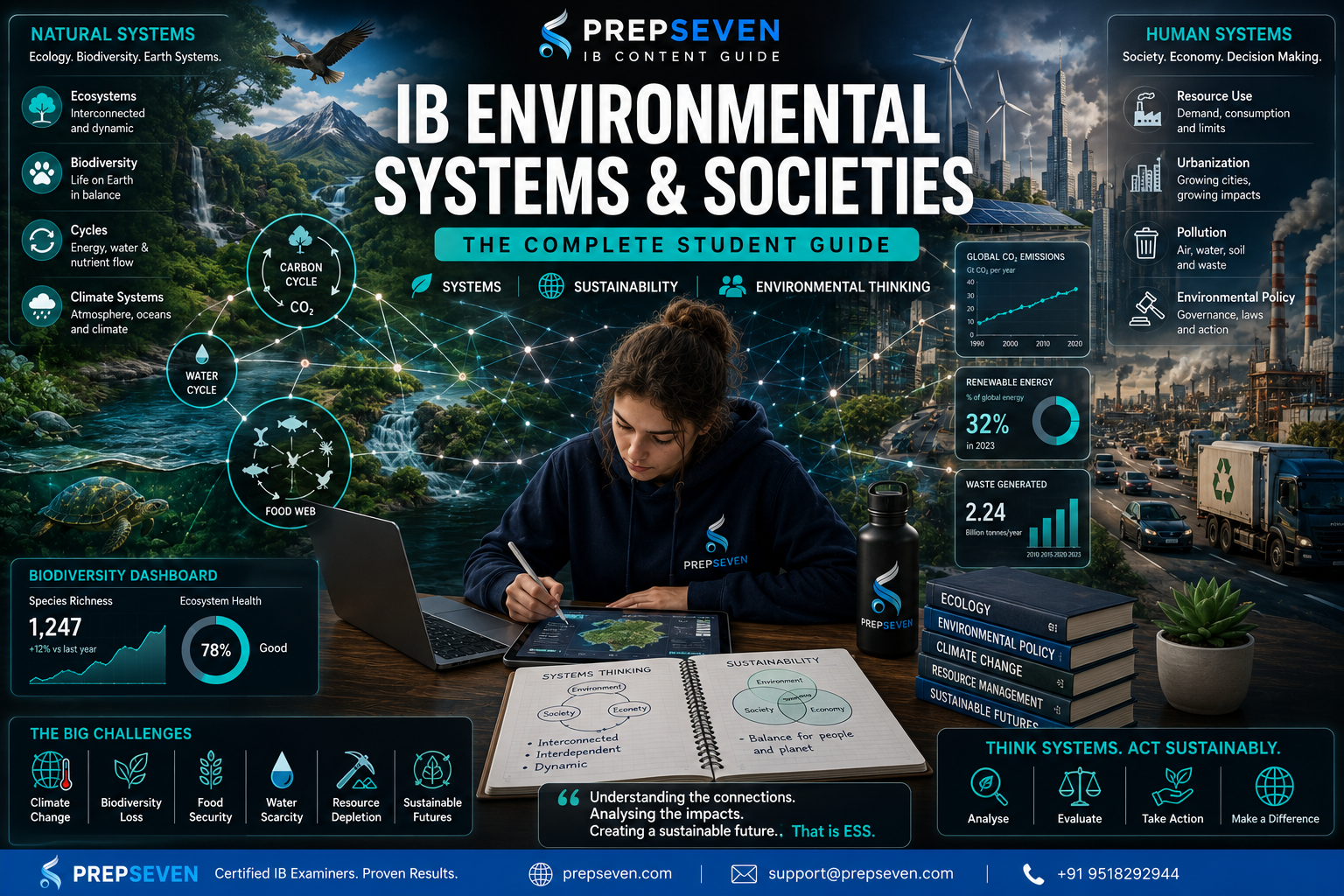
IB Environmental Systems and Societies, almost universally referred to as IB ESS, is one of the most distinctive courses in the Diploma Programme. It is the only IB subject that sits across two subject groups at once: Group 3 (Individuals and Societies) and Group 4 (Sciences). This means a student who takes ESS can use it to satisfy either their Group 3 or Group 4 requirement, which gives it a particular kind of strategic value in diploma planning.
The course is offered at Standard Level only. There is no HL version of ESS. This is worth knowing upfront because some students assume there must be a higher level option, particularly students who are drawn to the subject and wonder whether they should be doing Biology HL instead.
ESS is built around a central premise: you cannot fully understand environmental problems using science alone, and you cannot solve them using social science alone. Climate change, biodiversity loss, food security, pollution, and resource depletion are simultaneously ecological and political, economic and ethical. ESS asks you to hold all of these dimensions at once, and that is genuinely harder than it sounds.
ESS is sometimes dismissed as the easier science option. Students who treat it that way tend to be unpleasantly surprised by the exam. The course requires you to integrate scientific knowledge with systems thinking, ethical frameworks, and critical analysis of human behaviour. Paper 1 in particular is unlike any other IB science paper.
Why ESS Is Strategically Unique in the IB Diploma
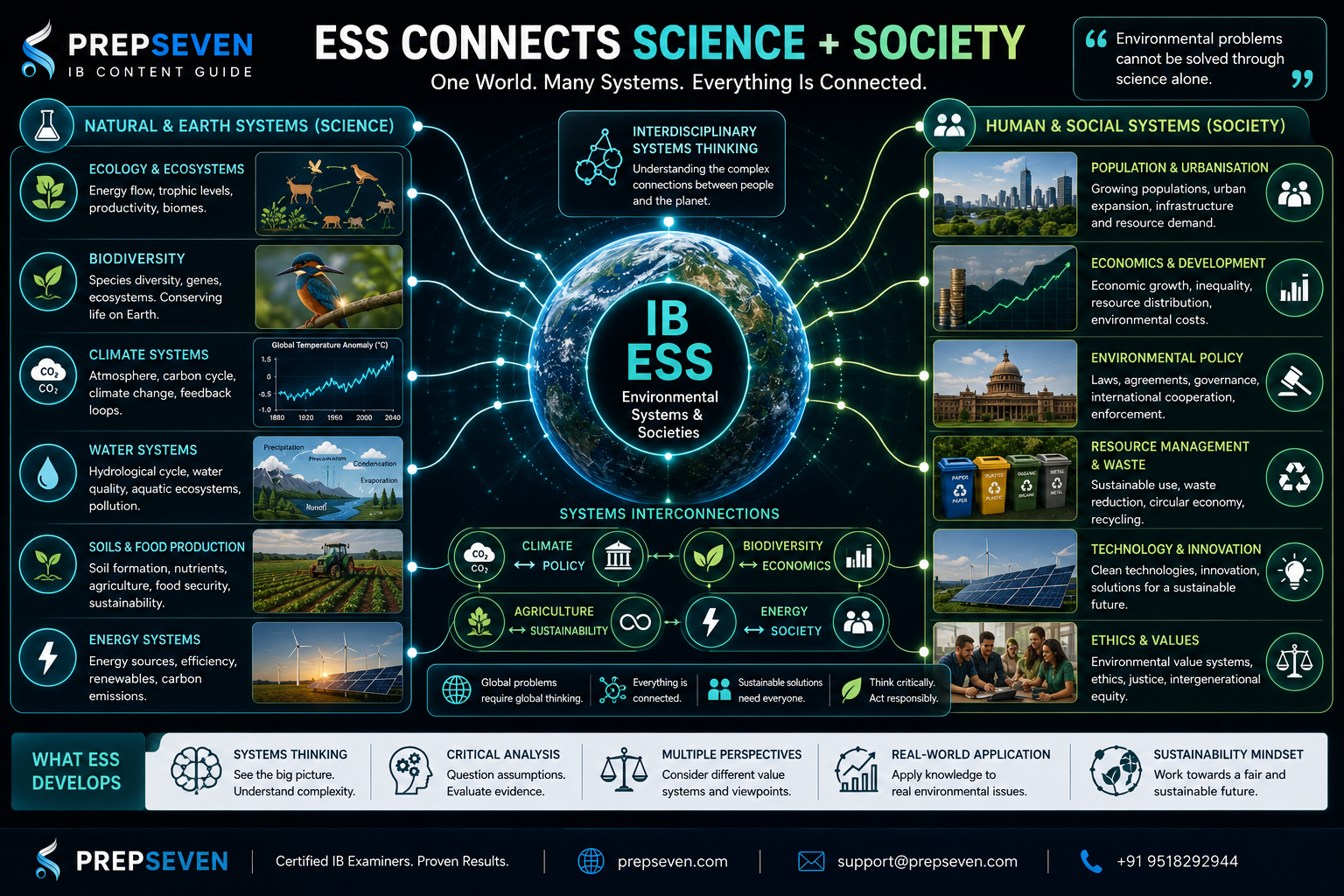
The dual group status of ESS is genuinely rare in the IB and it deserves a clear explanation, because students and parents sometimes misunderstand it.
In the standard IB diploma, students must take one subject from each of six groups. Group 3 is Individuals and Societies (history, economics, geography, psychology, and so on). Group 4 is Sciences (biology, chemistry, physics, and so on). ESS can count as either Group 3 or Group 4, but not both simultaneously.
This creates a specific opportunity: a student who wants to take two Group 3 subjects, or who wants to take two Group 4 sciences, can use ESS to free up that flexibility. For example, a student taking History HL and Economics HL can take ESS as their Group 4 science without needing to take Biology or Chemistry. Or a student taking Biology HL and Chemistry SL can take ESS as their Group 3 subject instead of History or Geography.
If your subject combination feels constrained by the group requirements, ESS is worth examining carefully as a strategic choice. It is the subject in the entire diploma that gives you the most flexibility in how you build your six-subject combination.
What the Syllabus Actually Covers
The ESS syllabus is organised into eight topics. They move from foundational ecological concepts through to global environmental challenges, and they are deliberately designed to build on each other. A student who understands the earlier systems-based topics will find the later applied topics significantly more accessible.
The syllabus may look like a collection of separate environmental topics, but the thread connecting all of them is systems thinking. The IB wants you to see each environmental issue not as a standalone problem but as part of an interconnected web of ecological, social, economic, and political forces. Students who develop this systems lens early in the course find both papers significantly more manageable.
Assessment Breakdown: How You Are Actually Graded
Paper 1: Case Study Based Questions
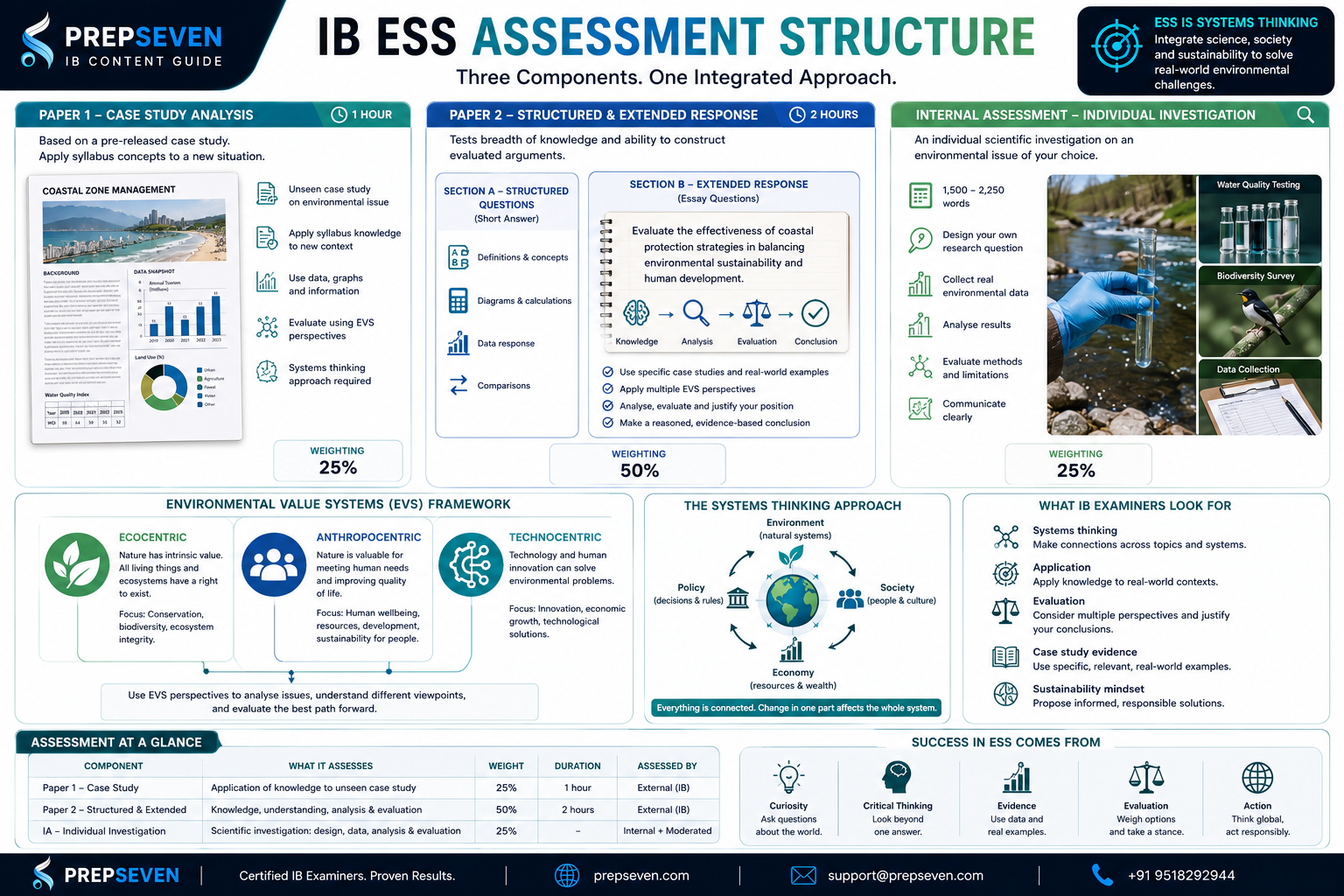
Paper 1 is one hour long and is based on a previously unseen case study, a substantial piece of stimulus material about a real or hypothetical environmental issue. This case study is given to you at the start of the exam. You have not seen it before. You must read it quickly, understand what it is describing, and answer structured questions using both the case study material and your own syllabus knowledge.
Paper 1 is the component most students underestimate. The temptation is to treat it as a reading comprehension exercise. It is not. The questions require you to apply concepts from across the syllabus to a new situation. A question might present data about an aquatic ecosystem and ask you to evaluate a management strategy using an environmental value systems framework. That question is testing ecology, systems thinking, EVS theory, and evaluation skills simultaneously.
The case study in Paper 1 is released to schools a few weeks before the exam as a pre-release document. Your teacher will guide you through it in class. Students who engage seriously with the pre-release material and practise applying multiple syllabus concepts to it consistently outperform students who read it once and assume they are prepared.
Paper 2: Structured and Extended Response
Paper 2 is two hours long and contains a mixture of structured short-answer questions and extended response essay questions. The structured questions test breadth across the syllabus: definitions, diagrams, calculations, comparisons. The extended response questions require sustained argument and evaluation.
The extended response questions are where the most marks are available and where the widest range of student performance occurs. A weak extended response summarises information. A strong extended response constructs an argument, uses specific case study evidence, evaluates from multiple perspectives including different EVS frameworks, and arrives at a justified conclusion. The word ‘evaluate’ appears constantly in ESS Paper 2 questions, and it means something precise: you need to present evidence for different positions and make a reasoned judgement.
One consistent pattern in IB examiner reports for ESS: students who include specific named examples, real places, real policies, real species, real data, score significantly higher on extended response questions than students who write in general terms. ‘Some countries have implemented carbon pricing’ earns far less credit than ‘Sweden’s carbon tax, introduced in 1991 and now at over 130 USD per tonne, has been associated with a 25% reduction in emissions from the heating sector while maintaining economic growth.’
Internal Assessment: The Individual Investigation
The ESS Internal Assessment is an individual scientific investigation that you design and carry out yourself. It is 1,500 to 2,250 words and carries 25% of your final grade. It is assessed against five criteria: Personal Engagement, Exploration, Analysis, Evaluation, and Communication.
The IA is a genuine field or lab investigation. ESS students collect real environmental data: water quality measurements, biodiversity surveys, soil samples, atmospheric readings, questionnaire data about environmental attitudes. The quality of your data collection directly affects how much you can do in your analysis and evaluation sections.
The Evaluation criterion is where many ESS IAs lose marks. Students present their findings clearly but then write a brief conclusion and call it done. Strong evaluations interrogate the methodology: what are the limitations of the data you collected? What sources of error exist? How representative is your sample? What would you do differently? These are not afterthoughts. They are the difference between a 6 and a 7 on the IA.
Choose your IA topic based on access to data, not just interest. An investigation into microplastic levels in a local water body is excellent if you have equipment and access. An investigation into urban heat island effects is excellent if you can take systematic temperature measurements across different land use zones. The question is always: can I actually collect enough quality data to do real analysis?
Understanding Environmental Value Systems: The Concept That Runs Through Everything
Environmental Value Systems, almost always abbreviated to EVS in class and in exams, is the single most important conceptual framework in the ESS course. It refers to the set of beliefs and values through which a person or society understands environmental issues and decides how to respond to them.
The IB identifies three broad EVS positions: ecocentric, anthropocentric, and technocentric. Ecocentric views place inherent value in all living things and ecosystems regardless of their utility to humans. Anthropocentric views place humans at the centre and value nature primarily for what it provides to human wellbeing. Technocentric views hold that technology and human ingenuity can solve environmental problems and that economic growth and environmental health are compatible.
These are not just vocabulary terms to memorise. They are lenses that the exam will ask you to apply to real environmental decisions. A question might describe a proposal to build a dam in a biodiversity hotspot and ask you to evaluate it from two different EVS perspectives. A student who has genuinely understood the EVS framework can construct a sophisticated answer that captures the real intellectual tension in that decision. A student who has only memorised the definitions will produce a superficial one.
The most commonly lost marks in ESS extended responses involve EVS. Students mention it but do not use it analytically. The distinction is between writing ‘a technocentric perspective would support this’ and writing ‘a technocentric perspective would support this because it holds that the economic development enabled by the dam will generate resources to invest in alternative conservation strategies, making the biodiversity loss an acceptable short-term cost.’ The second version is what earns marks.
What Actually Gets Students to a 7
They build a case study bank throughout both years
ESS Paper 2 extended responses live or die on specific evidence. The IB expects you to cite real examples: named policies, specific ecosystems, actual data, identifiable places. Students who have built a personal bank of well-understood case studies across each syllabus topic, not just the ones their teacher spent the most time on, have a significant advantage. You do not need dozens of case studies. You need perhaps ten to fifteen genuinely well-understood ones that you can deploy flexibly across different question types.
They engage seriously with the pre-release case study for Paper 1
The pre-release document is not a gift to students who read it once. It is a gift to students who annotate it carefully, identify every concept from the syllabus that it touches, and practise applying those concepts to questions they have not seen before. Teachers who run mock Paper 1 exercises with the pre-release material before the exam give students the best possible preparation for the real thing.
They practise writing evaluated conclusions, not just summaries
The word ‘evaluate’ appears in a significant proportion of ESS Paper 2 questions. Students who write thorough summaries of the issue but avoid making a judgement consistently score in the middle of the grade range. Evaluation requires you to weigh evidence, acknowledge competing perspectives, and arrive at a reasoned position. Practise ending every extended response with a genuine conclusion that your preceding argument has earned, not a hedged statement that both sides have valid points.
They treat the IA as a real scientific investigation
The ESS IA is assessed partly on the quality of the data and the sophistication of the analysis. Students who treat it as a form-filling exercise, collecting minimal data and writing a formulaic report, produce work that scores in the low to mid range. Students who approach it as a genuine inquiry, asking a question they are curious about, collecting robust data, and engaging honestly with the limitations of their methodology, produce work that scores at the top.
They connect topics across the syllabus rather than studying them in isolation
ESS topics do not exist in separate compartments. Climate change connects to atmospheric systems, to biodiversity, to food security, to water systems, to energy production. A student who has revised Topic 6 in isolation will struggle when an exam question asks them to trace the consequences of a warming climate through multiple interconnected systems. The students who score 7 have developed a mental map of how all the syllabus topics relate to each other.
Common Mistakes That Cost Marks
A Realistic Year-by-Year Approach
Year 1 (Grade 11): Build the Conceptual Foundation
- Engage deeply with Topic 1 (Foundations of ESS) even though it feels abstract at first. The systems thinking and EVS frameworks you build here are the tools you will use across every other topic.
- Start your case study bank early. Each time a new topic is introduced, identify one or two real-world examples that you understand well enough to write about in an exam.
- Begin thinking about your IA topic by the end of Term 2. Field investigations require planning time, especially if your data collection depends on seasonal conditions or specific equipment.
- Practise applying EVS frameworks to current environmental news. Read an article about a real policy decision and ask yourself: how would an ecocentrist, an anthropocentrist, and a technocentrist each respond to this? That exercise builds exactly the analytical muscle the exam tests.
Year 2 (Grade 12): Deepen, Connect, and Practise
- Do at least three full past paper sets under timed conditions before your mock exams. Paper 1 in particular requires practice with the format of applying syllabus concepts to an unseen case study quickly.
- When you receive the Paper 1 pre-release case study, annotate it systematically: which syllabus topics does it touch? Which EVS frameworks are relevant? What data does it contain that could appear in a question?
- Complete your IA draft and submit it for teacher feedback no later than the start of Term 2. The iteration cycle is where IA marks are made.
- In the final revision period, practise writing full extended responses under timed conditions. Fluency in constructing an evaluated argument under time pressure is a skill that only develops through repeated practice.
How PrepSeven Helps You Score Higher in IB ESS
ESS sits at the intersection of scientific knowledge and social analysis, and that combination requires a specific kind of teaching. Our ESS tutors understand both dimensions of the course deeply. They know the syllabus content, but they also know how to help students develop the systems thinking and multi-perspective evaluation that Paper 2 demands.
Here is what working with a PrepSeven ESS tutor typically looks like:
- Paper 1 preparation sessions using past pre-release materials, where your tutor teaches you to read a case study strategically and apply syllabus concepts under time pressure.
- Extended response practice where your tutor marks your answers against the IB criteria, focusing particularly on the quality of your EVS application, the specificity of your case study evidence, and the strength of your evaluated conclusions.
- IA mentorship from research question design through to final submission, with particular attention to the Evaluation criterion that consistently separates strong IAs from average ones.
- Systems thinking sessions that help you build connections across all eight syllabus topics, so that cross-topic exam questions become opportunities rather than surprises.
Book your free demo lesson at prepseven.com and work through an ESS extended response question with one of our tutors. You will see immediately how much of the marking is about analytical depth rather than content knowledge.